A single blocked catch basin during a heavy rain event can flood a neighborhood, trigger an MS4 NPDES violation, and expose a municipality to liability claims that dwarf the cost of a year's worth of preventive cleaning. Public works departments managing stormwater infrastructure in 2026 face tighter EPA enforcement, increasing urban flood frequency, and growing resident expectations — all manageable with a CMMS-tracked stormwater maintenance program that documents every inspection and cleaning for permit compliance.
Government · Public Works · Stormwater Infrastructure
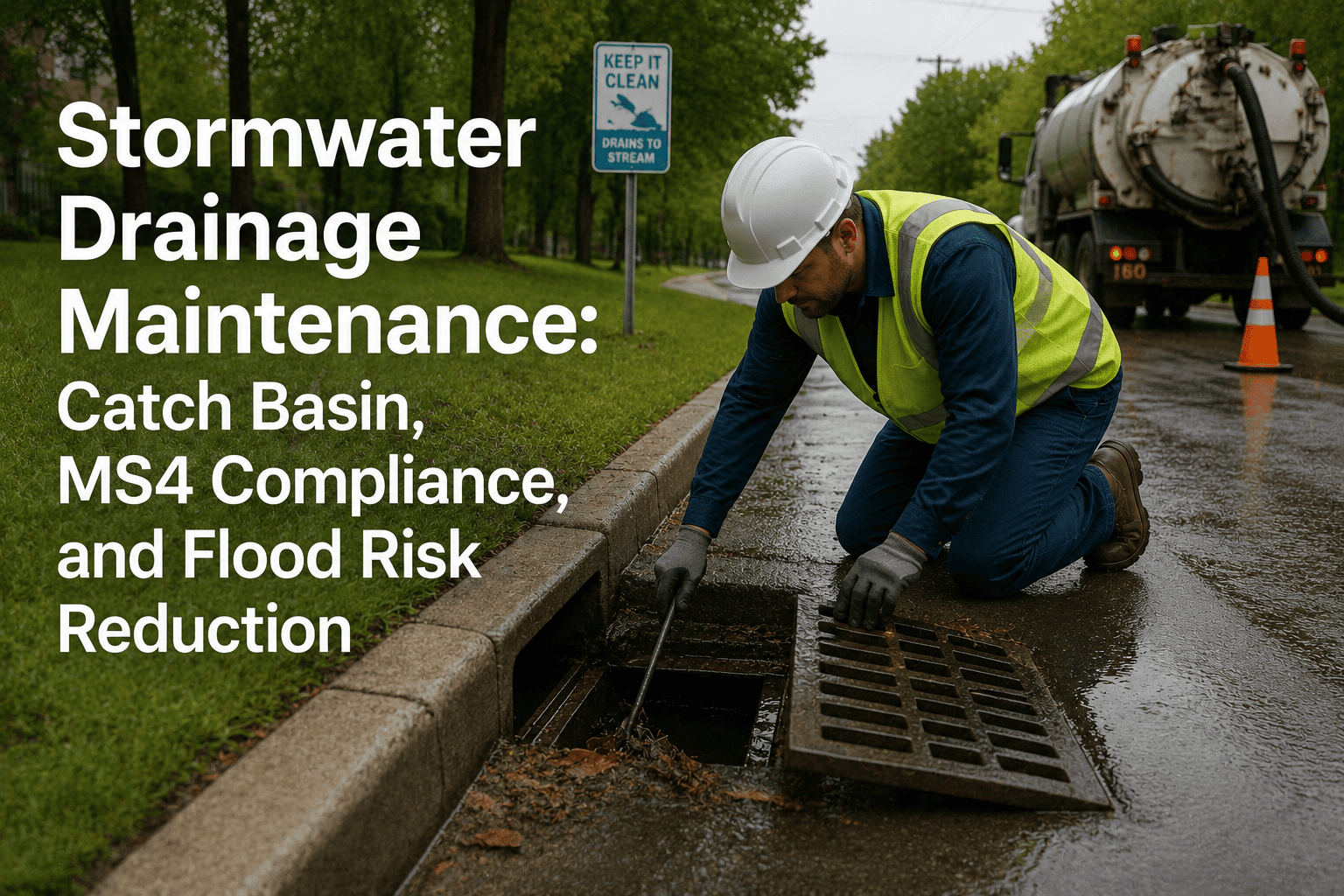
Stormwater Drainage Maintenance: Catch Basin, MS4 Compliance, and Flood Risk Reduction
The complete 2026 playbook for municipal stormwater programs — cleaning schedules, NPDES documentation, culvert inspection protocols, and CMMS-tracked compliance that survives EPA audits.
$15K–$57K
EPA MS4 NPDES violation fine per day of non-compliance
68%
of urban flooding events linked to blocked catch basins or undersized culverts
3×
more expensive to repair failed culverts vs preventive inspection and lining
MS4 Basics
What MS4 NPDES Compliance Actually Requires
Phase I and Phase II MS4 permits require municipalities to implement six minimum control measures. Most violations stem not from ignorance of the requirements but from inadequate documentation of maintenance activities performed.
MCM 1
Public Education and Outreach
Annual outreach on stormwater pollutant sources. Document materials distributed, events held, and community reach metrics in your CMMS for annual report.
MCM 2
Public Involvement and Participation
Resident reporting mechanisms for illicit discharges. Track complaint intake and resolution in work order system to demonstrate responsiveness.
MCM 3
Illicit Discharge Detection and Elimination
Systematic outfall mapping and dry-weather screening. CMMS tracks inspection dates, findings, and elimination work orders per outfall ID — critical for permit renewal.
MCM 4
Construction Site Runoff Control
BMP inspection program for active construction sites. Inspection frequency and findings must be documented per site — typically tracked as a recurring inspection work order type.
MCM 5
Post-Construction Stormwater Management
Long-term maintenance of permanent BMPs (detention ponds, bioretention). Each BMP asset needs a PM schedule in CMMS with inspection and maintenance records attached.
MCM 6
Pollution Prevention and Good Housekeeping
Municipal facility inspections, street sweeping records, catch basin cleaning logs — the most documentation-intensive MCM and the one most commonly cited in audit findings.
Maintenance Schedules
Recommended Cleaning and Inspection Intervals by Asset Type
Intervals below represent EPA Stormwater Best Practices guidance and reflect findings from APWA stormwater O and M surveys. High-load urban areas typically require more frequent service than intervals shown.
| Asset Type |
Inspection Interval |
Cleaning / Maintenance |
Documentation Required |
CMMS Trigger |
| Catch Basins (standard) |
Annually |
When sump reaches 50% capacity |
Date, location, sediment depth, photo |
Annual inspection PM |
| Catch Basins (high-load) |
Semi-annually |
After major storm events |
Same + storm trigger notation |
Bi-annual PM + storm trigger |
| Culverts (under 36 in) |
Every 2 years |
Cleaning when 20% blockage observed |
Condition rating, blockage %, photo |
Biennial inspection PM |
| Culverts (36 in and above) |
Annually |
Video inspection every 5 years |
Video log, structural condition report |
Annual PM + 5-yr video PM |
| Open Ditches / Swales |
Twice annually |
Vegetation management as needed |
Mowing dates, sediment removal |
Spring and fall PM work orders |
| Detention / Retention Basins |
Annually |
Sediment removal when 25% filled |
Sediment survey, outlet inspection |
Annual PM + sediment trigger |
| Outfall Structures |
Annually + dry-weather screen |
Erosion repair as needed |
Discharge observation, photo, erosion assessment |
Annual PM + screening log |
OxMaint — Stormwater Compliance CMMS
MS4 audit documentation in seconds, not hours of spreadsheet digging.
OxMaint stores every catch basin cleaning, outfall inspection, and BMP maintenance record with GPS coordinates, technician sign-off, and photo attachments — ready for annual report generation and EPA audit response at any time.
Flood Risk Reduction
How Maintenance Frequency Directly Reduces Flood Risk
The relationship between catch basin cleaning frequency and localized flood risk has been quantified in multiple FHWA and EPA studies. Here is what the data shows.
40%
Flood Event Reduction
Cities that shifted from reactive to annual scheduled catch basin cleaning saw a 40% reduction in localized flood complaints over a 3-year measurement period, per APWA case study data.
$6:$1
Flood Damage Avoided
Every dollar invested in routine stormwater maintenance avoids an average of six dollars in flood damage repair costs, property claims, and emergency response — FHWA Local Roads Program analysis.
72 hrs
Post-Storm Response Window
The 72-hour window after major storm events is critical for identifying blockages before the next rain. CMMS-generated post-storm inspection work orders ensure no high-risk basin is missed in the response sweep.
Expert Review
What Stormwater Program Managers Are Saying
Our MS4 annual report used to take two people three weeks to compile because our inspection records were scattered across paper forms, field tablets, and three different spreadsheets. With a CMMS tracking every work order, we generated the draft annual report in one afternoon. The auditor commented it was one of the most complete submissions they had reviewed.
Stormwater Program Manager
Mid-size city, 95,000 population — Pacific Northwest
We had a repeat flood zone in the southeast quadrant that we couldn't explain. When we started tracking catch basin inspection dates by GPS location, we discovered 23 basins in that zone hadn't been cleaned in four years because the route had been dropped when a crew member retired. That is exactly the kind of gap a manual system cannot catch — but a CMMS can.
Director of Public Works
Suburban municipality, 42,000 residents — Southeast US
FAQs
Frequently Asked Questions — Stormwater Maintenance and MS4 Compliance
How often are catch basins required to be cleaned under MS4 permits?
MS4 permits do not specify a universal cleaning frequency — they require municipalities to implement and document a "good housekeeping" program that is effective at preventing pollutant discharges. In practice, EPA auditors look for annual inspection of all catch basins and cleaning when sump depth reaches 50% capacity. High-impervious, high-load areas typically require semi-annual cleaning to meet the effectiveness standard. The critical requirement is complete documentation of every inspection and cleaning —
OxMaint's CMMS stores this automatically with GPS coordinates and technician records per basin.
What records does a municipality need to survive an MS4 audit?
EPA MS4 auditors typically request: a complete list of all catch basins and drainage structures with last inspection date; cleaning records with dates, locations, and sediment volumes removed; outfall screening logs with dry-weather discharge observations; BMP inspection and maintenance records for all post-construction facilities; street sweeping logs; and illicit discharge investigation and elimination records. Cities that maintain these in a searchable CMMS can respond to audit document requests same-day.
Book a demo to see OxMaint's MS4 reporting dashboard.
What is the inspection interval for culverts under MS4 programs?
EPA guidance and FHWA culvert management standards generally call for culverts under 36 inches to be inspected every 2 years, with larger culverts inspected annually and subjected to CCTV video inspection every 5 years for structural condition assessment. Culverts that show corrosion, joint separation, or significant sediment accumulation should be flagged for priority reinspection. A CMMS that attaches inspection photos and condition ratings to each culvert asset creates the defensible audit trail that permit renewal requires.
How can a CMMS help a city reduce stormwater-related flood liability?
Municipal flood liability often hinges on whether the city can demonstrate it maintained its stormwater infrastructure in a reasonable manner. A CMMS provides timestamped proof that inspections and cleanings were performed on schedule — a critical defense in negligence claims. Beyond legal protection, a
CMMS like OxMaint also enables post-storm rapid response by generating location-prioritized work orders for field crews within hours of a storm event, reducing the blocked-basin window that causes repeat flooding in vulnerable neighborhoods.
Get Started Today
One missed inspection should not become a six-figure flood liability.
OxMaint gives stormwater programs a complete audit trail for every catch basin, culvert, and BMP — with automated PM scheduling so no asset falls out of the inspection cycle. Schedule a personalized demo for your permit requirements and network size.