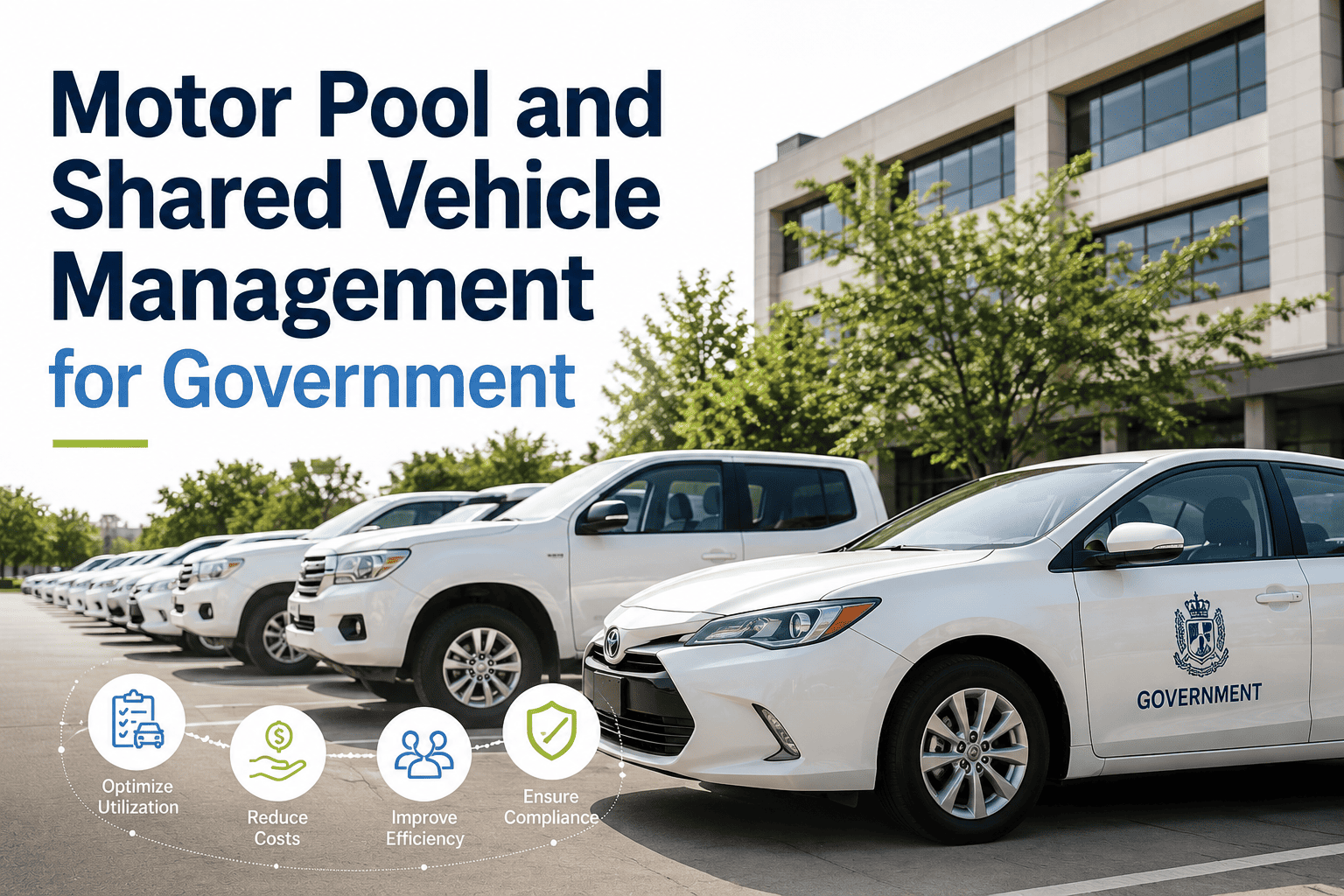
A municipal motor pool is where fleet utilization either becomes visible and efficient — or stays buried under departmental silos and idle vehicles. Agencies that share vehicles across departments routinely cut fleet size 18–30% within the first year, freeing capital for higher-priority services while maintaining the same mission capability. This guide walks through reservation systems, utilization tracking, chargeback allocation, and the shared fleet program mechanics that let public sector fleets right-size without hurting service levels. If you want to put the framework into practice immediately, you can Start Free Trial and configure a live motor pool in under an hour.
GOVERNMENT MOTOR POOL GUIDE
Can your municipality serve the same mission with 25% fewer vehicles?
Across the U.S. public sector, individual department fleets average 38% utilization. A shared motor pool lifts that figure toward 62–70% — turning idle assets into measurable savings without cutting service hours.
WHY MOTOR POOLS WORK
The math behind shared vehicle management
A dedicated departmental vehicle sits idle roughly 22 of every 24 hours. A shared pool vehicle serves 3–5 drivers in that same window — and that single shift in utilization changes the entire cost structure of a public fleet.
Target ≥ 60% utilization per vehicle before adding capacity. Most municipal pools stabilize at 3.2 drivers per shared vehicle.
GSA benchmarks annual light-duty TCO at $9,400. Retiring 30 vehicles from a 120-unit fleet returns $282K per year.
RESERVATION & TRACKING
Four numbered streams that keep a shared pool accountable
Each stream maps to a measurable output. Skip any one and the pool drifts back into departmental ownership within 90 days.
Centralized booking with approval routing
Drivers reserve a vehicle class — not a specific unit — through a single portal. Approvals route to department heads for trips over 50 miles or overnight use. Pools that enforce class-based booking see 19% fewer no-shows than those assigning specific vehicles.
Automated key dispensing and odometer capture
RFID key lockers release the assigned vehicle only to the approved driver, capturing odometer at checkout and return. This single automation cuts dispatch staffing needs by 60% and eliminates the handwritten logbook gap that auditors flag most often.
Live location, idle time, and after-hours alerts
GPS telematics feeds utilization data back into the reservation system in real time. Geofences around the pool yard trigger alerts if a vehicle leaves after hours or sits outside its return window — the two behaviors most correlated with unreported damage.
Per-mile allocation to the using department
Reservation and telematics data roll into a monthly chargeback invoice billed by mile or by hour to each using department. Visibility into per-trip cost is the single biggest behavioral lever — departments self-regulate reservations once they see the bill.
BEFORE → AFTER
What changes when a city moves to a shared pool
A side-by-side look at the operating model most municipalities start with versus the model a motor pool program produces within 6–9 months.
| Dimension | Departmental fleet (Before) | Shared motor pool (After) |
|---|---|---|
| Average utilization | 32–38% | 62–70% |
| Vehicles per 100 staff | 14 | 9 |
| Annual TCO per vehicle | $9,400 | $7,100 (amortized over more trips) |
| Reservation visibility | Spreadsheets per department | Single system, all departments |
| Chargeback accuracy | Allocated by headcount | Allocated by actual miles/hours |
| Maintenance scheduling | Reactive, driver-reported | Forecast by odometer, auto-blocked |
| Audit trail | Paper logbooks | Digital reservation + telematics record |
MONTH-BY-MONTH ROLLOUT
A 6-month timeline to stand up a municipal motor pool
Public sector rollouts move on a slower cadence than private fleets. This timeline reflects what agencies with 80–150 vehicles actually experience — not a best-case scenario.
Baseline & inventory audit
Tag every vehicle with department, annual mileage, and last 90 days of trips. Identify the 20% of vehicles that account for 80% of idle hours — these are the first pool candidates.
Policy & chargeback model
Council or city manager approves the inter-departmental chargeback rate ($0.58–$0.65/mile is typical for light-duty). Without a signed chargeback policy, the pool collapses into free-riding within one quarter.
Pilot with 2 departments
Launch the reservation system with Public Works and Building Inspections — two departments with overlapping but non-identical schedules. Aim for 25 shared vehicles in pilot before expanding.
Key lockers & telematics install
Deploy RFID key lockers at the central yard and install telematics on all pilot vehicles. This is the month utilization data becomes trustworthy enough to drive chargeback invoices.
First chargeback invoices issued
Departments receive their first per-mile bill. Expect pushback — it is the moment usage behavior visibly shifts. Pool managers typically see a 12% drop in reservation volume the month invoices go out.
Right-size & expand citywide
Review utilization data to retire or auction the bottom 15–20% of vehicles by usage. Expand the pool to remaining departments. Most agencies hit full citywide adoption by month 9.
REAL-WORLD EXAMPLE
A 120-vehicle municipal fleet, before and after
Consider a mid-sized city running 120 light-duty vehicles across six departments — Public Works, Parks, Building Inspections, Code Enforcement, Health, and Administration. The annual fleet budget is roughly $1.13M.
After standing up a shared motor pool with reservation software, RFID key lockers, and per-mile chargeback, the city retired 30 underutilized vehicles (mostly half-ton pickups assigned to individual inspectors). Capital from auctioned units ($214K) funded telematics and locker hardware. By month 14, cumulative savings had fully recovered the $330K program investment. Departments reported no missed inspections or service calls — utilization rose from 34% to 67%, and the chargeback invoices created natural demand for trip consolidation.
READY TO RIGHT-SIZE?
Turn idle vehicles into measurable savings.
Stand up a shared motor pool with reservations, telematics, and chargeback in a single platform — built for public sector fleets.
FREQUENTLY ASKED
Motor pool management — the questions fleet managers ask most
Answers drawn from public sector deployments ranging from 40-vehicle town pools to 600-unit county fleets.
How many vehicles can a municipality realistically cut by moving to a shared pool?
Most agencies retire 15–25% of light-duty vehicles in Year 1 and another 5–10% in Year 2 as utilization data matures. The exact number depends on trip overlap between departments — cities with strong seasonal demand variation (snow removal, leaf collection) tend to retain more reserve vehicles but still see meaningful reductions in administrative and inspection fleets.
What chargeback rate should we set per mile?
GSA's standard mileage rate for light-duty government vehicles sits at $0.58–$0.67/mile depending on fuel and region. Set your internal rate to recover fuel, depreciation, maintenance, and insurance — most municipal pools land between $0.55 and $0.65. Review annually; if the pool builds a surplus, lower the rate rather than accumulating a reserve that auditors will flag.
Do we need telematics, or can we run the pool on reservations alone?
Reservations alone work for pools under 20 vehicles. Beyond that, telematics closes the gap between booked and actual usage — capturing after-hours trips, idle time, and unauthorized detours that reservation data misses. For chargeback accuracy and audit defensibility, telematics is strongly recommended. You can configure both in a single workflow when you Start Free Trial or walk through it on a demo call.
How do we handle maintenance scheduling in a shared pool?
The reservation system should auto-block vehicles approaching service intervals based on odometer readings from telematics or key-locker capture. Set preventive maintenance triggers at 5,000-mile intervals for light-duty and 10,000 for heavier units. When a vehicle enters the shop, the system pulls it from the available pool and reassigns pending reservations to the next available unit of the same class.
What is the biggest reason municipal motor pools fail?
Lack of a signed chargeback policy. Without per-department billing, there is no behavioral pressure to consolidate trips, and the pool reverts to "first come, first served" free-riding. The second most common failure is weak executive sponsorship — a motor pool touches multiple departments, and without a city manager or fleet director with authority to enforce participation, adoption stalls after the pilot phase. Schedule a working session through Book a Demo to map governance before you deploy.
START YOUR MOTOR POOL
See how much your fleet could shrink — without shrinking service.
Stand up reservations, telematics, chargeback, and maintenance in one platform purpose-built for government motor pools.
Free 14-day trial · No credit card