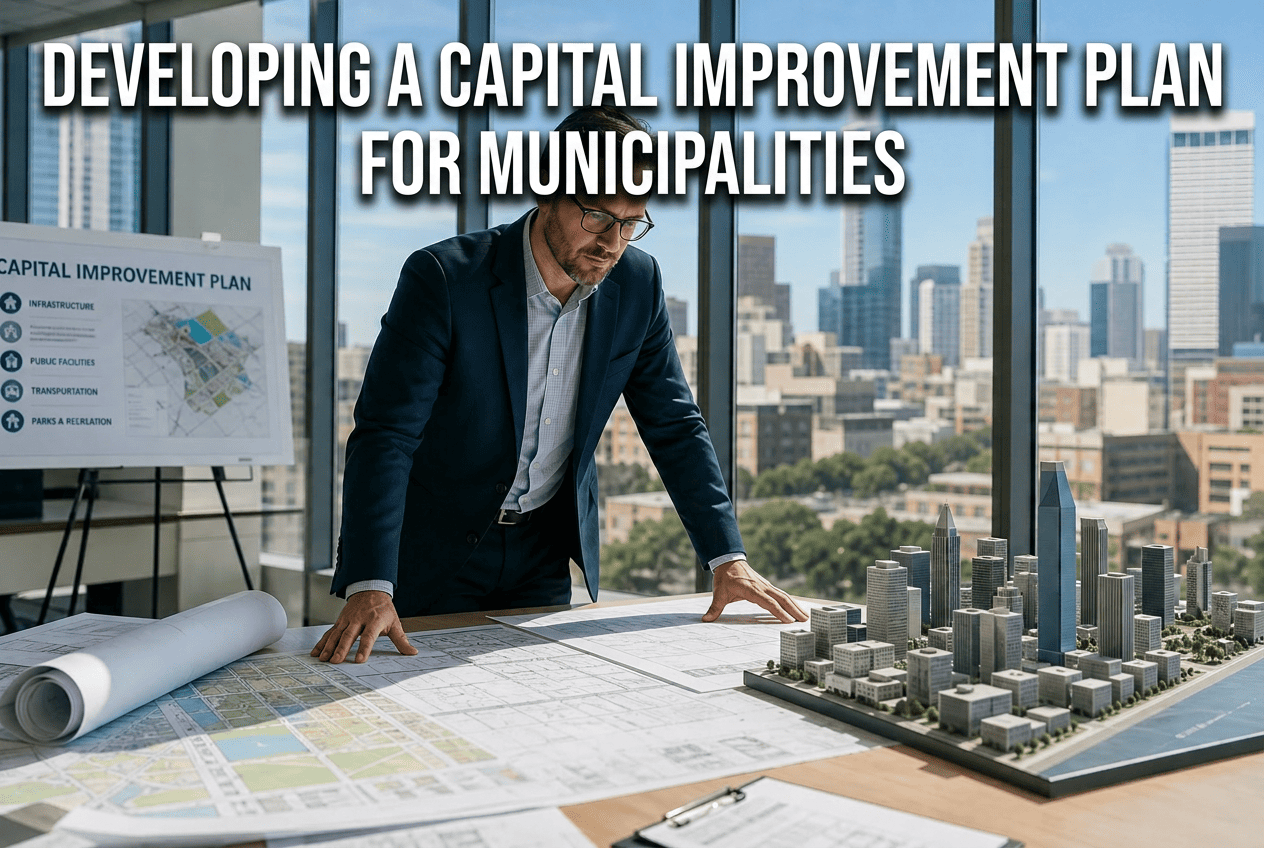
Municipal Capital Improvement Planning: Complete CIP Guide
By Taylor on February 10, 2026
When a city council approves a $47 million capital improvement program built on spreadsheet guesswork instead of condition data, the consequences compound for decades. The road reconstruction that should have been prioritized sits in Year 5 while a cosmetic streetscape project consumes Year 1 funding—not because the streetscape was more critical, but because a council member championed it louder. Three years later, the deferred road fails catastrophically, costing $8.2 million in emergency reconstruction versus the $3.1 million planned rehabilitation would have cost. Meanwhile, the community's water treatment plant—rated "poor" by engineers five years ago—continues deteriorating because it lost the political prioritization contest to visible above-ground projects. This is capital improvement planning without data, without framework, and without strategic discipline. Talk to our team about building a CIP process that prioritizes infrastructure investment based on asset condition, risk, and community impact—not politics.
Strategic Framework for 2026 & Beyond
Municipal Capital Improvement Planning: Complete CIP Guide
Project prioritization, funding strategies, public engagement, and implementation frameworks for strategic infrastructure investment that builds community resilience
40%Cost savings from proactive vs. deferred investment
Why Most CIP Programs Fail Their Communities
Capital improvement planning is the single most consequential financial decision a municipality makes—yet most CIP processes rely on departmental wish lists, political negotiation, and outdated condition assessments. When $47 million in taxpayer investment is allocated based on who speaks loudest at council meetings rather than which assets face the greatest risk of failure, the community pays the price in emergency repairs, service disruptions, and infrastructure that deteriorates faster than it's replaced.
The Five Failure Modes of Traditional CIP
01
Political Prioritization
Projects ranked by council advocacy instead of condition data. Visible "ribbon-cutting" projects win over invisible underground infrastructure every time.
Avg. cost: $2.4M in deferred failure per cycle
02
No Asset Condition Data
Decisions made without knowing actual infrastructure health. "We think the pipes are fine" replaces engineering assessments until a catastrophic failure proves otherwise.
Avg. cost: $5.1M in emergency capital per year
03
Siloed Department Wish Lists
Each department submits projects independently with no cross-functional prioritization. Water, streets, parks, and facilities compete instead of coordinate.
Avg. cost: 30% budget inefficiency from missed coordination
04
Funding Source Mismatch
Projects designed without matching to optimal funding sources. Grant-eligible projects funded with general obligation bonds while grant deadlines pass unused.
Avg. cost: $1.8M in missed grant revenue per year
05
No Public Engagement Loop
Community learns about projects at groundbreaking, not planning. Citizen priorities never captured. Opposition emerges late, delaying projects 12-18 months.
Avg. cost: $900K in delay costs per contested project
The Strategic CIP Framework: From Wish Lists to Investment Plans
A data-driven capital improvement program transforms political wish lists into strategic investment portfolios. Every project is scored against objective criteria—asset condition, safety risk, regulatory mandate, economic impact, and community priority—ensuring that limited capital dollars flow to the investments that deliver maximum public value. This isn't bureaucracy; it's fiduciary responsibility.
6-Phase CIP Development Lifecycle
A repeatable annual process that transforms capital planning from reactive to strategic
1
Asset Condition Assessment
Engineering inspections, CMMS data analysis, remaining useful life calculations, and condition scoring for every asset class
Months 1-3
2
Needs Identification & Scoping
Department project submissions, cost estimating, scope definition, and alignment with master plans and comprehensive plans
Months 2-4
3
Priority Scoring & Ranking
Multi-criteria scoring matrix applied to every project: condition severity, safety risk, regulatory mandate, economic development, equity impact
Months 4-5
4
Funding Strategy & Matching
Match each project to optimal funding: GO bonds, revenue bonds, grants, impact fees, special assessments, enterprise funds, or federal programs
Months 5-7
5
Public Engagement & Council Adoption
Town halls, online surveys, interactive budget tools, equity mapping, council workshops, public hearings, and formal adoption vote
Months 7-9
6
Implementation & Performance Tracking
Project delivery, construction management, change order control, budget tracking, schedule monitoring, and post-completion performance measurement
Months 9-12 (ongoing)
Build Your CIP on Data, Not Politics
See how Oxmaint's asset condition data, work order analytics, and capital planning tools give municipalities the foundation for defensible, data-driven capital improvement programs.
The cornerstone of a credible CIP is a transparent, repeatable scoring methodology that removes subjective bias. When every project is scored against the same criteria with the same weights, the CIP defends itself—council members, citizens, and department directors can see exactly why Project A ranked above Project B. This transparency builds trust and survives political transitions.
Funding Sources: The Capital Finance Toolkit
A strategic CIP matches every project to its optimal funding source—maximizing grant capture, minimizing debt service, and protecting the general fund. Municipalities that treat all capital projects as bond-funded leave millions in federal and state grants uncaptured while unnecessarily increasing debt burden on taxpayers.
Municipal Capital Funding Sources
Debt Financing
General Obligation Bonds
$5M — $500M+
Backed by full faith and credit of the municipality. Voter-approved. Lowest interest rates. Used for general public benefit projects: roads, parks, public buildings.
Best for: Large-scale community-wide infrastructure
Debt Financing
Revenue Bonds
$2M — $200M+
Repaid from enterprise fund revenues (water/sewer rates, utility fees). No voter approval required in most states. Higher interest rates than GO bonds.
Best for: Water, sewer, stormwater, and utility infrastructure
Federal / State
IIJA & Federal Grants
$100K — $50M+
Infrastructure Investment and Jobs Act programs: BEAD, Water SRF, RAISE, INFRA, PROTECT. Competitive and formula grants. Typically 80/20 or 60/40 match.
Best for: Bridge, broadband, water, transit, resilience projects
Federal / State
State Revolving Funds (SRF)
$500K — $100M+
Below-market-rate loans for water and wastewater projects. Some principal forgiveness available. Administered by state environmental agencies.
Best for: Water treatment, sewer rehab, stormwater compliance
Local Revenue
Impact Fees & Special Assessments
$50K — $10M
New development pays proportional share of infrastructure capacity. Special assessments charge property owners who directly benefit from specific improvements.
Best for: Growth-driven capacity projects, neighborhood improvements
Local Revenue
Enterprise Funds & Pay-Go Capital
$50K — $5M
Annual capital set-aside from operating budgets. No debt service cost. Funded by utility rates, permit fees, or dedicated sales tax. Sustainable for routine capital renewal.
Best for: Vehicle/equipment replacement, small rehab projects
Public Engagement: Building Community Buy-In
CIP programs that exclude citizens from the prioritization process face predictable opposition at public hearings—delayed projects, contested bonds, and eroded trust. Modern public engagement integrates community input at the scoring stage, not after decisions are made. When residents see their priorities reflected in the scoring matrix, bond referendums pass and contested projects become community-supported investments.
Public Engagement Framework for CIP Success
Phase 1 — Inform
Months 1-3
Infrastructure condition report published online
Interactive GIS map showing asset condition by neighborhood
Social media campaign: "Know Your Infrastructure" series
Outcome: Citizens understand the scope of infrastructure needs before prioritization begins
Participatory budgeting for discretionary project pool
Interactive budget simulator: "Build Your CIP" online tool
Outcome: Residents actively shape the final CIP with direct input on project selection
Phase 4 — Close the Loop
Months 8-12
Public hearing with side-by-side engagement input vs. CIP decisions
Annual CIP report card showing project delivery vs. promise
Real-time project tracking dashboard for citizens
Outcome: Trust cycle completed—citizens see their input reflected and delivery accountable
From Asset Data to Capital Strategy
Oxmaint provides the asset condition data, maintenance history analytics, and remaining useful life calculations that power defensible CIP prioritization—replacing guesswork with engineering evidence.
The Deferred Maintenance Trap: Why Timing Is Everything
The most expensive infrastructure decision a municipality makes is the decision to wait. Deferred maintenance accelerates asset deterioration exponentially—a road that costs $8 per square yard to seal-coat today will cost $65 per square yard to reconstruct in seven years. The CIP is where proactive investment defeats reactive emergency spending, but only if the program accounts for lifecycle cost rather than first-year price tags.
The Cost of Deferral: Lifecycle Investment Comparison
Proactive CIP Strategy
Year 1: Preventive Seal Coat$120K
Year 8: Overlay Rehabilitation$480K
Year 18: Mill & Overlay$720K
Year 30: Full Reconstruction$2.1M
30-Year Total$3.42M
vs.
Proactive saves $4.78M per mile corridor
Deferred / Reactive Approach
Years 1-10: Nothing (deferred)$0
Year 7: Pothole Patching (recurring)$340K
Year 11: Emergency Reconstruction$3.8M
Year 22: Second Reconstruction$4.06M
30-Year Total$8.20M
Expert Perspective: Making CIP Survive Political Transitions
The CIP programs that survive election cycles are the ones built on objective scoring that any new council member can understand in a 30-minute briefing. When a newly elected official asks "why are we building this?" and the answer is a transparent scoring matrix showing the project scored 87 out of 100 on condition severity, safety risk, and regulatory mandate—the project survives. When the answer is "the previous council wanted it"—it doesn't. Data-driven CIPs also survive public scrutiny because citizens can verify the logic. We publish our scoring methodology, every project's individual scores, and the resulting priority ranking on our website. If someone disagrees with a project's ranking, we can have a constructive conversation about the criteria weights rather than a political fight about favoritism.
— City Manager, Municipality with 15-year data-driven CIP track record
15
Years of consistent CIP execution across 4 administration changes
93%
Bond referendum passage rate with data-driven public engagement
$62M
In federal grants captured through strategic CIP-to-grant alignment
The municipalities that achieve infrastructure excellence share a common discipline: they treat the CIP as a living document powered by real asset data, measured against objective criteria, shaped by genuine community input, and tracked through digital project management. Every year, condition assessments update the scoring, community engagement refreshes priorities, and performance dashboards hold delivery accountable. If your CIP is built on last year's spreadsheet and next year's political landscape, it's time to build something that lasts. Start your data-driven CIP journey and give your community the infrastructure investment strategy they deserve.
Build a CIP That Outlasts Any Election Cycle
Oxmaint transforms maintenance data into capital planning intelligence—asset condition scores, lifecycle cost projections, failure risk rankings, and budget forecasting that give your CIP the data foundation to be transparent, defensible, and effective for decades.
What is the ideal planning horizon for a municipal CIP?
Most best-practice CIP programs use a 5-year funded plan within a 10-20 year planning horizon. The first year of the CIP becomes the adopted capital budget with specific appropriations. Years 2-5 are planned and programmed but subject to annual adjustment based on updated condition data, revenue projections, and community priorities. The 10-20 year horizon captures long-range needs like major facility replacements, utility system expansions, and transportation corridor projects that require multi-year design and land acquisition. Annual updates to the CIP—informed by CMMS asset condition data—keep the plan current and responsive to changing infrastructure realities.
How do we prevent political interference from overriding the scoring methodology?
The most effective safeguard is transparency. Publish the scoring methodology, individual project scores, and the resulting priority rankings publicly before council deliberation begins. When any stakeholder can verify how every project was evaluated, politically motivated reordering becomes visible and politically costly. Additionally, establish the scoring criteria and weights through a public process before any projects are scored—this separates the policy decision (what we value) from the allocation decision (which projects win). Reserve a small "council discretionary" allocation (typically 5-10% of total CIP) for projects that elected officials want to champion outside the scoring framework, which acknowledges political realities while protecting the integrity of the core program.
How does CMMS data improve capital improvement planning?
CMMS platforms provide the asset-level evidence that transforms CIP from opinion-based to data-driven. Specific CMMS data elements that directly inform CIP prioritization include: work order frequency and cost trends by asset (identifying assets approaching end-of-life), preventive maintenance compliance rates (assets consistently failing PMs indicate condition decline), emergency repair costs per asset class (quantifying the financial penalty of deferral), remaining useful life projections based on actual condition decline rates, and total cost of ownership analysis comparing rehabilitation versus replacement. This data eliminates the "we think the pipes are fine" assumption by providing engineering evidence of actual infrastructure condition across every asset class.
What role does public engagement play in CIP success?
Public engagement serves three critical functions in the CIP process. First, it captures community priorities that technical staff may not weight appropriately—residents may prioritize neighborhood sidewalks and parks over a wastewater treatment upgrade that engineers consider more urgent. Second, it builds the political support necessary for bond referendums—communities that participate in CIP development pass bond measures at significantly higher rates than those presented with completed plans. Third, it provides an accountability loop: when citizens help shape the CIP and then see annual report cards showing delivery against promises, trust in government infrastructure management strengthens. The most effective engagement happens early (before projects are scored) and continuously (annual report cards), not just at public hearings when decisions are already made.
How should municipalities handle unfunded CIP projects?
Every CIP should maintain a transparent "unfunded needs" list that quantifies the gap between identified infrastructure needs and available capital resources. This list serves multiple purposes: it documents the infrastructure backlog for federal and state grant applications (agencies with quantified needs lists score higher on competitive grants), it provides council and community with an honest assessment of deferred investment risk, and it creates a ready pipeline when unexpected funding becomes available (stimulus programs, windfall revenues, new grant programs). Unfunded projects should be scored and ranked using the same methodology as funded projects so that when resources become available, the highest-priority unfunded project moves immediately into the funded program without political re-negotiation.