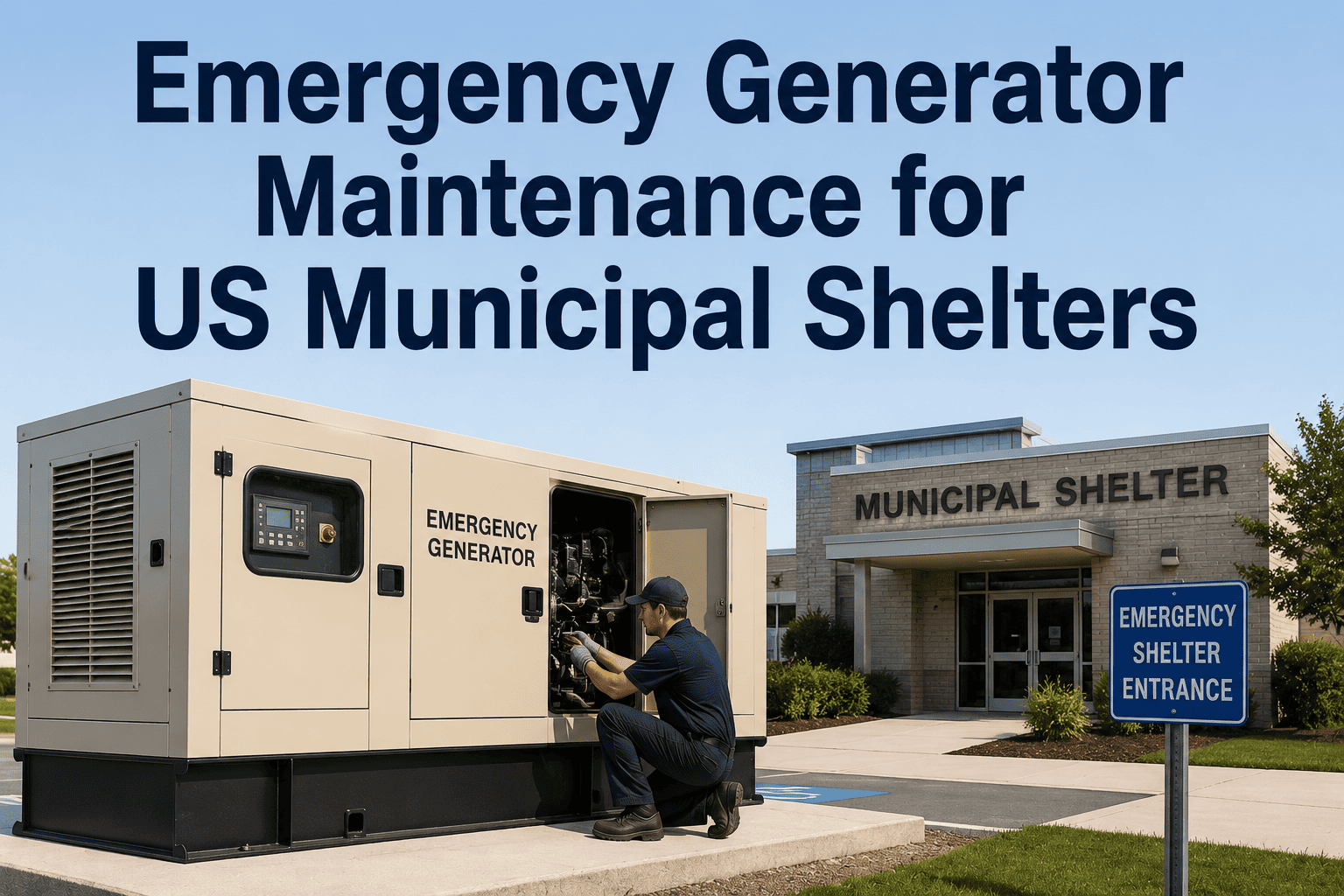
The hurricane force winds hit the substation at 2:14 AM. Grid power is lost instantly across the municipality. At the main wastewater treatment plant, the Automatic Transfer Switch (ATS) signals the 2MW standby diesel generator to start. You have exactly 10 seconds before the pumps fail and raw sewage begins backing up into residential basements. If that battery is dead—or if wet stacking has clogged the injectors—you are facing a public health crisis, EPA fines of up to $50,000 per day, and a catastrophic loss of public trust.
This scenario keeps municipal facility managers awake at night. Statistics from the Electrical Generating Systems Association (EGSA) suggest that 20-30% of backup generators fail to start when needed, often due to minor maintenance oversights. For municipalities operating under strict NFPA 110 and CSA C282 standards, compliance isn't just about paperwork; it's about life safety (Type 10) and critical infrastructure protection. A missed weekly inspection or a falsified load bank report can lead to massive liability.
This compliance handbook provides the systematic frameworks used by leading North American municipalities to ensure Emergency Power Supply Systems (EPSS) reliability, automate NFPA 110 documentation, and eliminate "failure to start" events. Explore how digital maintenance platforms secure municipal power assets →
23%
of genset failures due to battery issues
$50K
potential daily fine for EPA violations
10 sec
max restoration time for Level 1 systems
64%
still rely on paper logbooks
Critical Components of Municipal EPSS
Municipal backup power requires a holistic view of the Emergency Power Supply System (EPSS). Compliance extends beyond the engine itself to the fuel storage, switching mechanisms, and cooling systems. Understanding these subsystems is vital for meeting NFPA 110 Level 1 requirements.
Start Time Max 10 Seconds
Fuel Supply Min 96 Hours
Critical Factor Battery Health
Common Failure: Sulfation on battery terminals preventing crank
Operation Open/Closed Transition
Exercise Monthly
Critical Factor Contact integrity
Common Failure: Solenoid burnout prevents load transfer
Testing Annual Analysis
Polishing As Required
Critical Factor Water Separation
Common Failure: Microbial growth clogging fuel filters
NFPA 110 Compliance Schedule: Complete Reference
The National Fire Protection Association (NFPA) Standard 110 is the benchmark for North American municipal compliance. Maintenance schedules are rigid; missing a check can result in compliance failures during Joint Commission or Fire Marshal audits. Below is the standard inspection cadence for Level 1 (Life Safety) systems.
Visual Inspection
Walkaround check
Weekly
Leak Detection
Oil/Water/Fuel levels
Battery System
Sp. Gravity / Conductance
Weekly
Voltage Stability
Check charger float
No-Load Run
Start & Run (Cold)
Monthly
30 Minutes Min
Verify EPSS metrics
ATS Function
Transfer Cycle
Monthly
Operability
Verify end-to-end
Fuel Quality
Lab Analysis (ASTM)
Annually
Cetane / Water / Bac
Polish if degraded
Load Bank Test
Run at >30% Nameplate
Annually
Eliminate Wet Stacking
2 hours continuous
Cooling System
Belts / Hoses / Coolant
Weekly / Annual
Temp Regulation
Replace hose 3-5 yrs
Level 1 Install
Installation Acceptance
One-Time
Step-Load Test
Base reference data
3-Year Load Test
Supplemental Load
Every 36 Mos
4 Hours Total
If monthly <30% load
Breaker Testing
Exercise Breakers
Biennially
Trip Function
Verify isolation
Swipe to see more →
Schedule a municipal compliance assessment for your fleet →
Troubleshooting Response: Decision Flowchart
When a generator fails to start during a storm, panic can set in. This decision framework helps municipal technicians systematically diagnose "Failure to Start" alarms to restore power to critical lift stations or traffic signals.
"Fail to Start" Alarm / ATS Signal Failure
Is the control panel showing a specific fault code?
YES
Targeted Diagnosis
1. Cross-reference code (e.g., Low Coolant) 2. Visually inspect indicated system 3. Reset controller if safe (One attempt) 4. Log fault in CMMS audit trail
NO
Systematic Check
1. Check Battery Voltage (Crank test) 2. Verify Fuel Solenoid/Prime 3. Check Emergency Stop Status 4. Dispatch emergency generator tech
Digitize Your NFPA 110 Logbooks
Eliminate "pencil-whipped" inspections. Automate weekly run logs, capture load bank data, and generate audit-proof reports for the Fire Marshal with a municipal-grade CMMS.
Top 5 Generator Failures & Fixes
Understanding failure modes like wet stacking is crucial for preventative maintenance.
01
Battery Failure (Sulfation)
Symptom: Solenoid clicks but engine won't crank; low voltage alarm.
Fix: Replace batteries every 24-36 months regardless of test results; install smart chargers.
02
Wet Stacking
Symptom: Black ooze at exhaust stack; engine smoking; reduced power.
Fix: Annual Load Bank testing (2 hours min) to burn off carbon deposits.
03
Block Heater Failure
Symptom: Low Coolant Temp alarm; hard starting in cold weather.
Fix: Verify heater hose temp weekly; keep spare heaters in inventory.
04
Fuel Contamination
Symptom: Engine sputtering; clogged filters; "algae" in water separator.
Fix: Annual fuel polishing; biocides; keep tanks full to reduce condensation.
05
Coolant Leaks
Symptom: Puddles under unit; overheating under load.
Fix: Replace rubber hoses every 3-5 years per NFPA recommendations.
Build standardized preventive maintenance workflows in your platform →
Digital CMMS Integration for Compliance
Paper logbooks are the single biggest risk factor in municipal audits. Illegible handwriting, missing dates, and "pencil-whipping" (filling out logs without doing the work) leave towns vulnerable to liability. Digital systems enforce accountability and ensure that the EPSS will actually perform when the grid fails.
Traditional Logbooks
X Binders lost in remote pump stations
X No alerts for missed weekly inspections
X Load bank data disconnected from history
X Audits require manual data compilation
CMMS-Enabled
✓ Cloud access to all asset records
✓ Auto-escalation for missed PMs
✓ IoT integration for run-hour logging
✓ One-click NFPA 110 Audit Reports
01
Automated Scheduling
System automatically triggers weekly visuals, monthly runs, and annual load tests based on compliance logic.
02
Mobile Offline Mode
Technicians at remote lift stations can complete inspections and upload photos even without cellular service.
03
Fuel Tracking
Monitor fuel levels and consumption rates to ensure 96-hour runtime capabilities during extended outages.
04
Asset Lifecycle
Track total cost of ownership, repair history, and warranty status to justify capital replacement budgets.
99%
start reliability with digital PMs
30%
reduction in emergency repair costs
100%
audit readiness for Fire Marshal
Request a platform walkthrough for public works →
Expert Perspective
North American power grids are facing unprecedented stress from extreme weather events and aging infrastructure. For municipalities, the "run to failure" mindset for backup generators is no longer viable. The complexity of modern Automatic Transfer Switches and Tier 4 Final diesel engines requires rigorous, documented care.
Industry analysis confirms that 64% of generator failures are attributed to fuel, battery, or cooling system neglect—all preventable issues. By digitizing maintenance, municipalities not only ensure compliance with NFPA 110 but also protect their communities from the cascading failures that occur when water, sewage, and emergency services lose power.
Conclusion
Generator reliability is the backbone of municipal resilience. There is no grace period during a blackout. Adhering to the NFPA 110 schedule, understanding common failure modes like wet stacking and battery sulfation, and transitioning from paper logs to digital asset management are the only ways to guarantee performance. This handbook serves as your roadmap to a state of constant readiness, ensuring that when the grid fails, your city remains safe and operational.
Start building your generator compliance program today →
Is Your Municipality Audit-Ready?
Connect your generators, ATS units, and fuel systems to a maintenance platform built for government compliance. Automated alerts, mobile logs, and instant reporting for critical infrastructure.
Frequently Asked Questions
What is the difference between NFPA 110 Level 1 and Level 2?
Level 1 systems are installed where failure of the equipment could result in loss of human life or serious safety hazards (e.g., hospitals, emergency lighting, fire pumps). Level 2 systems serve equipment that is less critical to human life and safety (e.g., sewage treatment, data processing). Municipalities usually manage a mix of both, but Level 1 has stricter inspection and restoration time (10 seconds) requirements.
Why is "Wet Stacking" a problem and how do we prevent it?
Wet stacking occurs when a diesel engine runs below its designed operating temperature (usually light load), causing unburned fuel to accumulate in the exhaust system. It creates a fire hazard and damages the engine. It is prevented by running the generator at >30% load during monthly tests or performing an annual Load Bank test to burn off the deposits.
Does NFPA 110 require us to test the Automatic Transfer Switch (ATS)?
Yes. The ATS must be operated monthly. This test involves electrically operating the transfer switch from the standard position to the alternate position and back. It ensures the mechanical linkage moves freely and the contacts are conductive. Many municipalities overlook this, leading to generators that start but never take the building load.
How long do we need to keep generator maintenance records?
NFPA 110 requires that maintenance and testing records be maintained for the life of the equipment. For Joint Commission (healthcare) or other AHJs, specific retention periods (e.g., 3 years rolling) may apply for easy access, but the best practice is to digitize records permanently to establish a "cradle-to-grave" history for the asset.
Can we use a digital system to replace paper logbooks?
Yes, and it is highly recommended. Digital CMMS platforms provide better data integrity, timestamped entries, and user authentication, which auditors prefer over handwritten logs. Digital systems also allow for instant retrieval of historical data during an inspection, rather than searching through physical binders.