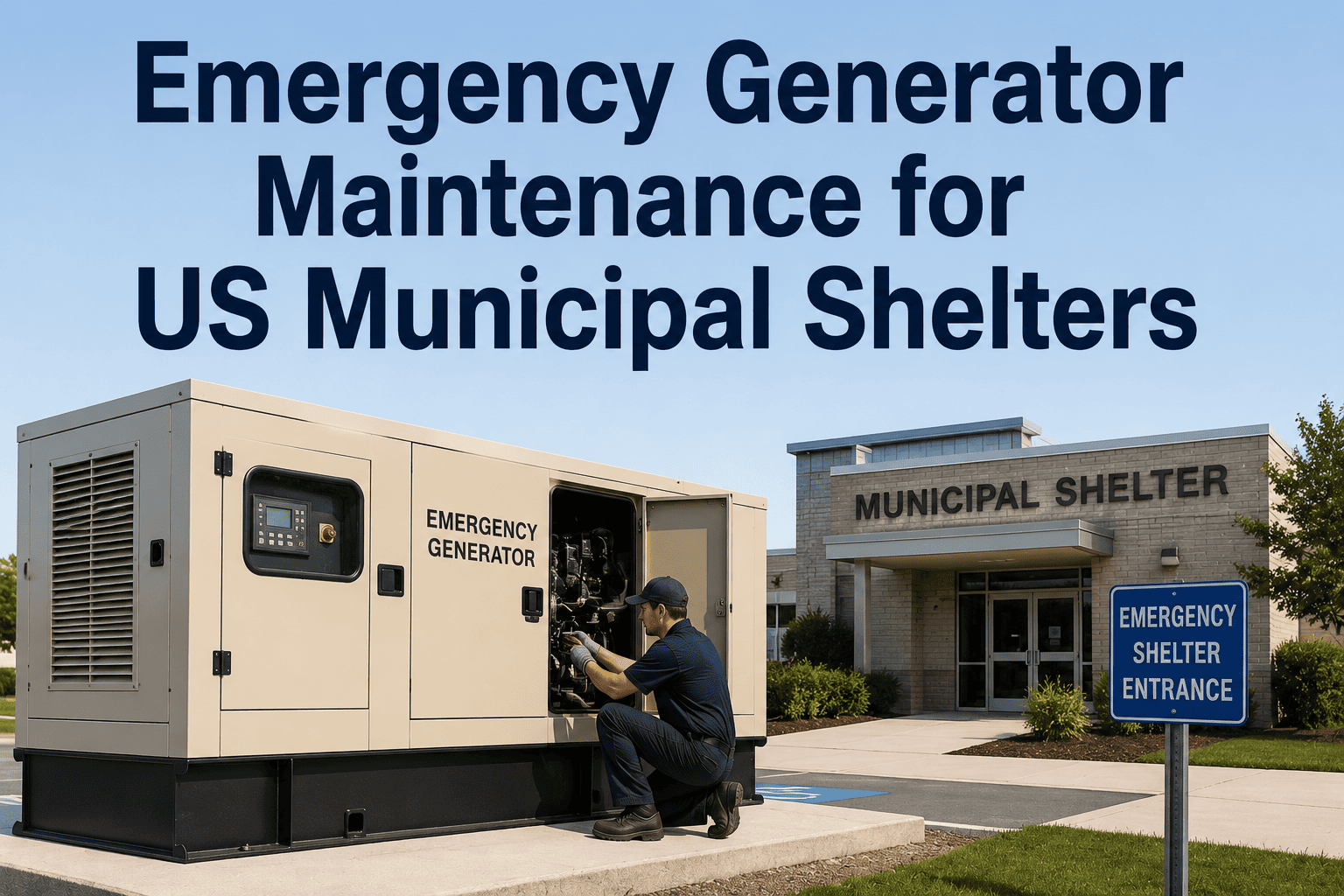
Emergency Generator Maintenance for US Municipal Shelters

By James Smith on June 5, 2026

emergency-generator-maintenance-municipal-shelters

When a hurricane, ice storm, or power grid failure hits, municipal emergency shelters must be operational within minutes — not hours. The generators that power those shelters require disciplined, documented maintenance schedules that most facilities cannot prove they follow. OxMaint AI gives emergency management teams a centralized, mobile-first system to track every generator test, fuel check, load bank run, and parts replacement — with complete compliance records always on hand.

Emergency Preparedness — Municipal Infrastructure

Emergency Generator Maintenance for US Municipal Shelters

Shelter generators must start on the first try — every time. OxMaint tracks fuel, load tests, battery condition, and PM schedules so your backup power is never a question mark during a declared emergency.

72hrs
FEMA-standard minimum generator runtime requirement for emergency shelters
43%
of municipal generator failures during declared emergencies traced to missed PM tasks
$180K
average cost per shelter closure incident due to generator failure during an emergency
Why It Fails

The Hidden Risk in Generator Maintenance Gaps

01
Monthly Load Tests Skipped
Generators sitting idle deteriorate rapidly. Without documented monthly load-bank tests, fuel systems clog, batteries discharge, and automatic transfer switches corrode — silently, invisibly.
02
Fuel Degradation Undetected
Diesel fuel degrades after 6–12 months without treatment. Manual fuel logs are inconsistent. A generator with stale fuel will start in testing but fail under full emergency load within 4 hours.
03
No Centralized Compliance Record
NFPA 110 and FEMA readiness audits require documented test logs, fuel records, and parts history. Without a CMMS, departments scramble to reconstruct records from email threads and hand-written logs.
PM Framework

OxMaint Generator PM Schedule — By Interval

Weekly
Visual inspection — leaks, corrosion, fuel level
Battery voltage check and terminal condition
Engine oil level verification
Coolant level and condition check
Monthly
30-minute load bank test at minimum 30% rated load
Automatic transfer switch operation test
Fuel polishing system check
Air filter condition assessment
Annual
Full-load test — 2 hours at 100% rated capacity
Oil and filter change — record brand and quantity
Coolant replacement and flush
NFPA 110 compliance documentation package
Compliance Data

Generator Readiness — Paper vs OxMaint Digital Tracking

Readiness Factor Manual Logs OxMaint CMMS Outcome
Monthly load test completion rate 58% 100% +42%
Time to produce NFPA 110 audit package 6–8 hours Under 2 minutes 99% reduction
Fuel level alerts before critical threshold None Automated — 72hr advance New capability
Parts history available on first request 34% 100% Full coverage
Missed PM tasks per generator per year 4.2 avg 0 Eliminated
OxMaint AI — Emergency Readiness

Your shelter generators need to start on the first try during a declared emergency. OxMaint makes sure every PM, fuel check, and load test is documented and on schedule.

Expert Perspective

The number one cause of generator failure at emergency shelters during active disasters is not mechanical — it is maintenance negligence that was entirely preventable. Fuel degradation, corroded battery terminals, and clogged air filters all develop over months of inactivity. A digital PM system that automatically schedules, tracks, and documents every maintenance interval removes the human memory variable from the equation. When an emergency director can pull up a complete maintenance history for every generator in 30 seconds, the readiness posture of that shelter changes fundamentally.

Emergency Management Infrastructure Specialist
Former FEMA Regional Advisor — Shelter Operations & Resilience, 18 Years
FAQ

Frequently Asked Questions

Yes. OxMaint stores all generator maintenance activity — test records, fuel logs, oil change history, and parts replacements — in a structured asset record that maps directly to NFPA 110 documentation requirements. A compliance-ready report can be exported as a PDF in under two minutes, with every maintenance event timestamped and attributed to the performing technician. This eliminates the hours of manual reconstruction that typically precede audits. Book a demo to see the compliance report format for your jurisdiction.
OxMaint allows facilities to set minimum fuel threshold levels per generator. When a technician logs a fuel check below the alert threshold — or when a scheduled fuel check is overdue — the system sends an automated notification to the designated facility manager and maintenance coordinator. For shelters managing multiple generators across sites, the dashboard provides a real-time fuel status view for every asset in one screen. Start your free trial and configure fuel alerts for your shelter fleet.
Absolutely. OxMaint uses a multi-site hierarchy so emergency managers can view all generators across all shelter locations in a single dashboard — or drill into any individual facility for asset-level detail. PM schedules, work orders, and compliance records are maintained per asset but reportable at the department or county level. This is especially useful for emergency managers overseeing 10 to 50 shelter sites during a regional disaster response. Book a demo to see a multi-site generator dashboard demonstration.
OxMaint includes a parts inventory module that allows facilities to log consumables — filters, oil, coolant, belts, and batteries — against each generator asset. When a PM task is completed, the technician selects parts used, and the inventory count updates automatically. Low-stock alerts notify procurement before critical parts run out. Every part used is recorded in the asset's maintenance history, so repair cost tracking and lifecycle analysis are always current. Start your free trial to configure your generator parts catalog.

Municipal shelters cannot afford a generator that fails when it matters most. OxMaint keeps every test logged, every fuel level monitored, and every PM on schedule — automatically.

Preventive maintenance. Compliance records. Parts tracking. Mobile field access. Built for emergency readiness.
Share This Story, Choose Your Platform!