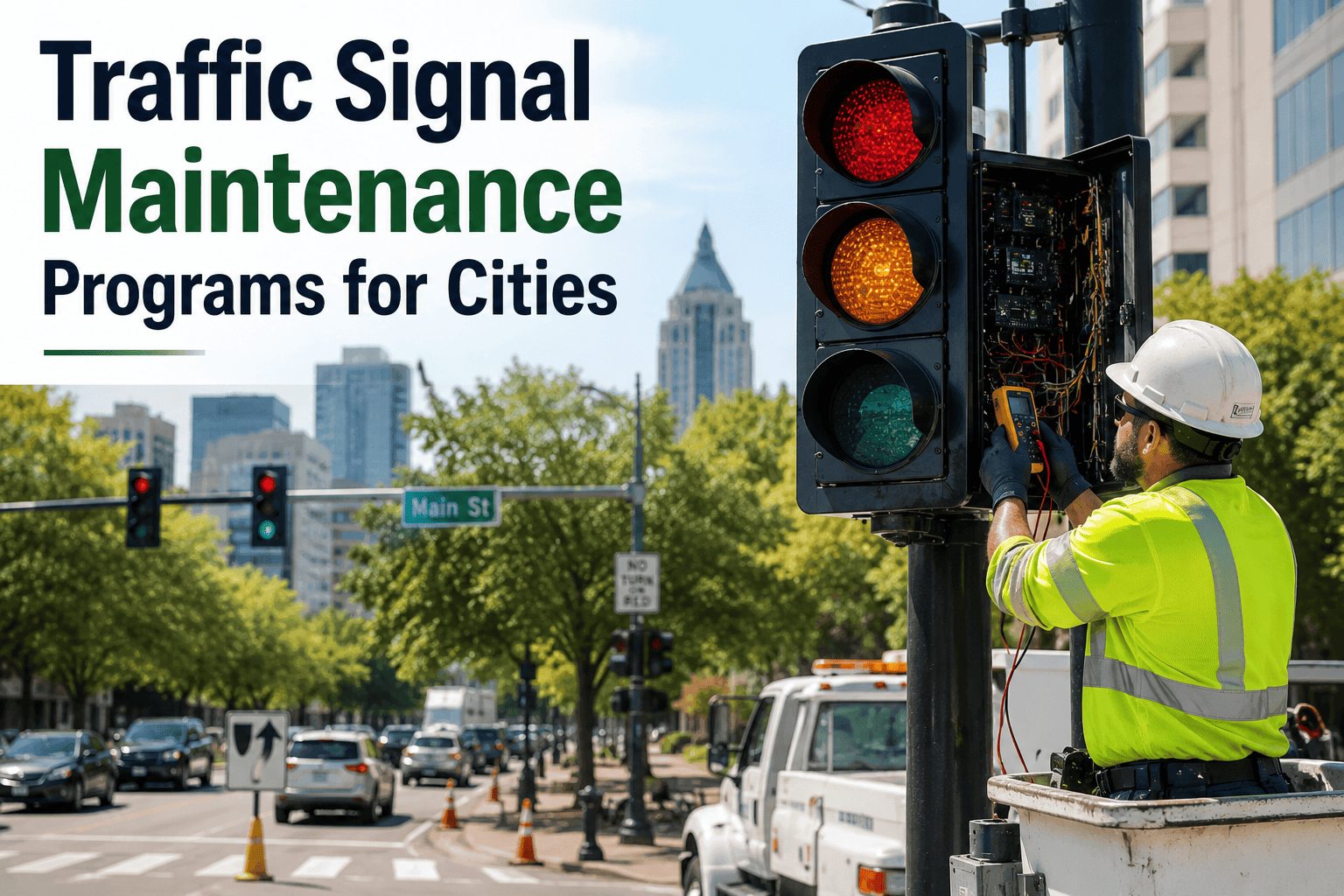
Your traffic signal network operates across 847 intersections. Federal MUTCD compliance audits occur annually. State DOT inspections can happen any time. Meanwhile, your maintenance records exist in paper logs, spreadsheets, and the institutional memory of technicians approaching retirement. When the audit arrives, you scramble for weeks—and still receive citations.
Digital maintenance management systems like Oxmaint CMMS deliver audit-ready compliance—but only with proper implementation aligned to MUTCD, FHWA, and state-specific requirements. Successful traffic agencies achieve 100% inspection compliance, zero audit findings, and 40-60% reduction in administrative burden within 6-12 months.
Ready to achieve perpetual audit readiness for traffic signal compliance?
Digital maintenance tracking transforms compliance from crisis to confidence. See how 120+ traffic agencies across North America achieved zero-finding audits through systematic CMMS implementation.
Understanding North American Traffic Signal Compliance Framework
Traffic signal compliance operates across three regulatory layers: federal MUTCD standards, state DOT requirements, and local ordinances. Each demands specific documentation:
Federal MUTCD Requirements
Core mandate: Manual on Uniform Traffic Control Devices (MUTCD) establishes minimum standards for traffic signal installation, operation, and maintenance across all public roads.
Documentation required: Signal timing records, maintenance logs, inspection histories, warranty compliance, and equipment specifications meeting MUTCD standards.
Penalty exposure: $10K-$100K+ per violation
State DOT Compliance
Varies by state: California (CA-MUTCD), Texas (TMUTCD), New York, Florida—each adds state-specific requirements on top of federal MUTCD.
Documentation required: Annual inspection certificates, preventive maintenance schedules, equipment inventory, signal timing approvals, and incident response records.
Penalty exposure: Funding suspension, liability transfer
FHWA Highway Safety Requirements
Federal oversight: Federal Highway Administration enforces compliance for federally-funded projects and interstate highways. Requires documented safety management systems.
Documentation required: Safety performance metrics, crash correlation data, signal warrant studies, and systematic maintenance verification.
Penalty exposure: Federal funding clawback, project delays
The 5 Compliance Challenges (And Solutions)
Compliance fails when documentation gaps exist. Here's how to address the barriers:
Traffic Signal Compliance Challenges & Solutions
Challenge 1: "We Can't Prove We Did the Inspections"
Manifestation: Paper inspection forms lost, incomplete, or illegible. No timestamp verification. Auditors question whether inspections actually occurred. Technician memory is only evidence.
Solution: Digital inspection checklists with GPS timestamps, technician authentication, and photo documentation. Every inspection automatically logged with who, when, where, and what was found.
Success indicator: Auditor says "This is the most complete documentation we've seen"—zero findings for inadequate records.
Challenge 2: "Inspection Schedules Keep Slipping"
Manifestation: MUTCD requires specific inspection intervals (typically 30-90 days). Without automated tracking, intervals stretch. 15% of signals overdue at any time. Audit citations for missed inspections.
Solution: Automated PM scheduling in Oxmaint—system generates work orders based on MUTCD intervals, escalates overdue items, and prevents compliance gaps.
Success indicator: Dashboard showing 100% on-time inspection completion for 12+ consecutive months.
Challenge 3: "We Don't Know What Equipment We Have"
Manifestation: Asset inventory incomplete or outdated. Controllers replaced without records updated. LED upgrades not documented. Auditors find equipment not matching records—compliance violation.
Solution: Complete asset registry with barcode/QR tagging. Every controller, signal head, detection device, and cabinet inventoried with installation dates, specifications, and warranty status. Mobile updates when equipment changes.
Success indicator: 100% inventory accuracy verified through spot-check audits.
Challenge 4: "Signal Timing Records Are Scattered"
Manifestation: Timing plans in traffic engineer's files, central system, and field cabinets—none matching. Auditors find discrepancies. Can't prove current timing matches approved plans.
Solution: Centralized timing plan repository linked to each intersection asset. Version control showing all changes with approval documentation. Field verification checklists confirming implementation matches approved plans.
Success indicator: Complete timing change audit trail from approval through implementation verification.
Challenge 5: "Incident Response Documentation Inadequate"
Manifestation: Knockdown repairs documented inconsistently. Response times unknown. Can't demonstrate adequate emergency response capability. Liability exposure when accidents occur at malfunctioning signals.
Solution: Digital incident workflow—from citizen report through dispatch, arrival, repair, and restoration. Automatic timestamp at each stage. Photo documentation before/after. Complete chain of custody for liability protection.
Success indicator: Average response time documented and improving. Complete incident records supporting liability defense.
Modernize Audit Readiness Through Digital Maintenance Management
Traffic agencies face audits from federal FHWA, state DOT, and internal compliance reviews. Digital maintenance management transforms audit preparation from weeks of scrambling to instant report generation:
Automated Inspection Documentation
Traditional challenge: Paper inspection forms stored in filing cabinets or scattered digital folders. Assembling complete inspection history for 500+ intersections takes 2-4 weeks before audit.
With CMMS: Every inspection automatically timestamped, GPS-verified, and stored with photos and technician credentials. One-click report generation showing complete inspection history by intersection, date range, or compliance requirement.
Audit impact: Audit prep time reduced from 3 weeks to 4 hours. Zero findings for missing or incomplete inspection records.
Continuous Compliance vs. Periodic Scrambles
Traditional challenge: Compliance gaps discovered during audit preparation. Mad rush to complete overdue inspections, update records, and fix discrepancies before auditor arrives.
With CMMS: Real-time compliance dashboard showing: all signals current on required inspections, preventive maintenance 100% on schedule, no overdue work orders, equipment inventory accurate.
Audit impact: Operate in continuous state of audit readiness. Inspections become non-events—auditors review digital records, verify a few field samples, depart with zero findings.
Liability Protection Through Documentation
Traditional challenge: Accident occurs at intersection. Plaintiff attorney requests maintenance records. Incomplete documentation suggests negligence—even if maintenance was actually performed.
With CMMS: Complete maintenance history with timestamps, photos, and technician verification proves adequate maintenance. Response time documentation demonstrates reasonable care. Equipment condition records show proactive management.
Audit impact: Documented maintenance history becomes liability shield. Insurance carriers often provide premium reductions (8-15%) for agencies with comprehensive digital maintenance records.
Turning Inspections into Compliance — Documentation Lifecycle
Documentation without completeness is liability. Here's how inspections convert to audit-ready compliance:
Scheduling: Automated PM Generation
What's scheduled: MUTCD-compliant inspection intervals by signal type—30-day lamp checks, 90-day controller inspections, annual comprehensive reviews, special event timing verifications.
Intelligent scheduling: System considers geographic clustering (efficient routes), technician certifications (qualified personnel), and workload balancing (sustainable pace).
Execution: Mobile-Guided Inspections
Field workflow: Technician arrives at intersection, scans QR code on cabinet. Oxmaint mobile app displays MUTCD-compliant checklist specific to that signal type and equipment configuration.
Documentation captured: GPS coordinates verify location. Timestamp proves when. Technician credentials establish who. Photos document conditions. Checklist responses record findings.
Deficiency Management: Issue-to-Resolution Tracking
When problems found: Inspection reveals burnt lamp, damaged signal head, or controller malfunction. System automatically generates corrective work order with priority based on safety impact.
Tracking workflow: Issue documented → work order created → parts ordered if needed → repair scheduled → work completed → verification inspection → issue closed. Complete chain of custody.
Reporting: Audit-Ready Documentation
Standard reports: Inspection compliance by period, work order completion rates, response time metrics, equipment inventory status, preventive maintenance completion percentage.
Custom reports: State-specific compliance requirements, federal funding documentation, insurance carrier requirements, internal performance metrics.
Continuous Improvement: Trend Analysis
Pattern recognition: Which intersections have most frequent problems? What equipment types fail most often? Are certain corridors requiring excessive maintenance?
Strategic value: Data-driven capital planning, preventive maintenance optimization, equipment standardization decisions, resource allocation improvements.
Real Compliance Transformation: Zero Findings in 9 Months
Mid-Size Municipal Traffic Department — 623 Signalized Intersections, $4.2M Annual Budget
Starting Position: Paper-based inspection system with 15-20% of signals overdue for required inspections at any time. Previous state DOT audit resulted in 12 findings requiring $180K in corrective actions. Audit preparation consumed 160 staff-hours over 4 weeks. Two senior technicians approaching retirement held most institutional knowledge about system history.
Implementation Approach:
- Months 1-2: Foundation — Complete asset inventory of all 623 intersections with equipment specifications, installation dates, and condition assessments. Barcode/QR tags installed on every cabinet. Historical paper records digitized for past 3 years. MUTCD-compliant inspection checklists configured in Oxmaint.
- Months 3-4: Workflow Activation — Automated PM scheduling activated based on MUTCD intervals and state DOT requirements. Mobile inspection app deployed to 8 field technicians with 2-day training. Real-time sync established—inspections documented as completed, visible immediately in central system.
- Months 5-6: Process Refinement — Deficiency tracking workflow refined based on field feedback. Priority classification aligned with safety impact (critical = same-day response, standard = 72-hour, routine = scheduled PM). Dashboard configured showing real-time compliance status.
- Months 7-9: Full Operation — 100% inspection compliance achieved for first time in department history. Corrective work order completion rate improved from 68% to 94%. Average deficiency resolution time reduced from 18 days to 6 days. State DOT audit announced for Month 9.
9-Month Results:
- Audit outcome: Zero findings—first clean audit in 8 years. DOT inspector commented: "This is the most comprehensive maintenance documentation we've seen from any agency this year."
- Inspection compliance: 100% on-time completion vs. previous 82%. No overdue inspections for 5 consecutive months.
- Administrative efficiency: Audit preparation time reduced from 160 hours to 12 hours (92% reduction). Annual administrative savings: $45K in staff time.
- Deficiency management: Average resolution time improved from 18 days to 6 days. Open deficiency backlog reduced from 127 items to 23 items.
- Knowledge capture: Complete maintenance history preserved digitally before senior technician retirements. New technicians productive within 2 weeks vs. previous 3-month learning curve.
- Liability protection: Complete documentation available for 3 incident investigations—all resolved favorably with no municipal liability. Insurance carrier reduced premium 12% based on improved documentation.
Total 12-Month Value: $312,000 (avoided citations $180K + administrative savings $45K + insurance reduction $38K + productivity gains $49K)
Implementation Investment: $67,000 (CMMS licensing + hardware + integration + training)
ROI: 366% | Payback: 3.2 months
Expert Insight
Common Questions About Traffic Signal Compliance
Core requirements: MUTCD Chapter 4D establishes that traffic signals must be properly maintained, operated, and monitored. While specific intervals aren't federally mandated, industry standards and state DOT requirements typically include:
Routine inspections: Visual inspection of signal operation (monthly), lamp/LED function verification (30-60 days), controller cabinet inspection (90 days), detection system verification (90 days).
Comprehensive inspections: Annual detailed inspection covering all components, timing plan verification, equipment inventory confirmation, and condition assessment.
State variations: California, Texas, Florida, and other states add specific requirements. Oxmaint includes state-specific checklist templates ensuring compliance with local requirements.
Mobile-first design: Oxmaint mobile app works offline for areas with poor connectivity. Inspections completed in field sync automatically when connection restored.
Real-time visibility: Supervisors see inspection completion as it happens. Dashboard shows which intersections completed today, which are scheduled, which are approaching due date.
Route optimization: System suggests efficient inspection routes minimizing windshield time. Technicians complete 15-25% more inspections daily with optimized routing.
Quality assurance: Required fields prevent incomplete submissions. Photo requirements ensure documentation standards met. Supervisor review workflow for deficiency approvals.
Canadian framework: Provincial transportation ministries (MTO in Ontario, MOTI in BC, Alberta Transportation, etc.) establish requirements similar to US state DOTs. TAC (Transportation Association of Canada) provides national guidance.
Key differences: Inspection intervals, documentation formats, and reporting requirements vary by province. Some provinces require specific certifications for traffic signal technicians.
CMMS adaptation: Oxmaint supports Canadian provincial requirements with configurable checklists, metric units, and compliance templates aligned to TAC guidelines and provincial standards.
Making compliance tangible:
Avoided citations: Previous audit findings cost $X. Digital documentation eliminates 90%+ of common findings. Projected savings: 90% × $X.
Administrative efficiency: Current audit prep consumes X staff-hours annually. CMMS reduces to 10% of current effort. Staff time savings: 90% × X hours × hourly rate.
Liability protection: Average traffic signal lawsuit settlement: $250K-$2M. Complete documentation reduces liability exposure 60-80%. Risk-adjusted value significant.
Federal funding eligibility: Agencies with systematic maintenance documentation qualify for HSIP (Highway Safety Improvement Program) and other federal grants. Typical awards: $50K-$500K annually.
Combined business case: "$67K investment delivers $180K avoided citations + $45K admin savings + $38K insurance + immeasurable liability protection = $263K+ first-year benefit, 4× ROI."
Ready to Achieve Perpetual Audit Readiness?
You've seen agencies achieve zero-finding audits while you're scrambling with paper records. You know digital documentation can transform compliance—but worry about implementation complexity, staff adoption, and proving ROI.
The path forward: Start with complete asset inventory (foundation for everything else), implement automated inspection scheduling (ensures nothing falls through cracks), deploy mobile inspections (documentation happens in real-time), and build compliance dashboards (continuous visibility). Real traffic agencies achieve zero-finding audits, 92% administrative reduction, and complete liability protection within 6-12 months.
Transform compliance from crisis to confidence
Stop dreading audits. Digital maintenance management delivers perpetual audit readiness with complete documentation. Join 120+ traffic agencies across North America using Oxmaint for MUTCD compliance excellence.