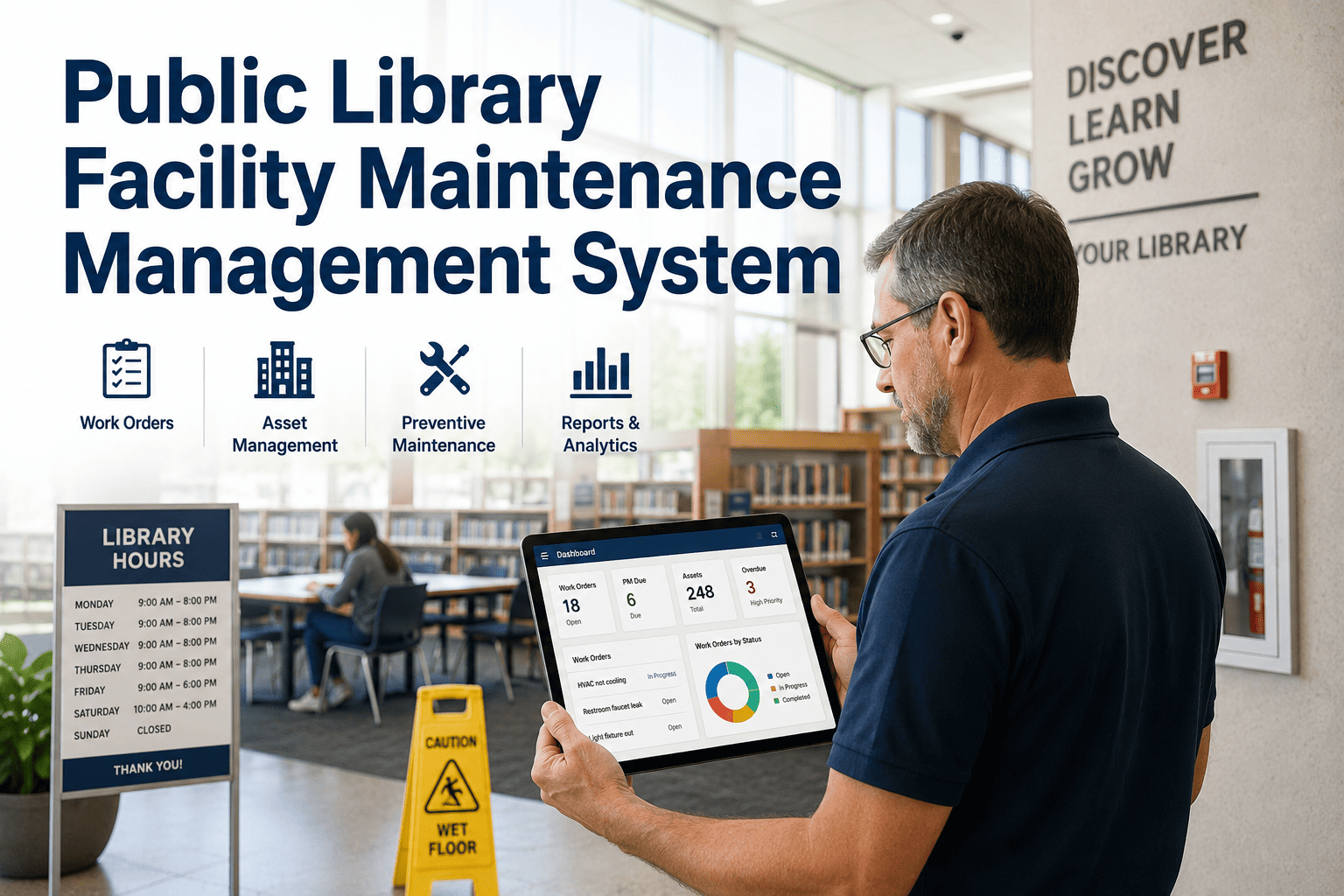
Public libraries are among the most consistently used government facilities in any municipality — open 60 to 70 hours per week, serving every demographic from toddlers to seniors, and operating with maintenance budgets that rarely match their utilization intensity. A leaking roof in a community library does not just damage books — it disrupts the one climate-controlled, internet-connected public space that thousands of residents depend on. Yet most public library maintenance programs still run on phone calls, paper logs, and reactive repairs. OxMaint's Work Order Management module gives library facility teams the structure to get ahead of maintenance requests, track every asset in the building, and generate the documentation that library directors and city councils need for budget justification.
Blog
Work Order Management
Government Buildings
Public Library Facility Maintenance Management System
A practical guide to modernizing work order management, asset tracking, and compliance documentation for public library facility teams.
Why Libraries Are a Unique Maintenance Challenge
Unlike office buildings that close at 6pm or warehouses with minimal public interaction, libraries blend the demands of public-facing retail, archive preservation, and community event space — all in a single building managed by a small staff with no dedicated maintenance role. The result is a maintenance environment where everything is urgent, nothing is tracked, and the building's condition is only visible through patron complaints.
Public Hours / Week
60–70
Most government offices operate 40 hrs. Libraries absorb 50–75% more wear per year.
Avg Maintenance Budget (Per Sq Ft)
$2.80
Below the $4–6/sqft industry standard for similar-use public buildings (IMLS data).
Work Orders Handled Reactively
67%
Without a CMMS, most library maintenance is complaint-driven, not scheduled.
What a Library Facility Management System Needs to Do
Library facility management differs from general government building maintenance in four key ways that shape what a CMMS needs to handle effectively.
01
Multi-Zone Work Order Management
A library has distinctly different zones — children's area, rare book stacks, public restrooms, AV equipment rooms, exterior grounds — each with different maintenance frequency requirements, contractor access rules, and patron disruption tolerances. Work orders need zone tagging so the right crew is scheduled at the right time without affecting open service hours.
02
Asset Lifecycle Tracking
Library HVAC systems, roof membranes, floor coverings, and AV equipment all have predictable lifecycles. Tracking purchase dates, warranty status, and service history enables data-driven decisions about repair vs replace — critical when budget justification requires documented asset condition evidence.
03
Public-Facing Maintenance Requests
Library staff who are not maintenance technicians need a simple way to submit maintenance requests. OxMaint's mobile request portal allows any staff member — even front desk clerks — to submit a work request with photo and location tag, which routes to the maintenance queue automatically.
04
Budget Reporting for Board & Council Review
Library directors present maintenance spending to city councils and library boards who have limited technical context. OxMaint generates visual spending reports by asset category, building zone, and work type — formatted for non-technical audiences and exportable for inclusion in board meeting packets.
OxMaint gives library facility teams a mobile work order system, asset registry, and board-ready reporting — with a setup time of under 2 weeks. Book a 30-minute demo or start free.
Common Library Maintenance Assets and Recommended PM Schedules
| Asset Category |
Key Components |
Recommended PM Frequency |
Risk if Neglected |
| HVAC Systems |
Air handlers, chillers, boilers, VAV boxes |
Filters monthly, full PM quarterly, annual inspection |
Collection humidity damage, ADA temperature compliance |
| Roof & Envelope |
Membrane, gutters, flashing, skylights |
Bi-annual inspection, after every major weather event |
Water damage to collections, mold growth |
| Plumbing |
Restroom fixtures, water heaters, backflow preventers |
Monthly restroom inspection, annual backflow test |
ADA compliance, health code violations |
| Electrical & Lighting |
Panel boards, emergency lighting, exterior fixtures |
Quarterly emergency lighting test, annual panel inspection |
Fire code violations, safety incidents |
| AV & Technology |
Projectors, public PC stations, security cameras |
Monthly cleaning, bi-annual full function check |
Service disruption, patron experience degradation |
| Elevators |
Cab, mechanical room, doors |
State-mandated annual inspection plus quarterly service |
ADA compliance failure, legal liability |
Expert Perspective on Library Facility Management
"
The biggest gap in public library facility management is not resources — it is documentation. When libraries cannot demonstrate what maintenance they have done and why, they cannot make a credible case for budget increases or capital funding. A CMMS transforms maintenance from an invisible cost center into a documented record of stewardship that protects the building investment and the collection it houses. Libraries that have implemented structured work order management consistently outperform peers in both budget advocacy and actual facility condition scores.
Patricia Wahlgren
Facility Standards Committee, Public Library Association (PLA) — Branch of the American Library Association
Frequently Asked Questions
Is OxMaint suitable for a single-branch library with limited staff and no dedicated maintenance person?
OxMaint is designed to work for teams of any size, including libraries where the director or a staff generalist handles maintenance coordination. The mobile request portal means any staff member can submit work requests without training, and OxMaint can route those requests to a contracted maintenance provider rather than in-house staff. Automated preventive maintenance scheduling means critical inspections are never missed even without a dedicated facilities professional. Most single-branch libraries are fully operational on OxMaint within 5 to 7 business days of starting their account.
Start a free trial to see the simple setup process.
How does OxMaint help with ADA compliance documentation for public library spaces?
OxMaint allows you to tag work orders and assets with ADA compliance flags, ensuring that accessibility-related maintenance — elevator inspections, accessible restroom fixtures, ADA signage, ramp and pathway maintenance — is scheduled, tracked, and documented separately from general maintenance. When an ADA audit occurs or a patron complaint is filed, you can pull a complete history of accessibility-related maintenance actions with timestamps and technician records. This documentation has supported libraries in defending accessibility compliance in multiple state audit reviews.
Book a demo to see the compliance tagging workflow.
Can OxMaint generate reports formatted for library board or city council presentations?
Yes. OxMaint's analytics module includes export templates designed for non-technical audiences, including maintenance spending by category, work order completion rates, asset condition summaries, and deferred maintenance registers with estimated cost-to-address. These reports can be exported as PDFs or Excel files suitable for inclusion in board meeting packets. Library directors have used OxMaint's deferred maintenance reports to successfully justify capital budget requests that were previously denied due to lack of documented evidence.
Start a free trial and access the reporting module immediately.
PUBLIC LIBRARY FACILITIES · OXMAINT
Your Library Deserves a Maintenance System as Organized as Your Catalog.
OxMaint brings structured work order management, asset tracking, PM scheduling, and board-ready reporting to public library facility teams — regardless of size, staffing, or technical background.