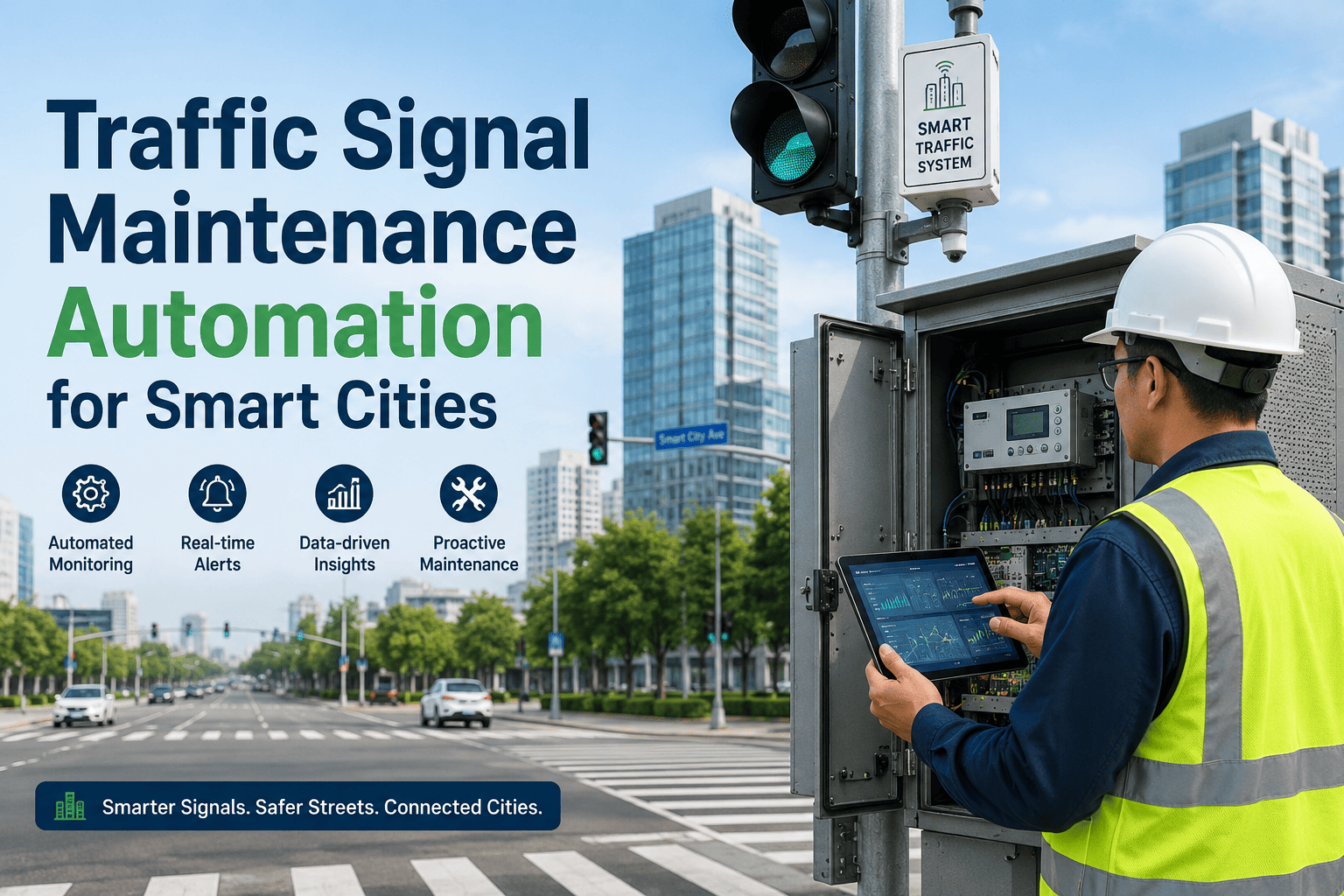
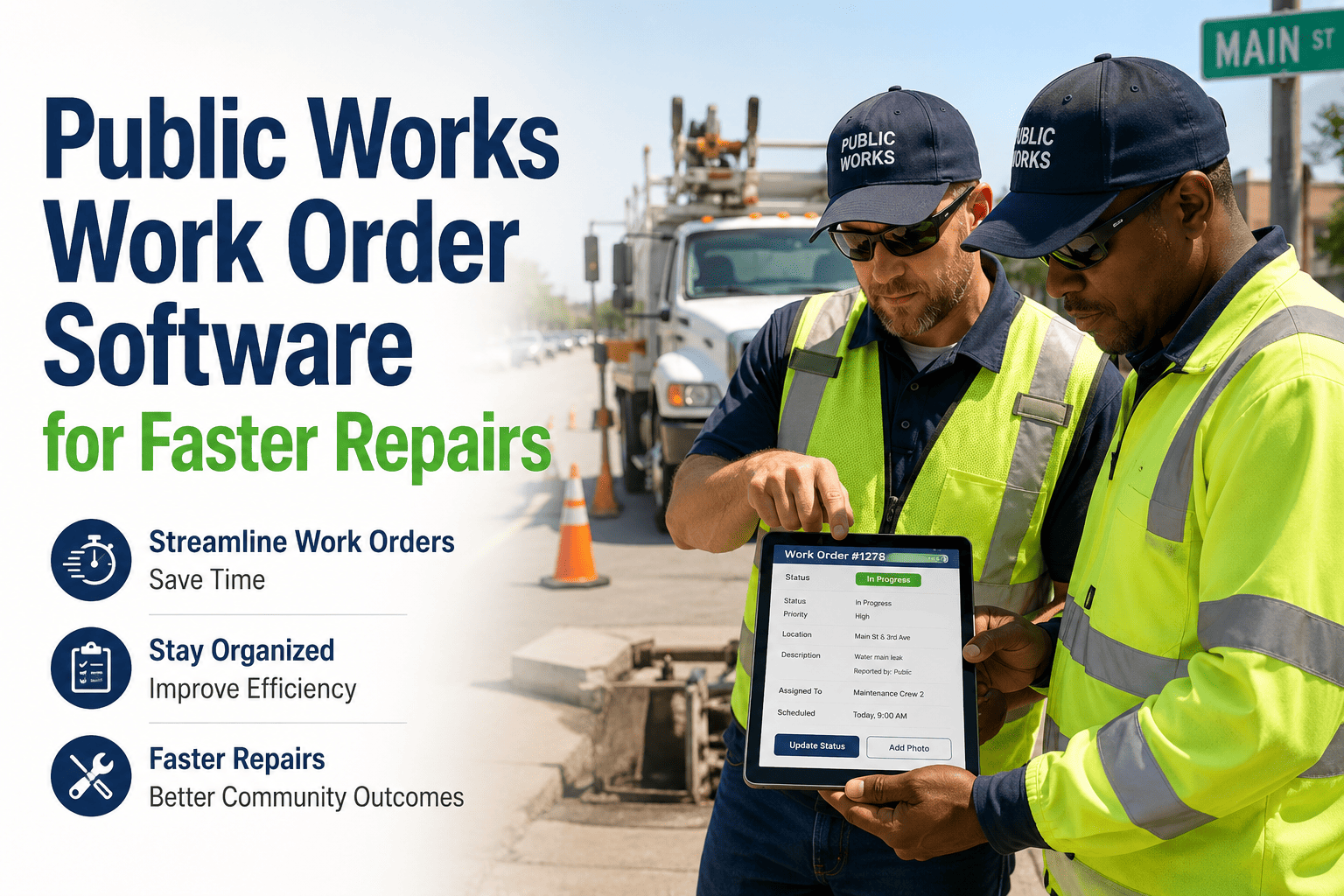
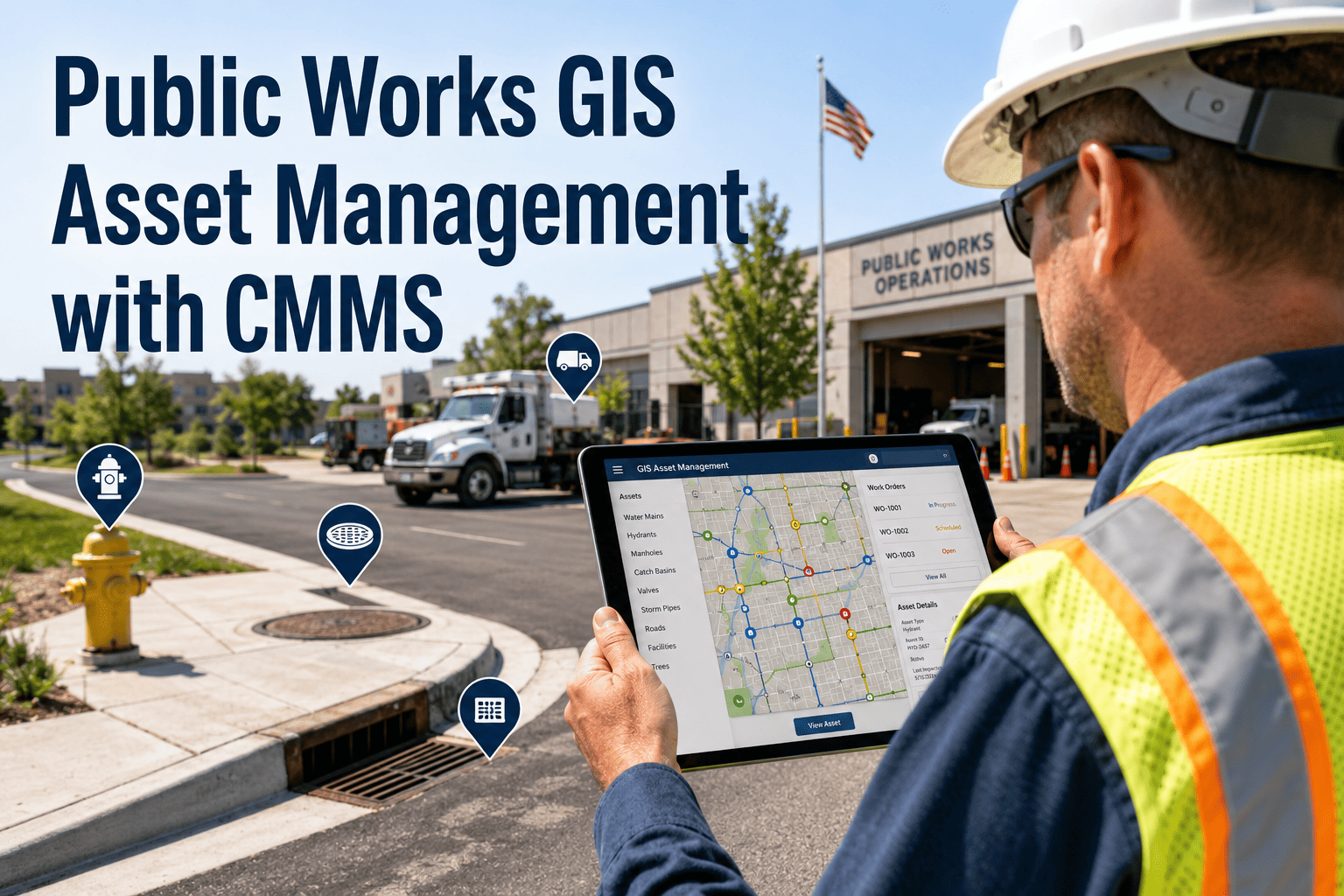
A malfunctioning traffic signal does not just create frustration — it creates accidents, emergency response delays, and regulatory liability for the municipality responsible for it. Cities across the US manage between 200 and 4,000 signalized intersections each, and most still track maintenance through spreadsheets, technician phone calls, and reactive dispatch. Every hour a signal operates in a fault state is an hour of preventable risk. OxMaint's AI Automation module gives transportation departments a structured digital workflow for signal inspection scheduling, fault response, contractor coordination, and compliance documentation — purpose-built for the maintenance realities of smart city infrastructure.
Smart Cities · AI Automation · Transportation Infrastructure
Traffic Signal Maintenance Automation for Smart Cities
How AI-driven work order creation, automated inspection scheduling, and real-time fault response transform traffic signal maintenance from reactive to predictive.
$54K
Average cost of a fatal intersection accident linked to signal malfunction (NHTSA data)
23min
Median emergency response delay at an uncontrolled intersection vs signalized
41%
Of signal maintenance work orders are reactive (breakdown) in cities without CMMS
The Signal Maintenance Challenge at Scale
Transportation maintenance teams face a compounding set of constraints: fixed budgets, aging cabinet hardware, increasing intersection density from urban expansion, and growing public expectations for zero-fault infrastructure. The average signalized intersection requires 6–8 scheduled maintenance actions per year plus an unpredictable volume of fault responses. Without automation, this workload overwhelms even well-staffed departments.
6–8
Annual Scheduled Maintenance Actions Per Intersection
Lamp replacement cycles, controller firmware updates, cabinet inspections, detection loop testing, and timing plan reviews. Manual scheduling fails to keep pace with the volume across large intersection portfolios.
4hrs
MUTCD Required Response Time for Signal Faults
The Manual on Uniform Traffic Control Devices mandates 4-hour response for signal-out conditions. Without automated dispatch, teams routinely miss this window, creating documentation exposure in liability cases.
68%
Of Signal Failures Preceded by Warning Signs in Cabinet Data
Controller diagnostic logs contain early fault indicators days before visible failure. AI pattern analysis of cabinet data enables predictive maintenance that prevents the failure entirely.
OxMaint AI Automation: How It Works for Traffic Signals
OxMaint connects to traffic management systems, controller cabinet data feeds, and SCADA networks to automate the full signal maintenance lifecycle — from scheduled inspection triggers to fault response dispatch to compliance record generation.
| Workflow Stage |
Manual Process (Without OxMaint) |
Automated Process (With OxMaint) |
Time Saved |
| Scheduled Inspection Trigger |
Dispatcher checks spreadsheet calendar weekly |
AI auto-generates work order 5 days before due date, assigns to available technician |
4–6 hrs/week eliminated |
| Fault Detection Response |
Controller alert sent to shared inbox, manually reviewed |
Controller fault triggers P1 work order in <5 minutes, technician notified via mobile |
45–90 min average response improvement |
| Parts/Material Request |
Technician calls warehouse, manually checks stock |
Work order auto-checks inventory, flags shortfalls, generates PO if below threshold |
Parts delay eliminated in 78% of cases |
| MUTCD Compliance Documentation |
Technician fills paper form, supervisor logs manually |
Work order closure auto-generates timestamped compliance record mapped to intersection ID |
Documentation completeness 97% vs 54% |
| Contractor Work Verification |
Supervisor phone check, no systematic logging |
Contractor completes WO on mobile with GPS timestamp, photo evidence required for closure |
Full accountability with zero supervisor overhead |
See how OxMaint AI automation handles the full traffic signal maintenance workflow — from controller fault to closed work order in under 4 hours. Book a 30-minute demo with OxMaint's transportation team.
Smart City Integration: OxMaint Connects to Your Infrastructure
Modern smart city deployments generate enormous volumes of infrastructure data — connected controllers, adaptive signal networks, V2X communication systems. OxMaint serves as the maintenance operations layer that converts infrastructure data signals into maintenance actions, ensuring that the intelligence embedded in smart city hardware translates into actual uptime improvements.
ATM
Adaptive Traffic Management Systems
OxMaint integrates with ATMS platforms to receive real-time controller status data and automatically flag assets showing degraded performance patterns for scheduled preventive inspection.
SCADA
SCADA & Traffic Management Centers
Bi-directional SCADA integration allows TMC operators to trigger work orders directly from their console and receive real-time work order status updates without leaving their operational dashboard.
GIS
GIS Asset Mapping
Every intersection in OxMaint is mapped to its GIS coordinate. Maintenance history, fault frequency, and upcoming schedule are viewable on a geographic map view — useful for route-based dispatch optimization.
Results: City Transportation Department Before vs After OxMaint
Before — Manual Maintenance Workflow
MUTCD 4-hr fault response compliance rate
58%
Average fault-to-dispatch time
2.8 hours
Scheduled maintenance completion rate
71%
Documentation completeness for compliance audit
54%
Reactive vs preventive work order ratio
3:1 reactive
After — OxMaint AI Automation
MUTCD 4-hr fault response compliance rate
97%
Average fault-to-dispatch time
23 minutes
Scheduled maintenance completion rate
98%
Documentation completeness for compliance audit
97%
Reactive vs preventive work order ratio
1:4 preventive
"
Cities that have moved to CMMS-driven signal maintenance are not just more efficient — they are dramatically better protected in liability situations. When an intersection accident occurs and attorneys subpoena maintenance records, having timestamped, GPS-verified work order histories for every inspection is the difference between a defensible record and an indefensible gap. Smart city investment in connected infrastructure only delivers its full value when the maintenance layer is equally smart.
Jennifer Calloway
Traffic Operations Division Manager, Institute of Transportation Engineers (ITE)
Frequently Asked Questions
Does OxMaint integrate with existing traffic management software like Econolite or Intelight?
OxMaint integrates with major traffic management platforms via REST API and NTCIP protocol support, including systems built on Econolite, Intelight, Siemens Mobility, and custom ATMS deployments. Integration maps controller asset IDs to OxMaint intersection records so fault events from your TMC automatically create linked work orders without manual data entry. The integration team handles configuration during onboarding, and existing asset data can be imported directly from your current inventory records.
Book a demo to discuss your specific integration requirements.
How does OxMaint help us meet MUTCD 4-hour fault response requirements?
OxMaint creates a P1 priority work order within 5 minutes of receiving a signal fault event from your controller network or SCADA system. The assigned technician receives an immediate mobile push notification with intersection location, fault type, recommended action, and nearest parts cache. The timestamp from fault detection to technician acceptance is automatically recorded, creating the compliance documentation your department needs to demonstrate MUTCD adherence. If the 4-hour window is at risk, OxMaint sends escalation alerts to supervisors automatically.
Start a free trial to configure your fault response workflow.
Can OxMaint track contractor-performed signal maintenance with the same audit trail as in-house work?
Yes. Contractors performing signal maintenance access OxMaint through a mobile app that is separate from staff accounts but fully integrated into the work order system. Every contractor action — arrival time, work performed, parts installed, departure time — is logged with GPS verification and optional photo attachment requirements. This creates the same audit-ready record for contractor work as for in-house maintenance, and performance data feeds into contractor evaluation scorecards that support future contract renewal decisions. Contractor accounts are included at no additional per-seat cost in OxMaint government plans.
Book a demo to see the contractor mobile workflow.
TRAFFIC SIGNAL AUTOMATION · OXMAINT
Automate Signal Maintenance. Protect Your City. Meet Every Compliance Deadline.
OxMaint gives transportation departments AI-powered work order automation, real-time fault dispatch, contractor accountability, and MUTCD-ready documentation — all in one platform designed for smart city maintenance teams.