Public Works Safety Programs: Complete Development Guide
By Taylor on February 6, 2026
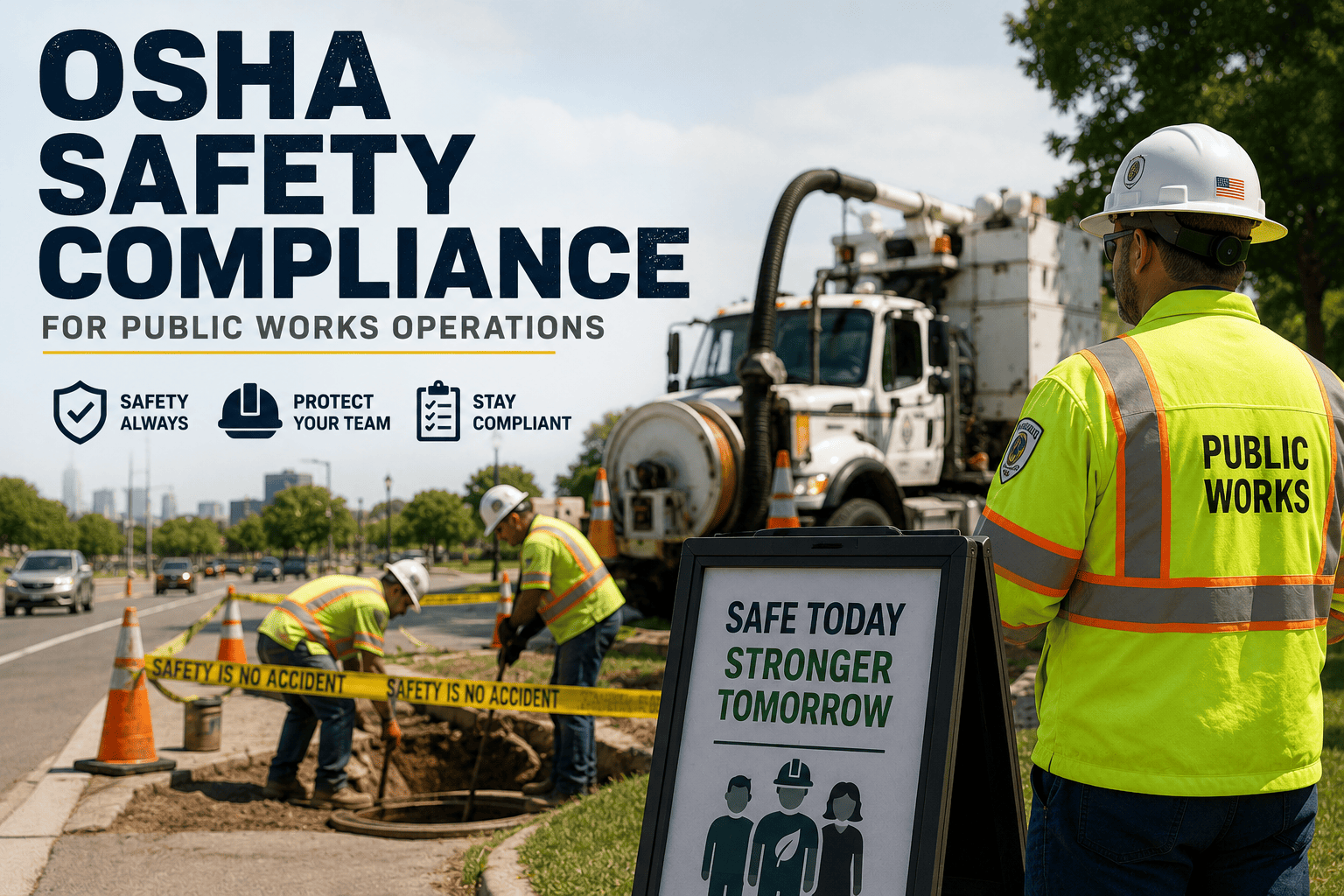
Your public works crew responded to 1,847 work orders last quarter across roads, water, sewer, and parks. Every job generated safety-critical data—near-miss reports, equipment inspection logs, hazard exposures, PPE compliance checks, and incident timestamps. That data told a story about a trenching crew that skipped shoring inspections three times in one month, a water main repair team working next to live traffic without proper flagging, and a fleet mechanic lifting loads without lockout/tagout. But without a digitized safety management system, that story went unread. The result? A trench collapse that hospitalized a 22-year veteran worker, triggered an OSHA investigation with $156,000 in citations, shut down operations for two weeks, and devastated a department that thought of itself as "family." Systematic safety programs transform scattered compliance activities into a living culture where every worker goes home whole.
Safety Program Development
Zero Injuries Is a System, Not a Slogan
OSHA-compliant safety program framework for municipal public works departments
Municipal public works ranks among the most hazardous government occupations. Workers face confined space entry in manholes, excavation collapse risks, high-voltage electrical exposure, vehicular strike hazards in traffic zones, and chemical exposure at water treatment plants—often in the same week. When safety programs exist only as binders on a shelf, workers rely on informal knowledge transfer that dies with retirements. OSHA doesn't accept "we didn't know" as a defense, and neither do juries in wrongful death lawsuits.
Anatomy of a Safety Program Failure
How compliance gaps escalate to catastrophic outcomes
Root Cause
No Documented Hazard Assessment Process
Week 1
Near-Miss Unreported
Trench wall shows cracks; crew proceeds without shoring check
Week 4
Training Gap Missed
New hire assigned to excavation crew—no competent person training documented
Week 8
Trench Collapse
Worker buried to chest—emergency rescue, hospitalization, permanent disability
Week 10
OSHA Willful Citation
$156,000 fine, mandatory program overhaul, media coverage, council scrutiny
Total Impact
$487,000+
Fines + medical + legal + operational disruption + reputational damage
A systematic safety program prevents this cascade at every step. Digital hazard assessments flag risks before work begins, training management ensures every worker is certified for assigned tasks, near-miss reporting creates an early warning system, and incident investigation workflows drive corrective actions. Teams that implement comprehensive safety programs don't just avoid fines—they build departments where experienced workers stay and new talent wants to join.
The Seven Pillars of Public Works Safety
OSHA's recommended practices framework identifies core elements that every safety program must address. For public works departments with diverse hazard exposures—from confined spaces to traffic control to heavy equipment—each pillar requires specific procedures, training, and documentation tailored to municipal operations.
Comprehensive Safety Program Architecture
Seven integrated systems that create a culture of safety
01
Management Leadership
Executive commitment, safety policy, resource allocation, and accountability structures
OSHA 1904 / 1910
02
Hazard Assessment
Job Hazard Analysis (JHA), workplace inspections, and risk scoring by task and location
29 CFR 1926 Subpart P
03
Written Programs
Documented SOPs for confined space, excavation, LOTO, fall protection, traffic control
OSHA Written Program Req.
04
Training & Competency
Task-specific certifications, refresher schedules, competent person designations
OSHA 1926.21 / 1926.651
05
Incident Investigation
Root cause analysis, corrective action tracking, near-miss reporting systems
OSHA 1904 Recordkeeping
06
Emergency Response
Rescue plans for confined spaces, evacuation procedures, first aid/AED programs
The gap between having a safety program and having an effective safety program is digitization. When JHAs live in a CMMS linked to specific work orders, every crew completes hazard assessments before breaking ground. When training records auto-alert supervisors 30 days before certifications expire, no worker is assigned a task they aren't qualified for. Agencies ready to see this transformation can schedule a demo to watch the workflow firsthand.
Paper Safety Programs vs. Digital Safety Management
Safety Function
Paper / Binder
Spreadsheet
CMMS-Integrated
Hazard Assessment
Filed post-job, rarely reviewed
Logged but not linked to WOs
Auto-triggered per work order type
Training Tracking
Annual sign-in sheets only
Manual expiry tracking
Auto-alert 30/60/90 days before expiry
Incident Reporting
Days to file, incomplete data
Same-day email forms
Instant mobile report with photos/GPS
Equipment Inspection
Clipboard in truck cab
Scanned copies, no follow-up
Digital checklists auto-generate WOs
OSHA Audit Readiness
Weeks to compile records
Hours, gaps common
Instant retrieval, complete audit trail
40%Fewer recordable incidents
100%Training compliance achievable
ZeroSurprise OSHA findings
Digitize Your Safety Program
Watch how Oxmaint links JHAs to work orders, automates training compliance, and creates instant OSHA audit trails. Our 30-minute demo shows the complete safety management workflow.
Municipal leaders often view safety programs as compliance overhead, but the financial case is overwhelming. OSHA data shows that every $1 invested in workplace safety returns $4-6 in reduced workers' compensation, lower insurance premiums, eliminated OSHA penalties, and retained productivity. For a public works department with 50 field workers, the numbers translate directly to budget protection.
Safety Investment ROI Calculator
Based on 50-person public works department, 5-year historical incident data
Workers' Comp Reduction
40% fewer claims, lower EMR rating
$280K
$168K
$112,000
OSHA Citation Avoidance
Zero willful/serious violations
$156K risk
$0
$156,000
Lost Productivity Recovery
Fewer lost workdays, less overtime backfill
$190K
$85.5K
$104,500
Insurance Premium Savings
Lower EMR drives 15-25% premium reduction
$420K
$327.6K
$92,400
Total Annual Protection Value
$464,900
$4-6 return for every $1 invested in safety programs
Building the Safety Workflow: From Hire to Retirement
A comprehensive safety program isn't a single document—it's a continuous workflow that begins on Day 1 of employment and runs through every work order, every inspection, and every near-miss. When each stage is digitized in a CMMS, the system becomes self-reinforcing: incidents trigger investigations, investigations drive training updates, training updates change JHAs, and revised JHAs prevent future incidents.
The Continuous Safety Improvement Cycle
Every stage feeds the next—creating a self-reinforcing safety culture
01
Onboarding
Orientation, baseline certs, PPE fit, GHS training
02
Pre-Task JHA
Hazard ID tied to work order before each job
03
Field Execution
PPE compliance, equipment checks, supervisor audits
04
Incident / Near-Miss
Mobile reporting, photo documentation, immediate alert
05
Investigation
Root cause analysis, corrective actions, trend tracking
06
Program Update
Revised JHAs, new training, improved SOPs → cycle repeats
Expert Perspective: Why Culture Eats Compliance for Breakfast
"
You can have a perfect safety manual and still have injuries. What separates zero-injury departments from the rest isn't documentation—it's culture. Culture means a laborer feels empowered to stop a job when something doesn't look right, a supervisor treats near-miss reports as gifts rather than problems, and the director puts safety data on the council agenda alongside budget numbers. A CMMS doesn't create culture, but it provides the data infrastructure that makes a safety culture visible, measurable, and sustainable.
— Risk Manager, Municipal Insurance Pool
Leading Indicators
Track near-miss reports, inspection completion rates, and training currency—not just injuries. These leading indicators predict and prevent tomorrow's incidents.
Worker Empowerment
Stop-work authority must be real, not theoretical. Digital near-miss reporting via mobile apps removes the friction that prevents workers from speaking up.
Supervisor Accountability
Tie safety KPIs to supervisor evaluations. When JHA completion rate and crew training currency affect performance reviews, compliance becomes a leadership priority.
The municipalities succeeding with safety share common characteristics: leadership that treats safety as a core value rather than a compliance checkbox, data systems that make hazards visible before they cause harm, and a culture where reporting problems is rewarded, not punished. If you're ready to explore what this looks like for your department, our team can help you build the roadmap. Schedule a consultation to design your safety program architecture.
Build a Safety Culture That Protects Your Team
Join public works departments using Oxmaint to digitize JHAs, automate training compliance, track incidents, and build OSHA-ready audit trails—all from one platform.
What OSHA standards apply specifically to municipal public works?
Municipal public works departments must comply with both General Industry (29 CFR 1910) and Construction (29 CFR 1926) standards depending on the work being performed. Key standards include: Excavation Safety (1926 Subpart P) for trenching, Confined Space Entry (1910.146/1926.1203) for manholes and vaults, Fall Protection (1926 Subpart M) for elevated work, LOTO (1910.147) for equipment maintenance, Electrical Safety (1910 Subpart S/1926 Subpart K) for utility work, and Traffic Control (MUTCD) for work zones. A CMMS helps track which standards apply to each work order type and ensures required procedures are completed.
How do we conduct effective Job Hazard Analyses for field crews?
Effective JHAs for public works follow a four-step process: break the job into sequential steps, identify hazards at each step, determine risk levels (severity × probability), and establish controls (elimination → substitution → engineering → administrative → PPE). The key is making JHAs practical and task-specific rather than generic. A CMMS stores JHA templates by work order type (e.g., "Water Main Repair" or "Tree Trimming"), auto-attaches the relevant JHA when a work order is created, and requires crew sign-off before work begins. This ensures JHAs are living documents, not shelf decorations.
What should a near-miss reporting system include?
An effective near-miss system must be anonymous (or at least non-punitive), mobile-accessible for field reporting, and fast—if it takes more than 2 minutes, workers won't use it. Essential data fields include: date/time/location, brief description, hazard category (dropdown), photo upload, and suggested corrective action. The system should auto-notify the safety officer and generate a corrective action work order. Track the near-miss-to-incident ratio as a leading indicator: healthy programs report 10-20 near-misses per recordable incident. Low near-miss reporting usually means under-reporting, not safety.
How do we track training compliance across multiple certifications?
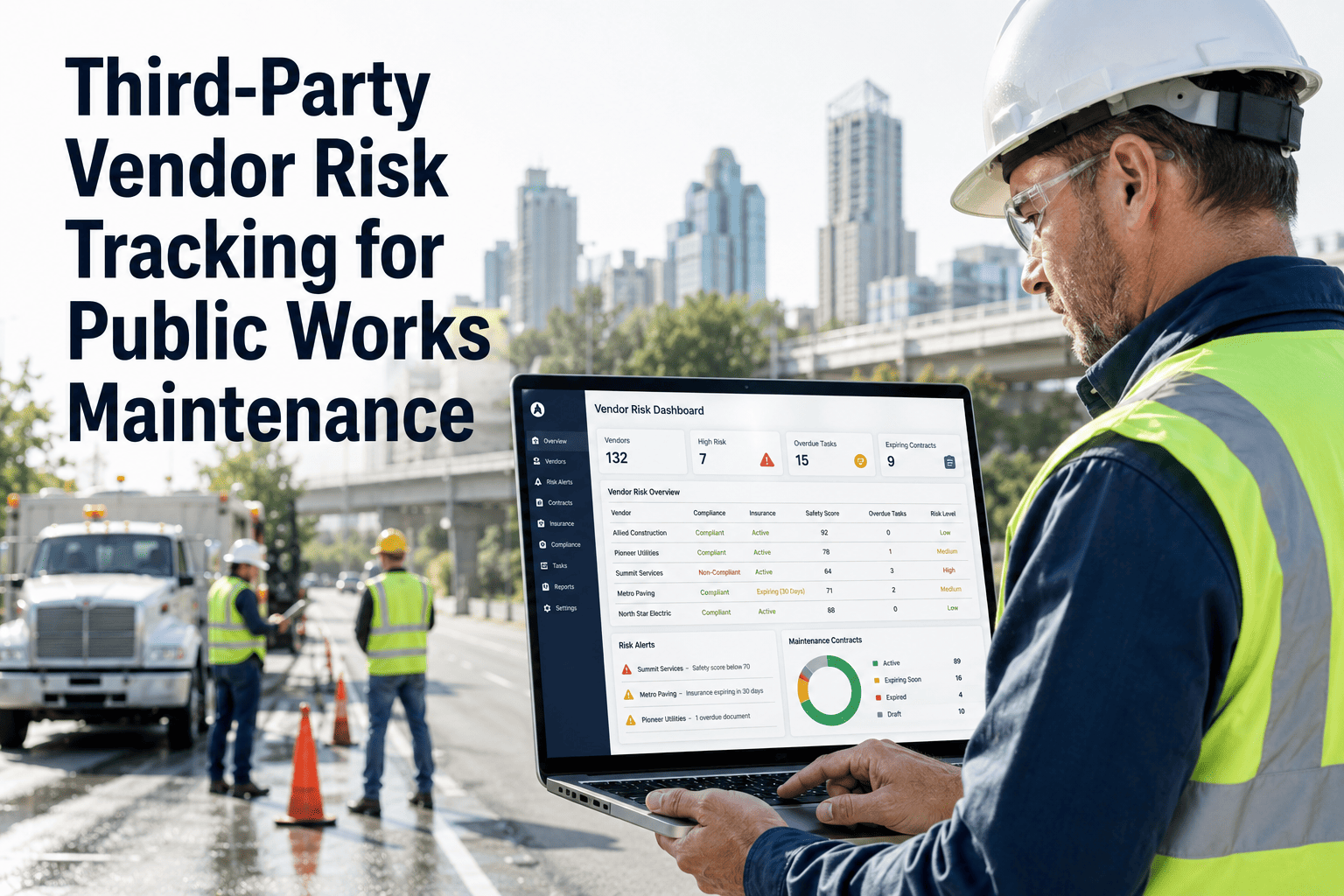
Public works workers may need 10-15 different certifications: CDL medical cards, confined space entry, competent person (excavation), flagger certification, first aid/CPR, forklift/equipment operator, HAZWOPER, GHS/chemical handling, electrical safety, and more. A CMMS stores each worker's certification records with expiration dates, auto-generates alerts at 30/60/90 days before expiry, and prevents work order assignment to uncertified workers. Monthly compliance dashboards show department-wide training currency, and annual training plans auto-schedule refresher courses based on expiration patterns.
What safety metrics should we report to leadership and council?
Report a balanced scorecard of leading and lagging indicators: Leading indicators include JHA completion rate (target: 100%), training compliance percentage, near-miss reports per month, safety inspection completion rate, and corrective action closure time. Lagging indicators include OSHA recordable incident rate (TRIR), days away/restricted/transferred (DART) rate, workers' compensation costs, Experience Modification Rate (EMR), and lost workday count. Present trends over 12-month rolling periods, not just snapshots. When leadership sees the direct correlation between leading indicator improvement and workers' comp cost reduction, sustained safety investment becomes politically defensible.