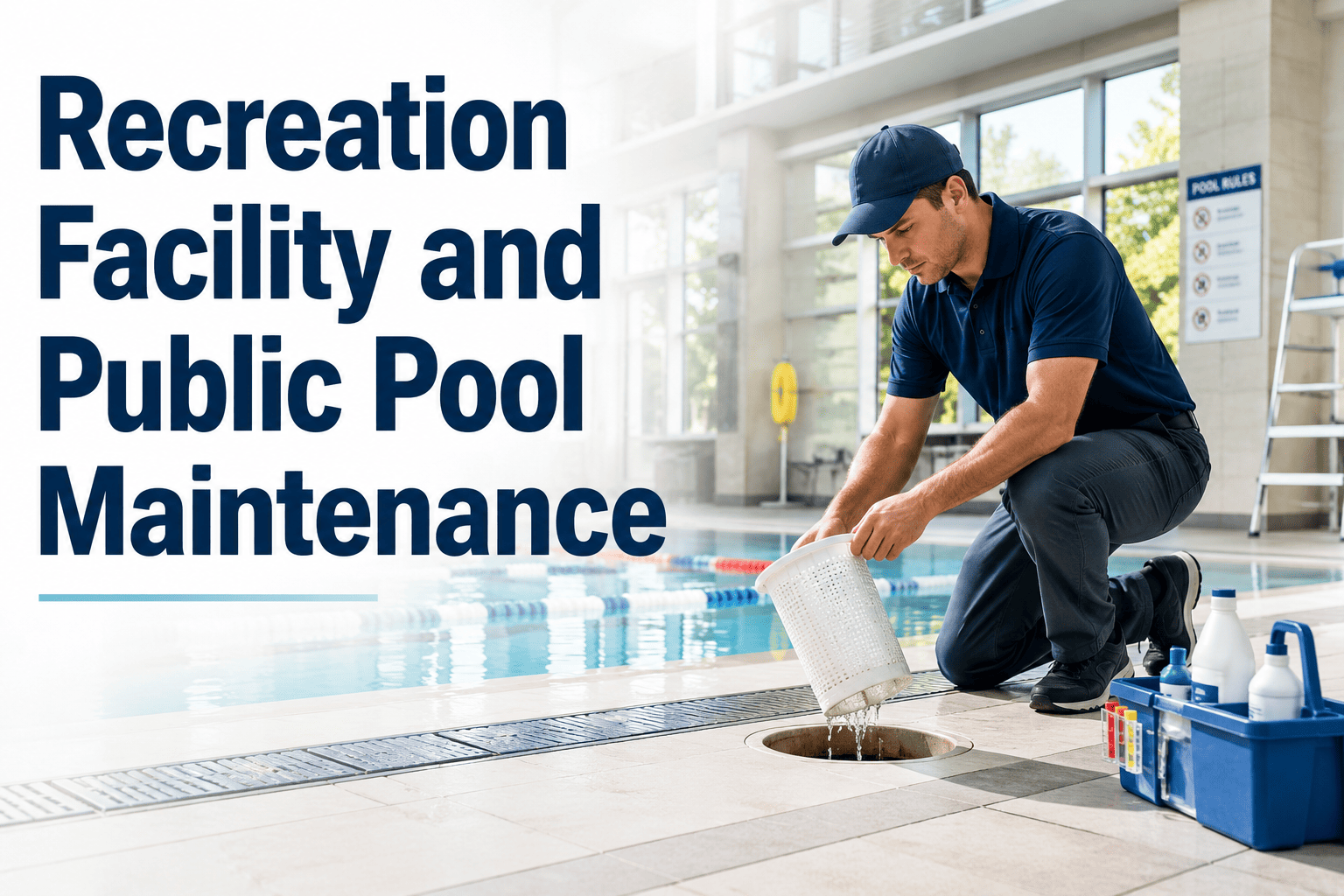
Parks and recreation departments run some of the most heavily used, most litigated assets in local government — public pools, gymnasiums, splash pads, fitness centers, and multi-purpose fields that see thousands of residents pass through every week. A single missed water test, an undocumented drain cover check, or a skipped HVAC filter change in a packed rec center can trigger a health department closure or a liability claim that lands directly on the director's desk. Recreation maintenance is not routine janitorial work — it is a compliance-heavy, safety-critical operation spanning water chemistry, mechanical systems, lifesaving equipment, and ADA access, all on overlapping daily, weekly, and seasonal schedules. Parks and recreation teams using recreation and public pool maintenance software replace scattered logbooks and sticky-note reminders with one system that tracks every asset, every certification, and every inspection across the whole portfolio.
Parks & Recreation · Public Pool Compliance · 2026
Recreation Facility and Public Pool Maintenance That Keeps Every Site Open and Audit-Ready
A single platform for water chemistry logs, drain cover checks, HVAC and mechanical PM, lifeguard equipment, and health department documentation — built for parks and recreation directors managing multiple facilities at once.
1 to 4
annual health inspections most public pools must pass, on top of daily internal checks
$100K
maximum civil penalty per VGB Act drain cover violation at a public facility
90 days
of water chemistry logs inspectors commonly request during a facility review
Missing logs
are the leading cause of pool shutdowns — more often than actual water quality
Why Pools and Rec Facilities Carry Outsized Risk
Recreation assets combine three things that rarely show up together in municipal facilities: constant public contact, life-safety equipment, and layered federal, state, and local regulation. That combination is what turns a small maintenance gap into a headline.
Water Safety
Drain Cover and Entrapment Compliance
Federal drain cover rules require documented inspection of every anti-entrapment cover before a pool opens, with service life and replacement dates tracked per cover — not per facility.
Chemistry
Water Testing Frequency and Gaps
Chlorine and pH must be tested and logged multiple times daily. Health departments treat a two-day gap in the log the same as a failed test — the data has to exist, not just the result.
Equipment
Lifesaving and Mechanical Readiness
Reaching poles, AEDs, rescue tubes, pumps, and filtration systems all need scheduled checks. A missing rescue tube at one station can close a pool as fast as a chemistry failure.
Access
ADA and Multi-Site Accountability
Lifts, ramps, and accessible entry points require the same documented upkeep as the pool itself, and directors overseeing several sites need one place to see status across all of them.
Maintenance Cadence Across a Recreation Portfolio
Daily
Chlorine and pH testing before opening
Drain cover visual inspection
Lifesaving equipment count
Weekly
Filtration and circulation system check
Gym and fitness equipment safety walk
Chemical inventory and storage review
Monthly
AED and rescue equipment tagging
HVAC filter change in indoor facilities
Operator certification status review
Seasonal
Pre-opening full system commissioning
Winterization and closing checklist
ADA lift and ramp condition audit
| Facility Type |
Primary Compliance Driver |
Typical Inspection Frequency |
| Public Pools |
State health code, VGB Act drain covers, CPO-certified staffing |
Daily internal, 1 to 4 external per year |
| Spray Parks & Zero-Depth Pools |
Recirculation and disinfection provisions separate from standard pools |
Daily internal, seasonal external |
| Gymnasiums & Fitness Centers |
Equipment safety inspection, HVAC and flooring maintenance |
Weekly internal, annual external |
| Community & Civic Centers |
Fire, electrical, and ADA access compliance |
Monthly internal, annual external |
| Athletic Fields & Courts |
Surface condition, lighting, and irrigation system upkeep |
Weekly internal, seasonal external |
Parks & Recreation Director Perspective
The pools rarely fail because the water is bad. They fail because a log had a gap, a cover inspection never got written down, or a certification expired without anyone noticing. Once every facility reports into one system with reminders built in, those gaps stop happening — and inspection day stops being stressful.
Reactive Upkeep vs. a Managed Recreation Portfolio
Paper Logs and Spreadsheets
Water test results recorded on clipboards that can be lost, damaged, or backdated
Certification expirations tracked manually per staff member, per site
No visibility across multiple pools and rec centers from one place
Work orders created only after someone remembers to report the issue
Oxmaint-Managed Facilities
Digital, timestamped water logs with automated reminders before a test is due
Certification and drain cover expiration tracked per asset, with advance alerts
Portfolio-wide dashboard showing every site's compliance status in real time
Failed checks and equipment issues auto-generate assigned work orders instantly
See Your Whole Recreation Portfolio in One Dashboard
From a single neighborhood pool to a district with dozens of parks and centers, Oxmaint gives directors one place to track compliance, assets, and work orders.
Frequently Asked Questions
What records do health inspectors usually ask for at a public pool?
Inspectors typically request water chemistry logs going back 30 to 90 days, operator certifications, drain cover inspection records, and equipment maintenance history.
Oxmaint keeps all of these in one exportable record per facility.
How does a CMMS help with VGB Act drain cover compliance?
Each drain cover is logged as an asset with its install date and service life. The system reminds staff before a cover expires and stores every inspection result, so replacement never depends on someone's memory.
Can one system manage pools, gyms, and fields together?
Yes. Recreation departments manage every asset type — aquatic, mechanical, structural, and grounds — on the same platform, with schedules and checklists specific to each facility type.
Book a demo to see a multi-facility setup.
How does this reduce liability exposure for a recreation department?
Documented, timestamped compliance records are the strongest defense in a liability claim. A complete digital history shows the facility was actively maintained, rather than leaving the department to reconstruct paper records after the fact.
Is this practical for a small parks department with limited staff?
Small teams benefit the most, since automated reminders and mobile check-offs remove the need for a dedicated compliance coordinator. Most departments are fully set up within a few weeks.
Keep Every Pool and Rec Facility Open, Safe, and Audit-Ready
Oxmaint brings water chemistry logs, equipment PM, certifications, and inspection records into one system built for parks and recreation departments.