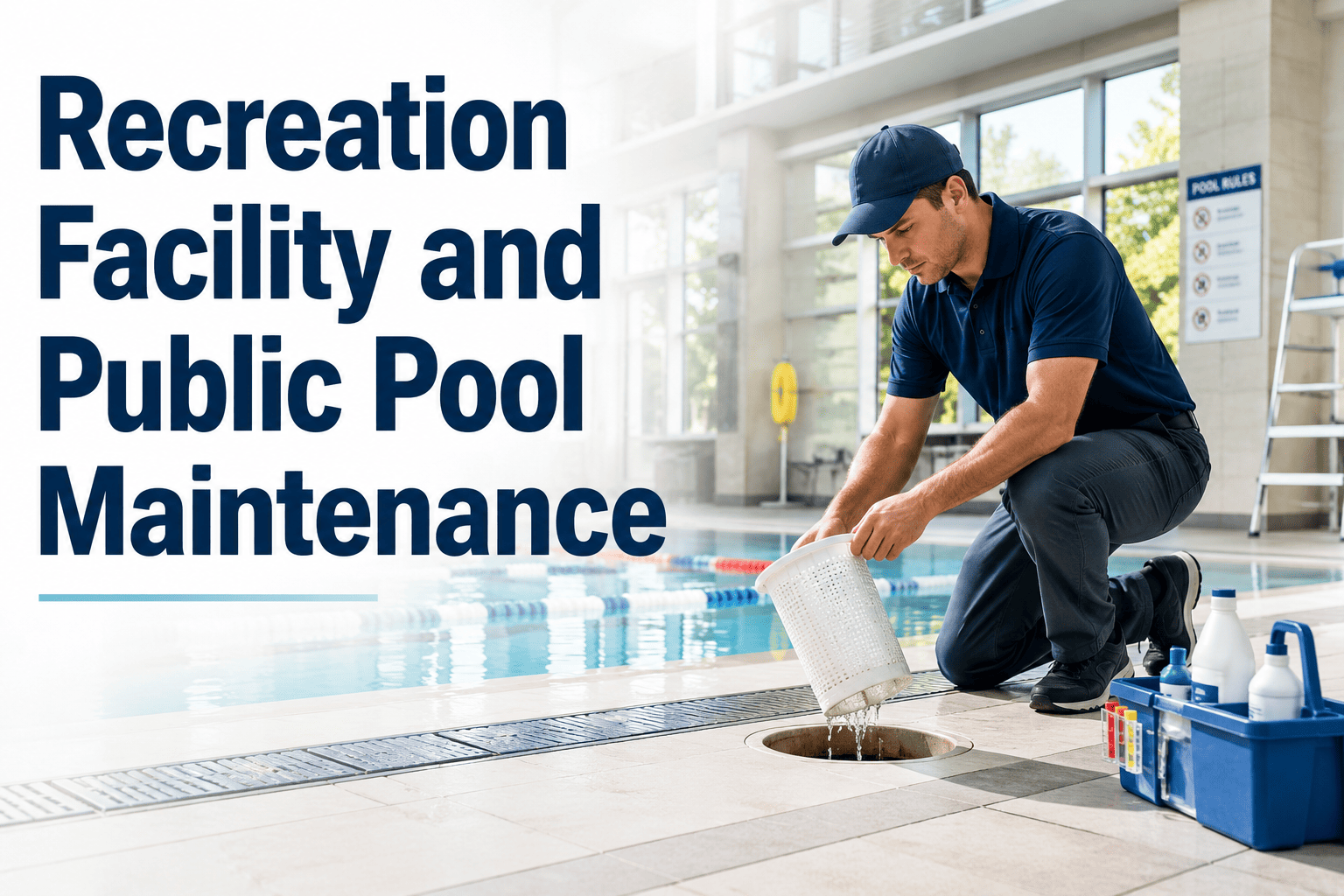
Municipal aquatic facilities are among the highest-liability public assets a parks and recreation department operates — subject to daily health department water chemistry inspections, MAHC-aligned filtration compliance, and life safety equipment checks that must be documented before every public swim session. Authorities without structured maintenance programs average a 43% emergency equipment repair ratio at aquatic facilities, with unplanned filtration or chemical feed system failures costing $38,000–$120,000 per event including pool closure, emergency contractor fees, and public health notification requirements. Book a demo to see how Oxmaint automates pool water quality tracking, chemical log management, and health compliance documentation for municipal aquatic operations.
Public swimming pool and aquatic facility maintenance is a structured system for scheduling preventive maintenance on filtration equipment, pumps, chemical feed systems, and mechanical infrastructure — while documenting water chemistry readings, health department compliance logs, and life safety inspections required before every public swim session. A CMMS reduces emergency repair ratios from 40%+ to under 16% and produces the audit-ready chemical and equipment records required by state health departments, MAHC-aligned codes, and OSHA pool chemical handling standards.
The Real Cost of Reactive Aquatic Facility Maintenance
A municipal pool operating on informal work orders and paper chemical logs is one filtration failure away from a multi-week closure, a public health notification, and an emergency repair bill that consumes the entire annual aquatics maintenance budget. Deferred pump seal replacements, missed filter backwash cycles, and undocumented chemical feed calibrations compound silently — until a health department inspector closes the facility or a catastrophic equipment failure forces an emergency shutdown mid-season. Book a demo to see how Oxmaint structures preventive maintenance and compliance documentation for municipal aquatic facilities.
State health departments require documented free chlorine, pH, alkalinity, and cyanuric acid readings at defined intervals — typically every 2 hours during operation. Paper logs fail audit at 34% of inspected municipal facilities, resulting in forced closures and remediation costs averaging $14,000 per event.
Circulation pumps, filter media, and backwash valves operating without scheduled PM intervals fail during peak season — when replacement lead times are longest. A single pump failure during summer operations costs $38,000–$120,000 including emergency labor, rental equipment, and lost admissions revenue.
Lifeguard equipment, emergency oxygen systems, AED devices, and anti-entrapment drain covers require documented inspection and certification on defined schedules. Missed intervals expose the municipality to OSHA citations, liability in drowning incidents, and insurance coverage disputes exceeding $500,000 per claim.
Circulation pumps, heat exchangers, chemical feed systems, and pool shell infrastructure have defined useful lives — but without Facility Condition Index scoring per asset, capital budget requests to city councils are estimate-only submissions with a 47% approval rate versus 88% for evidence-backed FCI requests.
Aquatic Facility PM Automation — Live in Under 3 Weeks
Automated chemical log scheduling, filtration PM intervals, life safety inspection tracking, and health department compliance exports — from a single platform across your entire aquatics portfolio.
Aquatic Facility Asset Categories Oxmaint Manages
Municipal aquatic facilities contain more regulated asset categories per square foot than almost any other public building — each with distinct PM intervals, compliance documentation requirements, and capital replacement cycles.
Sand filters, DE filters, cartridge filters, and backwash valves. Filter media replacement every 5–7 years, backwash valve rebuild annually. Missed backwash cycles degrade water clarity and increase chemical demand by 18–30%.
Main circulation pumps, booster pumps, and feature pumps. Bearing inspection semi-annually, mechanical seal replacement every 2–3 years. Unplanned pump failure during peak season costs $38,000–$120,000 per event.
Chlorine injection pumps, CO2 pH control systems, cyanuric acid feeders, and chemical storage areas. Calibration quarterly per MAHC guidelines. OSHA 29 CFR 1910.119 Process Safety Management applies to bulk chemical storage above threshold quantities.
Pool water heaters, heat exchangers, natatorium HVAC, dehumidification systems, and exhaust ventilation. Natatorium HVAC failure generates accelerated corrosion of building structure — remediation costs exceed $280,000 for undetected moisture damage.
AED devices, emergency oxygen systems, anti-entrapment drain covers (Virginia Graeme Baker Act compliance), lifeguard equipment, and pool perimeter fencing. Annual certification required — documentation required for every inspection cycle.
Pool shell condition, expansion joint integrity, deck surface slip resistance, gutter and skimmer systems, diving boards, and water play features. ADA accessibility compliance for pool lifts and ramp entries inspected annually.
How Oxmaint Manages Aquatic Facility Maintenance
Every filtration system, pump, chemical feed unit, HVAC component, and life safety device registered in a six-level hierarchy: Portfolio (parks department) → Facility → System → Asset → Component. PM intervals configured per MAHC, OSHA, and manufacturer specifications — work orders auto-generated on schedule with alerts at 30, 7, and 1 day before deadline. A full aquatic center is registered and scheduled in under 2 weeks. Book a demo to see the aquatic asset registry configured for your facility.
Operators log free chlorine, combined chlorine, pH, total alkalinity, cyanuric acid, and calcium hardness readings directly in the mobile app — timestamped and GPS-confirmed. Readings outside acceptable ranges trigger automatic supervisor alerts with corrective action prompts. All logs exportable as state health department submission packages in under 30 minutes. Book a demo to see the water quality log module for your aquatics program.
State health department inspection readiness reports generated automatically from PM completion records, water chemistry logs, and life safety certification records. Inspectors receive a complete, timestamped, photo-evidenced compliance package covering every required documentation point — reducing first-attempt inspection failure rates from 34% to under 4%.
Facility Condition Index calculated per asset category and updated automatically after each work order. Rolling 10-year capital replacement forecasts formatted for parks department CIP submissions — covering pump replacements, filter media, chemical system upgrades, pool shell rehabilitation, and natatorium HVAC overhauls. FCI-backed budget requests carry an 88% city council approval rate. Book a demo to see capital forecasting for your aquatics portfolio.
Platform Features — Aquatic Facility Management
Mobile chemical readings with automatic out-of-range alerts, corrective action prompts, and state health department export formatting. Eliminates paper log audit failures at 34% of inspected facilities.
Work orders auto-generated for filter backwash, pump bearing inspection, chemical feed calibration, heat exchanger service, and life safety certifications — per MAHC, OSHA, and manufacturer intervals with tiered deadline alerts.
Real-time PM compliance rates, open chemical log exceptions, overdue life safety certifications, and FCI scores across every pool and aquatic facility — without manual reporting or spreadsheet compilation.
Every water chemistry reading, equipment inspection, and life safety certification exported as a timestamped, photo-evidenced, GPS-confirmed record — formatted for state health department review in under 30 minutes.
AED, emergency oxygen, Virginia Graeme Baker drain cover compliance, and lifeguard equipment certifications tracked per device with renewal alerts — producing documented inspection history for every liability exposure point.
FCI auto-updated per asset after every work order. 10-year capital replacement forecast for parks department CIP submissions — covering pump overhauls, filter media replacement, pool shell rehabilitation, and natatorium HVAC at 88% council approval rate.
KPI Scorecard — Municipal Aquatic Facility Operations
Outcomes — Oxmaint-Deployed Aquatic Facilities
Aquatic Equipment PM Intervals and Compliance Requirements
| Asset or System | PM Interval | Regulatory Standard | Planned Cost | Emergency or Deferred Cost |
|---|---|---|---|---|
| Circulation pump bearing inspection | Semi-annually | Manufacturer specification, MAHC | $420 per pump | $38,000–$120,000 unplanned failure |
| Filter media replacement | Every 5–7 years | MAHC Section 4, state pool codes | $4,200–$8,500 per filter | $18,000–$42,000 emergency replacement with closure |
| Chemical feed pump calibration | Quarterly | MAHC, OSHA 29 CFR 1910.119 | $180 per system | $14,000+ health department closure per event |
| Anti-entrapment drain cover inspection | Annually and after each season | Virginia Graeme Baker Act (federal) | $120 per drain | $500,000+ liability exposure per drowning incident |
| AED and emergency oxygen certification | Annually | OSHA, state health department codes | $280 per device per year | Insurance coverage dispute, $500,000+ liability |
| Natatorium HVAC inspection | Semi-annually | ASHRAE 62.1, state building codes | $1,800 per system annually | $280,000+ structural remediation for moisture damage |
Health Department Compliance Documentation — Export Ready in Under 30 Minutes
From water chemistry logs to Virginia Graeme Baker drain cover certifications — every reading and inspection timestamped, photo-evidenced, and formatted for state health department review. Schedule a demo for your aquatics maintenance program.
Frequently Asked Questions
Continue Reading
Stop Managing Pool Chemistry and Equipment PM on Paper Logs and Spreadsheets
Automated water quality tracking, filtration PM scheduling, life safety certification management, and health department compliance exports — live across your aquatic facility portfolio in under 3 weeks with no hardware and no IT project.