When a municipal building manager realizes their flagship solar array hasn't produced power for three months because a single tripped inverter went unnoticed, the true cost of neglected renewable infrastructure becomes clear. Government agencies lead renewable energy adoption, but installing panels is only half the battle. Dust accumulation, inverter faults, and tracking motor failures can quietly erase expected energy savings. To ensure maximum energy production and ROI from taxpayer-funded renewable investments, public works departments must transition from "install and forget" to proactive oversight. Solar maintenance — cleaning, inverter monitoring, performance tracking — is critical to fulfilling the promise of government clean energy. Talk to our team about integrating automated government solar monitoring and maintenance diagnostics into your public facilities programme.
Public Energy — 2026 Edition
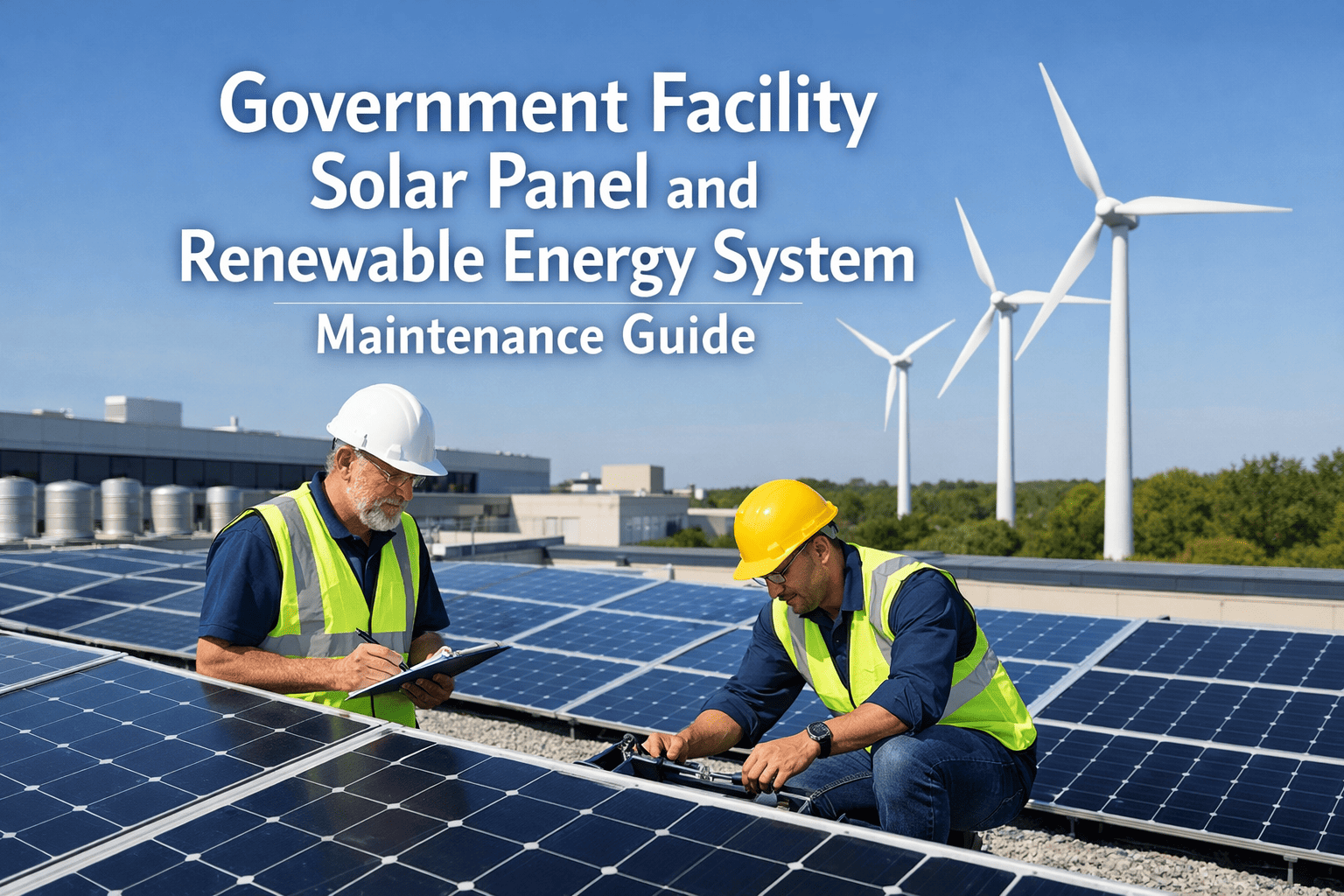
Solar Panel and Renewable Energy Maintenance for Government Properties
Ensure maximum energy production and ROI from taxpayer-funded renewable investments. Automate municipal solar maintenance, monitor inverter health, and track system performance across all public building solar installations.
Solar Performance
Real-time solar performance government tracking
Inverter Uptime
Continuous solar inverter maintenance & alerts
Panel Efficiency
Scheduled cleaning and heat degradation checks
CMMS Integration
Automated renewable energy maintenance government workflows
100%Visibility of government renewable energy assets
24/7Government solar monitoring & telemetry
30%Boost in government solar ROI via predictive care
ZeroUnplanned downtime for public solar installations
Why Government Solar Assets Degrade Without Maintenance
Public building solar arrays face relentless exposure to environmental hazards. Dust, pollen, and bird droppings accumulate on panels, reducing photon absorption. Inverters—the brains of the system—suffer from thermal stress and grid voltage fluctuations. Solar tracking mechanisms seize due to poor lubrication. Without scheduled government solar maintenance, system efficiency can drop by 20% to 30% annually, wiping out the financial and environmental benefits promised to taxpayers. A robust maintenance plan requires continuous government solar tracking and automated CMMS workflows to fix issues before output drops. Start your free trial to automate your solar maintenance schedules.
The Five Failure Modes of Unmaintained Solar Arrays
Soiling Losses
30% Drop
Accumulated dirt, debris, and snow block sunlight from reaching photovoltaic cells, severely degrading overall energy yield.
Risk: Massive Output Reduction
Inverter Faults
Critical
Without solar inverter maintenance, thermal overload or grid anomalies cause silent shutdowns, resulting in zero power generation.
Risk: Total String Failure
Micro-cracks
Silent
Thermal cycling and physical stress create microscopic fractures in solar panel government assets, creating localized hot spots.
Risk: Fire Hazard & Degradation
Tracker Jams
High
Mechanical components in government solar tracking systems fail without lubrication, leaving panels misaligned with the sun.
Risk: Poor Sun Alignment
Reactive Habits
Costly
Agencies only check systems when the municipal power bill unexpectedly spikes, leading to months of lost government solar ROI.
Risk: Wasted Taxpayer Funds
The Solar Maintenance Lifecycle for Government
A resilient municipal solar maintenance programme requires a structured lifecycle—from baseline asset onboarding to continuous performance telemetry. Each phase feeds production data into the CMMS, creating a closed loop where energy yield is continuously monitored, panels are cleaned before output suffers, and corrective work orders are auto-generated to keep government clean energy flowing.
CMMS-Scheduled Renewable Energy Workflow
IoT Integration & Telemetry
Government Solar Monitoring
✓ Connect inverter APIs to the CMMS for real-time production data.
✓ Establish baseline KWh targets based on seasonal weather patterns.
✓ Monitor individual string performance to detect localized shading.
Continuous telemetry ensures that solar performance government targets are met daily, not just estimated annually.
Anomaly & Fault Identification
Solar Inverter Maintenance
✓ Automatically flag inverter dropouts, grounding faults, or voltage spikes.
✓ Compare actual output against expected output to identify soiling losses.
✓ Detect thermal anomalies via scheduled drone-based thermography.
Early detection prevents minor faults from escalating into catastrophic equipment failure or fire hazards.
Scheduled Cleaning & Servicing
Solar Panel Government Tasks
✓ Dispatch scheduled panel washing routines based on local dust/pollen indexes.
✓ Perform mechanical lubrication on single-axis and dual-axis tracking mounts.
✓ Inspect wire management, conduit integrity, and pest/bird guard barriers.
Routine physical servicing preserves the 25-year structural lifespan of a public solar installation.
CMMS Work Order Automation
Municipal Solar Maintenance
✓ Underperformance thresholds automatically generate investigative work orders.
✓ Technicians are routed to exact inverter locations with necessary replacement parts.
✓ Consolidate vendor warranty claims and track total cost of ownership.
Seamless CMMS integration ensures immediate action on critical renewable energy maintenance government tasks.
Automate Government Solar Maintenance
Oxmaint integrates with IoT energy meters and inverter APIs to track output, schedule panel cleanings, and auto-generate corrective work orders—guaranteeing maximum ROI on public renewable infrastructure.
Renewable Security Subsystems: The Solar Asset Stack
Government solar arrays rely on distinct subsystems—each with specific maintenance cadences and operational requirements. Solar panels capture energy. Inverters convert and synchronize it. Trackers follow the sun. Failure to maintain any single layer compromises the overarching efficiency of the government renewable energy program. Book a demo to see component-level maintenance tracking.
Solar Subsystem Maintenance Profiles
Inverters & Electrical
Focus: Conversion & Grid Tie
Filter cleaning & fan tests
Firmware updates for grid compliance
AC/DC disconnect testing
Thermal imaging of combiner boxes
Maintenance Cadence:
Continuous API monitoring
Semi-annual physical inspection
Target: 99% Uptime & seamless power conversion.
Photovoltaic Arrays
Focus: Energy Capture
Automated soiling analysis
Deionized water washing schedules
Visual inspection for micro-cracks
Vegetation/shading management
Maintenance Cadence:
Seasonal cleaning cycles
Annual drone thermography
Target: Maximum photon absorption & panel integrity.
Mounts & Trackers
Focus: Structural & Alignment
Motor and actuator lubrication
Torque checks on structural bolts
Wind stow protocol testing
Corrosion mitigation
Maintenance Cadence:
Quarterly lubrication routes
Post-storm structural checks
Target: Optimal angle adherence and high-wind survivability.
Deployment Lifecycle: Securing Public Solar Assets
Implementing a comprehensive municipal solar maintenance programme requires a structured approach. Facilities departments must establish baselines, enforce cleaning routines, and integrate telemetry to guarantee public building solar efficiency.
Solar Maintenance Deployment Lifecycle
From neglected arrays to optimized, high-yield infrastructure
01
Asset Registration
Conduct an initial baseline to map all public building solar hardware. Log panel models, inverter serial numbers, warranty terms, and grid-tie details into the CMMS.
Phase 1
02
Telemetry Integration
Connect government solar monitoring tools via API. Enable real-time ingestion of energy production data (KWh), inverter fault codes, and weather station metrics.
Phase 2
03
Preventive Schedules
Establish recurring renewable energy maintenance government workflows. Automate work orders for panel washing, vegetation clearing, and physical inspections based on seasonal needs.
Phase 3
04
Performance Optimization
Deploy automated threshold alerts. If an array's output drops 15% below the forecasted clear-sky expectation, the CMMS dispatches a technician to investigate immediately.
Phase 4
05
Capital Renewal & ROI
Analyze long-term solar performance government data. Use historical repair costs and output degradation curves to accurately forecast when inverters or panels require capital replacement.
Phase 5
Maximize Your Solar Energy Yield
Oxmaint's monitoring integration tracks inverter health, calculates soiling losses, and manages warranty claims across your government solar portfolio—auto-generating maintenance tasks before yields drop.
Expert Perspective: Renewable Energy Is a Managed Asset
"
When we installed solar on our municipal buildings, the council thought the savings would be automatic. We essentially treated them like roofs—install them and forget them. A year later, we audited our energy bills and found a 30% shortfall in expected savings. It turned out a main inverter had tripped due to a grid surge, and several arrays were heavily soiled by nearby construction dust. We had no government solar monitoring in place. By connecting our inverter APIs to Oxmaint, we transitioned to proactive renewable energy maintenance government. Now, if an inverter drops offline, a work order is generated within minutes. We schedule panel washings dynamically based on actual solar performance government data rather than arbitrary calendars. Active government solar maintenance is the only way to realize the true ROI of a public solar installation.
— Director of Sustainability, Municipal Government
30%
Increase in realized energy yield
Zero
Undetected inverter outages
100%
Warranty claims successfully tracked
Automated
Panel cleaning & inspections via CMMS
Government agencies that succeed with clean energy share a common discipline: they treat solar panel government assets with the same rigour as critical HVAC infrastructure. Panel cleaning, solar inverter maintenance, and tracker lubrication are not optional—they are essential to the financial model. By integrating government renewable energy telemetry into CMMS-scheduled workflows, these programmes achieve expected government solar ROI. Start building your solar maintenance programme.
Protect Every Public Solar Installation
Oxmaint's platform tracks inverter performance, panel cleaning schedules, and structural inspections across your entire public portfolio—auto-scheduling solar maintenance to ensure peak clean energy output.
Frequently Asked Questions
Why is government solar maintenance necessary if panels have no moving parts?
While the panels themselves are static, their efficiency degrades rapidly without municipal solar maintenance. Dust, pollution, and bird droppings cause "soiling losses" that block sunlight. Furthermore, the system includes highly sensitive electronics. Solar inverter maintenance is critical to prevent thermal overload, while wiring must be checked for pest damage or weather degradation to maintain safe government clean energy production.
How does CMMS integration improve government solar monitoring?
A CMMS takes raw data from government solar monitoring tools and turns it into action. If an inverter's API reports an error code or output drops below a threshold, the CMMS automatically generates a prioritized work order for renewable energy maintenance government teams. It eliminates the need for personnel to manually check dashboards all day, ensuring solar performance government issues are addressed instantly.
How frequently should public building solar panels be cleaned?
Cleaning frequency depends heavily on local environmental factors. A public solar installation near agricultural zones, highways, or construction sites may require quarterly cleaning. In rainier climates, semi-annual washing may suffice. The CMMS helps determine the optimal schedule by tracking output degradation; when the cost of lost energy exceeds the cost of a wash crew, a government solar maintenance work order is triggered.
What is the maintenance requirement for government solar tracking systems?
Unlike fixed-tilt systems, arrays with government solar tracking have moving parts (motors, actuators, bearings) that require routine mechanical care. Without regular lubrication, torque checks, and alignment calibrations scheduled via the CMMS, these systems will seize, locking the solar panel government assets in suboptimal positions and severely damaging the overall government solar ROI.
How does automated maintenance impact government solar ROI?
Automated government renewable energy maintenance directly protects the financial return of the asset. By ensuring 99%+ inverter uptime and preventing a 15-30% annual loss due to soiling or tracker failure, agencies maximize their kilowatt-hour generation. Furthermore, the CMMS tracks parts and labor against asset warranties, ensuring the municipality doesn't pay out-of-pocket for premature equipment failures.