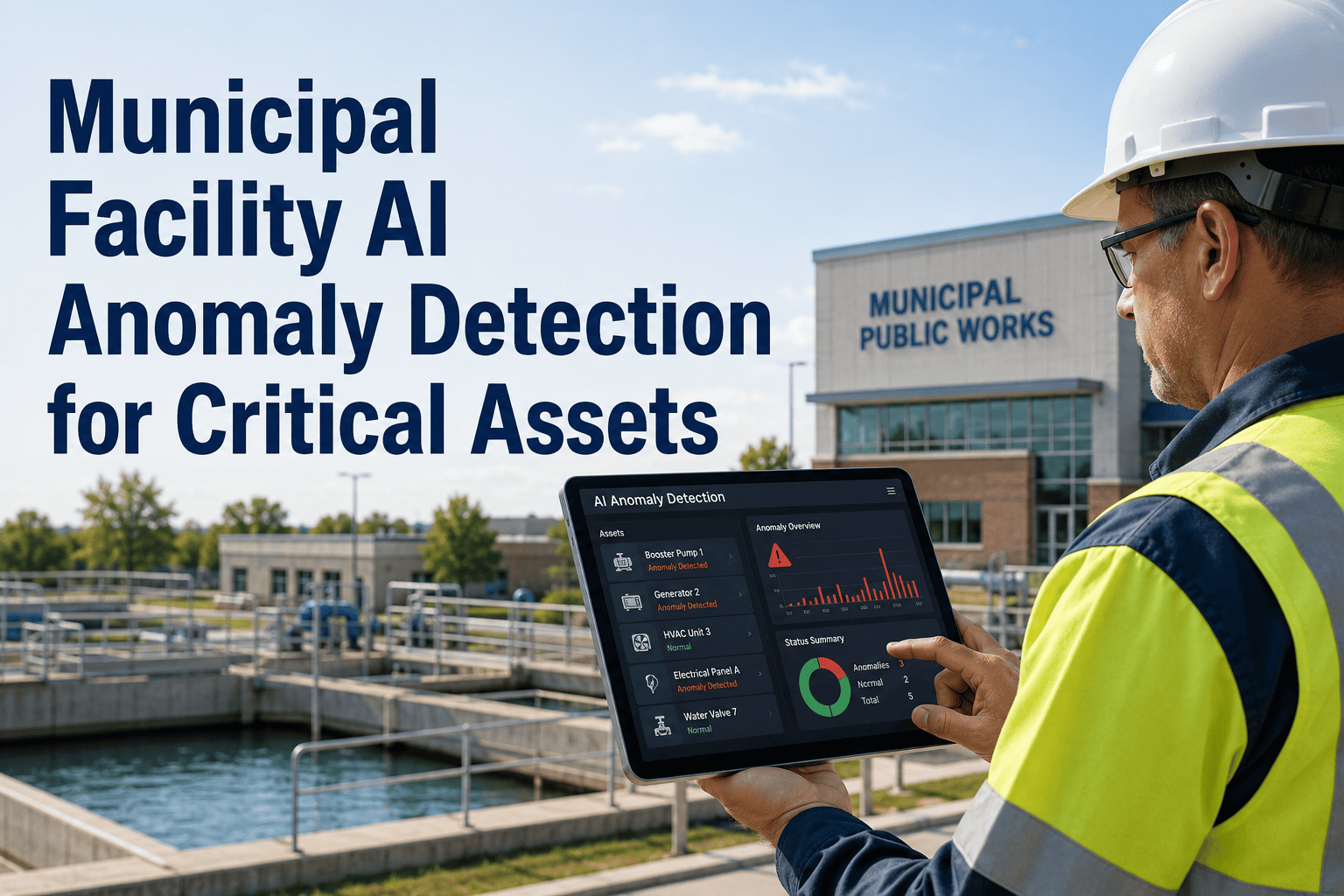
A water pump fails at 2 AM on a Tuesday. By the time the morning crew discovers it, a municipal well has been offline for six hours, pressure in three neighborhoods has dropped, and an emergency contractor is already being called. The pump showed elevated current draw for eleven days before it failed — but no one was watching. AI anomaly detection for municipal assets solves exactly this problem: continuous monitoring of critical infrastructure signals so deviations are caught weeks before they become outages that affect residents. Start your free trial and configure AI-powered anomaly detection for your public assets in OxMaint.
11 days
Average warning window available before asset failure — detected only by continuous monitoring
62%
Of critical municipal asset failures preceded by measurable anomalies that went undetected without AI
$180K
Average emergency repair and service disruption cost for a single unplanned pump or HVAC failure in a public facility
What AI Anomaly Detection Actually Does in a Municipal Context
AI anomaly detection is not a dashboard that shows you what already broke. It is a continuous pattern recognition system that learns what "normal" looks like for each asset — motor current, vibration frequency, pressure differential, temperature gradient — and alerts operations staff the moment a reading begins deviating from that learned baseline. In municipal facilities, this capability matters most on assets where failure has direct public impact: water systems, wastewater lift stations, HVAC in public buildings, traffic signal power systems, and emergency backup generators.
Water
Water Pumping Stations
MonitoredMotor current, flow rate, discharge pressure, bearing temp
AnomalyCurrent draw rising 8% above rolling baseline — early impeller wear
Lead Time7 to 21 days before failure
Wastewater
Lift Station Pumps
MonitoredRun cycles per hour, wet well level deviation, amp draw trend
AnomalyCycle frequency doubling without corresponding inflow increase — seal leakage or check valve failure
Lead Time5 to 14 days before overflow risk
HVAC
Public Building HVAC Units
MonitoredSupply air temp delta, compressor runtime ratio, return air humidity
AnomalyCompressor runtime exceeding 85% duty cycle for 3 consecutive days — refrigerant loss or coil fouling
Lead Time10 to 30 days before failure
Power
Emergency Generators
MonitoredFuel consumption per test run, coolant temp, output voltage stability
AnomalyFuel consumption increasing 15% per test cycle — injector fouling or governor drift
Lead Time4 to 8 weeks of detectable trend
How OxMaint AI Anomaly Detection Works — Step by Step
1
Asset Baseline Learning
OxMaint ingests 30 to 90 days of operational data for each critical asset — from sensors, SCADA feeds, manual meter reads, or maintenance logs. The AI builds a normal operating profile: expected ranges, seasonal variation, load-dependent behavior. This baseline is asset-specific, not a generic threshold.
2
Continuous Deviation Scoring
Every new reading is scored against the learned baseline. A single high reading may be noise. A persistent directional trend — even within specification limits — scores as an anomaly. OxMaint detects gradual drift that would never trigger a threshold alarm but reliably precedes failure.
3
Anomaly Alert with Context
Alerts reach the maintenance team with the specific signal, the deviation magnitude, the affected asset, and a recommended action — not just a notification that something looks different. The operations supervisor receives an alert with enough information to make a dispatch decision without additional investigation.
4
Automatic Work Order Generation
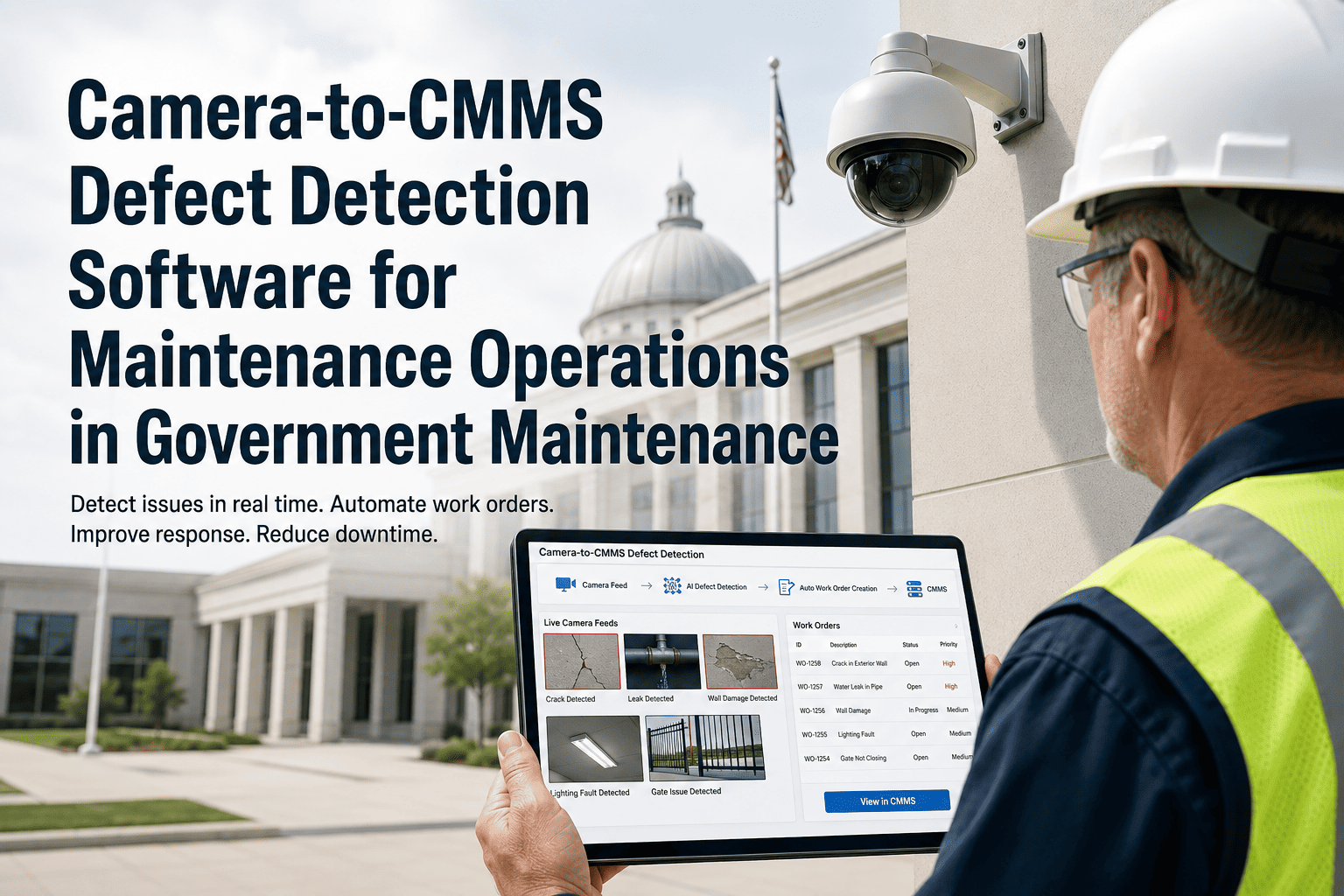
Confirmed anomalies generate a CMMS work order with the asset ID, anomaly description, priority level, and detection timestamp pre-populated. The work order enters the maintenance queue immediately — no manual transcription, no delay between detection and dispatch.
5
Closed-Loop Learning
When the technician closes the work order with a root cause, OxMaint feeds that outcome back into the model. A confirmed bearing failure traced to the vibration anomaly strengthens the detection pattern for similar assets across all municipal facilities in the account.
Anomaly Detection vs Threshold Alarms — The Critical Difference
| Capability |
Threshold Alarms (Traditional) |
AI Anomaly Detection (OxMaint) |
| Detects gradual drift before spec breach |
No — alarms only on limit exceedance |
Yes — pattern deviation triggers alert |
| Adapts to seasonal variation |
No — static thresholds year-round |
Yes — baseline adjusts to operating context |
| Provides lead time before failure |
Hours — threshold hit is near-failure |
Days to weeks — early pattern detection |
| Creates work order automatically |
Manual — operator must respond and create |
Automatic — WO in queue within minutes |
| Learns from repair outcomes |
No — static rule set |
Yes — closed-loop model improvement |
Built for Public Sector Operations
Protect Critical Municipal Assets Before Residents Notice a Problem
OxMaint AI monitors water systems, lift stations, HVAC, and generators continuously — detecting anomalies weeks before failures occur and automatically generating work orders for your maintenance team.
Expert Review
MV
Marcus Vega
Public Works Infrastructure Director — 25 years in municipal utilities and facility operations
The argument for AI anomaly detection in municipal operations is straightforward: our maintenance crews cannot watch every pump, every HVAC unit, and every generator continuously. A threshold alarm tells you the house is already on fire. Anomaly detection tells you the smoke detector battery is getting low three weeks before there's any smoke. For public agencies operating under tight budgets with aging infrastructure, the ROI is not theoretical — it is the emergency call that did not happen, the contractor who was not called at 2 AM, the residents who did not notice anything was wrong because the problem was solved before it became one.
Frequently Asked Questions
What data sources does OxMaint use for anomaly detection in municipal facilities?
OxMaint ingests data from multiple sources: IoT sensor feeds and SCADA system exports via API, manual meter readings and inspection records entered by technicians, and historical work order data that provides context on past failure patterns. The system does not require full sensor coverage to function — even facilities with partial automation can begin anomaly detection using a hybrid of sensor data and structured manual inputs. Implementation is phased to match each facility's existing data infrastructure.
Start your free trial and connect your existing data sources to OxMaint's anomaly detection engine.
How long does it take for the AI to learn a municipal asset's baseline behavior?
Initial baseline learning requires 30 to 90 days of operational data depending on the asset type and the variability of its operating environment. Assets with strong seasonal patterns — HVAC systems, outdoor water infrastructure — benefit from 90 days to capture the variation. Assets with stable operating conditions, like indoor lift stations or generators on fixed test schedules, establish reliable baselines within 30 days. Existing historical data can be imported to shorten this period significantly. OxMaint flags when a baseline is considered statistically sufficient before shifting the asset to active anomaly monitoring.
Book a demo to see baseline configuration for your specific asset types.
How does OxMaint handle false positives — anomaly alerts that turn out to be nothing?
False positive management is built into the feedback loop. When a technician inspects an asset in response to an anomaly alert and finds no issue, that outcome is recorded in the work order closure and fed back to the model. The system uses this data to adjust its sensitivity thresholds for that specific asset — reducing recurrence of false positives over time without manual tuning. Typical facilities see false positive rates drop by 60 to 70 percent within 90 days of active use as the model adapts to asset-specific normal variation patterns.
Does AI anomaly detection replace scheduled preventive maintenance for municipal assets?
No — anomaly detection and preventive maintenance work together, not as alternatives. PM schedules address time-based degradation that accumulates regardless of condition signals: lubrication, filter replacement, belt inspection, and regulatory test requirements. Anomaly detection adds condition-based insight between PM intervals, catching failures that PM schedules cannot predict because they result from random events, contamination, or accelerated wear under unusual operating conditions. OxMaint manages both PM schedules and condition-based anomaly workflows in the same system.
Configure both PM and anomaly detection for your municipal assets in OxMaint.
OxMaint AI — Public Sector Operations
Stop Discovering Failures After Residents Call to Complain
Continuous anomaly monitoring for water systems, wastewater, HVAC, and emergency power. Automatic work orders. Compliance-ready records. Built for public works teams managing critical infrastructure on tight budgets.