When a residential street goes dark, accident risks multiply for pedestrians and drivers alike. When an intersection light fails, liability exposure skyrockets with every passing vehicle. When business districts lose illumination, crime rates often see a correlative spike. Yet many public works departments rely on citizen complaints to identify outages—leaving dangerous dark spots unaddressed for days or weeks until a resident calls in.
This guide provides municipal lighting crews and public works directors with a comprehensive troubleshooting checklist for street light outages, covering electrical diagnostics, component verification, and safety protocols that restore illumination quickly. Departments ready to modernize their lighting management can start building their smart street lighting system today.
Street lights are more than urban furniture; they are active public safety instruments. Treating lighting maintenance with the same urgency as pothole repair or signal outages is essential for modern municipal management.
Impact of Street Lighting Failures
Traffic & Pedestrian Safety
Critical Zone: Intersections, crosswalks, school zones, sharp curves
Risk Factor: 3x higher fatality rates for pedestrians in unlit zones at night
Failure Impact: Increased vehicle collisions, pedestrian strikes, municipal liability lawsuits
Urgency: Immediate repair required (Category 1 priority)
Crime Deterrence
Critical Zone: Parking lots, alleyways, business districts, parks
Function: Natural surveillance and psychological deterrence
Failure Impact: Increased vandalism, theft, and assault reports in darkened areas
Urgency: High priority repair (24-48 hour target)
Community Quality of Life
Critical Zone: Residential subdivisions, walking paths, downtown promenades
Function: Wayfinding, neighborhood aesthetics, resident comfort
Failure Impact: High volume of citizen complaints, reduced property values
Urgency: Standard maintenance cycle (3-5 day target)
Don't leave your citizens in the dark. Implement systematic outage tracking and predictive maintenance to resolve lighting failures before residents even notice.
Systematic troubleshooting prevents repeat visits ("callbacks") by ensuring the root cause is fixed, not just the symptom. This checklist guides crews through the electrical path from the pole base to the luminaire.
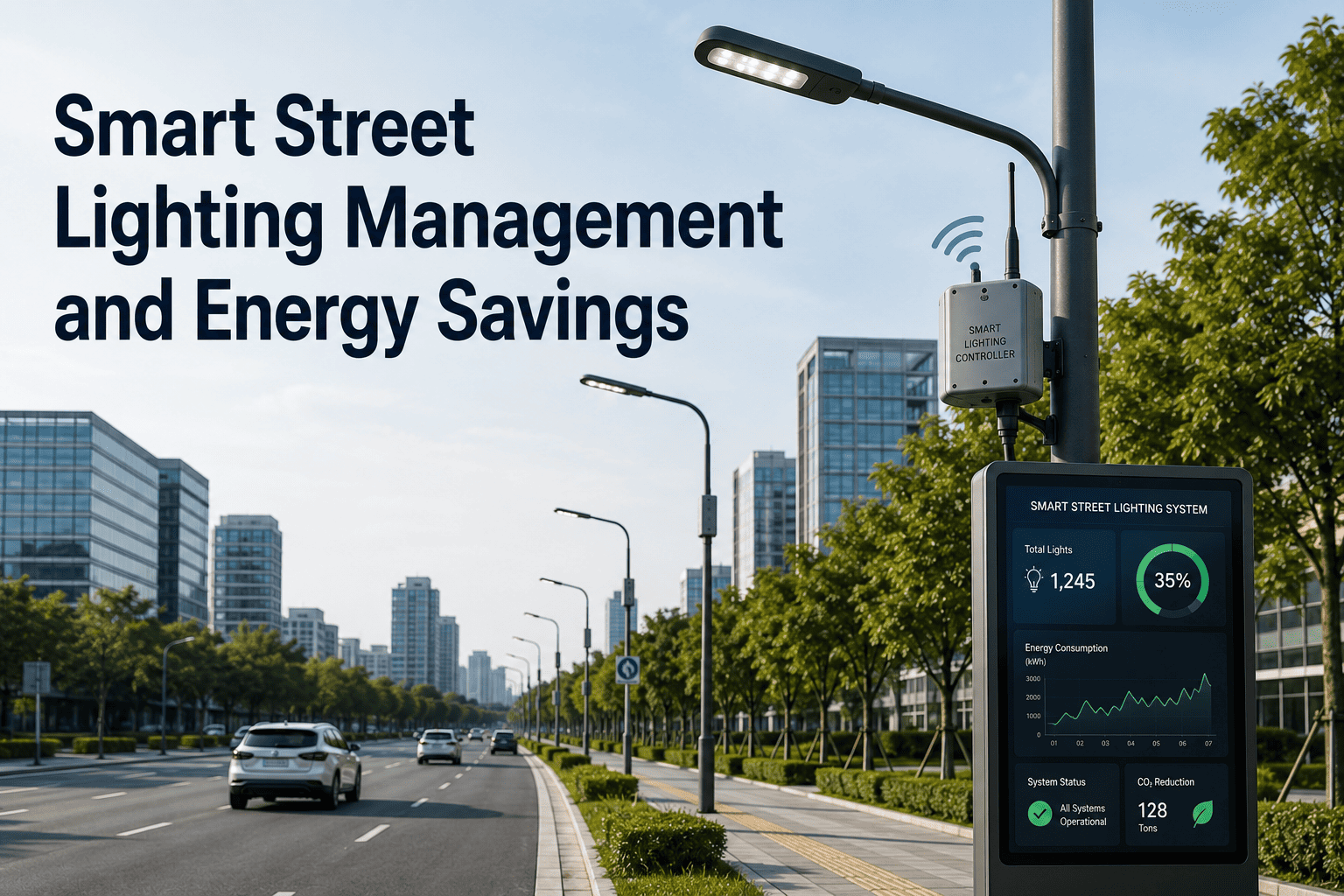
Modern LED conversions with smart controllers allow municipalities to move from "fix it when they call" to "fix it before it fails." IoT nodes on street lights provide real-time telemetry that predicts outages.
Smart Lighting Telemetry & Alerts
1
Day-Burner Detection
Smart nodes detect current draw during daylight hours, instantly flagging "day burners" (lights stuck on). This saves electricity and prevents premature lamp burnout, eliminating the need for daytime patrols to find them.
ROI: Reduces energy waste by 12 hours/day per fault; eliminates manual scouting
2
Driver Health Monitoring
Continuous monitoring of LED driver temperature and output voltage. AI algorithms analyze fluctuations to predict driver failure weeks in advance, allowing crews to replace components during scheduled routes rather than emergency callouts.
ROI: Consolidates truck rolls; prevents dark streets in critical areas
3
Impact/Tilt Detection
Accelerometers inside the smart node detect sudden impacts (car hitting pole) or dangerous leaning (storm damage). The system triggers an immediate high-priority safety alert for structural inspection before the pole falls.
ROI: Mitigates catastrophic liability from falling poles; speeds up accident response
4
Power Quality Analysis
Monitoring for voltage spikes, sags, or dirty power at the fixture level. Identifying unstable grid power helps public works coordinate with utilities to fix upstream issues that would otherwise repeatedly destroy expensive LED fixtures.
ROI: Protects warranty validity; prevents repeated component destruction
Automated Outage Resolution Workflow
1
Smart node detects 0mA current draw during night hours (Lamp Out)
→
2
System auto-creates work order with GPS location, pole ID, and likely part needed
→
3
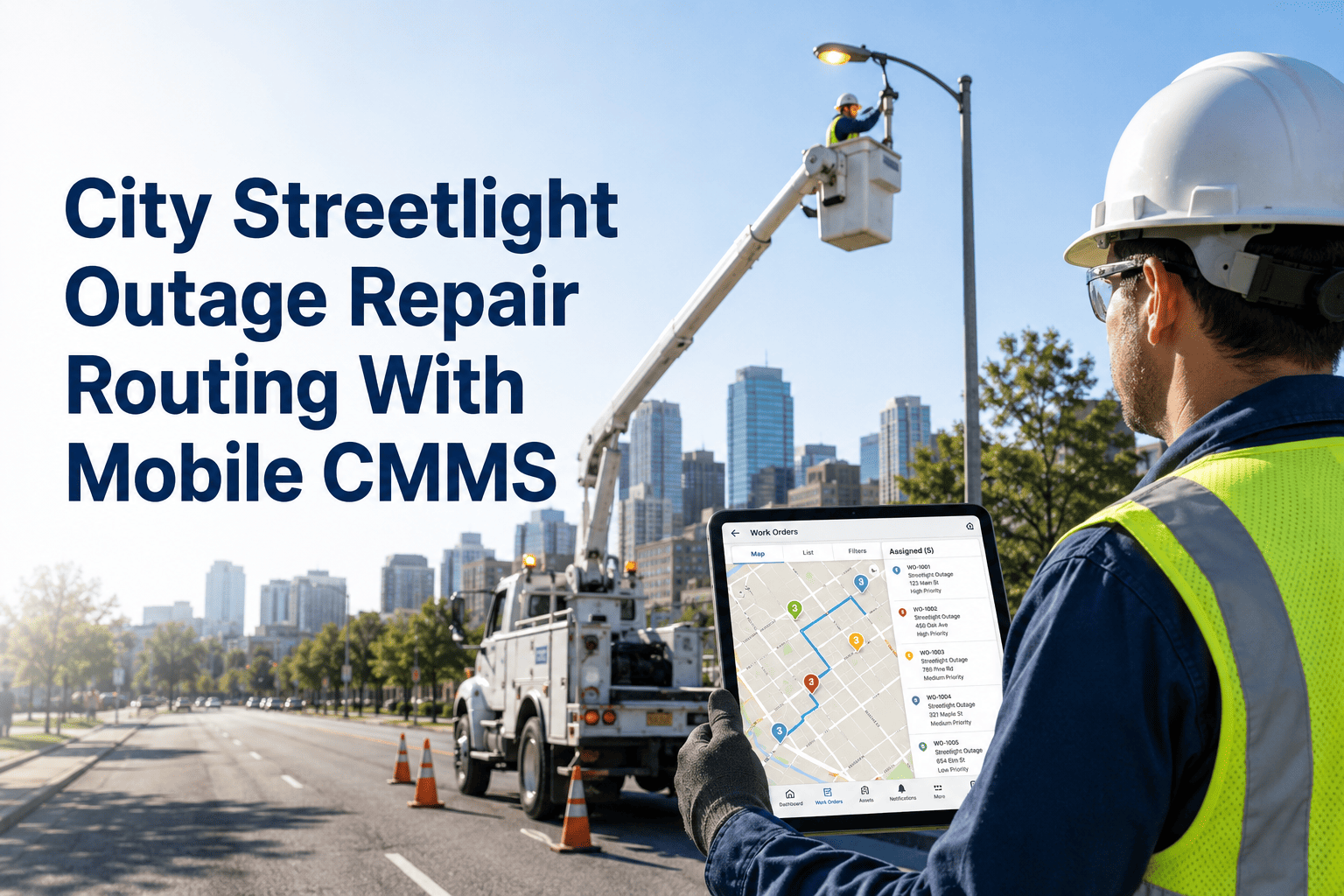
Task assigned to nearest technician's mobile device based on zone optimization
→
4
Tech arrives, scans QR code, confirms repair, and closes ticket via app
→
5
System runs auto-test tonight to verify fix before marking "Resolved"
See smart lighting management in action. Book a demo showing how integrating IoT nodes with CMMS automates your entire street light maintenance workflow.
Book Custom Demo →
Standardization ensures safety and efficiency. These SOPs guide crews through routine patrols, emergency responses, and mass deployment projects to ensure consistent quality across the grid.
✓ Define patrol zones to ensure 100% city coverage every 30-60 days
✓ Use mobile GIS app to mark outages in real-time while passenger spots
✓ Categorize outages: Simple (Lamp/Photo), Complex (Cable/Power), Emergency (Leaning)
✓ Identify "cycling" lights (HPS turning on/off) indicating end-of-life lamps
✓ Note vegetation blocking light distribution for trimming crews
✓ Verify section/cabinet lighting (entire street out indicates fuse/breaker issue)
✓ Sync patrol data to CMMS for morning dispatch routing
✓ Respond within 2 hours of report (Police/Fire/Citizen priority)
✓ Secure site immediately: de-energize circuit at nearest disconnect/fuse
✓ Verify absence of voltage on exposed metal/wires before touching
✓ Remove pole debris from roadway; cap and tape wires effectively
✓ Install "Danger" flagging or temporary cover over base if foundation remains
✓ Document damage with photos for insurance recovery (driver liability)
✓ Verify wattage/lumen package matches roadway class (don't over/under light)
✓ Update asset data: scan new fixture QR, record install date for warranty
✓ Ensure NEMA socket is oriented North (for photocell accuracy)
✓ Apply dielectric grease to connections to prevent future corrosion
✓ Test dimming functionality if smart controller is installed
✓ Recycle old HPS/Mercury Vapor lamps according to HazMat protocols
Illuminating Efficiency with Smart Asset Management
Oxmaint CMMS integrates GIS, mobile work orders, and IoT data to streamline street lighting operations, reducing response times and energy costs.
Trusted by public works departments managing thousands of roadway assets
Street lighting is heavily regulated to ensure public safety and worker protection. Maintenance documentation must prove adherence to national electrical codes and local illumination ordinances.
Grounding requirements for metal poles
Clearance heights over roadways/sidewalks
Worker approach distances to live parts
Structural strength guidelines for wind loading
Automated: Inspection forms include NESC specific checkpoints to ensure field compliance
Minimum lux/foot-candle levels per road type
Uniformity ratios (preventing "zebra striping")
Glare control requirements
Color temperature (CCT) consistency
Automated: Asset records store lumen data to verify road classes meet IES RP-8-18 standards
Timestamped repair logs for liability defense
GASB 34 asset valuation tracking
Warranty tracking for LED fixtures
Accident/Knockdown cost recovery records
Automated: Complete digital paper trail protects municipality against "failure to maintain" lawsuits
Up-light shielding compliance
Blue light spectrum limitations
Adaptive dimming schedules
Hazardous bulb disposal manifests
Automated: Smart schedules programmed centrally; disposal logs attached to work orders
→ Import existing GIS data (pole locations) into CMMS
→ Conduct field audit to verify pole IDs, fixture types (LED vs HPS), and conditions
→ Set up QR code tagging system for instant field scanning
→ Create digital "Lamp Out" reporting portal for residents
→ Define critical zones (intersections, school zones) for priority logic
Milestone: 100% accurate digital twin of lighting grid; citizen reporting active
→ Deploy mobile app to crews for paperless work orders
→ Install smart controllers on 50-100 test fixtures in problematic areas
→ Configure automated "Day Burner" and "Outage" alerts
→ Standardize repair codes (e.g., "Replace Photocell", "Reset Breaker") for analytics
→ Train staff on safety SOPs and data entry standards
Milestone: Crews using tablets; first smart alerts detecting outages automatically
→ Analyze "Bad Actor" report to identify poles with frequent failures
→ Integrate inventory management (auto-reorder bulbs/photocells)
→ Establish preventative cleaning/tightening schedules for older circuits
→ Present "Uptime" and "Response Time" reports to City Council
→ Plan full-scale smart node rollout based on pilot ROI
Milestone: Data-driven maintenance strategy; reduced backlog; improved public satisfaction
A reactive approach to street lighting—waiting for the phone to ring—is no longer sustainable or safe. The modern standard demands a proactive stance where outages are detected by sensors or identified through systematic patrols before they endanger the public. A well-maintained lighting grid reduces crime, prevents accidents, and enhances the nighttime economy.
By implementing digital checklists, mobile workflows, and predictive asset management, municipalities can drastically reduce the "Mean Time to Repair" (MTTR). Crews stop chasing vague complaints and start executing targeted repairs with the right parts in hand. Documentation shifts from messy paper logs to defensible digital records that prove diligence in the face of liability claims.
The technology to illuminate your city efficiently exists today. Whether managing 500 decorative lamps or 50,000 cobra heads, the path to reliability starts with better data and better processes. For a personalized assessment of your street lighting maintenance strategy, request a consultation with our public works asset specialists.
What causes a street light to cycle on and off (blink)?
Cycling is most commonly caused by an HPS (High Pressure Sodium) lamp reaching the end of its life. As the lamp ages, it requires higher voltage to maintain the arc. The ballast provides this voltage, but eventually, the lamp overheats, resistance rises, and the arc extinguishes. After cooling down (1-2 minutes), it re-strikes, repeating the cycle. This indicates the lamp needs immediate replacement. In LED fixtures, blinking usually indicates a failing driver or an incompatible photocell, not the LED chips themselves.
Why are "day burners" (lights on during the day) a problem?
Lights that stay on during the day ("day burners") are typically caused by a failed photocell that has failed in the "closed" (on) position—a fail-safe design feature. While safer than failing "off" at night, day burners double energy costs for that fixture and cut the lamp's remaining lifespan in half. For a standard LED fixture, a day burner wastes approximately $30-50 per year in electricity. Identifying and fixing them quickly is a "low hanging fruit" for municipal cost savings.
How does a CMMS improve liability defense for slip/trip or accident claims?
When accidents occur at night, plaintiffs often claim "inadequate lighting" contributed to the event. A paper-based system often lacks proof that the city knew about or fixed an outage. A CMMS provides an immutable digital audit trail: exactly when the outage was reported, when the crew arrived (GPS stamped), what work was performed, and the exact time the light was verified functional. This data proves the municipality exercised "reasonable care" and responded within standard timeframes, often leading to the dismissal of negligence claims.
Should we replace photocells every time we change a lamp?
Best practice suggests replacing the photocell during any lamp replacement or major repair. Photocells use chemical sensors that degrade over time (drifting caused by UV exposure), leading to late turn-ons or day-burning. Since the cost of a standard photocell ($5-10) is negligible compared to the cost of rolling a truck and crew ($150-300), preventative replacement avoids a second trip just to change a sensor a few months later.
What is the difference between NESC and NEC compliance for street lights?
The NEC (National Electrical Code) generally covers wiring *inside* buildings and on private property. Street lighting on public right-of-way typically falls under the NESC (National Electrical Safety Code), which focuses on utility-grade safety, clearances, and strength requirements. However, the service point (where the utility feed connects to the municipal meter/cabinet) often bridges both. Crews must be trained specifically on NESC standards, particularly regarding approach distances and grounding for metal poles, which differ from standard indoor electrical work.