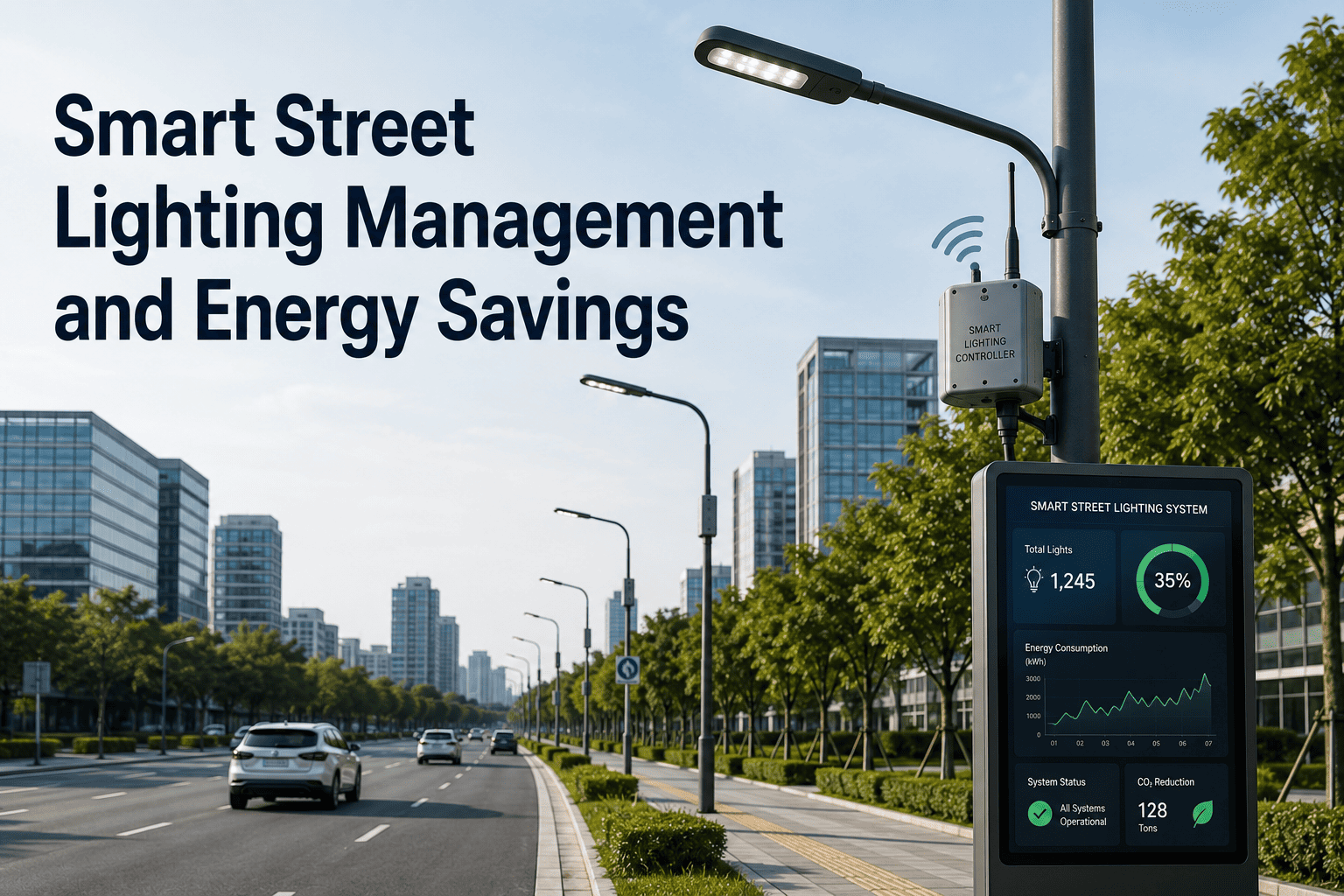
A resident calls 311 to report a dark intersection for the third time in two months. The public works crew dispatches a bucket truck, only to discover the same HPS fixture they "repaired" last month has failed again—because the ballast was deteriorating, not the bulb. Meanwhile, the city's energy bill shows $1.8M annually for 22,000 streetlights, 40% of which are outdated high-pressure sodium fixtures burning twice the wattage of modern LEDs for half the light output.
This "replace the bulb and move on" approach drains municipal budgets silently but significantly. Between wasted energy on obsolete fixtures, repeated truck rolls for recurring failures, and liability exposure from dark corridors, poor street lighting management costs the average mid-sized city $400,000-$800,000 annually in preventable expenses. For public works directors tasked with doing more with less, every dark pole isn't just a complaint—it's a safety hazard and a budget leak waiting to be fixed.
This guide provides a structured workflow for municipal street lighting maintenance, integrating LED retrofit planning, digital outage management, energy monitoring, and citizen report tracking into a seamless program. Agencies ready to stop wasting energy and money can start modernizing their lighting operations today.
Street lighting maintenance isn't just about replacing burned-out bulbs; it's about energy optimization, public safety, and infrastructure modernization. A reactive "wait for complaints" model represents hundreds of thousands in wasted energy and preventable truck rolls.
Wasted Energy Costs
Outdated HPS and metal halide fixtures consuming 150-400W versus 50-150W LED equivalents with better light output
40-60% energy overspend
Repeated Truck Rolls
Dispatching $350+ bucket truck crews for recurring failures instead of addressing root causes through predictive replacement
$150K-$300K annual waste
Public Safety Liability
Dark intersections and corridors correlating with increased pedestrian accidents, vehicle collisions, and crime rates
$50K+ per liability claim
Citizen Satisfaction Erosion
Repeated 311 complaints about the same dark streets destroying public trust in municipal services
#1 citizen complaint category
Stop burning budget on outdated lighting. Oxmaint's lighting management workflow tracks every fixture from outage report to LED retrofit, ensuring you capture every energy dollar saved.
Not all lighting assets are managed the same way. Municipal teams need to categorize fixtures, controls, and infrastructure to prioritize retrofits, schedule maintenance, and maximize energy savings. A digital workflow segments these streams automatically.
High-Pressure Sodium (HPS) fixtures 150W+
Metal Halide decorative & area lights
Mercury Vapor fixtures (phase-out mandated)
Fluorescent parking structure lighting
Action: Inventory all non-LED fixtures, calculate ROI per fixture type, prioritize highest-wattage replacements first.
Energy Savings: 40-70% per retrofitted fixture
Photocell controllers (dusk-to-dawn)
Smart dimming nodes & wireless controllers
Motion/occupancy sensors for pathways
Central management system (CMS) gateways
Action: Deploy smart nodes on new LED installations, configure dimming schedules, monitor outage alerts remotely.
Additional Savings: 15-30% beyond LED retrofit alone
Wooden poles (rot, lean, woodpecker damage)
Steel/aluminum poles (corrosion, base rust)
Underground wiring & junction boxes
Foundations & anchor bolts
Action: Inspect poles on 5-year cycle, prioritize replacements by structural rating, log lean measurements.
Risk: Pole failures cause fatalities & major liability
Service panels & circuit breakers
Underground conduit & pull boxes
Metering equipment & connections
Fuse holders & contactors
Action: Thermal scan panels annually, track circuit-level outage patterns, upgrade aging conductors.
Value: Prevents cascading multi-pole outages
The difference between a dark street and a safe community is process. Implementing a digital "Report, Diagnose & Resolve" system ensures every outage—whether citizen-reported or sensor-detected—has a defined resolution pathway and documented outcome.
Street Lighting Outage Resolution Workflow
1
Outage Detection
Smart sensor auto-detects failure OR citizen submits 311 report. CMMS creates geolocated work order.
→
2
Root Cause Diagnosis
System checks fixture history: repeat failure? Ballast age? Circuit-level outage pattern? Flags for retrofit vs. repair.
→
3
Batched Dispatch
Non-critical outages batched by geographic zone. Crew receives optimized route with parts list per pole.
→
4
Resolve & Document
Crew repairs/retrofits, scans pole QR code, uploads photo. 311 reporter receives auto-notification of resolution.
Ready to automate your outage management? See how Oxmaint's lighting module batches outages by zone, optimizes truck routes, and closes 311 tickets automatically.
Book a Personalized Demo →
Municipalities managing thousands of fixtures across arterials, residential streets, parks, and parking lots need a phased retrofit strategy. A centralized digital workflow ensures consistent ROI tracking, utility rebate capture, and warranty management city-wide.
Reactive Patching vs. Strategic LED Retrofit Program
| Common Issue |
Program Solution |
Fiscal Impact |
| One-off LED replacements at premium per-unit cost |
Bulk procurement by fixture type with volume pricing |
25-40% lower per-fixture cost |
| Utility rebates missed due to poor documentation |
CMMS auto-generates rebate applications with install data |
Recovers $50-$150 per fixture in rebates |
| LED warranty claims lost without install records |
Digital install date, serial #, and warranty expiry tracking |
10-year warranty protection preserved |
| No baseline energy data to prove savings |
Pre/post retrofit energy monitoring by circuit & meter |
Documented 40-60% energy reduction for council |
| Retrofit crews re-visiting poles for missing data |
Mobile checklist: photo, GPS, wattage, pole condition logged |
Eliminates $200+ per return visit |
Managing a municipal street lighting network involves regulatory obligations, utility coordination, and public accountability. Whether it's proving energy savings for grant compliance or documenting response times for citizen complaints, digital records are essential.
✓ Utility rebate documentation & submissions
✓ Energy Star / DLC qualification verification
✓ Carbon reduction reporting for climate goals
✓ Grant compliance energy savings verification
CMMS Solution: Pre/post wattage tracking, automated energy reports
✓ Outage response time documentation
✓ Pole structural inspection records
✓ Dark corridor/intersection priority tracking
✓ Accident location correlation analysis
CMMS Solution: Timestamped repair logs, GIS dark zone mapping
✓ Per-fixture retrofit cost tracking
✓ Energy savings ROI documentation
✓ Warranty claim & credit reconciliation
✓ Maintenance cost per pole trending
CMMS Solution: Automated ROI dashboards, council-ready reports
✓ 311 complaint-to-resolution tracking
✓ Repeat complaint identification
✓ Average response time reporting
✓ Automated citizen notification on resolution
CMMS Solution: 311 integration, auto-close notifications
Turn Dark Streets into Safe, Efficient Infrastructure
See how municipal lighting programs are using digital workflows to cut energy costs 40%, reduce truck rolls 50%, and eliminate repeat citizen complaints.
Stop paying premium energy rates for obsolete fixtures.
Municipal lighting programs implementing digital outage management and LED retrofit tracking report immediate financial returns and operational improvements:
40%
Energy Cost Reduction
Average savings from LED retrofit + smart controls
65%
Fewer Truck Rolls
Batched routing + root cause elimination
92%
311 Resolution Rate
First-time fix with digital diagnosis
3.2yr
LED Retrofit Payback
Average ROI period including utility rebates
Want to calculate your city's lighting savings potential? Get a customized energy ROI assessment for your street lighting retrofit and maintenance program.
→ Import existing fixture inventory into CMMS (pole #, fixture type, wattage, location)
→ Conduct field audit of fixture types, identifying all non-LED assets for retrofit prioritization
→ Deploy QR code tags on poles for instant field scanning and history access
→ Establish energy baseline by circuit/meter for pre-retrofit savings measurement
→ Configure 311 integration for automated outage work order creation
Milestone: 100% digital inventory; energy baseline established; 311 connected
→ Train crews on mobile outage response workflow with zone-batched routing
→ Launch pilot LED retrofit on highest-wattage arterial corridor (100-200 fixtures)
→ Configure utility rebate tracking and automated application generation
→ Implement repeat-failure detection flagging fixtures for retrofit vs. repair
→ Set up energy monitoring dashboard comparing pre/post retrofit consumption
Milestone: Crews using tablets; pilot retrofit documented with energy data
→ Analyze pilot energy savings and document ROI for city council presentation
→ Expand retrofit program to residential streets using pilot procurement pricing
→ Deploy smart lighting controls on high-traffic corridors for adaptive dimming
→ Generate first automated 311 response time and outage resolution report
→ Establish annual pole inspection cycle with structural rating scoring
Milestone: Proven energy savings; scaled retrofit program; council-ready ROI data
For municipalities, street lighting maintenance is the most visible indicator of government effectiveness—and the lowest-hanging fruit of energy savings. It requires no new tax revenue, no voter approval, and often pays for itself within 3-4 years through energy reduction alone. It simply requires a modern process replacing reactive bulb-swapping with strategic asset management.
Modern CMMS platforms provide the structure needed to make this shift effortless. Automated outage detection, zone-batched dispatch routing, LED retrofit tracking, and energy monitoring dashboards turn a chaotic complaint-driven operation into a data-driven lighting program. The result is safer streets, lower energy bills, fewer citizen complaints, and documented ROI that earns continued budget support.
Don't let another $350 truck roll replace a bulb that should have been an LED retrofit. Start building the lighting program your community deserves. For a personalized assessment of your street lighting strategy, request a consultation from specialists who understand municipal lighting operations.
What is the typical ROI payback period for municipal LED street light retrofits?
Most municipalities achieve full payback within 2.5-4 years depending on existing fixture wattage, utility rates, and available rebates. A city replacing 250W HPS fixtures with 100W LEDs at $0.10/kWh saves approximately $66 per fixture annually in energy alone. With utility rebates covering 30-50% of fixture cost, payback accelerates to under 3 years. Smart dimming controls can reduce payback further by adding 15-30% additional savings beyond the LED conversion itself.
How does a CMMS help manage citizen lighting complaints?
The CMMS integrates directly with 311/CRM systems to automatically create geolocated work orders from citizen reports. It de-duplicates complaints (multiple residents reporting the same dark pole), identifies repeat failures on the same fixture flagging it for replacement rather than repair, and sends automated resolution notifications to complainants when repairs are completed. Managers get dashboards showing average response times, geographic hotspots, and first-time-fix rates.
Should we retrofit all fixtures at once or use a phased approach?
A phased approach is recommended for most municipalities. Start with the highest-wattage fixtures (250W+ HPS on arterials) for maximum immediate energy savings and fastest ROI. Phase two targets medium-wattage residential fixtures. Phase three addresses decorative and specialty lighting. This approach spreads capital expenditure across budget cycles, allows crews to refine installation processes, and generates early energy savings that can partially fund subsequent phases.
How do smart lighting controls add value beyond LED conversion?
Smart controls (wireless nodes on each fixture) enable remote on/off switching, scheduled dimming (reducing output 30-50% during low-traffic hours), automatic outage detection without citizen reports, and energy metering per fixture. They add 15-30% energy savings on top of the LED conversion. More importantly for operations, they eliminate the need for nighttime patrol drives to find outages—the system alerts you immediately when any fixture fails, with exact pole location.
How do we capture utility rebates during the retrofit program?
Most utilities offer prescriptive rebates of $50-$200 per fixture for qualifying LED conversions. The CMMS tracks every installation with the data utilities require: old fixture wattage, new fixture wattage, DLC qualification number, installation date, and installer certification. This data auto-populates rebate applications, ensuring no rebate is missed. For a 5,000-fixture retrofit, captured rebates can total $250,000-$1,000,000—often the difference between a project that needs financing and one that fits within existing capital budgets.