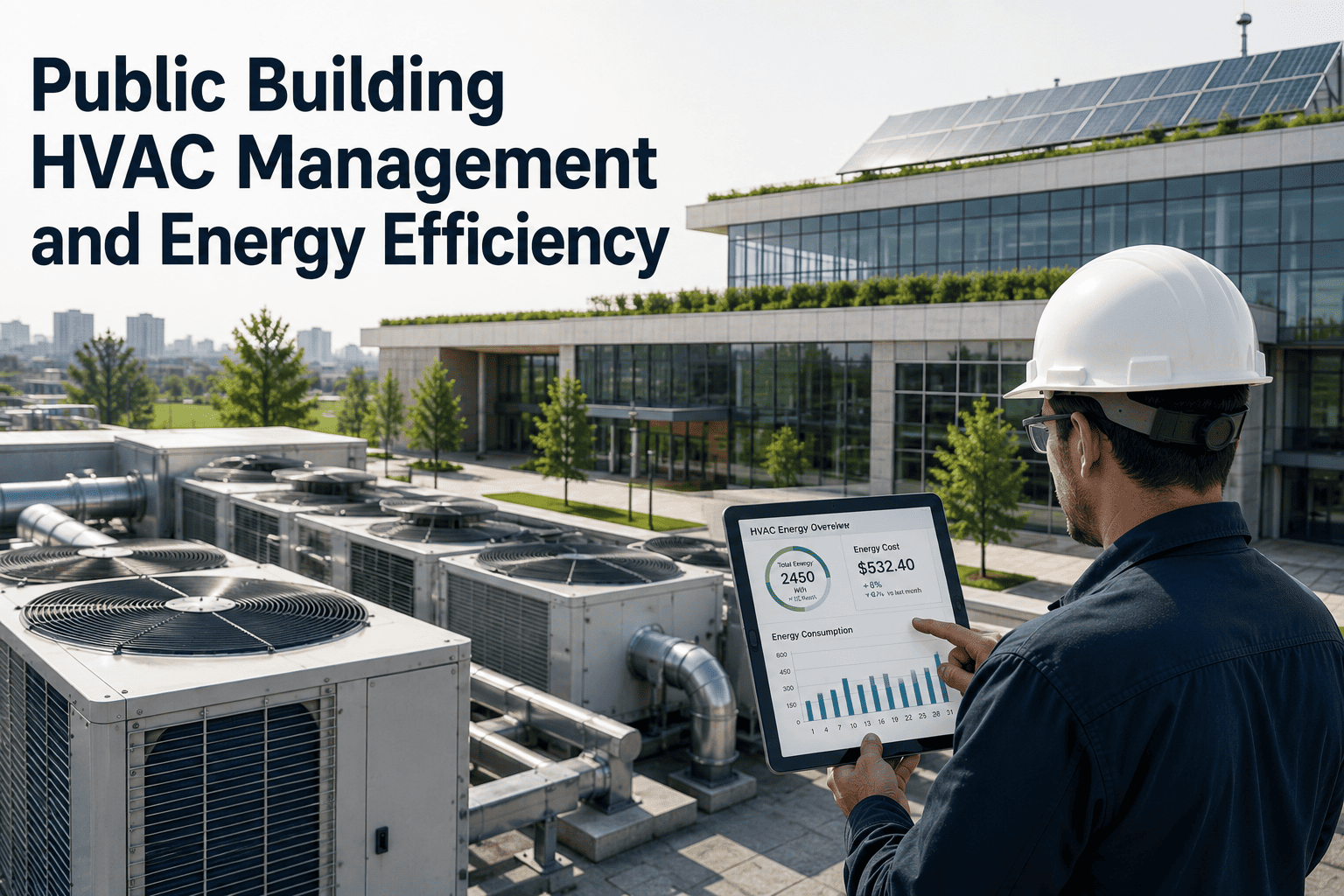
For public building facility managers, HVAC systems aren't just about comfort—they're the critical infrastructure that enables schools, libraries, courthouses, and community centers to serve their communities effectively. But beneath those quiet air handlers lies a configuration complexity that can account for 40-60% of your building's total energy costs. Between chillers cycling inefficiently, air handlers running at fixed speeds regardless of occupancy, and scheduling systems operating on decades-old assumptions, mechanical systems represent both your greatest operational challenge and your largest untapped efficiency opportunity. The public sector reality—buildings typically spanning 20,000 to 200,000 square feet with limited maintenance budgets—means you can't afford the energy waste that comes from misconfigured systems, nor the comfort complaints that derail public meetings and disrupt essential services.
The 2024 ASHRAE Standard 90.1 updates have added new requirements including demand-controlled ventilation for spaces over 500 square feet and economizer integration for systems above 54,000 BTU/h, with enhanced commissioning requirements that didn't exist in previous editions. For public building teams without dedicated controls engineers, maintaining compliance while optimizing energy costs requires a smarter approach than annual service contracts and reactive troubleshooting. The convergence of building automation systems, AI-powered analytics, and digital maintenance platforms has created an opportunity to transform HVAC configurations from a mysterious black box into a transparent, optimized system—facilities using smart configuration management resolve comfort complaints 68% faster while reducing energy consumption by up to 25%.
Modernize public building HVAC response using AI + IoT data
Traditional HVAC configuration operates on fixed parameters—setpoints programmed during commissioning, schedules based on assumed occupancy, and control sequences that haven't been optimized since installation. This approach ignores the dynamic reality of public building operations: meeting room usage varies dramatically between days, weather affects heating and cooling loads in real-time, and equipment performance degrades gradually until sudden failure. IoT sensors and building automation systems transform this static approach into precision management by continuously monitoring zone temperatures, equipment status, energy consumption, and occupancy patterns—sending data to analytics platforms where AI algorithms identify optimization opportunities, predict maintenance needs, and recommend configuration changes in real time.
The intelligence layer transforms raw sensor data into actionable configuration decisions. When discharge air temperature drifts from optimal setpoint, the system doesn't just alert—it diagnoses whether the cause is damper position, coil fouling, or control valve issue, then generates a prioritized work order with the specific corrective action. When energy consumption spikes unexpectedly, the system correlates with weather data, occupancy patterns, and equipment status to determine whether it's appropriate response or a configuration fault requiring attention. This predictive capability allows public building teams to address issues before occupants notice anything wrong. Facilities implementing smart configuration management report resolving comfort complaints 68% faster than those relying on traditional methods, while reducing energy consumption by 25%. Operators ready to transform their HVAC operations can explore digital maintenance platforms designed for public facility environments.
The Variable Speed Revolution: Cutting Fan and Pump Costs by 40-60%
Air handlers and pumps are among the largest energy consumers in public building HVAC systems, and the physics of fan and pump efficiency creates an extraordinary savings opportunity. The Affinity Laws state that reducing motor speed by 50% reduces energy consumption by 87.5%—not 50%, but nearly 90%. This means a variable frequency drive (VFD) controlled fan running at half speed uses one-eighth the electricity of a constant-volume fan moving the same average airflow. Since ASHRAE 90.1-2019, most new HVAC systems require variable speed technology, but many existing public buildings still operate legacy constant-volume equipment consuming 2-4 times more electricity than necessary.
Beyond fan systems, chiller and boiler configurations represent the second-largest optimization opportunity. Proper chiller staging, condenser water reset, and chilled water supply temperature optimization can improve chiller plant efficiency by 15-30%. Combined with optimal start/stop algorithms that pre-condition buildings using thermal mass—rather than oversized equipment fighting to achieve setpoint—public facilities can dramatically reduce their HVAC energy footprint while maintaining occupant comfort throughout operating hours.
Operationalizing configuration management — a public building operating model
The challenge for public building HVAC teams isn't just collecting data—it's translating insights into consistent action when you have limited staff covering multiple buildings. A CMMS platform transforms building automation alerts into structured work orders with clear ownership, priority levels, and completion tracking. When a zone temperature sensor triggers a deviation alarm, the system doesn't send an email that gets buried—it creates a work order assigned to the responsible technician, includes the sequence of operations documentation, sets a completion deadline, and escalates to the facilities director if not addressed within the SLA window.
The operating model integrates seamlessly with contractor management. When seasonal changeover comes due, the system automatically generates a work order with the specific procedures required, schedules the task for the appropriate time period, and notifies the HVAC service contractor. Upon completion, the contractor uploads commissioning data and signs off digitally, creating an audit trail that satisfies energy code inspectors without manual recordkeeping. This level of automation allows public building teams to maintain institutional-grade HVAC operations across multiple facilities with limited internal resources. Those looking to streamline contractor coordination can connect with public facility implementation specialists to design custom workflows.
Expert Review: The Economics of Smart HVAC Configuration
We thought our HVAC systems were well-configured because we had a BAS and annual service contracts. Then we implemented systematic configuration tracking and discovered our economizers hadn't worked properly in three years, our schedules didn't match actual building use, and our reset sequences were defeating each other. Within eight months, the energy savings alone justified the entire program—and we've cut comfort complaints by more than half.
The compliance dimension adds another layer of value. ASHRAE 90.1-2022 now requires automatic fault detection and diagnostics (AFDD) for certain system types, and enhanced commissioning documentation for buildings over 25,000 square feet. Digital configuration logs provide the documentation trail that code officials and auditors expect, while automated alerts ensure configuration drift is caught before it creates efficiency losses or comfort problems. Public building teams that have experienced the stress of energy audits particularly appreciate the confidence that comes from always-current configuration records. Those seeking to strengthen their compliance documentation can evaluate audit-ready configuration platforms for their specific regulatory environment.
Conclusion: The Public Building Advantage in Smart HVAC Management
HVAC systems represent a unique opportunity for public buildings: they're the primary driver of occupant comfort and operational capability, yet they're often configured based on assumptions made during original commissioning that no longer reflect actual building use. The convergence of building automation systems, AI analytics, and digital maintenance platforms has made it possible to transform HVAC configurations from a static mystery into a dynamic, optimized system—delivering better comfort, lower operating costs, and bulletproof compliance documentation simultaneously.
The public building reality—stewardship of taxpayer resources, accountability to citizens, and the need to maintain essential services—applies perfectly to smart configuration management. While budget constraints might suggest deferring technology investments, the energy savings from proper configuration typically dwarf the implementation costs within 12-18 months. The facilities that act first will establish operational excellence as a differentiator, enjoying lower costs and fewer complaints while peer organizations continue running systems at suboptimal settings, fighting simultaneous heating and cooling, and scrambling to explain energy variances to budget committees.
For public building facility managers ready to modernize their HVAC operations, the path forward begins with visibility: understand current configurations, identify systems running below optimal efficiency, and establish baseline documentation. From there, the journey progresses through automation—replacing manual tracking with systematic configuration management, replacing reactive troubleshooting with predictive optimization, replacing paper records with digital audit trails. The destination is an HVAC system that occupants appreciate, auditors approve, and finance teams celebrate. Those ready to begin this transformation can access public facility implementation resources to evaluate the opportunity for their specific buildings.