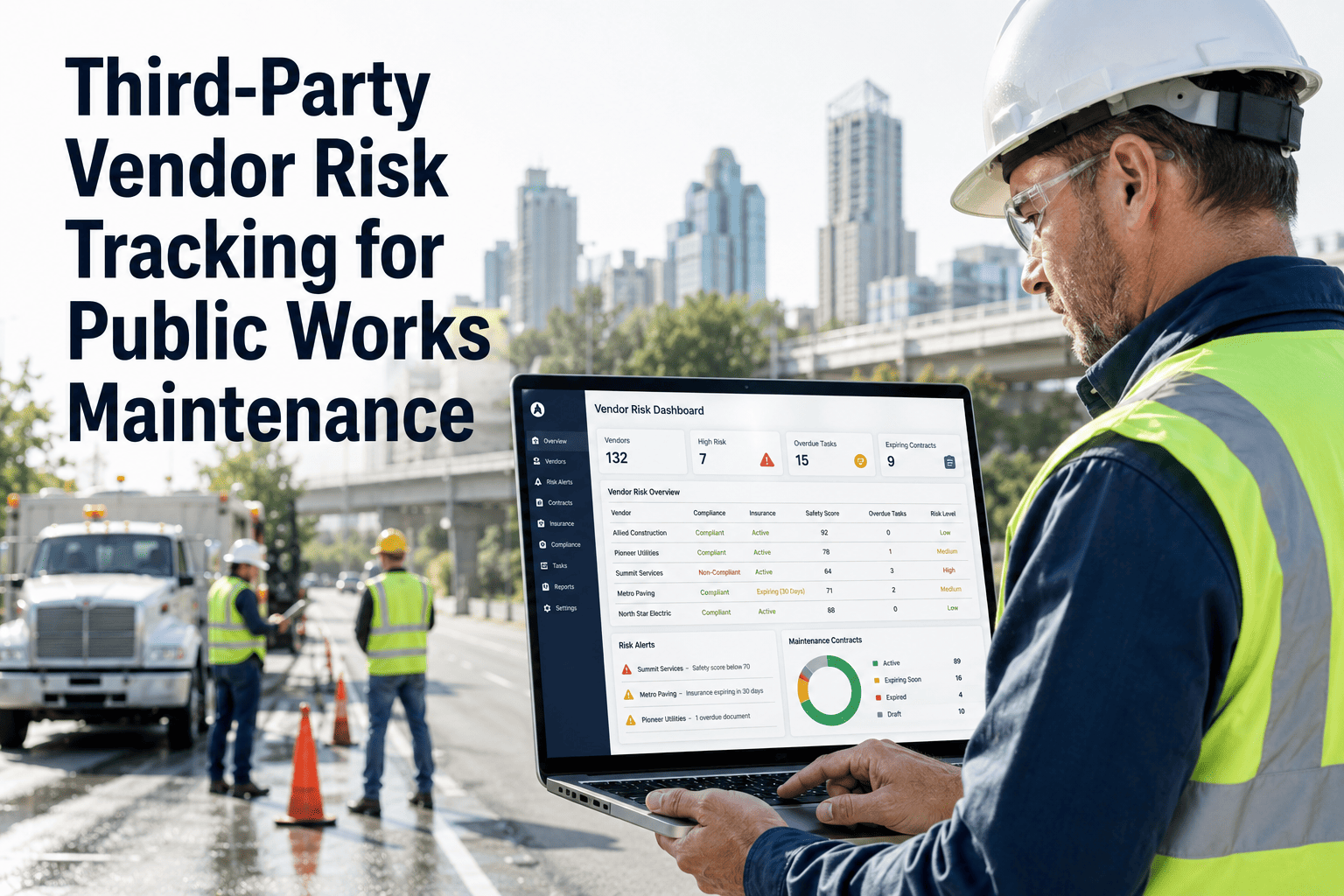
A State DOT discovered they were spending $8.4M annually on utility metering and preventive maintenance across 2,400 assets—yet couldn't answer basic questions when auditors asked: "Which vendors met their SLAs?" "Are preventive tasks actually preventing failures?" "What's your utility consumption trend?" Their vendor performance data existed in scattered spreadsheets, and preventive maintenance was scheduled by calendar, not condition.
State DOTs manage massive infrastructure portfolios: highway lighting systems consuming millions in electricity, rest area facilities with complex HVAC systems, weigh stations with specialized equipment, maintenance facilities with utility-intensive operations. Without integrated utility metering and vendor performance tracking, energy waste and contractor underperformance drain budgets invisibly.
Modern State DOT operations require real-time utility monitoring through IoT sensors, condition-based preventive maintenance, and vendor scorecards with automated performance tracking. Digital CMMS platforms for government infrastructure transform reactive management into data-driven optimization.
84%
State DOTs
Cannot produce real-time utility consumption data by asset category
$2.8M
Average Annual Waste
From undetected utility inefficiencies and vendor non-compliance
62%
Preventive Tasks
Performed on fixed schedules, not actual condition data
34%
Cost Reduction
Achieved with integrated utility metering and vendor scorecards
Core Issue: Utility metering and vendor management operate in silos. Integrated systems reveal waste patterns and contractor performance correlations invisible in manual tracking.
State DOTs manage dozens of vendors across electrical services, HVAC maintenance, lighting contractors, and facility management. Standardized scorecards enable apples-to-apples comparison:
On-Time Completion Rate
15%
Completed on schedule / Total scheduled
SLA Compliance
15%
Within SLA / Total requests
First-Time Fix Rate
10%
Fixed first visit / Total service calls
Inspection Pass Rate
15%
Passed inspections / Total inspections
Rework Required
10%
Inverse: (1 - Rework / Total jobs) × 100
Utility Efficiency Impact
5%
Consumption reduction post-service
Work Order Completion
10%
Fully documented / Total completed
Photo Documentation
5%
Jobs with photos / Total jobs
Reporting Timeliness
5%
Reports on-time / Total due
Budget Adherence
5%
Within budget / Total jobs
Invoice Accuracy
5%
Accurate invoices / Total invoices
Performance Grading Scale
| Score Range |
Grade |
Status |
Action Required |
| 95-100% |
A+ Excellent |
Exemplary |
Performance bonus eligible |
| 90-94% |
A Good |
Satisfactory |
Continue monitoring |
| 85-89% |
B Acceptable |
Needs Improvement |
Improvement plan required |
| 80-84% |
C Warning |
Action Required |
30-day correction period |
| <80% |
D-F Critical |
Contract Review |
Termination consideration |
Vendor Scorecard
Download State DOT Vendor Scorecard Template
Pre-configured Excel template with automated scoring formulas for electrical, HVAC, lighting, and facility maintenance vendors. Includes monthly tracking worksheets.
Real-time utility monitoring reveals consumption patterns, identifies anomalies, and correlates vendor maintenance with energy efficiency:
Highway Lighting Systems
IoT Sensors: Power consumption per circuit, bulb operational status, photocell performance, voltage quality
Automated Alerts:
- Circuit consumption 40% above baseline → Likely equipment failure or theft
- Bulb array showing irregular patterns → Photocell malfunction
- Power factor below 0.85 → Inefficient ballasts, schedule replacement
- Consumption spike during daylight → Control failure, immediate dispatch
Impact: State DOT saved $840K annually identifying failed photocells keeping lights on 24/7
Rest Area Facilities
IoT Sensors: HVAC energy usage, water consumption, lighting loads, overall facility power draw
Automated Alerts:
- HVAC consumption 60% above normal → Refrigerant leak or equipment failure
- Water usage spike overnight → Leak detection, prevents waste
- Building load increasing 15% monthly → Equipment degradation trend
- Simultaneous heating/cooling detected → Control system fault
Impact: 28% HVAC energy reduction through condition-based maintenance scheduling
Maintenance Facilities
IoT Sensors: Compressed air system efficiency, vehicle lift power usage, building HVAC, shop equipment loads
Automated Alerts:
- Compressor running constantly → Air leak in distribution system
- Shop equipment baseline drift → Predictive maintenance scheduled
- Heating costs 45% above comparable facilities → Insulation issues
- Peak demand charges increasing → Load management optimization
Impact: $320K annual savings from compressed air leak detection and repair
Weigh Stations
IoT Sensors: Scale equipment power, building systems, outdoor lighting, specialized electronic loads
Automated Alerts:
- Scale equipment power anomaly → Calibration drift or failure pending
- Building usage pattern change → Occupancy sensor malfunction
- Lighting loads irregular → Fixture degradation or control failure
- Total facility consumption trending up → Equipment efficiency declining
Impact: Prevented 3 scale failures through power consumption pattern analysis
Real-Time Utility Dashboard
Current Month Consumption
2,847,200 kWh
8.3% vs last year
Monthly Cost
$342,464
$31,200 vs budget
Active Alerts
7 Critical
Requires action
Highway Lighting
1,420,800 kWh
49.9%
Normal
Rest Area Facilities
680,400 kWh
23.9%
Normal
Maintenance Facilities
524,600 kWh
18.4%
+22% Above Normal
Weigh Stations
221,400 kWh
7.8%
Normal
Traditional preventive maintenance schedules by calendar (every 6 months, annually) wastes resources on equipment that doesn't need service and misses equipment degrading faster than expected. Condition-based PM uses sensor data:
Method: Service performed on fixed schedule regardless of condition
❌ Over-maintains healthy equipment (wasted resources)
❌ Under-maintains stressed equipment (failures occur)
❌ No data on why failures happen
❌ Cannot optimize PM intervals
Example: HVAC filters changed every 3 months at all 48 rest areas, even those with minimal usage
Method: Service triggered by actual equipment condition from sensors
✓ Service only equipment that needs it
✓ Prevent failures through early detection
✓ Data reveals failure patterns
✓ PM intervals optimize over time
Example: HVAC filters changed when pressure differential reaches 0.5" WC, varying from 6-16 weeks based on usage
Condition-Based PM Triggers
HVAC Systems
Sensors: Refrigerant pressure, amp draw, filter differential, discharge air temp
PM Triggers:
- Amp draw increases 15% → Compressor service scheduled
- Filter pressure ≥0.5" WC → Filter replacement work order
- Discharge temp variance >3°F → Refrigerant check needed
- Runtime hours reach threshold → Comprehensive PM
Lighting Systems
Sensors: Lumen output, ballast temperature, power factor, failure rate by circuit
PM Triggers:
- Lumen output drops 25% → Bulb replacement scheduled
- Ballast temp exceeds 180°F → Early replacement before failure
- Power factor <0.85 → Ballast efficiency degraded
- Circuit failure rate >3/month → Circuit inspection
Compressed Air
Sensors: System pressure, compressor load, dryer performance, leak detection acoustic
PM Triggers:
- Load factor >85% sustained → Capacity or leak issue
- Pressure cycles frequent → Storage or control problem
- Dryer dewpoint rising → Filter or desiccant service
- Acoustic sensors detect leaks → Immediate repair
Challenge
Managing utility costs across 160 facilities with no real-time consumption data. 22 vendors performing preventive maintenance on calendar schedules. No vendor performance tracking. Budget auditor questioned $8.4M vendor spending with zero accountability metrics. Average utility cost increasing 6-8% annually with no explanation.
Solution
• Deployed 840 IoT utility meters across highway lighting (480), rest areas (180), maintenance facilities (120), weigh stations (60)
• Implemented condition-based PM system replacing calendar schedules
• Created standardized vendor scorecard with automated tracking
• Rolled out mobile inspection app to 65 field personnel
• Integrated utility data with vendor performance metrics
Implementation
Phase 1 (Months 1-3):
IoT sensor deployment in pilot district, CMMS configuration, vendor onboarding
Phase 2 (Months 4-6):
Statewide sensor rollout, mobile app training, baseline data collection
Phase 3 (Months 7-12):
Condition-based PM activation, vendor scorecard enforcement, optimization
Results (Year 1)
Utility Cost Reduction
$2.8M
23% reduction through anomaly detection and efficiency optimization
PM Task Optimization
-38%
Unnecessary PM eliminated through condition-based scheduling
Vendor Accountability
100%
All vendors tracked with documented performance scores
Equipment Failures
-64%
Prevented through condition monitoring and predictive maintenance
Key Discoveries
Highway Lighting: 127 photocells failed in "on" position keeping lights running 24/7. Discovered via consumption pattern analysis. $680K annual waste identified.
HVAC Maintenance: Vendor performing quarterly filter changes regardless of condition. Condition-based scheduling revealed 60% didn't need service. Saved $240K annually.
Compressed Air: One maintenance facility consuming 3x peer facilities. Ultrasonic leak detection found 40+ leaks costing $180K annually in wasted electricity.
Vendor Performance: Top-rated vendor had 96% SLA compliance. Lowest-rated vendor at 78% failed to improve after 90-day warning. Contract terminated, replaced with high performer.
"We went from defending utility budgets with no data to optimizing energy spend with real-time intelligence. The vendor scorecard transformed contractor relationships from adversarial to collaborative while maintaining clear accountability."
— Maintenance Director, Midwest State DOT
Phase 1: Assessment & Planning
Months 1-2
□ Collect 12 months utility bills
□ Categorize consumption by asset type
□ Identify high-cost facilities
□ Calculate baseline metrics
□ Audit current vendor contracts
□ Define service categories
□ Design scorecard framework
□ Set performance targets
Deliverable: Deployment plan with ROI projection and pilot location selection
Phase 2: Pilot Deployment
Months 3-5
□ Install IoT sensors in pilot district
□ Configure CMMS platform
□ Deploy mobile apps to field staff
□ Integrate vendor portal
□ Train internal personnel (2 days)
□ Onboard vendors to system
□ Create inspection checklists
□ Establish alert thresholds
Deliverable: Fully operational pilot with 90 days baseline data
Phase 3: Statewide Expansion
Months 6-12
□ Roll out sensors to remaining districts
□ Expand mobile app to all personnel
□ Activate condition-based PM
□ Enforce vendor scorecards
□ Refine alert thresholds from data
□ Optimize PM intervals
□ Address underperforming vendors
□ Document ROI achieved
Deliverable: Fully optimized statewide system with documented savings
State DOTs managing thousands of assets across vast geographic areas cannot optimize utility spend and vendor performance without integrated real-time data. Manual tracking creates information silos that hide waste and enable contractor underperformance.
The combination of IoT-based utility metering, condition-based preventive maintenance, and automated vendor scorecards creates a system where energy efficiency and contractor accountability are continuous, measurable, and optimizable.
Modern CMMS platforms designed for state transportation agencies provide the infrastructure for integrated utility management and vendor accountability. Move from reactive to data-driven operations.
For State DOT Directors: Free utility & vendor assessment included with platform demo
What's the typical ROI timeline for IoT metering deployment?
Most State DOTs achieve positive ROI within 18-24 months. Sensor hardware costs $150-400 per asset. Typical savings: 20-30% utility cost reduction through anomaly detection, plus 15-25% PM optimization. Mid-size DOT with $8M utility spend sees $1.8M annual savings for $600K sensor investment.
How do we transition vendors to performance scorecards?
Phase in over 6 months: First 90 days are baseline monitoring without penalties. Share performance data monthly so vendors understand measurement. Activate scoring at month 4. Most vendors appreciate clear expectations over vague "satisfactory performance" language. Underperformers who can't adapt lose renewals.
Get transition plan.
Can our field staff with limited tech skills use mobile apps?
Yes—modern apps designed for field use require minimal training. Guided checklists walk through inspections step-by-step. Large buttons, simple workflows, works offline. Training takes 2-3 hours. Average field staff proficiency within 1 week of first use.
What about rural areas with no cell coverage?
Mobile apps work completely offline. Inspectors complete checklists, take photos, create work orders without connectivity. Data syncs automatically when they return to coverage area. Critical for State DOTs with facilities in remote locations.
How do we justify the budget for IoT sensors and CMMS?
Build business case showing current utility waste plus vendor non-compliance costs. Typical State DOT identifies $2-4M annual waste during assessment phase. Investment of $800K-1.2M pays for itself in 6-10 months. Frame as cost reduction initiative, not IT spending. Include case studies from peer DOTs.
What happens to vendors who fail scorecard requirements?
Progressive approach: Score 85-89% triggers improvement plan requirement. Score 80-84% results in probationary status with 30-day correction period. Score below 80% for 2+ consecutive months triggers contract review for possible termination. Most vendors improve when accountability is clear. Replace chronic underperformers.