Vendor insurance and bonding compliance in public works is the legal and financial shield that protects agencies, taxpayers, and contractors when projects go wrong. When an uninsured or under-insured contractor damages infrastructure, causes injury, or abandons a job site, the liability often cascades back to the contracting agency—turning a routine paving or facilities upgrade into a multi-million dollar claim. Verifying certificates of insurance, performance bonds, and licenses manually across dozens of active vendors is where most compliance programs fail. OxMaint automates vendor insurance compliance for public works, tracking expiration dates and blocking work orders the moment coverage lapses, so you can close liability gaps before they cost you—Start Free Trial to see it in action.
Public Works Risk Management
Is an uninsured contractor accident quietly becoming your agency's liability?
When a vendor's coverage lapses between renewals, the financial risk of jobsite injuries, property damage, and project defaults shifts directly to the public agency. Manual spreadsheet tracking fails because COIs expire silently—leaving your infrastructure projects exposed to uncovered losses and audit failures.
Coverage Requirements
What vendor insurance and bonding does public works require?
Public works contracts demand specific, verifiable coverage tiers before a contractor breaks ground. Failing to enforce these baseline requirements exposes the agency to third-party claims, OSHA penalties, and project abandonment costs that can exceed the contract value itself.
General Liability Insurance
Covers bodily injury and property damage to third parties. Most municipal contracts require a minimum of $1M per occurrence and $2M aggregate. Public agencies must be listed as an "Additional Insured" on the policy, not just a certificate holder.
Workers' Compensation
Mandatory in all 50 states for contractors with employees. Minimum coverage limits vary by jurisdiction but typically require $100K/$500K/$100K. A lapsed WC policy means the agency can be held liable for jobsite injuries under tort liability.
Performance & Payment Bonds
Required under the Miller Act for federal projects over $100K, and most state-level Little Miller Acts for projects exceeding $25K–$500K. Performance bonds guarantee project completion (typically 100% of contract value); payment bonds protect subcontractors.
Cost of Non-Compliance
The financial exposure of unenforced contractor compliance
When vendor compliance is unenforced, the financial exposure compounds rapidly. A single uncovered jobsite injury or infrastructure damage event can dwarf the entire annual budget of a maintenance department.
Agency Liability Exposure Formula
Total Risk = (Uncovered Claim Cost) + (Legal Defense Fees) + (Project Delay Penalties) + (Reputational Damage)
When a contractor's insurance has lapsed, the agency absorbs 100% of this figure. A single $500K injury claim can trigger a 15% spike in the agency's own insurance premiums for the following three years.
Real-world scenario: A mid-sized municipal water utility managing 120 active contractors discovered that 18% of their vendors had expired General Liability coverage during a surprise audit. One contractor had caused $85,000 in equipment damage two months prior—well after their policy had lapsed. Because the agency had not automated COI tracking, it absorbed the full replacement cost plus $22,000 in legal fees negotiating restitution.
Verification Process
How to verify contractor insurance and bonding in government projects
A defensible compliance program requires more than collecting a PDF at project kickoff. Agencies must verify coverage authenticity, track expiration dates, and enforce automatic work-stoppage when documents lapse.
Collect & Authenticate
Require vendors to submit COIs directly into the CMMS vendor portal. Verify the document against the issuing broker, ensure the agency is listed as Additional Insured, and check that coverage limits meet contract specifications.
Digitize Expiration Tracking
Every COI and bond must be tagged with an expiration date in the system. Manual spreadsheet tracking fails because one person cannot monitor 100+ expiration dates across overlapping policies. Automated alerts must trigger at 90, 60, and 30 days before lapse.
Enforce Work-Order Lockouts
The most critical step. When a vendor's insurance expires and no renewal is on file, the CMMS must automatically block new work orders and suspend site access badges. No compliance, no dispatch.
Audit-Ready Reporting
Generate instant compliance reports for council meetings, state audits, and OSHA inquiries. A single dashboard should show every active vendor, their coverage status, expiration dates, and bond amounts—eliminating 40+ hours of manual report preparation.
Manual vs. Automated
Spreadsheet tracking vs. CMMS-driven vendor compliance
Most public works agencies still manage vendor insurance compliance through Excel spreadsheets and shared drives. Here is how that approach compares to a CMMS-driven compliance model.
| Compliance Capability | Manual Spreadsheets | OxMaint CMMS |
|---|---|---|
| COI Expiration Alerts | Manual review, often missed | Automated 90/60/30-day alerts |
| Work-Order Lockout on Lapse | Impossible to enforce reliably | Automatic dispatch block |
| Audit Report Generation | 40+ hours per audit cycle | Instant, real-time dashboards |
| Vendor Onboarding | Email chains, lost attachments | Self-service vendor portal |
| Bond Amount Verification | Manual cross-referencing | Auto-validated against contract value |
The OxMaint Advantage
How OxMaint secures public works vendor compliance
OxMaint transforms vendor insurance and bonding compliance from a reactive liability into an automated, audit-ready process. Here is how our AI-powered CMMS maps directly to your compliance gaps.
Automated COI & Bond Tracking
Every uploaded certificate is parsed for coverage limits, additional-insured status, and expiration dates. The system sends automated renewal reminders to vendors and compliance officers at 90, 60, and 30 days. Outcome: Eliminates the 34-day blind spot of expired coverage.
Work-Order Compliance Lockout
If a vendor's insurance or bonding lapses, OxMaint automatically blocks new work order assignments and flags active jobs for review. No compliant documentation means no dispatch. Outcome: Zero uncovered contractor hours on your job sites.
Real-Time Compliance Dashboards
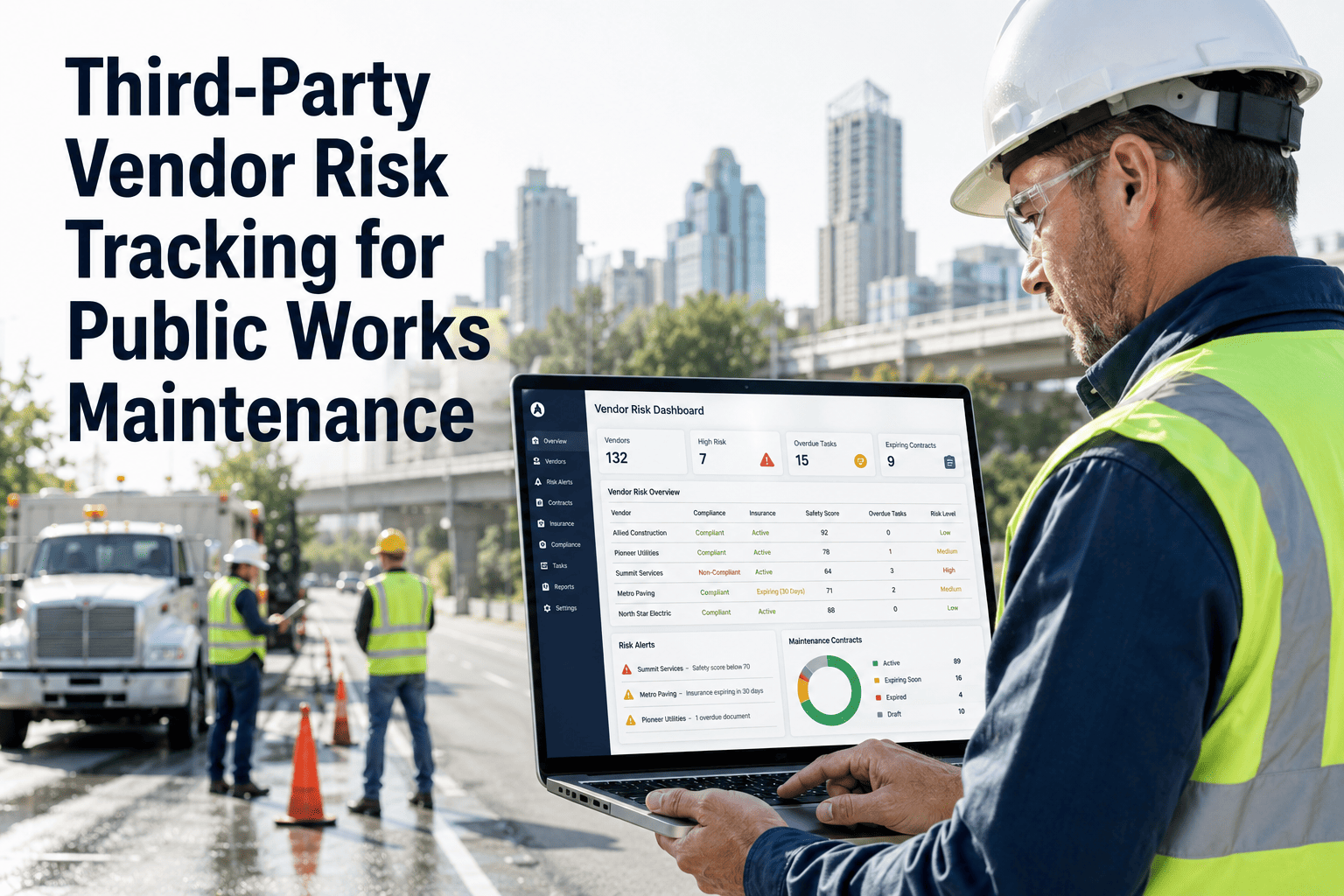
A single live dashboard shows every vendor's coverage status, bond sufficiency, and license validity. Filter by project, department, or contractor tier. Outcome: Cut audit preparation from 40 hours to 5 minutes.
Vendor Self-Service Portal
Contractors upload and update their own documentation directly into the portal, where OxMaint's AI validates the coverage against contract requirements before approval. Outcome: Reduces compliance admin time by 70% and eliminates lost email attachments.
Stop chasing expired certificates. Start automating vendor compliance.
See how OxMaint turns 40 hours of audit prep into a 5-minute dashboard review and eliminates uncovered contractor liability.
Frequently Asked Questions
Vendor insurance and bonding compliance in public works
What insurance is required for public works contractors?
Public works contractors typically must carry General Liability (minimum $1M per occurrence), Workers' Compensation ($100K/$500K/$100K), Commercial Auto ($1M), and sometimes Umbrella/Excess Liability ($2M–$5M) depending on contract size. The agency must be listed as an Additional Insured, not just a certificate holder, to ensure the policy extends coverage to the public entity.
What is the difference between contractor insurance and a performance bond?
Contractor insurance protects against third-party claims for bodily injury and property damage. A performance bond is a guarantee from a surety company that the contractor will complete the project according to contract terms. If the contractor defaults, the surety pays the agency to cover completion costs. Public projects over $100K (federal) or $25K–$500K (state) legally require both under the Miller Act and Little Miller Acts.
How do you track expiring certificates of insurance for vendors?
The most reliable method is automated tracking through a CMMS like OxMaint, which parses each COI for its expiration date and sends alerts at 90, 60, and 30 days before lapse. Manual spreadsheet tracking fails because a single compliance officer cannot monitor hundreds of overlapping expiration dates—resulting in an average 34-day blind spot where expired coverage goes undetected. You can Book a Demo to see how OxMaint automates this end-to-end.
Who is liable if an uninsured contractor causes damage on a public project?
If a contractor's insurance has lapsed and the agency failed to enforce compliance, the agency itself becomes liable for bodily injury, property damage, and project completion costs. The agency's own insurance may cover some claims, but uncovered events typically trigger premium increases of 15% or more and can expose the municipality to lawsuits from injured third parties.
Can a CMMS automatically block work orders for non-compliant vendors?
Yes. OxMaint enforces a compliance lockout that automatically prevents new work orders from being assigned to any vendor with expired insurance, bonding, or licenses. Active work orders are flagged for immediate review, and site access can be suspended until updated documentation is uploaded and validated. This ensures zero uncovered contractor hours are worked on your job sites. Start your Start Free Trial to test the lockout workflow.
Make vendor compliance automatic, not a liability.
Join the public agencies using OxMaint to automate insurance tracking, lock out non-compliant vendors, and generate audit-ready reports in seconds.
Free 14-day trial · No credit card