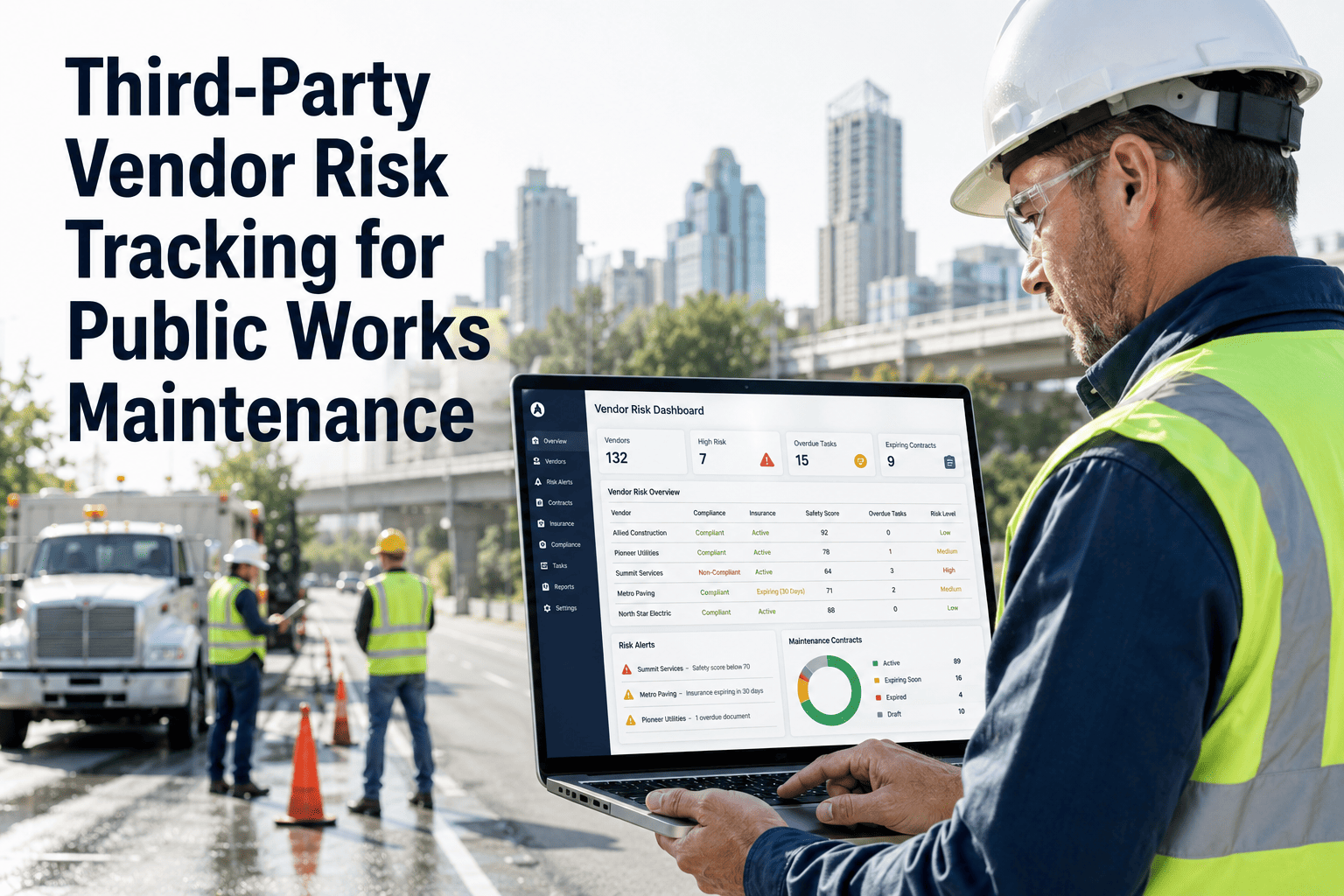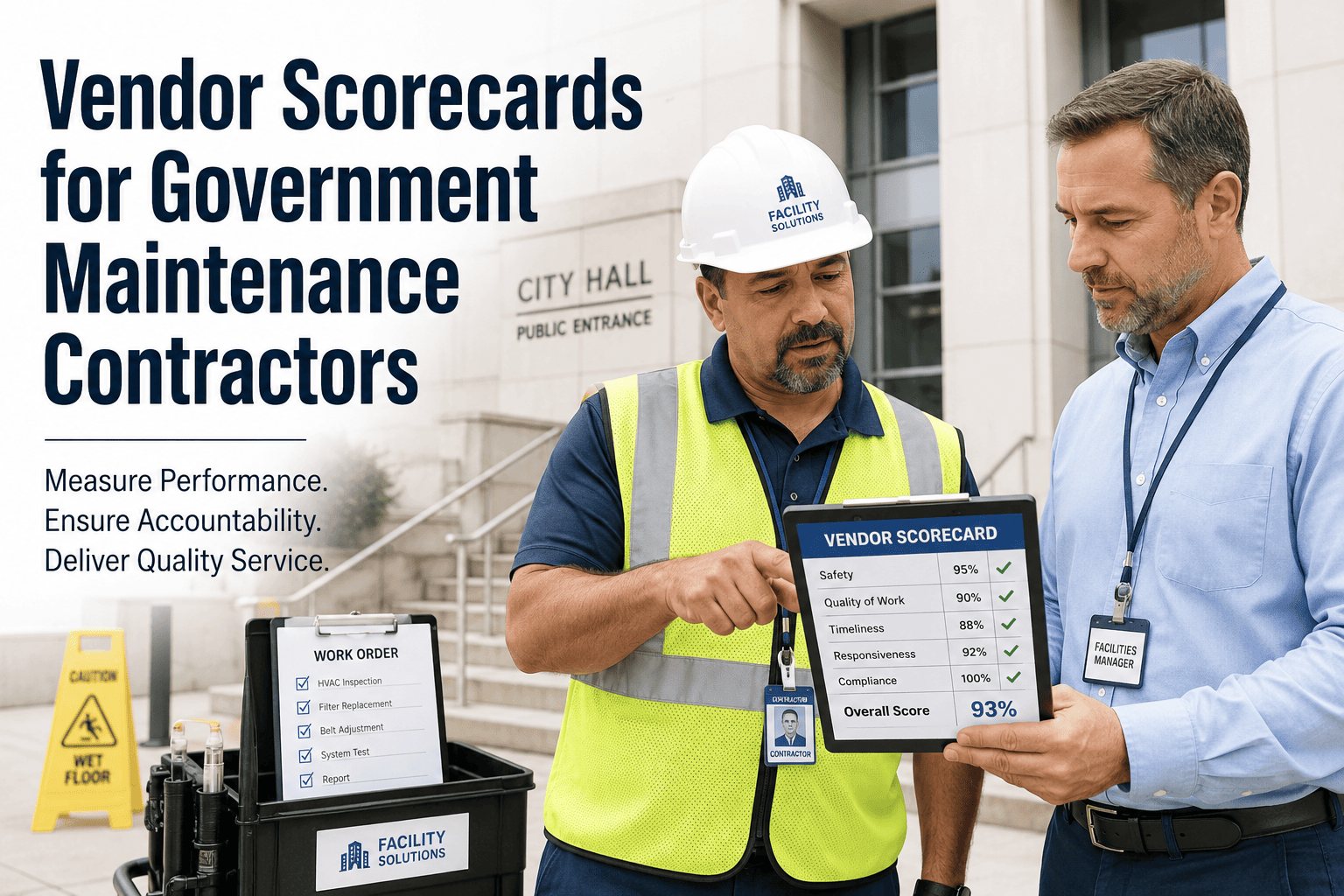
Government agencies spend hundreds of thousands to millions of dollars per year on outsourced maintenance contractors — and most renew those contracts based on relationship, convenience, and the absence of visible disaster rather than measurable performance. Without a vendor scorecard that tracks response time, first-time completion rate, repeat repair rate, safety incidents, and cost trend, agencies are essentially renewing contracts blind. The contractors who perform best rarely advertise it, and the ones who perform worst rarely admit it — which means objective performance data is the only reliable input to procurement decisions. OxMaint's vendor management module builds performance scorecards automatically from work order history — no manual data collection required — and a 30-minute demo shows how your agency can generate a scorecard for any existing contractor using data already in your system.
Vendor Scorecards for Government Maintenance Contractors
Stop renewing contracts based on relationships. Start renewing — or ending — them based on data.
What a Government Contractor Scorecard Must Measure
Generate Contractor Scorecards From Work Order Data You Already Have
OxMaint builds vendor scorecards automatically from work order completion records, SLA timers, inspection results, and invoice history — no manual data collection, no spreadsheet assembly.
Sample Contractor Scorecard — Municipal HVAC Program
| KPI | Contract Commitment | Actual (Last 12 Months) | Score | Trend |
|---|---|---|---|---|
| SLA Response Rate | 95% on time | 78% on time | 42 / 100 | Declining |
| First-Time Completion | 90% | 86% | 80 / 100 | Stable |
| Repeat Failure Rate | Less than 5% | 12% within 60 days | 38 / 100 | Worsening |
| Safety Incidents | Zero recordable | 1 near-miss logged | 75 / 100 | First occurrence |
| Invoice Accuracy | Within approved PO | Avg 7.2% over PO | 55 / 100 | Increasing |
| Overall Contractor Score | 58 / 100 | At Risk | ||
A score below 70 in OxMaint triggers an automatic contract review flag and notification to the procurement officer — before the renewal date arrives.
Council members ask why we renewed a contractor that had complaints — and the honest answer used to be "we didn't have data to justify non-renewal." That answer is unacceptable from a governance standpoint and politically difficult when things go wrong. Vendor scorecards built from objective performance data — response time, repeat repairs, invoice accuracy — give procurement teams the evidence to defend renewal decisions and, more importantly, to justify terminations before they become public incidents. Data-driven vendor management is not bureaucracy. It is the agency's legal defense against contractor performance disputes.
Three Outcomes That Change How Agencies Manage Contractors
Present 12 months of SLA violation data to a contractor at renewal — with documented frequency, affected assets, and estimated cost of downtime. This shifts negotiating leverage from the contractor to the agency and typically results in rate concessions or improved SLA commitments in the new contract.
Vendor performance scorecards showing consistent below-threshold performance across multiple KPIs over multiple reporting periods provide legally defensible grounds for contract termination — reducing risk of contractor disputes and ensuring procurement procedures are followed correctly.
Contractors who consistently score above 90 can be given preferred vendor status, early renewal offers, or expanded scopes — incentivizing performance across the vendor pool and building long-term relationships with the contractors who actually deliver on their commitments.
Build Contractor Scorecards From Your Existing Work Order Data
OxMaint's vendor analytics module generates contractor performance reports automatically — giving your procurement team objective evidence for every renewal, renegotiation, or termination decision.
Frequently Asked Questions
How does OxMaint calculate the vendor scorecard scores automatically?
OxMaint pulls data directly from closed work orders — SLA timer records, inspection pass/fail results, invoice-to-PO matching, safety observations, and return visit flags — and aggregates these into scores for each KPI. The weighting of each KPI can be configured per contract type or agency priority. Once configured, scores update automatically as work orders close — no manual data entry or spreadsheet compilation required. Configure your scorecard KPI weights in your OxMaint trial account.
Can we share scorecard reports directly with contractors as part of a performance review?
Yes. Vendor scorecards export as PDF with the agency logo, contractor name, reporting period, KPI breakdown, and supporting data. Agencies commonly share these reports with contractors at quarterly reviews or before renewal discussions. Giving contractors visibility into their own performance data often drives self-correction before formal contract action becomes necessary. Book a demo to see the scorecard export format and how it is typically used in contractor performance review meetings.
What if we have contractors who have been working with us for years with no formal performance data?
OxMaint can import historical work order data from spreadsheets or prior CMMS systems to populate scorecard history for existing contractors. For contractors with no prior data, a 90-day observation period generates the first scorecard from live work orders — giving agencies performance data at the very next contract renewal cycle. Start a free trial to see how historical contractor data is imported and mapped to scorecard KPIs.
Can different contracts have different scorecard KPI thresholds?
Yes. Each vendor contract in OxMaint can carry its own SLA targets, quality thresholds, and KPI weightings — reflecting the specific terms of that contract. A roads contractor and an HVAC contractor will have different response time commitments, different acceptable repeat failure rates, and different invoice variance tolerances. OxMaint scores each contractor against their own contract terms, not a universal standard. Book a demo to configure contract-specific scorecard thresholds for your vendor portfolio.
How does OxMaint alert the procurement team when a contractor score drops below threshold?
Procurement officers and contract managers receive automated alerts when a vendor's overall score or any individual KPI drops below the configured threshold — with the option to receive alerts at 60-day intervals, at a specific threshold breach, or both. This ensures procurement teams are notified of deteriorating contractor performance before the renewal date, not at it. Configure your vendor alert thresholds in the vendor management settings of your OxMaint trial.