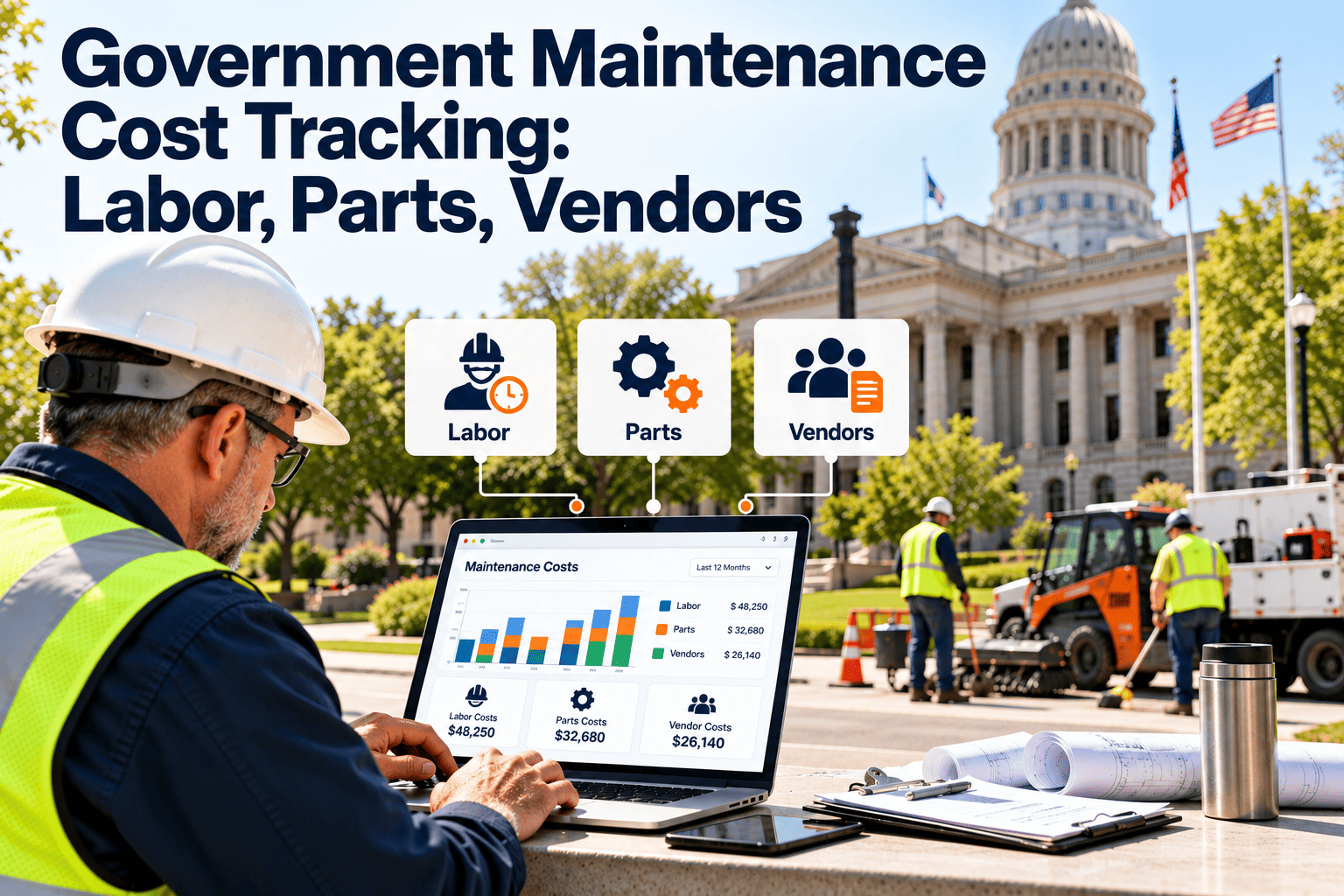
Government maintenance budgets are rarely short on data; they are short on data that connects. Labor hours sit in timesheets, parts in a storeroom ledger, and contractor invoices in accounts payable, so nobody can say what it cost to keep one pump station, road segment, or fleet vehicle running last year. Maintenance cost tracking closes that gap by tagging every dollar to an asset, a department, and a funding source at the moment the work happens. This guide shows how public works and facilities teams can build that discipline, and how maintenance management software keeps it consistent.
Maintenance Cost Tracking for Government: Labor, Parts, and Vendors in One Ledger
Stop reconstructing maintenance spend at budget time. Capture labor, materials, and contractor costs on every work order, then report by asset, department, and fund.
Why Maintenance Spend Is Hard to See in Public Agencies
Most agencies track money in the general ledger and work in a separate system. The two rarely meet at the asset level.
What finance sees
- Object codes such as salaries, supplies, and contracted services
- Totals by department and fiscal year
- Invoices matched to purchase orders
- No link between a dollar and the asset it kept running
What maintenance knows
- Which crew worked on which asset and for how long
- Which parts left the storeroom for which repair
- Which contractor was called out, and why
- No consistent cost value attached to any of it
The consequences show up at the worst moments
- Budget requests rely on last year's total plus a percentage, not on asset-level history.
- Replace-or-repair decisions are made on instinct because cumulative repair cost is unknown.
- Grant reimbursement packages take weeks to assemble from timesheets and receipts.
- Auditors ask for support on a charge and staff search email for the original request.
- Elected officials hear that maintenance is underfunded but cannot see where money actually goes.
The Anatomy of a Complete Maintenance Cost Record
A usable record has five parts. If any one is missing, the total understates the real cost of keeping an asset in service.
| Cost element | What to capture | Typical source | Common gap |
|---|---|---|---|
| Labor | Hours by technician, trade, and task, at a burdened rate | Work order time entries | Hours logged to a general code, not the job |
| Parts and materials | Part number, quantity, unit cost, issuing storeroom | Inventory transactions | Items pulled informally without a record |
| Vendors and contractors | Invoice amount, purchase order, scope, and completion date | Accounts payable and contracts | Invoice not linked back to the asset |
| Equipment and fleet use | Truck, lift, or tool hours charged at an internal rate | Equipment logs | Rates never defined, so cost shows as zero |
| Indirect and overhead | Allocation method applied consistently to direct costs | Finance policy | Applied differently by each department |
From Request to Closed Cost: The Work Order Costing Lifecycle
Cost accuracy is a workflow outcome. These six steps put the cost data in place before the work is finished.
-
1
Request tied to an asset Every request names the asset, location, and requesting department, so cost has a home before anyone picks up a tool.
-
2
Work order opened with cost codes The order carries a funding source, project or grant code, and work type such as preventive or corrective.
-
3
Planned estimate recorded Estimated hours and parts are entered so actual cost can later be compared with the plan.
-
4
Labor and parts posted in the field Technicians log time and issue stock from a phone or tablet while the job is underway, not at the end of the week.
-
5
Vendor invoices matched Contractor invoices are attached to the work order and purchase order, with scope and completion confirmed.
-
6
Order closed and cost locked A supervisor reviews and closes the order. The total feeds asset history and financial reports.
Three Tags That Make Every Dollar Reportable
Each work order should carry the same three tags. Together they answer most questions finance, auditors, and council members ask.
Keep code lists short and controlled. A dropdown with twenty approved funding codes beats a free-text field that produces two hundred spellings.
See what your next budget cycle looks like with real cost history
Walk through labor, parts, and vendor costing on your own asset types with the Oxmaint team.
Labor: The Largest and Least Accurate Cost Line
In most public works shops, labor is the biggest share of maintenance spend and the easiest to misstate.
Use a fully burdened rate
Hourly wage alone understates cost. Work with finance to publish a burdened rate per classification that includes benefits and payroll taxes, and review it each fiscal year.
Labor tracking checklist
- Every technician logs time against a work order, not a general bucket.
- Regular, overtime, and call-out hours are separated so premiums are visible.
- Travel and standby time follow a written policy.
- Crews working under mutual aid or emergency declarations log hours to a distinct event code.
- Supervisors review time entries before the order is closed.
Why this matters for grants
Federal awards follow the cost principles in 2 CFR Part 200, which expect charges to be allocable and supported by records. Disaster reimbursement programs also look for force account labor documented by employee, hours, and task.
Parts and Vendors: Closing the Gap Between Storeroom and Invoice
Parts and materials
- Issue every part against a work order so cost follows the repair.
- Set minimum and maximum levels for critical spares to avoid emergency buying.
- Count high-value items on a cycle and investigate variances.
- Track average or last-purchase cost and update it when prices change.
- Flag repeat part use on one asset as a sign of a deeper problem.
Vendors and contractors
- Link each purchase order to the asset and work order it supports.
- Record agreed scope, not-to-exceed amounts, and rates for time-and-material jobs.
- Compare invoice totals with approved estimates before payment.
- Keep vendor history per asset to expose repeat call-outs and rework.
- Store warranty terms so covered repairs are not paid twice.
Spend with outside vendors is where visibility tends to be weakest, because invoices live in a different system from the work.
Reports That Satisfy Both Finance and Auditors
Different readers need different cuts of the same data. Build each report once and schedule it.
| Report | Primary reader | Question it answers | Cadence |
|---|---|---|---|
| Cost by asset class | Public works director | Which asset types consume the most maintenance money? | Monthly |
| Budget versus actual by department | Finance office | Are we on track against the adopted budget? | Monthly |
| Spend by funding source | Grants and fund managers | Were restricted dollars used on eligible work? | Quarterly |
| Preventive versus corrective ratio | Maintenance managers | Are we planning work or reacting to failures? | Monthly |
| Vendor spend and rework | Procurement | Which contractors deliver value on repeat work? | Quarterly |
| Audit support packet | Internal and external auditors | Can this charge be traced to a request, approval, and completion? | On request |
KPIs Worth Tracking Once Costs Are Captured
Start with a handful. Each one turns raw cost into a decision.
Common Tracking Mistakes and the Fix
A 90-Day Plan to Start Tracking Costs
You do not need every asset loaded to begin. Start with one department and expand.
How Oxmaint Supports Maintenance Cost Tracking
Oxmaint is built to carry cost data through the same workflow crews already use, so finance reports come from the work itself.
- Work order management: labor, parts, and vendor costs recorded on one order.
- Asset management: full cost and repair history for each asset.
- Inventory: parts issued to orders with stock levels and reorder points.
- Preventive maintenance scheduling: planned work separated from reactive spending.
- Mobile workflows: time, photos, and notes captured in the field.
- Reporting and dashboards: cost views by asset, department, and funding source.
You can sign up to set up a pilot group, or book a demo to review your reporting needs first.
Capturing Costs by Funding Source
Restricted money has rules about what it can pay for. The work order is the best place to prove compliance.
| Funding source | Typical constraint | What the work order should show |
|---|---|---|
| General fund | Annual appropriation limits | Department, cost center, and work type |
| Enterprise funds such as water or sewer | Must be spent for that system | Asset linked to the utility system |
| State or fuel tax allocations | Limited to eligible road work | Road segment and eligible activity |
| Grants | Allowable costs and reporting | Award code, labor, parts, and invoices |
| Capital projects | Capitalization versus repair rules | Scope that supports the classification |
Repair or capital?
Policies differ on when work extends asset life enough to capitalize. Agree the rule with finance and add a work type so the distinction is clear at the time of the work.
Emergency and Disaster Work Needs Its Own Cost Trail
Storms, main breaks, and floods generate fast, unusual spending. Prepare the structure before they happen.
- Create an event code that can be applied to all labor, equipment, and materials for one incident.
- Record who worked, when, where, and on what task, even under pressure.
- Photograph conditions before and after work and attach them to the order.
- Track mutual aid crews and rented equipment separately from regular staff.
- Keep emergency purchases linked to their justification and approval.
After the event
A clean event code lets finance export every related cost in one report, which shortens reimbursement requests and supports internal review.
Choosing an Overhead Allocation Method
Common methods
- Percentage added to direct labor
- Flat rate per work order type
- Rate per labor hour for supervision and admin
- Internal service charges for fleet and facilities
Rules for any method
- Document the basis and have finance approve it
- Apply it the same way in every department
- Review the rate each fiscal year
- Show direct and indirect cost separately in reports
Questions Auditors Commonly Ask
Prepare the answers before the audit starts, and check that your system can produce the records quickly.
- Who requested this work, who approved it, and when?
- Which asset benefited, and was it eligible for the fund charged?
- How were labor rates set, and are hours supported by time entries?
- Do parts issued match inventory records and purchase receipts?
- Was the vendor selected under procurement rules, and does the invoice match the approved scope?
- Can you show completion evidence such as photos or inspection results?
Making the Numbers Useful to Elected Officials
Council members rarely want a ledger. They want to know what the money bought and what happens if funding changes.
- Show cost per asset class next to condition or failure counts, so spending connects to results.
- Report planned versus reactive work, which explains why deferred maintenance costs more later.
- Present the five assets with the highest cumulative repair cost and the replacement options.
Frequently Asked Questions
Give finance, auditors, and council the maintenance numbers they keep asking for
Track labor, parts, and vendor spend on every work order and report it by asset, department, and fund.