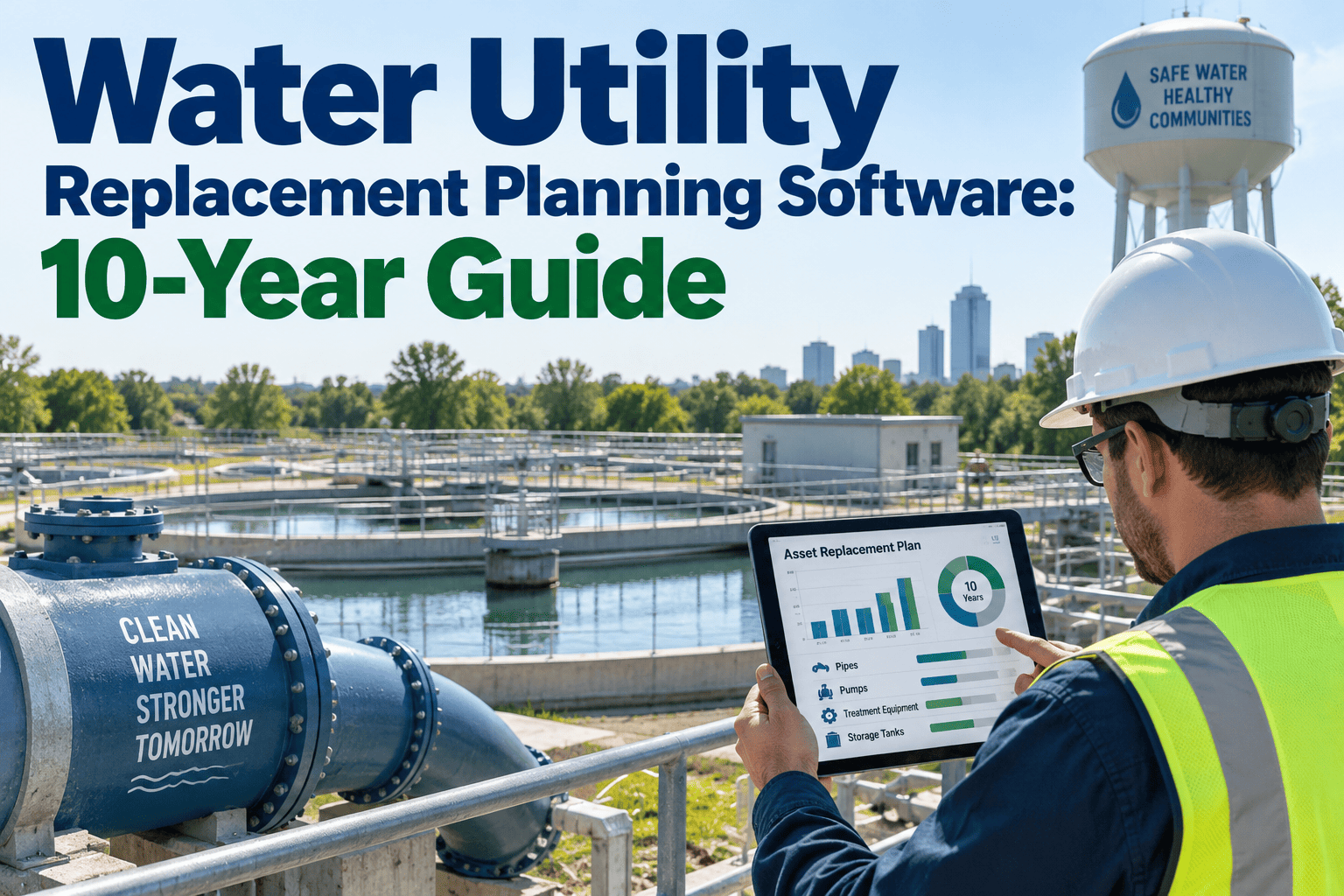
Most water utilities operate critical infrastructure worth hundreds of millions of dollars — yet manage it with spreadsheets, tribal knowledge, and deferred maintenance budgets that guarantee premature failure. A structured asset management plan aligned with AWWA and EPA standards gives utilities the framework to track condition, prioritize risk, and allocate capital where it extends asset life the most. OxMaint provides the CMMS foundation that turns asset management plans from shelf documents into operational systems driving daily maintenance decisions.
Build Your Water Utility Asset Management Plan in OxMaint
Asset registry, condition assessment, risk scoring, and capital planning — all in one CMMS built for water and wastewater utilities.
What Is a Water Utility Asset Management Plan?
An asset management plan is a documented strategy that defines how a utility will manage its physical infrastructure — from treatment plants and distribution mains to pump stations, storage tanks, and service connections — across the full lifecycle from installation through replacement. AWWA and EPA both define asset management around five core components: asset inventory, condition assessment, level of service goals, criticality and risk analysis, and capital improvement planning.
Without a plan, utilities default to reactive maintenance — fixing what breaks, deferring what can wait, and hoping regulators don't audit the gaps. With a structured plan connected to a CMMS like OxMaint, every maintenance decision is informed by asset condition data, risk priority, and budget reality. Book a demo to see how OxMaint structures all five components.
AWWA and EPA Asset Management Frameworks
Both AWWA and EPA converge on the same five-pillar framework — but approach it from different angles. AWWA's guidance targets operational excellence for utility managers, while EPA's framework emphasizes regulatory compliance and public health protection. A CMMS that supports both ensures your plan satisfies regulators and improves operations simultaneously.
| Core Component | AWWA Focus | EPA Focus | CMMS Role |
|---|---|---|---|
| Asset Inventory | Complete registry with age, material, size, location | Documented inventory of all regulated assets | Centralized asset database with GIS linkage |
| Condition Assessment | Inspection protocols, condition grading, deterioration curves | Evidence-based condition data for planning | Inspection records, condition scores per asset |
| Level of Service | Customer expectations, pressure, quality, reliability targets | Public health protection, Safe Drinking Water Act compliance | KPI dashboards tracking service delivery metrics |
| Criticality & Risk | Consequence of failure x likelihood of failure matrix | Risk-based prioritization for capital allocation | Automated risk scoring from condition + consequence data |
| Capital Planning | Long-range CIP aligned to asset lifecycle needs | Sustainable infrastructure investment planning | Budget-linked work orders, rehab/replace scheduling |
The Five Pillars: Building Your Asset Management Plan
Asset Inventory and Registry
You cannot manage what you have not inventoried. Build a complete asset registry capturing pipe material, diameter, installation year, location coordinates, and replacement cost for every asset in your system — from transmission mains to hydrants and valves.
- Capture material, age, size, depth, and replacement value
- Link each asset to GIS coordinates and system maps
- Include above-ground assets: pumps, motors, SCADA, tanks
Condition Assessment
Assign a condition grade to every asset based on inspection data, maintenance history, age, and material-specific deterioration rates. Condition grades drive both maintenance priority and capital planning timelines.
- 1–5 condition scale aligned to AWWA standards
- Inspection records linked directly to asset profiles
- Deterioration curves project remaining useful life
Level of Service Goals
Define measurable service targets — minimum pressure, maximum response time, water quality compliance rates, and system reliability metrics. These goals set the performance threshold that your maintenance program must sustain.
- Pressure, flow, quality, and reliability KPIs
- Customer complaint tracking and resolution metrics
- Regulatory compliance rates (SDWA, state permits)
Criticality and Risk Analysis
Not all assets carry equal risk. Multiply likelihood of failure (from condition data) by consequence of failure (from location, size, redundancy, and customer impact) to produce a composite risk score that drives capital and maintenance priority.
- Consequence factors: pipe size, proximity to critical facilities, redundancy
- Likelihood factors: condition grade, material, age, break history
- Risk matrix visualization for board and regulator reporting
Capital Improvement Planning
Translate risk scores into a funded, sequenced capital improvement plan. High-risk assets get rehabilitation or replacement first. Low-risk assets get monitored on extended cycles. Every dollar goes where it reduces the most risk per dollar spent.
- CIP projects linked to specific asset risk scores
- Multi-year budget forecasting from deterioration models
- Rehabilitation vs. replacement decision support
Implementation Roadmap: From Plan to Operational System
Asset Inventory Buildout (Months 1–3)
Import existing GIS data, billing system records, and maintenance logs into OxMaint. Field-verify critical assets with GPS and QR tagging. Establish a complete asset registry covering all pipe segments, valves, hydrants, pumps, tanks, and treatment equipment.
Condition Assessment and Risk Scoring (Months 3–6)
Apply condition grades to all inventoried assets using inspection records, age-based deterioration curves, and break history. Calculate risk scores by combining condition grade with consequence-of-failure factors. Flag high-risk assets for immediate capital planning.
Level of Service and KPI Baseline (Months 4–6)
Define service targets, establish KPI tracking dashboards, and baseline current performance against targets. Identify service gaps where infrastructure condition is driving service delivery failures.
Capital Plan Integration (Months 6–9)
Convert risk-ranked asset lists into funded CIP projects. Link each project to specific asset risk scores, estimated costs, and scheduled timelines. Align CIP with rate study projections and available funding sources.
Continuous Improvement and Reporting (Ongoing)
Update condition grades after every inspection and maintenance event. Recalculate risk scores quarterly. Report progress to governing boards and regulators using OxMaint's audit-ready documentation and dashboard exports.
Performance Benchmarks: Utility Asset Management Programs
Utilities that transition from ad-hoc infrastructure management to structured CMMS-driven asset management plans consistently outperform reactive peers across every infrastructure performance metric.
| Performance Metric | No Asset Management Plan | CMMS-Driven Plan | Improvement |
|---|---|---|---|
| Main Breaks per 100 Miles | 25 – 45 breaks/year | 10 – 20 breaks/year | 40% – 55% reduction |
| Non-Revenue Water | 25% – 40% | 12% – 20% | 15 – 20 point reduction |
| Emergency Repair Spend | 35% – 50% of maintenance budget | 10% – 20% of maintenance budget | Budget ratio inversion |
| CIP Accuracy (scope match) | 40% – 55% | 80% – 92% | 40% – 50% improvement |
| Regulatory Compliance Rate | 70% – 82% | 92% – 99% | 15% – 20% improvement |
| Asset Data Completeness | 30% – 50% inventoried | 85% – 98% inventoried | 40% – 55% gain |
EPA and State Regulatory Requirements
EPA's America's Water Infrastructure Act (AWIA) requires community water systems serving more than 3,300 people to develop risk assessments and emergency response plans that incorporate asset condition data. Many state drinking water programs now tie SRF loan eligibility to demonstrated asset management planning. A CMMS that documents your inventory, condition assessments, risk analysis, and capital plan satisfies these requirements automatically.
AWIA Risk Assessment Compliance
OxMaint documents asset condition, vulnerability, and consequence data required by AWIA Section 2013 — generating audit-ready risk assessment reports directly from your operational data.
State SRF Loan Eligibility
Many state revolving fund programs now require asset management plans as a condition of loan approval. OxMaint generates the inventory, condition, and capital planning documentation states require.
Sanitary Survey Readiness
State sanitary surveys evaluate infrastructure condition and maintenance practices. CMMS-documented inspection records, PM completion rates, and corrective action logs demonstrate compliance on demand.
Board and Rate Case Documentation
Asset condition data and risk-ranked capital needs provide the evidence base for rate increase justification — showing governing boards exactly which infrastructure investments are needed and why.
Start Your Water Utility Asset Management Plan Today
From asset inventory and condition scoring to risk analysis and capital planning — OxMaint gives water utilities the CMMS foundation for AWWA and EPA-aligned asset management.
Frequently Asked Questions
What is included in a water utility asset management plan?
A complete plan includes five components: asset inventory, condition assessment, level of service goals, criticality and risk analysis, and a capital improvement plan. AWWA and EPA both define these as the core pillars of utility asset management.
Is asset management planning required by EPA?
AWIA requires community water systems serving 3,300+ people to conduct risk assessments that incorporate asset condition data. Many states additionally require asset management plans for SRF loan eligibility and sanitary survey compliance.
How does a CMMS support asset management planning?
A CMMS serves as the operational backbone — centralizing asset data, tracking condition grades, calculating risk scores, generating work orders from risk priorities, and linking capital projects to specific asset needs with full audit documentation.
How long does it take to implement an asset management plan?
Most utilities achieve a functional plan within 6–9 months — asset inventory in months 1–3, condition assessment and risk scoring in months 3–6, and capital plan integration in months 6–9. Continuous improvement runs ongoing after that.
What is the difference between AWWA and EPA asset management guidance?
Both use the same five-pillar framework. AWWA focuses on operational best practices for utility managers, while EPA emphasizes regulatory compliance and public health protection. A CMMS like OxMaint supports both simultaneously.
How does risk-based asset management improve capital planning?
Risk scoring directs capital dollars to assets with the highest combination of failure likelihood and failure consequence — ensuring every dollar reduces the most risk. Utilities typically see 40–50% improvement in CIP scope accuracy compared to age-only replacement planning.