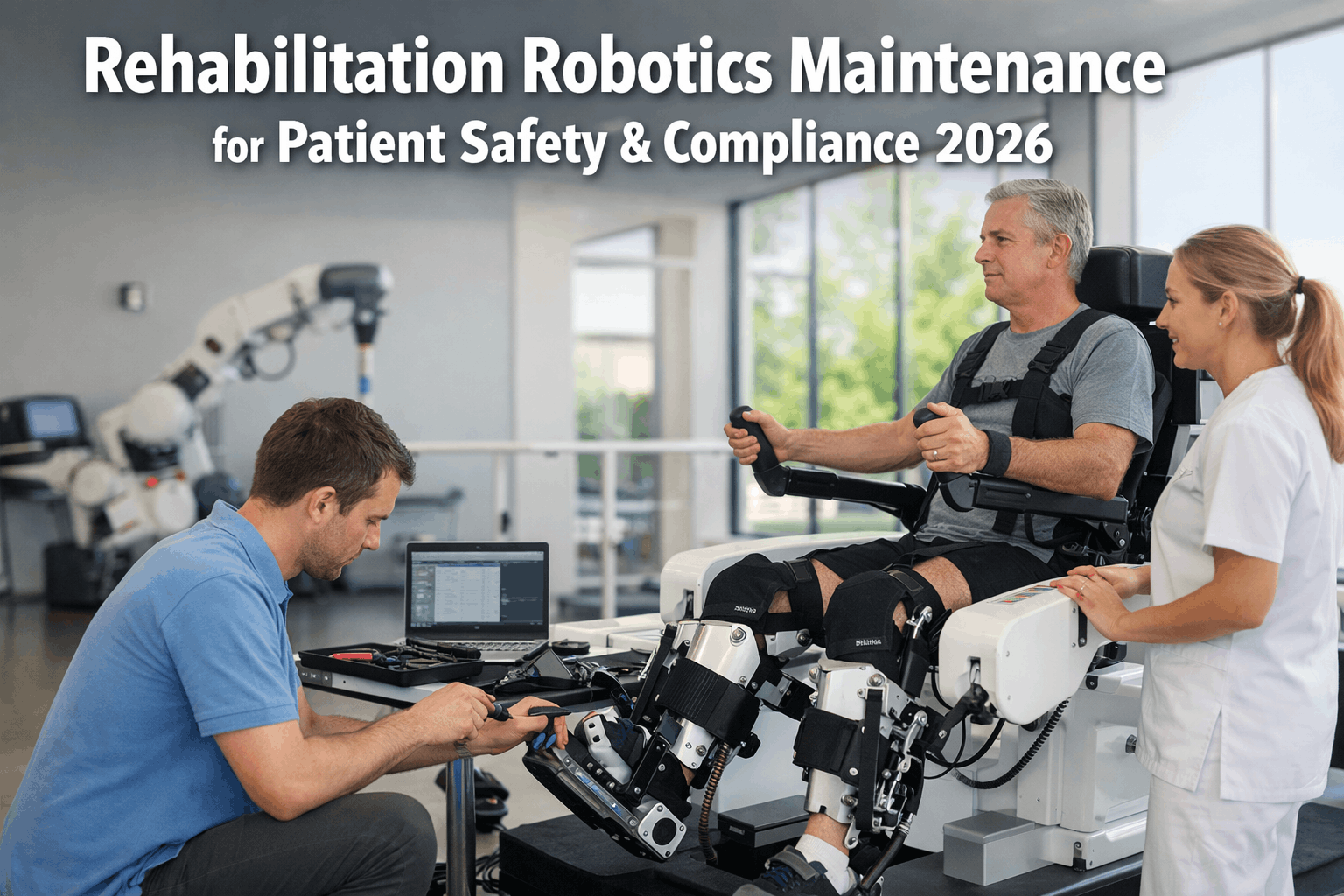
Robotic systems and artificial intelligence are redefining what is possible inside the operating room and the rehabilitation ward. Surgical robots now perform incisions with sub-millimetre accuracy, AI algorithms guide real-time procedural decisions, and rehabilitation exoskeletons restore movement for patients who would have faced years of manual physiotherapy. For healthcare facility managers responsible for the equipment sustaining these advances, keeping high-value robotic assets mission-ready is as critical as the technology itself. If your team is managing complex medical equipment on spreadsheets and reactive work orders, see what a modern approach looks like — start a free trial for 30 days and book a demo with Oxmaint today.
$14.4B
Surgical Robotics Market
Global market value projected by 2028, growing at 10.4% CAGR
21%
Fewer Complications
Robotic-assisted procedures reduce surgical complications versus open surgery
40%
Faster Recovery Times
Patients undergoing robotic surgery return to daily activity up to 40% sooner
6,000+
Robotic Systems Deployed
Active surgical robotic systems in hospitals globally as of 2024
OVERVIEW
What Are Robotics and AI in Surgical Assistance and Rehabilitation?
Surgical robotics combines precision mechatronics with AI-guided imaging to give surgeons enhanced dexterity, tremor elimination, and real-time visual intelligence inside the operating field. Rehabilitation robotics applies sensor-driven exoskeletons, AI movement analysis, and adaptive resistance systems to accelerate and personalise patient recovery far beyond what manual physiotherapy can achieve alone. Together these technologies are compressing procedure times, reducing hospital stays, and delivering measurably better patient outcomes — but they also introduce a class of high-value, high-complexity equipment that demands rigorous, data-driven maintenance management. Want to ensure your robotic assets never fail at a critical moment — start a free trial for 30 days and book a demo to see how Oxmaint keeps complex medical equipment performing at peak condition.
KEY CAPABILITIES
Core Technologies Driving Robotic Surgery and Rehabilitation
The current generation of surgical and rehabilitation robotics operates across four interconnected technology layers — each requiring specialist maintenance protocols, calibration schedules, and performance monitoring to remain safe and effective in clinical environments.
SURGERY
Robotic Surgical Arms
Multi-jointed robotic arms give surgeons 7 degrees of freedom and 10x motion scaling — enabling minimally invasive procedures in confined anatomical spaces with sub-millimetre precision and zero tremor.
AI GUIDANCE
Intraoperative AI Imaging
Real-time AI analysis of intraoperative imaging identifies anatomical boundaries, flags tissue anomalies, and provides surgeons with augmented visual overlays — reducing intraoperative errors by up to 35%.
REHAB
Exoskeleton Rehabilitation
Powered exoskeletons detect muscle activation signals and provide assistive or resistive force in real time — enabling neurologically impaired patients to complete up to 500 repetitions per session versus 50–100 with manual therapy.
ANALYTICS
AI Outcome Prediction
ML algorithms analyse patient biomechanics, recovery trajectory, and protocol adherence to predict optimal therapy intensity — adapting rehabilitation programmes dynamically for each individual patient.
PAIN POINTS
Why Robotic Medical Equipment Management Is Breaking Down
As robotic surgical and rehabilitation systems proliferate across hospital networks, the operational gaps in managing these assets are becoming impossible to ignore. Equipment downtime, compliance failures, and reactive maintenance on multi-million-pound systems carry consequences that go well beyond budget overruns.
!
Unplanned Robotic System Downtime
A single unplanned downtime event for a surgical robotic system can cancel 8–15 procedures per day, costing hospitals $50,000–$150,000 in deferred revenue and patient rescheduling costs per incident.
!
Missed Calibration and Safety Cycles
Robotic surgical and rehabilitation equipment requires strict manufacturer-mandated calibration intervals. Missed cycles create regulatory compliance failures, void warranties, and expose facilities to significant clinical liability.
!
No Asset Condition Visibility
Facilities managing robotic systems on paper records or spreadsheets have zero real-time visibility into component wear, actuator health, or sensor calibration status — until a failure forces emergency response.
!
Fragmented Multi-Site Records
Hospital networks operating robotic systems across multiple sites have no consolidated view of asset condition, maintenance history, or CapEx requirements — making strategic investment decisions based on guesswork.
Protect Your High-Value Robotic Assets With Oxmaint
Oxmaint gives healthcare engineering and facilities teams a unified CMMS for managing surgical and rehabilitation robotics — with condition scoring, preventive scheduling, and multi-site visibility built in from day one.
OXMAINT SOLUTION
How Oxmaint Keeps Robotic Medical Equipment Mission-Ready
Oxmaint is a modern CMMS and asset management platform built for multi-site healthcare and industrial operations. It provides the maintenance intelligence, condition tracking, and operational visibility that facilities teams need to keep complex robotic equipment performing safely at every procedure and every rehabilitation session. Healthcare engineering teams that deploy Oxmaint report significantly fewer unplanned downtime events, stronger compliance documentation, and clearer CapEx planning across their robotic asset portfolios. To see how this applies to your own environment, start a free trial for 30 days and book a demo with an Oxmaint operations specialist.
01
Full Asset Registry With Condition Scoring
Every robotic system, component, and sub-assembly is logged with a live condition score — giving engineering teams instant visibility into asset health across the entire facility portfolio.
02
Preventive Maintenance Scheduling
Maintenance tasks are scheduled automatically based on usage hours, cycle counts, and manufacturer intervals — ensuring calibration, lubrication, and inspection cycles are never missed on high-value robotic assets.
03
Work Order Management With Technician History
Every maintenance event is documented with technician assignment, parts used, labour hours, and resolution notes — building a complete, audit-ready service history for every robotic system on the network.
04
IoT and SCADA Integration
Connect robotic system sensors and building management feeds directly to Oxmaint for real-time performance data — triggering condition-based maintenance alerts before failures can impact clinical operations.
05
Rolling CapEx Forecasting
5–10 year CapEx models built on actual asset condition and lifecycle data — giving directors and portfolio managers the evidence base to justify robotic system replacement and upgrade investment with precision.
06
Audit-Ready GMP Documentation
Digital signatures, timestamped records, and GMP-compliant inspection logs ensure every robotic maintenance event meets regulatory requirements — with zero paper trail and instant retrieval during audits.
See How Leading Healthcare Teams Manage Robotic Assets With Oxmaint
Replace spreadsheets and reactive maintenance with predictive, data-driven asset management. No lengthy implementation. No heavy onboarding fees. Up and running in days.
COMPARISON
Reactive vs Preventive Management of Robotic Medical Equipment
The financial and operational gap between reactive and preventive maintenance approaches is most pronounced with high-value robotic assets, where a single unplanned failure carries costs — in equipment repair, deferred procedures, and compliance exposure — that dwarf the entire annual preventive maintenance budget.
| Dimension |
Reactive Maintenance |
Preventive with Oxmaint |
| Maintenance Trigger |
Equipment failure or visible degradation |
Usage hours, cycle counts, and condition-based alerts |
| Downtime Events |
Frequent, unpredictable, operationally disruptive |
Near-eliminated with scheduled maintenance windows |
| Repair Cost Profile |
Emergency repair costs average 4.8x planned maintenance |
Planned maintenance at standard cost, no emergency premium |
| Calibration Compliance |
Missed intervals, warranty voids, regulatory risk |
Automated scheduling ensures 100% compliance with manufacturer cycles |
| Asset Condition Visibility |
None until failure — blind spot across entire asset fleet |
Real-time condition scores across every robotic system and component |
| Audit Documentation |
Paper records, incomplete logs, manual retrieval |
Digital signatures, full audit trail, instant retrieval |
| CapEx Planning |
Budget decisions based on assumption and guesswork |
5–10 year CapEx forecasting built from actual asset lifecycle data |
| Multi-Site Visibility |
Siloed records with no consolidated portfolio view |
Single dashboard across all sites, systems, and asset hierarchies |
ROI AND RESULTS
What Proactive Robotic Asset Management Delivers
4.8x
Emergency Repair Premium
The cost multiplier of reactive versus planned maintenance on complex robotic systems — eliminated with Oxmaint preventive scheduling
25%
Reduction in Downtime
Facilities using CMMS-managed preventive maintenance on medical equipment report up to 25% fewer unplanned downtime events annually
100%
Audit Trail Completeness
Digital work orders and GMP-compliant documentation ensure complete, retrievable maintenance records across every robotic asset
10 Yrs
CapEx Forecast Horizon
Rolling 5–10 year CapEx forecasting built from real condition data — replacing guesswork with investment-grade asset lifecycle intelligence
FREQUENTLY ASKED QUESTIONS
Common Questions on Robotics, AI, and Surgical Asset Management
What types of surgical robots are currently used in clinical environments?
The most widely deployed surgical robotic platforms include da Vinci systems for laparoscopic and urological procedures, Mako systems for orthopaedic joint replacement, Rosa Brain for neurosurgery, and Versius for abdominal and gynaecological surgery. Each platform involves a complex assembly of robotic arms, end-effectors, camera systems, and AI-guided imaging modules — all of which require rigorous, manufacturer-compliant preventive maintenance schedules to remain safe and effective in clinical use. Facilities managing multiple platforms benefit from a unified CMMS that handles each system's specific maintenance requirements within a single dashboard.
How does AI improve outcomes in rehabilitation robotics specifically?
AI in rehabilitation robotics works by continuously analysing patient movement quality, muscle activation patterns, and recovery trajectory data — then adjusting resistance levels, session intensity, and therapy protocols in real time. This adaptive approach allows rehabilitation exoskeletons to deliver up to 500 repetitions per session compared to 50–100 in manual physiotherapy, with the added benefit of consistent, measurable data on patient progress. AI-powered rehab systems also identify compensatory movement patterns that could lead to re-injury, flagging them for clinical review before they become a problem. The maintenance implication is significant — these systems require regular sensor calibration to ensure the AI receives accurate biomechanical inputs.
Why is preventive maintenance critical for robotic surgical systems specifically?
Robotic surgical systems are among the highest-value, highest-criticality assets in any hospital facility. A single unplanned downtime event can cancel 8–15 procedures in a single day, generating $50,000–$150,000 in deferred revenue and patient impact costs. Beyond financial impact, missed calibration cycles on robotic arms or imaging systems introduce clinical risk and can void manufacturer warranties. Regulatory bodies in the USA, UK, Australia, and Germany all require documented maintenance records for robotic medical devices — making comprehensive, audit-ready CMMS documentation a compliance requirement, not just an operational preference.
How does Oxmaint support healthcare engineering teams managing robotic equipment?
Oxmaint provides a complete asset management platform built for multi-site healthcare and industrial operations. For robotic surgical and rehabilitation equipment, this means a full asset registry with component-level condition scoring, automated preventive maintenance scheduling based on usage cycles and manufacturer intervals, IoT integration for real-time performance monitoring, GMP-compliant digital documentation, and rolling CapEx forecasting built from actual asset lifecycle data. The platform requires no heavy implementation fees, no months of onboarding, and is mobile-first — meaning technicians can log work orders and inspections from the floor on any device. Multi-site hospital networks gain a single consolidated view of every robotic asset across the entire portfolio.
GET STARTED WITH OXMAINT
Keep Your Robotic Systems Operating at Peak Condition — Every Day
Oxmaint gives healthcare engineering and facilities teams a unified CMMS platform to manage complex robotic assets with the precision they demand. Full condition scoring, preventive maintenance scheduling, IoT integration, GMP documentation, and multi-site CapEx forecasting — all in one platform. No heavy implementation fees. No lengthy onboarding. See measurable results within days of deployment.