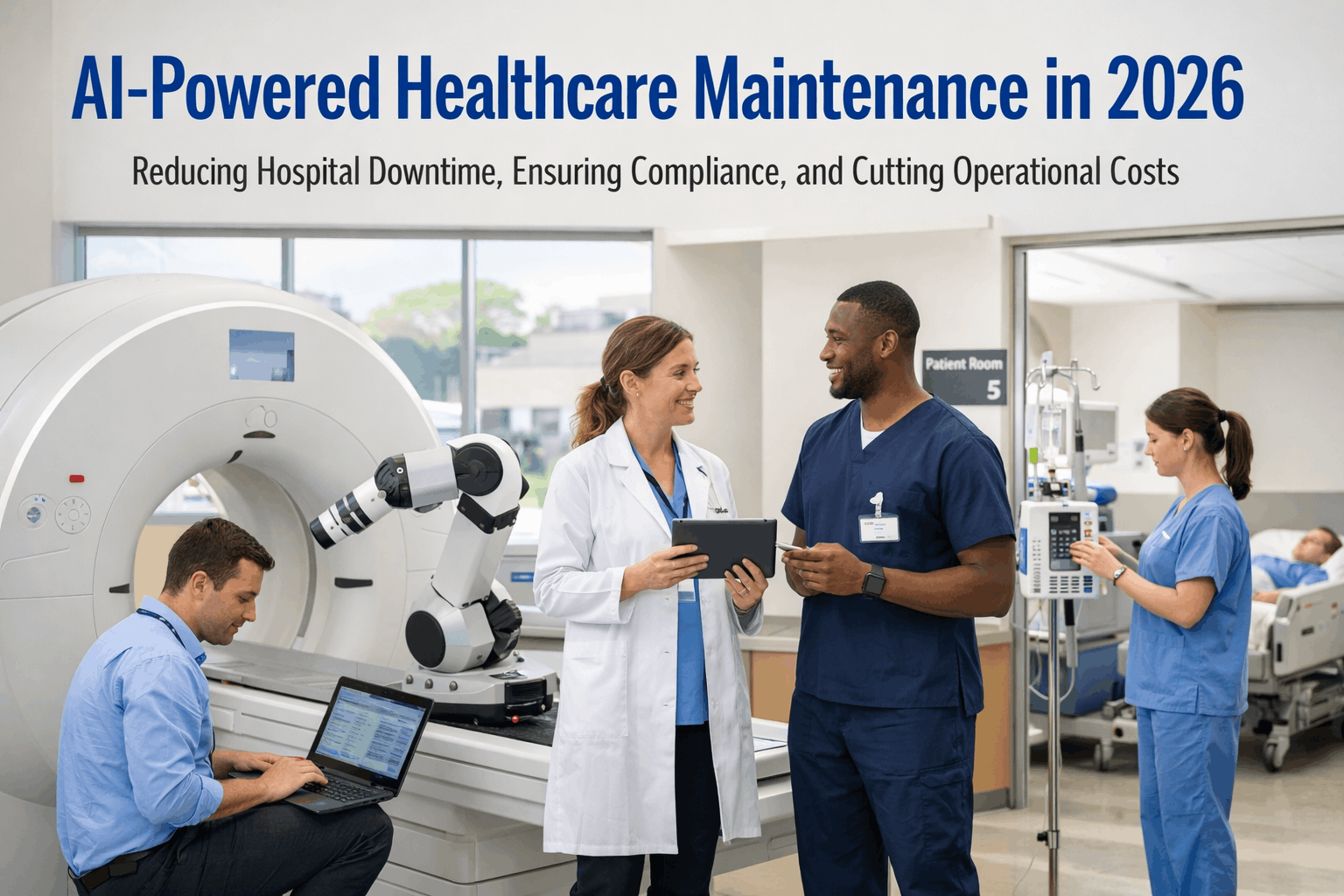
Healthcare facilities operate under a standard of operational accountability that most industries never experience — where a failed HVAC unit can compromise a sterile field, a broken sterilizer can halt an entire surgical schedule, and a missing maintenance record can trigger a Joint Commission citation. For facility directors, maintenance managers, and hospital operations leaders, the gap between reactive maintenance and a structured, data-driven program is not a matter of preference — it is a measurable difference in patient outcomes, regulatory standing, and bottom-line cost. CMMS software for healthcare facilities closes that gap systematically. Want to see how it maps to your specific environment? start a free trial or book a demo with the Oxmaint team today.
Structured Maintenance Starts Here
Oxmaint gives healthcare facility teams automated PM scheduling, audit-ready documentation, and full asset lifecycle visibility — in one platform built for clinical environments.
What Is CMMS Software for Healthcare Facilities?
A Computerized Maintenance Management System (CMMS) is the operational platform that centralizes every maintenance function in a healthcare facility — asset tracking, preventive maintenance scheduling, work order management, parts inventory, compliance documentation, and capital planning — into a single, auditable system. Where older tools issued static alerts and rule-based checklists, a modern healthcare CMMS integrates data from every asset in the facility, generates automated work orders based on time, runtime, or sensor thresholds, and produces documentation that satisfies regulatory requirements without manual reconstruction.
For hospital maintenance managers and facility directors, the practical difference is this: a CMMS replaces reactive firefighting with scheduled, traceable, budget-predictable operations. Every ventilator, every sterilizer, every chiller, and every generator has a full maintenance history, a condition score, and a projected end-of-life date. Auditors do not get paper logs — they get exportable records with timestamps and digital signatures. Finance teams do not get surprise capital requests — they get rolling 5–10 year CapEx models grounded in real asset condition data. Your team does not have to manage this alone — start a free trial and have your first PM schedule running within a day.
Traditional CDSS and maintenance logs ask: "Did this task get done?" A healthcare CMMS asks: "What is the condition of every asset, what is the risk of failure, and what intervention produces the best risk-adjusted outcome for the facility?" That distinction is the difference between compliance and operational excellence.
Top 10 Benefits of CMMS Software for Healthcare Facilities
Each benefit below is grounded in documented outcomes from healthcare facilities that moved from manual or fragmented maintenance operations to a structured CMMS platform. These are not vendor projections. They are measurable, reproducible improvements that show up in maintenance budgets, compliance audits, and asset lifecycle data. If any of these look like gaps in your current operation, book a demo and walk through how Oxmaint addresses them specifically.
Manual scheduling breaks down at scale. Intervals get missed, equipment gets skipped, and compliance records develop gaps that take weeks to reconstruct before an audit. CMMS auto-generates PM work orders based on calendar intervals, runtime hours, or cycle counts — whichever trigger applies to each specific asset. Healthcare facilities using automated PM scheduling report up to 40% fewer unplanned equipment failures in the first year. The system does not need a reminder. It never misses a due date. Start a free trial and configure your first automated PM schedule in under 20 minutes.
Joint Commission, CMS, OSHA, NHS, and equivalent bodies in Australia and the UAE all require documented, timestamped maintenance histories for every regulated asset class. CMMS creates that record automatically — every inspection, every PM, every repair, every sign-off — without any additional administrative effort from your team. When the surveyor arrives, the documentation is there. Audit prep time drops from days to hours. Facilities using Oxmaint report audit preparation time reductions of up to 70%. If a regulatory review is approaching, book a demo and see the compliance reporting module in full.
Every asset in a healthcare facility — from infusion pumps and imaging systems to centrifuges and backup generators — has a useful life that degrades in ways that are measurable if you are tracking the right signals. CMMS assigns a condition score to every asset based on maintenance history, repair frequency, and age-relative-to-expected-life. Capital replacement decisions stop being guesswork. Facilities tracking asset lifecycle through CMMS extend average equipment useful life by 18–24% while eliminating the surprise capital requests that derail annual budgets.
In healthcare, equipment downtime is not an inconvenience — it is a patient safety event and a revenue disruption. An MRI that fails during a scheduled scan day, a sterilizer that goes down during a high-volume surgical schedule, or a chiller that fails mid-summer all carry consequences that reach far beyond the maintenance budget. CMMS reduces mean time to repair (MTTR) by 28–35% through faster work order routing, real-time parts availability checks, and optimized technician assignment. Critical systems stay operational because issues are caught before they become failures.
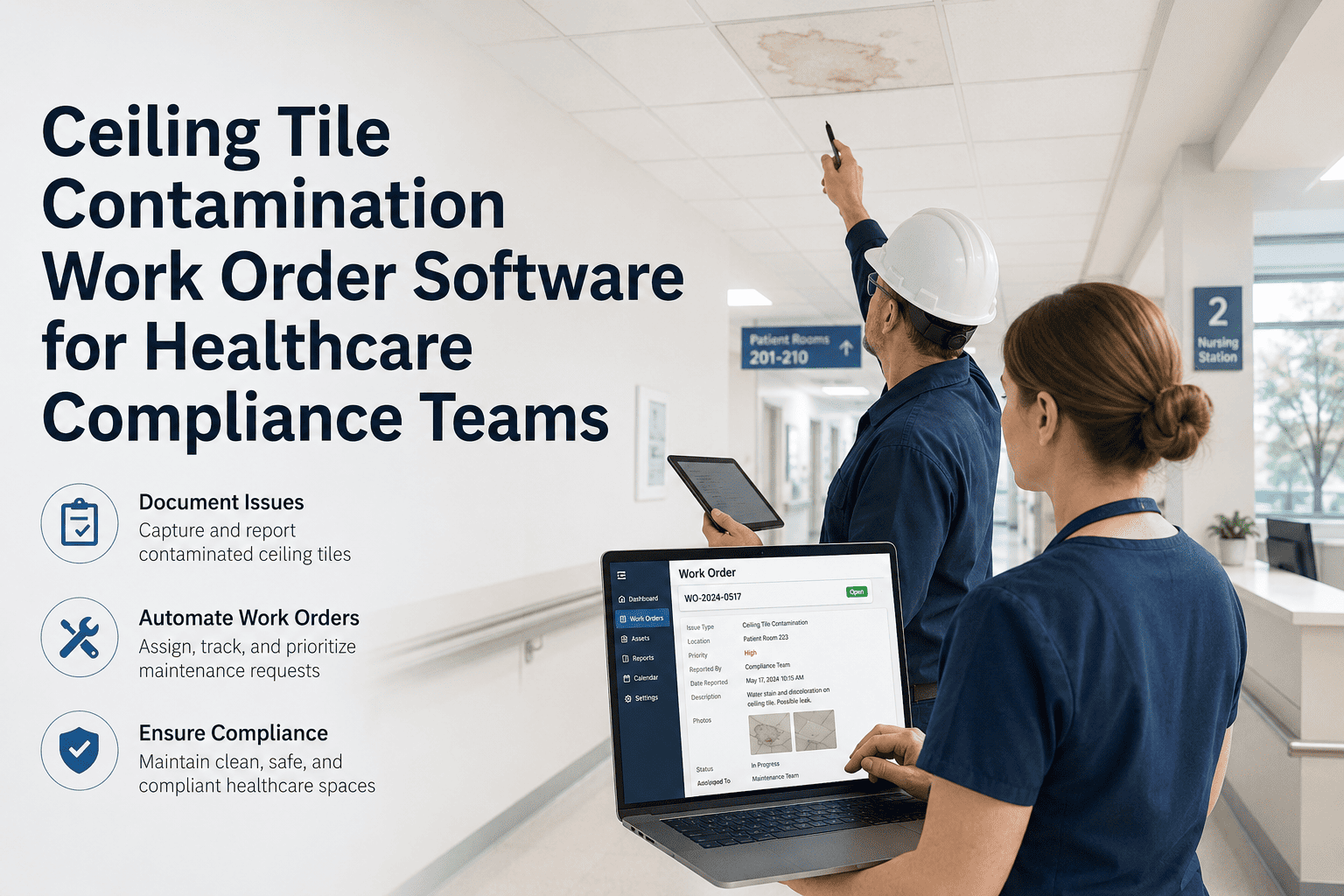
Paper-based work orders are lost, delayed, incomplete, and impossible to analyze at scale. Digital work order management through CMMS captures every step from submission to closure — priority routing, technician assignment, parts used, time logged, photos attached, and digital sign-off — in a single mobile-accessible workflow. Hospital maintenance teams reduce work order backlogs by an average of 45% within 90 days of platform adoption. The administrative overhead that was consuming technician time shifts to billable maintenance hours.
Running out of a critical part during an emergency repair is a preventable failure — and it happens consistently in facilities managing inventory through spreadsheets or memory. CMMS tracks parts stock in real time, triggers reorder alerts at minimum thresholds, and links every parts transaction to a specific work order and asset. Emergency procurement at premium pricing drops sharply. Healthcare facilities using CMMS inventory management reduce emergency parts costs by up to 22% annually. Start a free trial to see the inventory module in your own environment.
Time-based maintenance schedules miss failures that develop between intervals. Sensor-based condition monitoring does not. By integrating IoT sensors and SCADA data directly into the CMMS, facilities can trigger maintenance work orders automatically when a chiller's vibration signature deviates, a generator's runtime exceeds threshold, or a sterilizer's cycle time drifts outside spec. Predictive maintenance based on real-time sensor data reduces critical system failures by up to 50% compared to time-interval scheduling alone — and eliminates the cost of over-maintenance on assets that are not yet due.
The annual capital budget process in most healthcare facilities is a negotiation between what finance wants to spend and what operations knows is actually needed — with neither side having reliable data. CMMS changes that dynamic by generating rolling 5–10 year CapEx models built on real asset condition scores, maintenance cost histories, and expected remaining useful life. CFOs see exactly what equipment will need replacement and when, backed by data. No surprises in the budget cycle. No emergency capital requests mid-year. Book a demo to see the CapEx forecasting model configured for your asset base.
HVAC failures, sterilizer malfunctions, water system contamination events, and medical gas pressure deviations are not abstract risks — they are documented patient safety incidents with regulatory consequences. CMMS ensures these critical systems are maintained on schedule with GMP-compliant digital inspection forms, automated escalation when inspections are overdue, and full audit trails that demonstrate ongoing compliance. Infection control documentation is generated automatically. 73% of hospital-acquired infection events investigated by regulatory bodies involved lapses in environmental maintenance documentation.
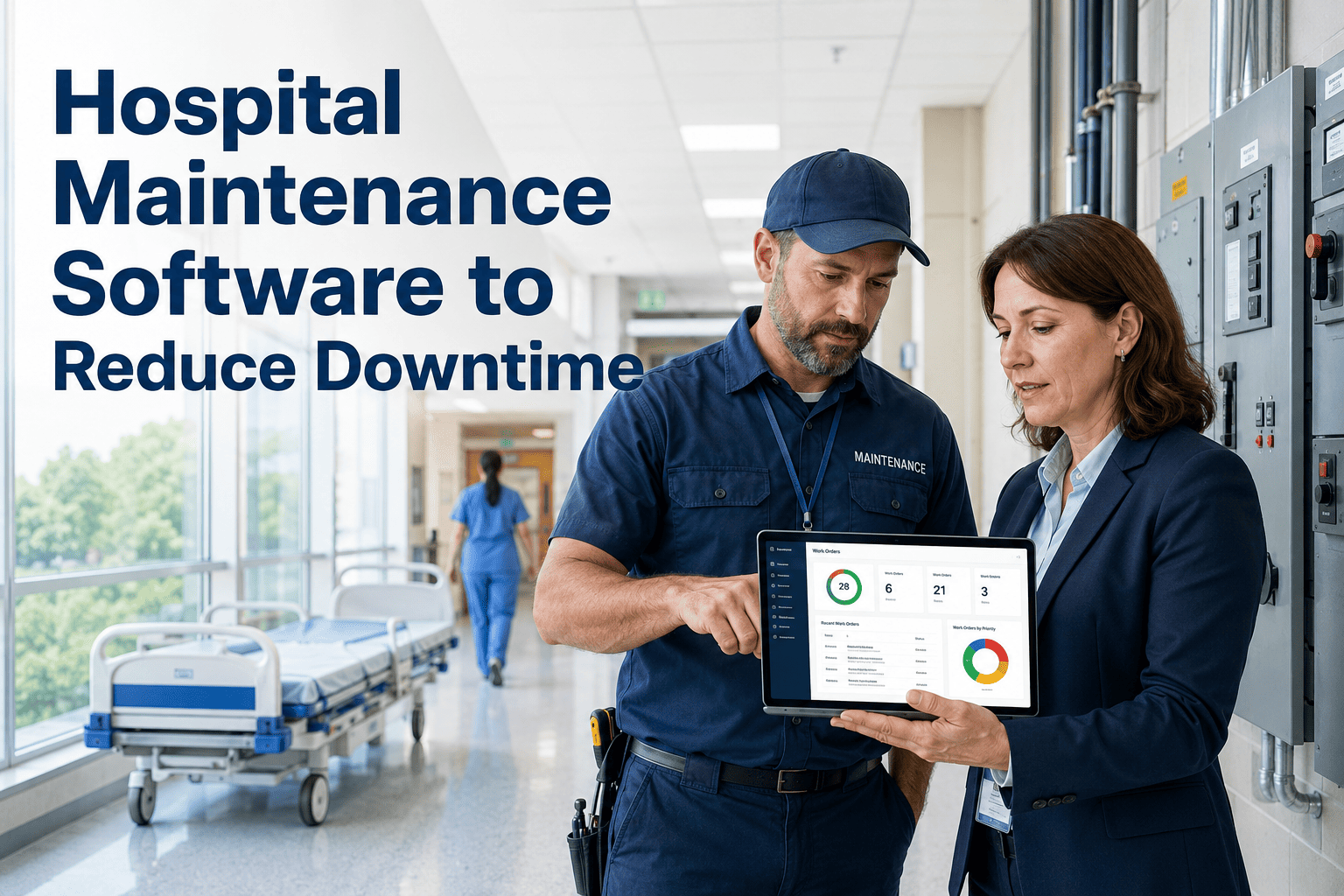
Hospital groups and integrated health networks managing multiple facilities operate blind when each site uses disconnected systems. A single Oxmaint portfolio dashboard surfaces maintenance KPIs, compliance status, asset conditions, and work order performance across every property simultaneously — enabling cross-site benchmarking, resource reallocation, and capital prioritization decisions that are simply not possible without centralized data. Portfolio managers and VPs of Operations use this view to identify underperforming sites, justify capital investment, and demonstrate operational maturity to ownership groups and investors. Start a free trial and connect your first two sites to see the portfolio view in action.
Core Pain Points CMMS Directly Eliminates
Before CMMS, the same operational failures repeat across healthcare facilities regardless of size, geography, or ownership structure. Identifying them is straightforward. Quantifying the cost is what typically drives action.
Teams spending 60–70% of their time responding to breakdowns rather than preventing them. Emergency repairs cost 4.8x more per incident than scheduled maintenance on the same asset.
Manual logs are incomplete, inconsistent, and audit-vulnerable. 82% of facilities on paper-based systems fail at least one compliance audit item annually — often on easily preventable documentation gaps.
CapEx decisions made on gut feel because no condition scoring exists. Assets get replaced too early or run past failure — both scenarios waste capital that is already under pressure in most healthcare budgets.
Multi-site health networks with disconnected systems have no cross-portfolio intelligence — no benchmarking, no pattern recognition, no ability to redirect resources from low-need sites to high-need sites in real time.
No real-time inventory visibility means parts are over-stocked on low-usage items and critically under-stocked on high-failure components — driving emergency procurement costs that are entirely avoidable.
Paper work orders, manual log entries, and phone-based job routing consume 30–40% of maintenance technician time that should be allocated to hands-on preventive maintenance tasks.
Reactive Maintenance vs. CMMS-Driven Preventive Maintenance
The operational and financial gap between reactive and preventive maintenance in healthcare is not incremental — it is structural. This comparison uses real-world healthcare facility data benchmarks to show what is actually at stake in the decision to adopt CMMS.
| Operational Area | Without CMMS — Reactive | With CMMS — Preventive |
|---|---|---|
| Maintenance Cost Model | Emergency repairs dominate — 4.8x higher cost per incident | Planned PM at 1x cost, budget predictable 12 months out |
| Equipment Downtime | Unplanned failures — avg. $1.55M cost per hour in critical systems | Downtime reduced 28–35% through proactive maintenance cycles |
| Compliance Documentation | Manual logs — incomplete, inconsistent, audit-vulnerable | Audit-ready digital records — timestamps, signatures, exportable |
| Asset Lifecycle Visibility | No condition scoring — CapEx decided on gut feel and history | Full lifecycle tracking — asset useful life extended 18–24% |
| Work Order Resolution | Paper-based, delayed routing — avg. 72-hour resolution time | Digital routing — resolution time cut by 45% within 90 days |
| Parts Inventory | Unknown stock levels — emergency procurement at premium pricing | Real-time inventory with auto-reorder — 22% cost savings annually |
| Multi-Site Intelligence | Siloed records — no cross-portfolio benchmarking possible | Centralized portfolio dashboard — KPIs benchmarked across all sites |
| Patient Safety Exposure | Critical system failures expose patients and increase liability | Proactive monitoring reduces critical system failures by up to 50% |
How Oxmaint Delivers These Benefits in Healthcare
Oxmaint is not a general-purpose maintenance tool adapted for healthcare. It is built for multi-site commercial and industrial operations — including healthcare networks that cannot afford gaps in maintenance coverage, documentation, or capital visibility. Here is the platform capability that maps directly to the ten benefits above.
Every asset tagged, categorized, and condition-scored. Full hierarchy from Portfolio down to Component — HVAC chillers to defibrillators, all in one registry.
Calendar, runtime, and cycle-count triggers. Auto-generates work orders, assigns technicians, and tracks completion with GMP-compliant digital sign-off.
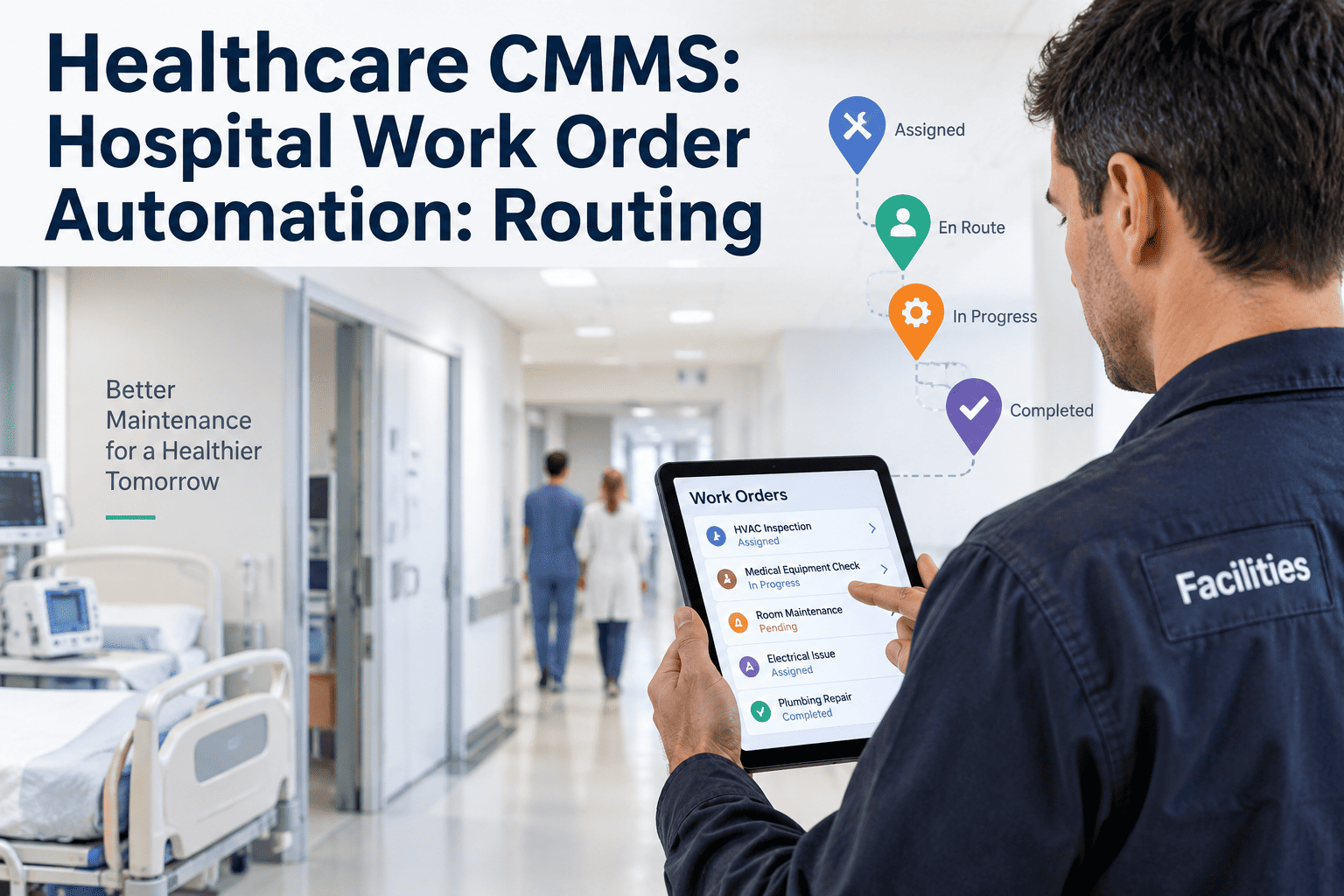
End-to-end digital work orders. Priority routing, photo documentation, parts logging, full technician history, and mobile access from any device on-site.
Connect real-time sensor data to maintenance triggers. When a critical system deviates from threshold, a work order fires automatically — before failure occurs.
Rolling 5–10 year capital plans built on real asset condition data. Investor-grade reports ready for board and finance review — no spreadsheet modeling needed.
Every maintenance action timestamped, signed, and exportable. Pass Joint Commission, CMS, OSHA, and NHS audits with a complete, defensible compliance record.
Technicians access work orders, log repairs, and complete inspections from any smartphone or tablet — no desktop, no paper forms, no manual data re-entry.
Cross-site KPI dashboards for VPs and ownership groups. Benchmark compliance rates, asset conditions, and cost-per-square-foot across every property in your network.
ROI from Healthcare CMMS — Documented Results
The return on CMMS investment in healthcare is not speculative. These figures are drawn from documented outcomes at healthcare facilities that transitioned from manual maintenance management to structured CMMS platforms. Most facilities recover their full platform investment within 6–12 months.
Healthcare CMMS Compliance Across Key Regulatory Frameworks
Healthcare facilities in different markets operate under different regulatory frameworks — but all share the same core requirement: documented, defensible, timestamped maintenance records for every regulated asset class. Oxmaint generates these records automatically, across all markets.
Automated PM documentation, digital signatures, and full maintenance histories that satisfy EC and LS chapter requirements. Audit prep time cut by up to 70% for surveyor readiness.
Lockout/tagout procedure documentation, equipment inspection logs, and hazardous area maintenance records — all audit-ready, searchable, and linked to specific asset records.
NHS Health Technical Memoranda compliance tracking for medical gas, electrical systems, and plant room maintenance — with full timestamped documentation and digital sign-off chains.
Australian Commission on Safety and Quality in Health Care standards met through GMP-compliant digital inspection forms and real-time compliance reporting dashboards.
Frequently Asked Questions
How long does CMMS implementation take in a hospital environment?
Most healthcare facilities are fully operational on Oxmaint within 2–4 weeks. No heavy IT implementation, no custom coding, no extended onboarding contracts. Asset registries can be imported from existing spreadsheets, PM schedules configured by your own team, and technicians mobile-trained in a single shift. Complex multi-site hospital networks with large asset libraries typically complete full deployment within 60–90 days. The fastest path is to start a free trial and test the setup process with your own data before any commitment.
Can CMMS software satisfy Joint Commission and CMS audit requirements?
Yes. Oxmaint generates timestamped, digitally signed maintenance records for every work order, inspection, and PM completion. Records are fully exportable and organized by asset, date, technician, and maintenance type — exactly the format Joint Commission and CMS auditors require for EC and LS chapter compliance. Facilities using Oxmaint report audit preparation time reductions of 70% compared to manual documentation processes. Book a demo to see the compliance reporting module in detail.
What is the typical ROI timeline for healthcare CMMS software?
Most healthcare facilities recover their full CMMS investment within 6–12 months. Primary ROI drivers are: reduction in emergency repair costs (4.8x higher than planned), labor efficiency gains from digital work order management, extended equipment lifespan reducing CapEx spend, and compliance penalty reduction from audit-ready documentation. For a 200-bed hospital managing 2,000+ assets, conservative ROI modeling projects $180,000–$450,000 in first-year savings against a platform cost well under $50,000 annually.
Does Oxmaint support multi-site hospital networks and healthcare portfolios?
Oxmaint is purpose-built for multi-site operations. The asset hierarchy — Portfolio, Property, System, Asset, Component — maps directly to how hospital groups and integrated health networks are structured. A single dashboard shows maintenance KPIs, compliance status, asset conditions, and work order backlogs across every facility in your network. Portfolio managers can benchmark sites, identify outliers, and prioritize capital allocation based on real data. Book a demo to see the multi-site portfolio view configured for your network structure.
Your Facility Deserves Better Than Reactive Maintenance
Every day without a CMMS is a day of compounding risk — rising repair costs, compliance gaps, and equipment failures that could have been prevented. Oxmaint gives your team automated PM, real-time asset visibility, audit-ready documentation, and investor-grade CapEx reporting. No long implementation. No heavy fees. Live in weeks, not months. No credit card required. 30-day free trial.
.jpg)
.jpeg)