Validation teams at pharmaceutical manufacturers carry a mandate that goes beyond the initial CSV project. Every change to a CMMS configuration, every new PM procedure, and every updated maintenance form needs to be evaluated for validation impact, documented with a change control record, and retained in an immutable audit trail that satisfies 21 CFR Part 11. Legacy CMMS platforms were not designed for ongoing validation maintenance, and most validation teams are spending more time managing the validation burden of a non-compliant CMMS than they spend on actual validation projects. OxMaint was built from its data architecture to its user interface with validation teams as the primary compliance stakeholder. Book a demo to walk through the OxMaint validation framework with a pharma validation specialist, or start a free trial and access the complete GAMP 5 validation package index before committing to deployment.
6 weeks
Typical CMMS validation timeline with OxMaint pre-built IQ/OQ/PQ package vs 18 months from scratch
Part 11
Pre-validated audit trail, e-signatures, and access control architecture — not configured post-deployment
100%
Of configuration changes subject to change control workflow with full audit trail
GAMP 5
Category 4 software validation framework with pre-built risk assessment and functional testing protocols
What validation teams are actually responsible for in a CMMS
The ongoing validation obligation most teams underestimate
The initial CMMS CSV project is well understood. What is often underestimated is the continuous validation maintenance obligation that follows go-live. Every configuration change, new form template, updated PM procedure, or role permission adjustment in a GxP-relevant CMMS needs to be assessed for validation impact, documented, and approved. Without a CMMS that has change control built into its core architecture, validation teams end up managing a spreadsheet of configuration changes made outside any formal process, creating exactly the kind of data integrity gap that triggers Form 483 observations.
01
Initial system validation
IQ/OQ/PQ execution against the configured CMMS environment, including all GxP-relevant modules, risk assessment, and functional testing protocol completion.
02
Change control for every configuration update
PM procedure edits, new form templates, role permission changes, and workflow modifications all require validation impact assessment and change control documentation.
03
Periodic review of validated state
Validated CMMS systems require periodic review to confirm the validated state has not been degraded by configuration drift, user-managed data edits, or undocumented changes.
04
Electronic signature integrity management
E-signature controls must be maintained, tested, and documented to demonstrate continued compliance. User account deactivation, role changes, and shared credential prevention are all validation team responsibilities.
05
Audit trail completeness verification
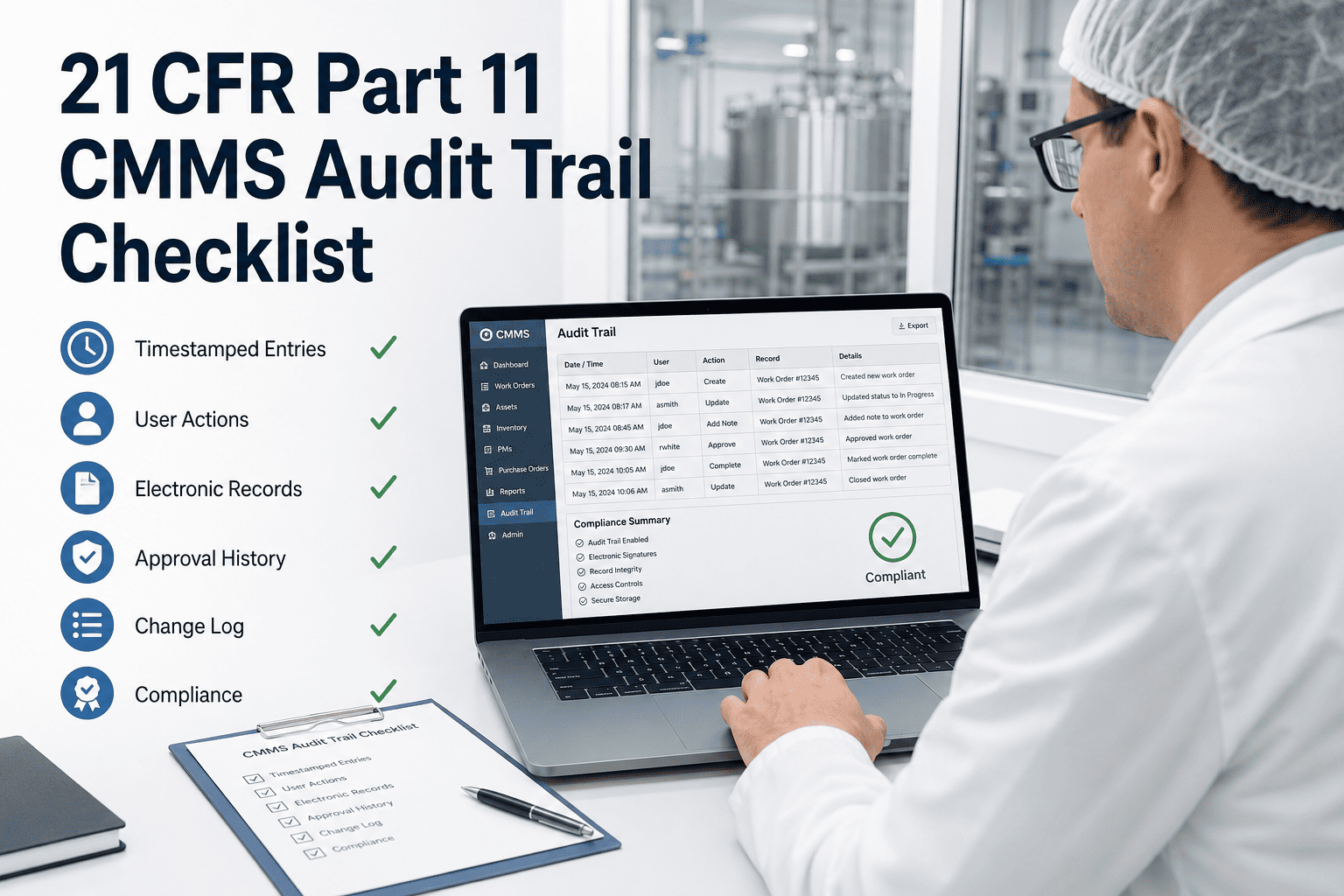
Periodic verification that the CMMS audit trail is capturing all required events, no records can be modified without a trail entry, and the audit trail itself cannot be edited or deleted by any user role.
06
Validation evidence for inspection
Maintaining an accessible validation binder, including the current validation status, the complete change history since initial qualification, and all periodic review records, ready for investigator access at any time.
Validation package contents
What OxMaint delivers to your validation team at deployment
| Validation Deliverable |
Standard Approach |
OxMaint Approach |
Time Saved |
| IQ/OQ/PQ protocol set |
Written from scratch by validation team |
Pre-built, site-configurable protocol templates supplied |
8 to 12 weeks |
| Risk assessment documentation |
Manual risk inventory, no template |
GAMP 5 risk assessment matrix supplied with all module risks pre-assessed |
3 to 4 weeks |
| Functional testing scripts |
Custom-written per CMMS configuration |
Module-level test scripts supplied, adapted during OQ execution |
4 to 6 weeks |
| Part 11 compliance evidence |
Vendor attestation letter, limited evidence |
Pre-validated architecture documentation with audit trail, e-signature, and access control evidence per module |
2 to 3 weeks |
| Change control procedure for CMMS |
Created post-deployment, often never formalised |
Change control procedure template supplied and built into system architecture |
Ongoing compliance maintained |
| Validation binder maintenance |
Manual updates, often incomplete |
System change log feeds directly into living validation record, no manual reconciliation |
12+ hours per change event |
For pharma validation teams
Reduce your CMMS validation timeline from 18 months to 6 weeks
OxMaint's pre-built GAMP 5 validation package is reviewed with your team during onboarding, not assembled from scratch by your validation engineers. Book a 30-minute demo and walk through the full package index with our pharma validation specialist before you commit to anything.
Change control architecture
How OxMaint enforces change control on every configuration update
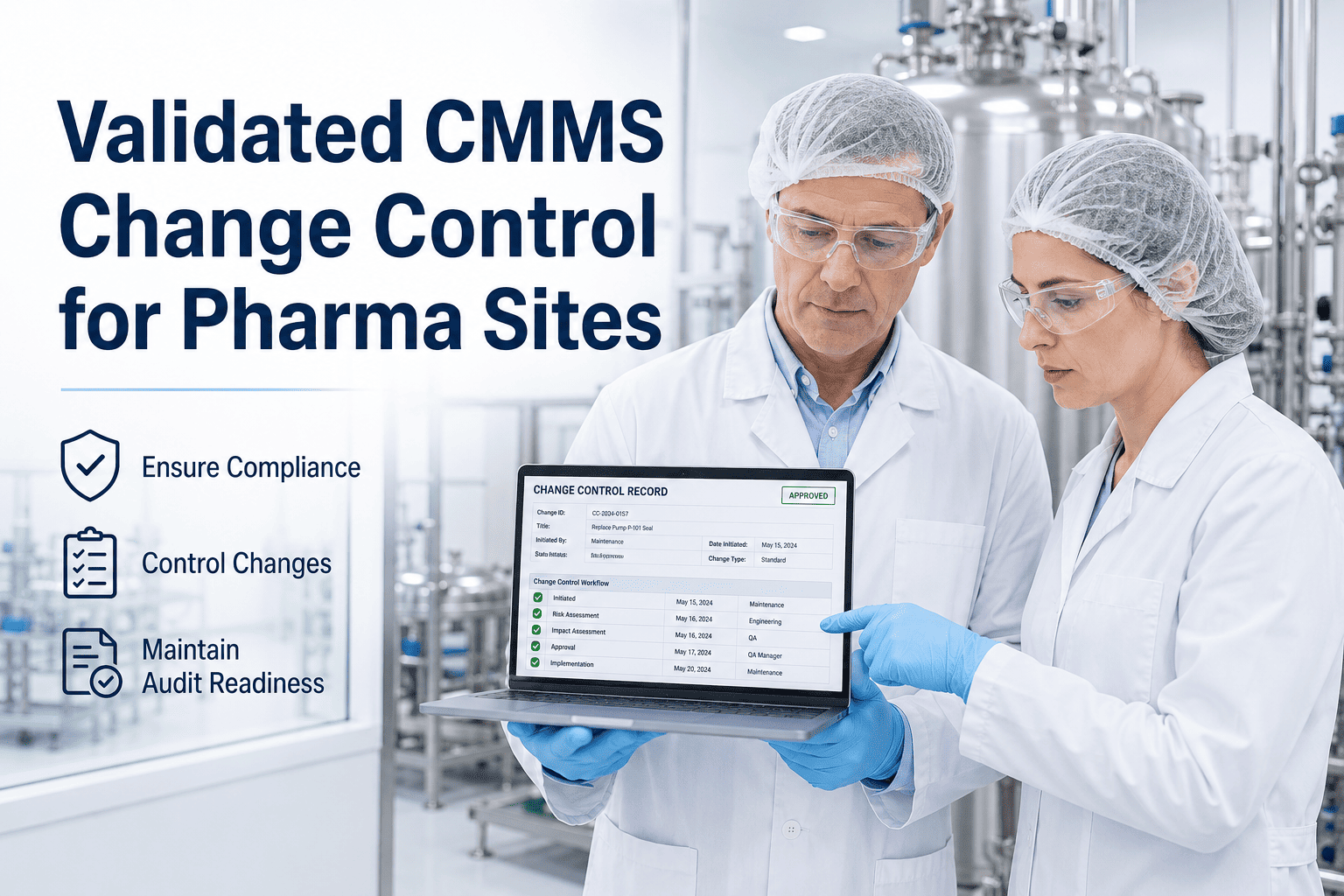
Configuration changes in OxMaint do not happen outside the change control workflow. Every modification to a GxP-relevant setting, form, procedure, or role permission triggers a mandatory change request workflow before the change takes effect. This is built into the system architecture, not a procedural control that depends on users following a separate SOP.
1
Change request initiated
Any user can initiate a change request. The request captures change description, business justification, and validation impact classification before submission.
2
Validation impact assessment
Validation team reviews the request and classifies its impact as minor, moderate, or major. Classification determines the testing and documentation requirements before approval.
3
QA electronic approval
QA lead provides a Part 11-compliant electronic signature approving the change. The change cannot be applied to the live system until this approval is received.
4
Change applied, audit trail updated
The change is applied to the system. The complete change record, including original value, new value, requester, approver, timestamp, and validation impact classification, is added to the immutable audit trail.
5
Validation binder automatically updated
The change is automatically reflected in the living validation record. No manual reconciliation is required. The validation binder is always current with the deployed system state.
Expert review
What pharma validation leads say about CMMS validation burden
NP
The single biggest validation time sink I have seen at pharmaceutical sites is not the initial CMMS CSV project. It is the ongoing maintenance of the validated state after go-live. Sites that deploy a CMMS without built-in change control end up with a growing backlog of undocumented configuration changes, a validation binder that no longer reflects the system as deployed, and a validation team spending most of their time trying to reconstruct change history rather than doing productive validation work. A CMMS with change control built into its architecture eliminates that problem entirely. The validation team can focus on new validation projects rather than managing the audit debt of a system that was never designed for it.
Nisha Patel
Head of Computer Systems Validation — Contract Pharmaceutical Manufacturing — Former CSV Lead at two Big Pharma global sites — 16 years CMMS and ERP validation
Frequently asked questions
Questions from pharma validation teams
Is OxMaint classified as a Category 4 application under GAMP 5, and does it come with a pre-built validation package?
OxMaint is classified as a GAMP 5 Category 4 configured software application. The pre-built validation package includes IQ/OQ/PQ protocol templates, a GAMP 5 risk assessment matrix with all modules pre-assessed, functional test scripts, and Part 11 compliance architecture documentation. The package is reviewed with your validation team during the onboarding phase and customised to your site configuration, reducing typical CMMS validation timelines from 18 months to approximately 6 weeks.
Book a demo to review the full package index with our pharma validation specialist.
How does OxMaint handle electronic signatures to satisfy 21 CFR Part 11.50 requirements?
OxMaint uses a unique-user electronic signature architecture where every signature is linked to the specific user's identity, the record being signed, and an immutable timestamp. Signatures cannot be copied, reassigned, or applied to records other than those signed. Shared login credentials are prevented at the architecture level, not by procedural control. The Part 11 signature compliance evidence is included in the validation package as a documented test protocol with pass records.
Start a free trial to test the e-signature workflow in a sandbox environment before committing to deployment.
What happens to validation status when OxMaint releases a software update?
OxMaint provides advance release notes for all software updates with a validation impact assessment per module. Updates are applied to a staging environment first for validation team review before production deployment. OxMaint's continuous validation support team coordinates the impact assessment process, provides supplemental OQ testing scripts for changed functionality, and updates the customer's validation binder documentation. No update is applied to the production environment without the customer's validation team approval.
Book a demo to walk through the update management protocol in detail.
Can the validation team configure which actions in OxMaint require an electronic signature without involving IT?
Yes. OxMaint has a signature requirement configuration panel accessible to system administrators with the QA or validation lead role. The validation team can define which work order types, record closure events, configuration changes, and deviation closures require a Part 11-compliant electronic signature. Configuration changes to the signature requirements are themselves subject to change control workflow, maintaining a complete audit trail of all signature policy decisions.
Start a free trial to explore the signature configuration panel and set up your site-specific signature matrix.
Validation team priority
A CMMS that manages its own validated state so your validation team does not have to
OxMaint reduces the ongoing validation maintenance burden of a pharma CMMS by building change control, audit trail management, and e-signature compliance into the system architecture. Your validation team reviews a pre-built package, not writes one from scratch. A 30-minute conversation with our pharma validation specialist will show you the complete package, the change control architecture, and the ongoing update management process in detail.