The FDA issued 303 drug warning letters in FY 2025 — a 59% jump from 190 in FY 2024 — and across the warning letters reviewed for cause, inadequate CAPA systems appeared in roughly 60% of enforcement actions against drug manufacturers. The single most-cited 21 CFR violation for four years running is § 211.22(d), failure to follow quality-unit procedures; the second is § 211.192, failure to investigate discrepancies. The pattern that the FDA is calling out is not random — it is the same equipment failing the same way two and three quarters later, and the same paper CAPA closing without an effectiveness check that proves the failure did not recur. Repeat equipment failures stop being a maintenance problem the moment they become a quality event, and the moment a quality event lacks a linked work order, a documented root cause, and a verified effectiveness check, it becomes a Form 483 observation — with a measured greater-than-50% probability of escalating to a warning letter. Oxmaint's CAPA-Linked Maintenance workflow closes that gap by connecting work orders, RCA, deviations, and CAPA actions in a single audit-ready chain — so a repeat failure on the same equipment ID auto-escalates from a maintenance work order to a deviation record to a formal CAPA with effectiveness verification, before an FDA investigator ever has to ask. This guide covers the closed-loop CAPA architecture, the recurrence-pattern detection logic, the deviation escalation tree, the four RCA methods the FDA expects to see in your investigations, and the 21 CFR crosswalk that maps each workflow step to its specific regulatory citation — and how a pharma CMMS for deviation management under 21 CFR Part 211 turns a recurrence trend into a closed CAPA before it shows up on Form 483.
Pharma Quality · GMP · 21 CFR Part 211 · CAPA Workflow
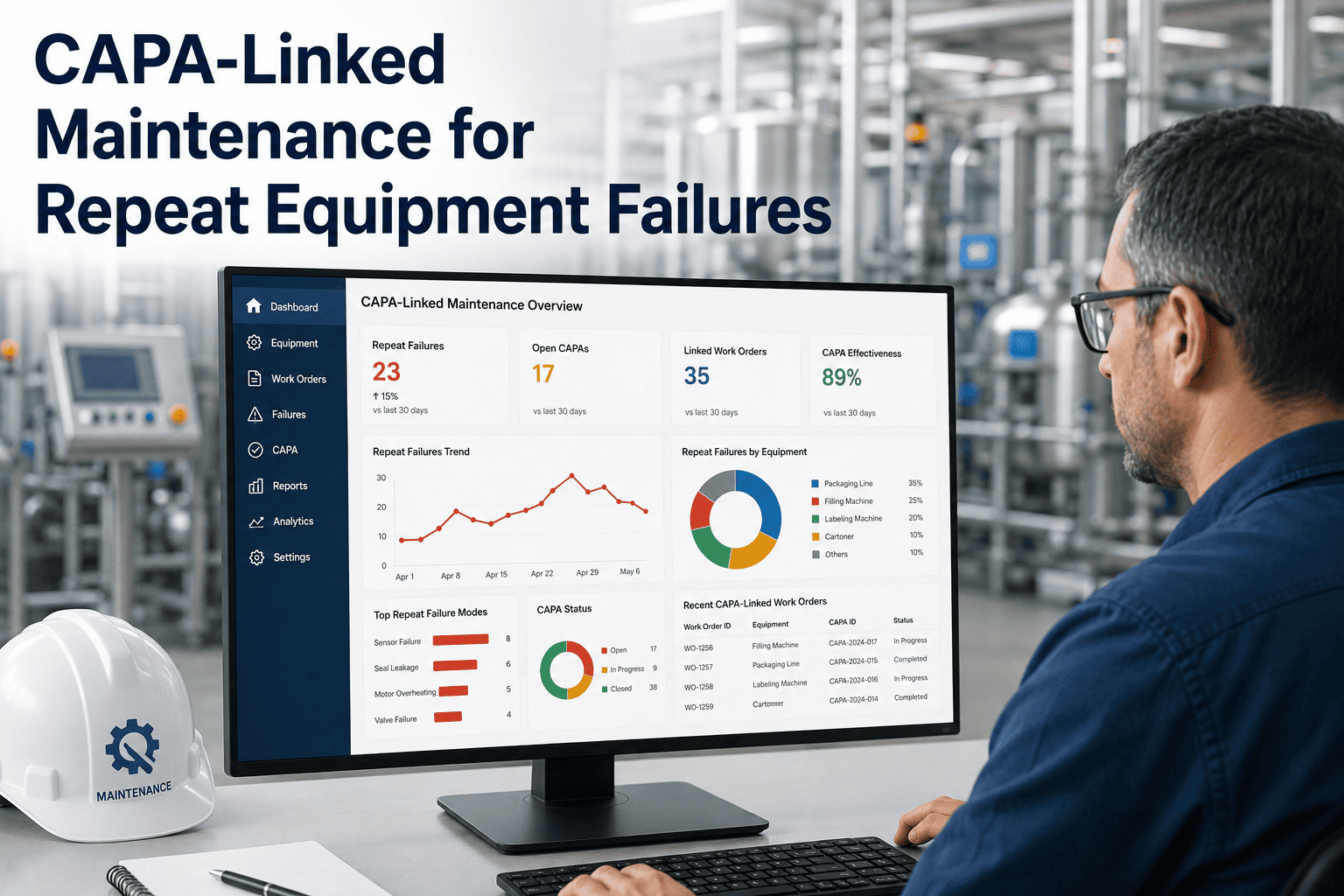
CAPA-Linked Maintenance for Repeat Equipment Failures
When the same root cause produces the same failure twice, the FDA does not see a maintenance problem — they see a quality system failure. The architecture below is what closes the loop between a work order and a CAPA before an inspector ever has to ask.
59%
Year-over-year increase in FDA drug warning letters · FY 2024 → FY 2025
211.192
Second most-cited Form 483 violation — failure to investigate discrepancies
60%
Of FDA enforcement actions against drug manufacturers cite inadequate CAPA
$50M–$600M
Typical remediation cost for a single warning letter — direct + lost revenue
15 days
FDA-recommended Form 483 response window · CAPA plan must be developed during or immediately after inspection close
23%
Of pharma manufacturers systematically track CAPA trigger criteria across all quality data sources
>50%
Probability of a warning letter when a 483 response is judged inadequate by FDA reviewers
21 CFR 211.22(d)
Most-cited 483 observation four years running · 184 citations in FY 2024 alone
The Closed-Loop CAPA Cycle: Six Stages, No Open Ends
A CAPA that closes without an effectiveness check is not a closed CAPA — it is a deferred 483 observation. The cycle below is the architecture that connects every work order, deviation, root cause analysis, and verification record into a single closed-loop chain that an FDA investigator can trace start-to-finish. Oxmaint enforces every transition between stages; you cannot advance without the prior stage's evidence attached.
Stage 1
Identification
Maintenance work order closed with failure flag · auto-cross-referenced against asset's prior 24 months of WO history · recurrence detected if same root cause within rolling window
21 CFR 211.192
→
Stage 2
Deviation Record
Quality system auto-opens a deviation tagged to the asset ID · severity classified · containment actions logged · cross-batch impact assessed
21 CFR 211.100(b)
→
Stage 3
Root Cause Analysis
Structured RCA — 5 Whys, Fishbone, FTA, or FMEA · investigation plan with scientifically justified scope · multidisciplinary team documented
21 CFR 211.192 · ICH Q9
↓
Stage 4
Corrective + Preventive Action
Action plan with named owner · implementation timeline · interim controls · cross-asset preventive scope · linked training records
21 CFR 211.100(a) · ICH Q10
←
Stage 5
Effectiveness Verification
30 / 60 / 90 day verification checkpoints · recurrence-interval trending demonstrates failure interval has lengthened post-CAPA · evidence cannot be retroactively added
ICH Q10 § 3.2
←
Stage 6
Closure + Trending
Formal closure record · immutable audit trail · feeds annual product quality review trend analysis · informs predictive recurrence model
21 CFR 211.180(e)
Closure data feeds back to identification — recurrence trending updates the rolling window
Recurrence Pattern Detection: What "Repeat Failure" Actually Looks Like
The reason FDA inspectors cite 21 CFR § 211.192 so often is that paper-based maintenance systems literally cannot see recurrence patterns until they have already produced three or four failures. The chart below shows what a typical recurrence pattern looks like on a single asset — and where Oxmaint's pattern detection forces the system to escalate before the regulator does.
Same root cause · WO-1556 · ESCALATE
CAPA opened · 5 Whys triggered
Without CAPA linkage: failures repeat indefinitely · 483 vulnerability builds
Recurrence threshold breach: second same-root-cause event within rolling window triggers auto-escalation
Post-CAPA: failure interval lengthens · effectiveness check confirms root cause eliminated
When a Deviation Becomes a CAPA: The Escalation Decision Branch
Not every deviation requires a formal CAPA — but every deviation requires a documented decision about whether it should. The branch below is the auto-classification logic Oxmaint applies to every maintenance-originated deviation, mapped against FDA's risk-based expectations under 21 CFR § 211.192 and ICH Q9. Each branch outcome generates its own audit-defensible record.
Deviation Logged · From Maintenance Work Order
Has the same root cause occurred within the rolling 12-month window?
YES
Auto-escalate to CAPA
Mandatory formal CAPA opened · multidisciplinary team assigned · RCA method selected based on complexity · 21 CFR 211.192 evidence chain begins
NO
Does the deviation affect product identity, strength, quality, or purity?
YES
Formal CAPA Required
Quality unit notified · cross-batch impact assessment per § 211.192 · OOS / OOT investigation triggered if applicable
NO
Risk-rated severity above threshold?
YES
Documented Investigation
Investigation per ICH Q9 · interim controls · trended in monthly quality review · escalates to CAPA if recurs
NO
Logged + Trended
Captured in deviation register · feeds annual product quality review · monitored for emerging pattern
From maintenance event to closed CAPA · in one audit-ready chain
Stop Building 483 Vulnerability One Repeat Failure at a Time
Oxmaint's CAPA-Linked Maintenance workflow detects the second recurrence of the same root cause automatically, forces deviation classification by 21 CFR § 211.192 logic, structures the RCA against FDA-expected methods, and locks the closure record behind a verified effectiveness check. The audit trail that survives a Form 483 inspection — built as the work happens, not after the regulator arrives.
Four RCA Methods the FDA Expects in a Compliant CAPA
The FDA's March 2026 draft guidance on Form 483 responses is explicit: an investigation that "lists symptoms" rather than driving to systemic cause is inadequate. The four methods below are the RCA techniques FDA inspectors actively look for in CAPA documentation — and the criteria for matching the right method to the failure type. Read more on RCA method selection for FDA-grade investigations.
5 Whys
Time: 30-60 min · Depth: Surface to mid-level
Best for
Single-cause failures with linear causation chain. Tablet compressor punch breakage, agitator seal failure, isolated alarm event. Quick, structured, defensible when the chain reaches a systemic cause.
Use only when the failure traces cleanly back. Branching causation requires a different tool.
Fishbone (Ishikawa)
Time: 2-4 hr · Depth: Multi-factor
Best for
Failures with multiple contributing factors across people, process, equipment, materials, environment, measurement. Bioreactor contamination event, fill-line reject spike, lyophiliser yield drop.
Requires structured facilitation; without it, the diagram becomes a list rather than an analysis.
Fault Tree Analysis
Time: 1-3 days · Depth: Logical causation
Best for
Critical equipment failures with multiple potential failure paths. HVAC pressure cascade in cleanroom, integrity test failure on sterile filter, autoclave cycle deviation. Probability-weighted causation mapping.
Computationally heavier; reserve for failures where the FDA will expect quantitative risk evidence.
FMEA / pFMEA
Time: 3-5 days · Depth: Predictive
Best for
Preventive scope — identifying failure modes before they recur on a new asset. Required for major equipment changes, new line qualification, and post-CAPA cross-asset preventive scope.
The only method on this list that supports preventive action; the others are corrective.
21 CFR Citation Crosswalk: Every Workflow Step Mapped to Its Regulation
A CAPA program is audit-ready when every workflow step in your CMMS has a documented citation to the FDA regulation it satisfies. The crosswalk below maps Oxmaint's CAPA-Linked Maintenance workflow to the specific 21 CFR Part 211 sections an inspector will reference during a cGMP inspection.
Workflow Step
Applicable 21 CFR Citation
Audit Trigger if Missing
Equipment maintenance scheduling & PM completion records
§ 211.67(b) · § 211.182
Gap in PM schedule for critical asset = immediate observation
Written procedures for production and process control
§ 211.100(a)
Top-5 most-cited 483 violation · systemic finding likely
Deviation logging and justification
§ 211.100(b)
Unrecorded deviation = data integrity finding
Investigation of unexplained discrepancies / failures
§ 211.192
2nd most-cited violation FY 2024 · 116 citations
Quality unit authority & written procedures
§ 211.22(d)
Most-cited 483 violation 4 years running · 184 citations FY 2024
Annual product quality review & trending
§ 211.180(e)
Absence of trended data = systemic CAPA finding
Electronic records & signatures for CAPA
21 CFR Part 11
Data integrity finding · 15% of all FY 2025 warning letters
CAPA effectiveness verification
ICH Q10 § 3.2
Closed-without-evidence = repeat-finding citation
The Effectiveness Verification Window: 30 / 60 / 90 Days
FDA's 2026 draft guidance is explicit that "effectiveness evaluations should go beyond routine testing and demonstrate that the underlying problem has been fully addressed." Oxmaint locks CAPA closure behind three verification checkpoints — each timestamped, each evidence-attached, each immutable — and ties each checkpoint into the broader GMP maintenance audit trail software record that supports your annual product quality review.
Day 30
Implementation Verification
Confirms the corrective action was actually executed as planned. Training completion records attached. SOP revision verified in document control. Asset modification confirmed via change control. Cannot be skipped — system blocks Day-60 advance.
Day 60
Interim Trend Check
Reviews the asset's failure record across the 60-day window post-implementation. Any recurrence of the same root cause within this window triggers automatic CAPA re-opening — the original CAPA is rejected as ineffective, and a deeper RCA is required.
Day 90
Effectiveness Verification + Closure
Statistical comparison of the asset's pre-CAPA failure interval vs the post-CAPA observation window. Effectiveness check passes only if the failure interval has measurably lengthened. Cross-asset preventive scope verified. Closure record locked into immutable audit log.
CAPA KPIs Your Quality VP Should See Every Quarter
Target: 100%
CAPA Closure with Effectiveness Evidence
Percentage of closed CAPAs with attached effectiveness verification record. The single metric an FDA investigator will pull first. Below 100% is a deferred 483 observation.
Target: under 5%
Repeat Root Cause Rate
Percentage of CAPAs reopened due to recurrence of the same root cause within 12 months. Industry baseline is 18-22%. Best-in-class pharma operations hold this under 5%.
Target: under 60 days
Mean CAPA Cycle Time
Average elapsed time from CAPA opening to verified closure. Below 60 days indicates a functioning system; above 120 days indicates the CAPA queue is becoming a backlog the FDA will flag.
Target: above 95%
Deviation-to-CAPA Decision Documentation
Percentage of logged deviations with documented escalation decision (CAPA-required / not-required). An undocumented decision is a 21 CFR § 211.100(b) finding regardless of the outcome.
Target: 100%
Recurrence Detection Coverage
Percentage of critical equipment assets with active recurrence-pattern monitoring across the rolling 12-month window. Gaps are silent risk — the failure has occurred but the system did not classify it as a repeat.
Target: 100%
CAPA-to-Work-Order Link Integrity
Percentage of CAPAs with traceable links to the originating maintenance work order, deviation record, and effectiveness verification batch. Broken links during inspection = systemic data integrity finding.
Expert Review
"
In two decades supporting US pharma manufacturers through Pre-Approval Inspections, routine cGMP inspections, and Form 483 responses, the single failure pattern I see most often is the closed CAPA that has no effectiveness evidence attached. The CAPA system existed, the deviation was logged, an action was taken — and then the record was marked closed without anyone ever proving the root cause was eliminated. When the FDA investigator pulls the asset's maintenance history during a routine inspection and finds the same root-cause failure recurring four months after the CAPA was closed, that is a § 211.192 observation in two seconds. The fix is not more procedure — it is a system architecture that does not let a CAPA close without a date-stamped effectiveness check tied to the asset's failure interval trend. The 2026 FDA draft guidance on 483 responses is explicit about this, and the firms that already operate this way will find the new guidance reinforces what they already do. The firms that do not operate this way are the firms now seeing 59% more warning letters year over year. Oxmaint's CAPA-Linked Maintenance architecture is one of the few I have seen where the closure transition is gated on the verification evidence, not on a checkbox.
Dr. Margaret Hollings, Ph.D., RAC
Former FDA Compliance Officer · 24 years pharma quality systems consulting across solid dose, sterile injectable, and biologics manufacturing · Regulatory Affairs Certified · Specialism in 21 CFR Part 211 audit defense and CAPA program remediation
Frequently Asked Questions
Q1
When does a maintenance work order have to become a deviation, and when does a deviation have to become a CAPA?
Oxmaint applies the FDA's risk-based logic under 21 CFR § 211.192 and ICH Q9 automatically.
Every maintenance work order with a failure flag auto-creates a deviation record if (a) the failure affects an asset that contacts the product or critical utility, or (b) the failure is a recurrence of the same root cause within the rolling 12-month window. A deviation auto-escalates to a formal
CAPA when (a) it is a documented recurrence, (b) it impacts product identity / strength / quality / purity, or (c) the risk-rated severity exceeds the configured threshold. Every escalation decision — including the "no CAPA needed" decisions — is logged with timestamp, rationale, and decision-maker for audit defense.
Book a demo to see the decision tree against your asset risk classifications.
Q2
How does Oxmaint integrate with our existing eQMS (Veeva Vault, MasterControl, TrackWise)?
Oxmaint integrates with the major pharma eQMS platforms via documented APIs. The pattern is bi-directional: maintenance-originated deviations flow from Oxmaint into the eQMS deviation register so the quality unit owns the workflow, while CAPA actions that touch equipment push back into Oxmaint as scheduled work orders with the eQMS CAPA ID embedded — so the maintenance technician sees the eQMS reference and the eQMS sees the closed work order as evidence. Integration timeline is typically 4-6 weeks alongside the Oxmaint deployment. For sites without a dedicated eQMS, Oxmaint's deviation and CAPA modules cover the full workflow natively, validated under 21 CFR Part 11.
Q3
Is Oxmaint validated under 21 CFR Part 11 for electronic records and electronic signatures?
Yes. Oxmaint operates under a Part 11-validated configuration that includes immutable audit trails, role-based access control with separation of duties, electronic signature meanings captured on every critical record action (open, modify, close, void), and tamper-evident timestamping. Validation deliverables include URS, FS, DS, IQ, OQ, PQ documents, traceability matrix, and risk assessment per GAMP 5 category 4 SaaS guidance. The validation pack ships with the implementation and is updated for each platform release.
Q4
How is "recurrence" defined, and can we configure the rolling window for our product portfolio?
Recurrence is defined as
the same documented root cause occurring on the same asset (or same asset family) within a configurable rolling window. The default window is 12 months, aligned to the FDA's expectation under 21 CFR § 211.180(e) for annual product quality review. Pharma sites manufacturing high-risk products (sterile injectables, biologics) commonly tighten the window to 6 months, and Oxmaint supports
asset-class-specific rolling windows — so a clean-in-place skid may have a 12-month window while an autoclave has a 6-month window. The window configuration itself is change-controlled and auditable.
Read more on the recurrence detection architecture.
Q5
What happens during an FDA inspection — can we generate the maintenance-CAPA evidence package on demand?
Yes. Oxmaint generates a
Day-1 FDA Evidence Package on demand: every closed CAPA with its originating work order, deviation record, RCA documentation, action plan, effectiveness verification, and Part 11 audit trail — organised by asset ID and date range. The package is generated as a PDF and CSV in under 10 minutes, includes a CFR citation crosswalk, and excludes nothing. The most successful inspection-defense practice we see is providing this package to the lead investigator on the morning of Day 2 rather than waiting for an individual document request — it signals system maturity and substantially reduces the depth of follow-up probing.
Start an Oxmaint free trial to see the evidence package format against your existing CAPA records.
Built to survive a Form 483 · Not built after one
Close the Loop Before the FDA Asks Why It's Open
Every repeat equipment failure that closes without a verified effectiveness check is a deferred warning letter. Oxmaint connects work orders, RCA, deviations, and CAPA actions in one auditable chain — locking CAPA closure behind 30/60/90-day verification evidence, detecting recurrence patterns before they reach Form 483 visibility, and generating the Day-1 FDA evidence package your quality team needs the moment an inspector walks in.



-in-healthcare-maintenance-prevent-equipment-failure-&-downtime.png)
