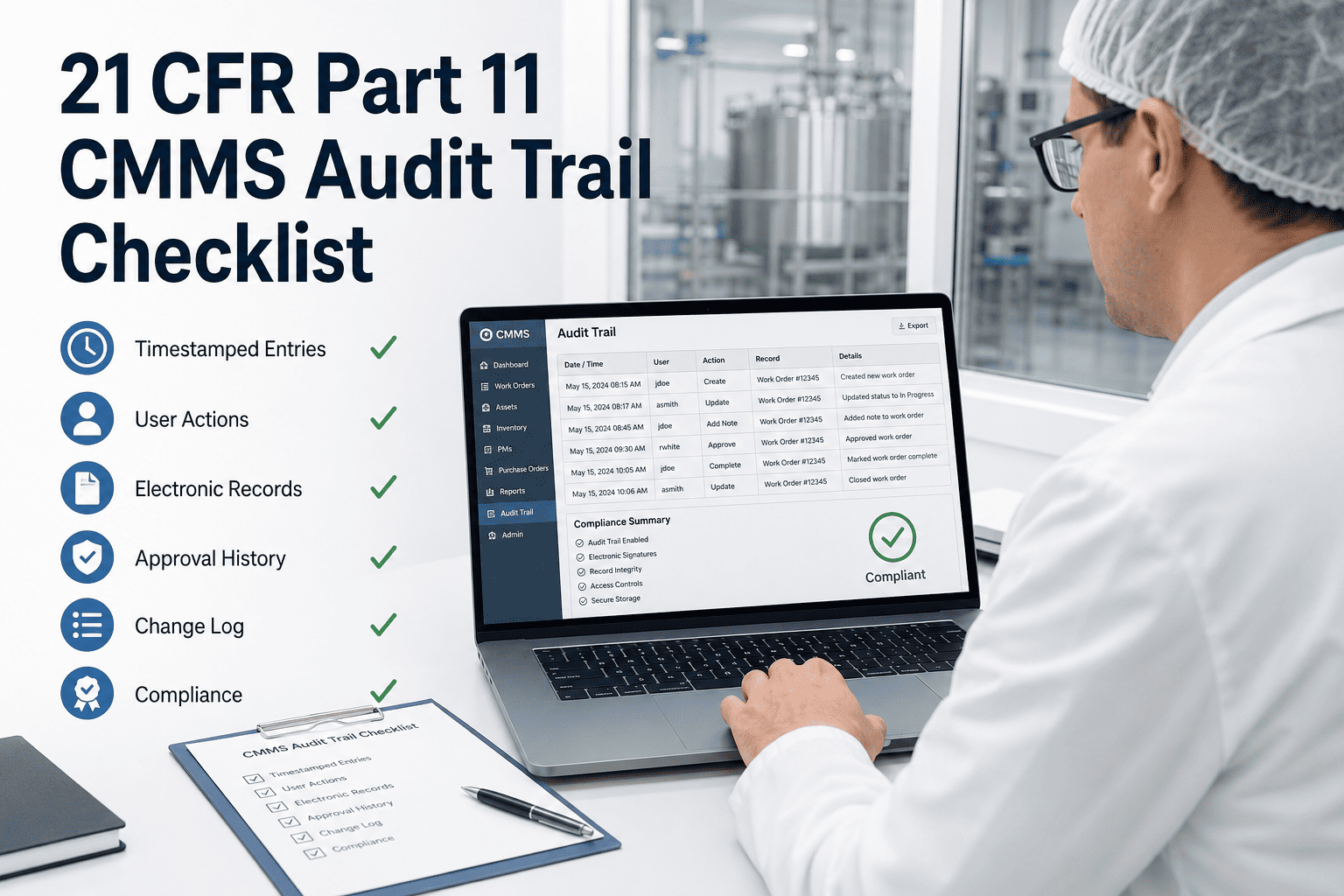
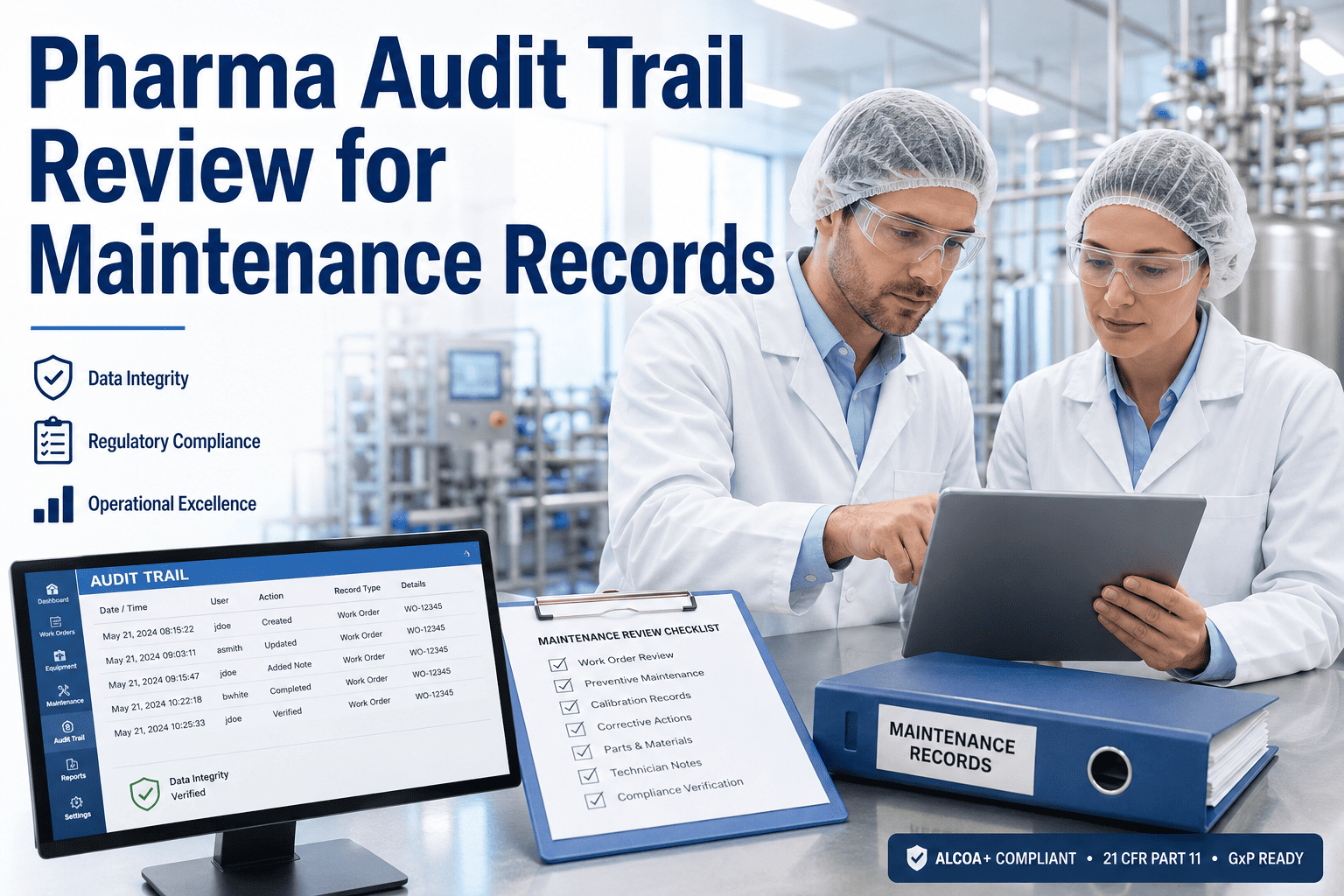
An audit trail in a pharma CMMS is not a log — it is a regulatory artifact. Every edit, every approval, every late closure, and every role change in a maintenance record must be captured, attributed, and unalterable. When FDA investigators request an audit trail review during an inspection, they are looking not just at what was recorded but at how the record changed over time — and whether anyone tried to cover a gap. Facilities without a CMMS audit trail face 21 CFR Part 11 findings that compound every other maintenance observation. Book a demo with OxMaint to see a live ALCOA-compliant audit trail, or start a free trial and configure your data integrity controls today.
Article · Data Integrity · CMMS Audit Trail · ALCOA
Audit Trail Review for Pharma Maintenance Events
Use CMMS audit trails to detect maintenance edits, late PM changes, approval gaps, and data integrity risks — before inspectors find them first.
#1
Most cited data integrity finding: missing or disabled audit trails in maintenance systems
21 CFR
Part 11 requires electronic records be accurate, indelible, and include a date/time-stamped audit trail
ALCOA+ Applied to Maintenance Records
Every maintenance event record must satisfy all eight ALCOA+ criteria. A CMMS audit trail provides the technical backbone that makes compliance demonstrable, not just claimed.
A
Attributable
Every entry — completion, edit, or approval — is tied to a named, authenticated user. No shared logins. No anonymous edits.
L
Legible
Records are readable now and in the future. Electronic records in a CMMS are always legible; handwritten logs often are not.
C
Contemporaneous
Data is recorded at the time of the maintenance event — not reconstructed afterward. Timestamps enforce this in a CMMS.
O
Original
First-capture data is preserved and distinguishable from any subsequent corrections. The audit trail stores original values alongside all changes.
A
Accurate
Records reflect what actually happened. CMMS-enforced mandatory fields prevent incomplete or placeholder entries at closure.
+
Complete, Consistent, Enduring, Available
The ALCOA+ extensions require records to cover the full maintenance event lifecycle, follow consistent formats across the system, be retained for the required period, and be retrievable on demand during inspections.
7 Audit Trail Red Flags FDA Investigators Look For
| Red Flag |
What It Signals to FDA |
Risk Level |
CMMS Prevention |
| Work order completed after inspection notification |
Retroactive record creation — evidence destruction concern |
Critical |
Locked timestamping prevents backdating |
| Batch of PM closures with no technician variation |
Records may have been mass-approved without actual work |
High |
Individual sign-off required per work order |
| Due date changed after original deadline passed |
Overdue PM concealed — PM compliance rate inflated |
High |
All date changes logged with reason code and approver |
| QA approval given before technician completion |
Approval process not functioning — rubber-stamp culture |
High |
Workflow enforces completion before approval routing |
| Measurement data edited after initial entry |
Data integrity failure — potential manipulation of readings |
Critical |
Measurement fields locked on QA approval — change requires QA override |
| Audit trail disabled or not configured |
System not Part 11 compliant — all records in question |
Critical |
Audit trail active by default — cannot be disabled by users |
| Missing approval signatures on deviation records |
Quality oversight absent — systemic control failure |
Medium |
Deviation records cannot close without required signatures |
OxMaint's audit trail captures every record change — who, when, what changed, and why — and cannot be disabled or altered by any user role.
How to Conduct a Pre-Inspection Audit Trail Review
Run an audit trail report for all work order edits in the 90 days before inspection. Sort by edit frequency per record — any work order edited more than twice should be individually reviewed for data integrity concern.
Filter for all PM due date changes where the original due date had already passed at the time of the change. Each of these events needs a documented justification — if it does not exist, create it now with the correct reason code and approver.
Confirm that for every work order, the technician completion timestamp precedes the supervisor review timestamp, which precedes the QA approval timestamp. Out-of-sequence approvals indicate a workflow bypass that must be explained before inspection.
Any calibration or measurement reading that was edited after initial entry is a potential data integrity finding. Review each case: if the original entry was a genuine error, a correction with reason code and dual-approver sign-off is required to defend the change.
KN
Kavitha Nair
Data Integrity Specialist · 14 Years in Pharma Electronic Records and 21 CFR Part 11 Compliance
Investigators have become increasingly sophisticated in audit trail analysis. They no longer just check whether an audit trail exists — they look at the shape of the data. Clusters of approvals at unusual hours, date changes that occur in batches, measurement values that were edited after the calibration was approved — these patterns are visible in seconds when an investigator downloads the audit trail to a spreadsheet. The facilities I work with that have no findings consistently run their own audit trail review quarterly, using exactly the same analytical approach that investigators use. You can never be surprised by data you have already reviewed.
Frequently Asked Questions
What is the difference between an audit trail and a change log in a CMMS?
A change log records what fields were changed and when — typically a simplified internal record. An audit trail under 21 CFR Part 11 must record who made the change, the original value, the new value, the timestamp, the reason for the change if required, and must be secure against modification by any user including administrators. A basic change log does not satisfy Part 11 requirements. OxMaint maintains a full Part 11-compliant audit trail across all maintenance record types by default.
Book a demo to see the audit trail interface.
How long do CMMS audit trail records need to be retained in pharma?
Under 21 CFR 211.180, maintenance records must be retained for at least one year beyond the expiry of the last lot of drug product manufactured using that equipment, or three years from the date of distribution if the product has no labeled expiry. Audit trails covering those maintenance records must be retained for the same period. For GMP-critical equipment with long-product cycles, this can mean five to seven years of audit trail data. OxMaint maintains full audit trail history with no data aging or deletion.
Start a free trial to configure your retention settings.
Can a CMMS audit trail be used to defend against a data integrity finding?
Yes — a clean, complete audit trail is one of the strongest defenses available against a data integrity allegation. If an investigator identifies a suspicious edit and you can show the complete context — the original value, the correcting user, the reason code, and a QA countersignature — the audit trail converts a potential integrity finding into a documented and controlled correction. The absence of an audit trail, by contrast, makes every record suspect because there is no way to distinguish a legitimate correction from an intentional alteration.
Book a demo to see OxMaint's audit trail export in inspection-response format.
How often should pharma maintenance teams review their CMMS audit trails?
Best practice is a formal audit trail review at least quarterly, covering the highest-risk record categories — calibration measurements, PM due date changes, deviation closures, and QA approval sequences. Sites that have received prior data integrity observations or are under consent decree should conduct monthly reviews with documented QA sign-off. OxMaint generates a scheduled audit trail anomaly report that flags high-risk patterns automatically, reducing the manual effort of a quarterly review to approximately one to two hours for most sites.
Find Data Integrity Risks Before the Inspector Does
OxMaint maintains a complete, Part 11-compliant audit trail across all maintenance events — with automated anomaly detection, approval sequence verification, and scheduled integrity review reports.