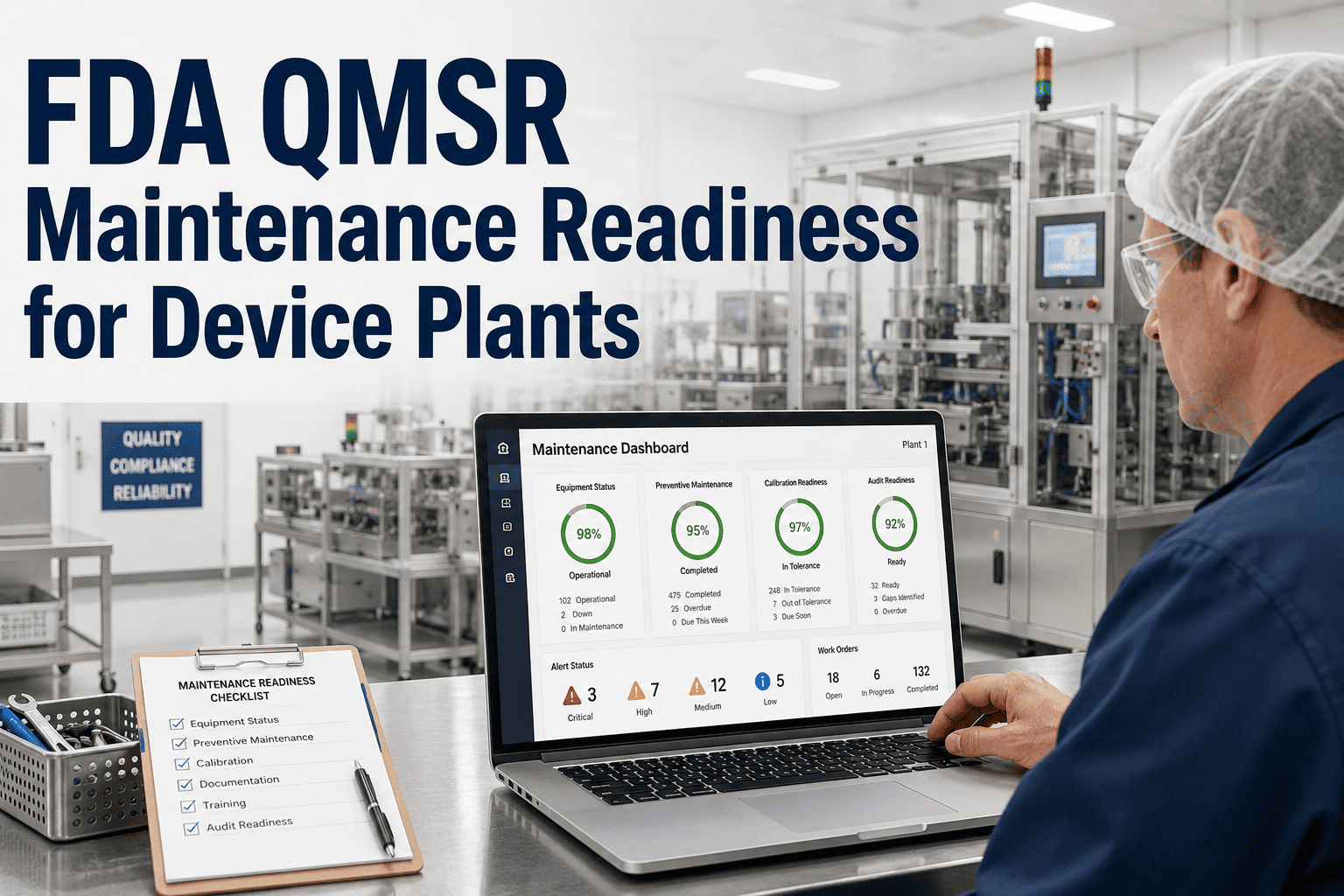
As of February 2, 2026, the FDA's Quality Management System Regulation (QMSR) replaced the 1996-era Quality System Regulation under 21 CFR Part 820 — and the Quality System Inspection Technique (QSIT) was retired the same day, replaced by the updated Compliance Program 7382.850. The new framework incorporates ISO 13485:2016 by reference and applies risk management explicitly across the entire QMS. For medical device manufacturers, the practical impact lands hardest on three operational systems: equipment maintenance evidence, calibration management traceability, and supplier quality records. Industry analyses estimate small-to-mid-size manufacturers face $100K+ in remediation costs when QMS infrastructure was built only to QSR standards. Oxmaint's QMSR-aligned maintenance and calibration platform structures those three systems against the exact evidence FDA investigators are now trained to request under Compliance Program 7382.850 — turning audit week from a four-month preparation crisis into a normal Tuesday.
FDA QMSR Maintenance Readiness for Device Plants
QMSR effective February 2, 2026. ISO 13485:2016 incorporated by reference. QSIT retired. Inspection Program 7382.850 now in force. The compliance bar has moved — and equipment maintenance, calibration, and supplier evidence are the three workflows most affected.
What Changed — QSR vs QMSR at the Maintenance Layer
The QSR and QMSR are "substantially similar" in FDA's own language, but several specific differences land directly on the equipment maintenance and calibration evidence trail. The table below isolates the changes maintenance and quality teams must absorb — not the entire regulatory delta.
| Area | QSR (Pre-Feb 2026) | QMSR (In Force Feb 2026) |
|---|---|---|
| Risk-Based Maintenance | Implied in QSR preamble · best practice | Explicitly required throughout QMS per ISO 13485:2016 + ISO 14971 alignment |
| Equipment Infrastructure | 21 CFR 820.70 · general buildings & equipment requirements | ISO 13485 Clause 6.3 Infrastructure · documented maintenance schedules required |
| Calibration / M&ME Control | 21 CFR 820.72 · monitoring & measuring equipment | ISO 13485 Clause 7.6 · traceable standards · calibration record retention |
| Supplier Controls | 21 CFR 820.50 · purchasing controls | ISO 13485 Clause 7.4 · risk-based supplier evaluation + monitoring documented |
| Records Retention | 21 CFR 820.180 · device-lifetime + 2 years minimum | 21 CFR 820.35 · same minimum + ISO 13485 Clause 4.2 record-control requirements |
| Inspection Method | QSIT (Quality System Inspection Technique) | Compliance Program 7382.850 · ISO 13485-aligned process |
| Terminology | Management with Executive Responsibility | Top Management · Quality Management System (QMS) |
The Five Maintenance Pillars QMSR Inspectors Now Look For
A 7382.850 inspection is structured around the ISO 13485 clause framework, not the old QSIT subsystems. Five operational pillars touch directly on equipment maintenance — and each has a specific evidence expectation. ISO 13485 CMMS alignment for medical device compliance maps each pillar to the CMMS capability that produces the required evidence.
Infrastructure & Equipment Maintenance
Documented maintenance schedules for every piece of production equipment, with records demonstrating execution against schedule. Inspector expectation: per-asset PM frequency justified by manufacturer recommendation, criticality, or historical failure data.
Monitoring & Measuring Equipment (M&ME) Calibration
All M&ME used to verify product specifications must be calibrated against standards traceable to national or international references (NIST, NPL). Calibration records, status indicators on the equipment, and out-of-tolerance response procedures required.
Supplier & Outsourced Maintenance Controls
Risk-based supplier evaluation, quality agreements, and ongoing performance monitoring. For outsourced calibration vendors, sterilization providers, and equipment service contractors, the manufacturer remains responsible for the quality of supplied work.
Process Validation & Revalidation
Production processes whose output cannot be fully verified by subsequent inspection (sterilization, welding, sealing, certain plastic moulding) must be validated, and revalidated after equipment changes, repairs above a defined threshold, or major maintenance events.
CAPA Integration With Maintenance Events
Maintenance events that indicate a systemic problem — recurring failures, OOT calibrations, supplier defects — must feed the Corrective and Preventive Action (CAPA) system. Inspectors increasingly trace from CAPA records back into maintenance history to validate the linkage.
The FDA Inspector Readiness Checklist — 7382.850 Alignment
A 7382.850 inspection follows a structured path through the QMS. This checklist captures the eight evidence requests most consistently raised in the first wave of QMSR-era inspections. CMMS-driven FDA inspection readiness is built around producing each of these in under 60 seconds during a live inspection.
The Documentation Evidence Matrix — Records Required by Activity Type
Every maintenance activity touching production equipment generates a different set of required records under QMSR. The matrix below maps the activity type to the records the CMMS must capture to satisfy the ISO 13485 clauses incorporated by reference.
| Maintenance Activity | PM Record | Calibration Cert | Tech Credentials | Revalidation | CAPA Link | Supplier File |
|---|---|---|---|---|---|---|
| Scheduled PM (in-house) | Required | — | Required | If triggered | If pattern | — |
| Corrective Repair | Required | If applicable | Required | Per protocol | Required | — |
| Calibration of M&ME | Required | Required | Required | — | If OOT | If outsourced |
| Outsourced Calibration | Required | Required | — | — | If OOT | Required |
| Equipment Modification | Required | If applicable | Required | Required | Per protocol | — |
| Vendor-Performed Service | Required | If applicable | — | Per protocol | If pattern | Required |
A QMSR Inspection Is a Test of Your Evidence Retrieval Speed — Not Your Equipment.
OxMaint structures every maintenance event, calibration cycle, and supplier interaction into a single audit-grade record system aligned to ISO 13485:2016 clauses and Compliance Program 7382.850 inspection paths.
The Calibration Workflow Under ISO 13485 Clause 7.6
Of all maintenance activities under QMSR, calibration of monitoring & measuring equipment has the highest evidence density per cycle. Calibration management for 21 CFR 820 CMMS means the workflow itself must be designed to satisfy ISO 13485 Clause 7.6 — not retrofitted afterwards.
The Supplier Evidence Chain — Risk-Based Per Clause 7.4
QMSR's risk-based framing changes the supplier evidence expectation. It is no longer sufficient to have a signed quality agreement on file — the manufacturer must demonstrate active, ongoing supplier evaluation proportional to the risk that supplier introduces into the device. Medical device supplier quality records management is the workflow that produces this chain continuously, not at audit time.
The Cost of QMSR Non-Compliance — Why CMMS Investment Pays Back in One Inspection
QMSR compliance investment is best framed against the cost of FDA enforcement action, not against productivity savings alone. The escalation ladder is well-documented: Form 483 → Warning Letter → Consent Decree → Product Seizure. Each step compounds the financial and reputational impact significantly.
QMSR-Specific KPIs Maintenance & Quality Teams Now Track
Pre-QMSR, equipment maintenance KPIs focused mostly on operational metrics — wrench time, MTBF, schedule compliance. Under QMSR, the metrics expand to include explicit quality and compliance dimensions. These are the six the maintenance director and quality manager now jointly review.
PM Schedule Compliance
Percentage of preventive maintenance completed within its defined window. Below 100% requires documented deviation justification with risk assessment under ISO 13485 Clause 6.3. Inspectors trace missing PM directly.
Calibration On-Time Rate
Percentage of M&ME calibrations completed before due date. A single overdue calibration on production-impact equipment is a typical Form 483 observation under Compliance Program 7382.850.
Evidence Retrieval Time
Time from FDA investigator request to producing the requested record. Above two minutes during live inspection erodes inspector confidence and increases the depth of subsequent requests.
OOT Closure Rate
Percentage of out-of-tolerance calibration findings closed with documented product impact assessment, lot containment decision, and CAPA linkage. Open OOTs are the highest-leverage finding in any QMSR inspection.
Supplier Audit Currency
Percentage of high-risk suppliers with current quality audit per the risk-based audit schedule under Clause 7.4. Skipped audits on critical suppliers (sterilizers, cal labs) are repeat findings in early QMSR-era inspections.
Maintenance-CAPA Linkage
Percentage of recurring maintenance failures (3+ events on same equipment) escalated into CAPA. The connection inspectors now trace under Clause 8.5 — failure trends without CAPA evidence is a near-automatic finding.
Expert Review — A Medical Device Quality Director's Perspective
I have prepared three medical device sites for FDA inspections under the old QSIT framework and one under the new Compliance Program 7382.850. The difference in inspector behaviour is immediate and significant. Under QSIT, the investigator worked through the seven QSR subsystems on a relatively predictable path. Under 7382.850, the investigator follows the ISO 13485 risk-based logic — they pick a high-risk asset, trace its entire maintenance and calibration history, follow the supplier chain backwards, and then jump into CAPA to verify the linkage to systemic issues. There is no warning, no QSIT-style structure, and no time to assemble evidence after the request. If your CMMS cannot produce a complete equipment dossier in under sixty seconds — with PM history, calibration certificates, technician credentials, supplier records, and any linked CAPA all in one view — you will receive a Form 483. The investment in a properly structured maintenance and calibration system is not a productivity decision under QMSR. It is a regulatory survival decision. The plants that understood this in 2025 and built their evidence infrastructure ahead of February 2026 are now passing inspections that catch unprepared peers off-guard.
Frequently Asked Questions
Does QMSR replace 21 CFR Part 820 entirely, or does Part 820 still exist?
21 CFR Part 820 still exists — but the content is now substantially the QMSR, which incorporates ISO 13485:2016 by reference. The title of Part 820 changed from "Quality System Regulation" to "Quality Management System Regulation" on February 2, 2026. The structure still lives at the same CFR citation, but the substantive requirements now point to ISO 13485 with FDA-specific additions in 21 CFR 820.10 (covering UDI, MDR, corrections and removals, record control, and labeling). 179 sections across 18 parts of Title 21 were updated to align with the new framework. Book a demo to walk through how OxMaint maps to each clause.
Does ISO 13485:2016 certification exempt a manufacturer from FDA inspection under QMSR?
No. The FDA has explicitly stated that ISO 13485 certification will not exempt a manufacturer from FDA inspection under QMSR. The FDA does not issue and does not recognize third-party ISO 13485 certificates of conformance as a substitute for inspection. FDA inspections under Compliance Program 7382.850 assess compliance with the QMSR — which includes both the incorporated ISO 13485 requirements and the FDA-specific provisions in 21 CFR 820.10. Manufacturers participating in MDSAP (Medical Device Single Audit Program) still face FDA inspections separately. Start free in OxMaint to build the evidence base for both inspection types.
What is the practical difference between the QSIT inspection technique and Compliance Program 7382.850?
QSIT was a top-down, subsystem-by-subsystem inspection technique structured around the seven QSR major subsystems (Management Controls, Design Controls, CAPA, Production & Process Controls, etc.). It was relatively predictable. Compliance Program 7382.850 follows the ISO 13485 risk-based logic instead: investigators select high-risk products, processes, or equipment and trace the QMS evidence outward from that anchor point. The inspection feels less structured and more probing, jumping between maintenance, calibration, supplier, and CAPA records based on what the investigator finds at each step. CAPA workflows for medical device CMMS become particularly important under this approach. Book a demo to see how OxMaint structures evidence for the new inspection model.
Our maintenance records are still on paper and in spreadsheets. What is the realistic timeline to become QMSR-ready?
For a mid-size manufacturer transitioning from paper records and spreadsheets, the typical timeline is 4–6 months to full QMSR maintenance readiness: Months 1–2 cover asset registry build, criticality classification, and ISO 13485 gap analysis. Months 3–4 cover digital PM schedules, calibration intervals, and supplier file consolidation in the CMMS. Months 5–6 cover live operations, mock inspections, and CAPA integration. The hardest single component is supplier file consolidation — most manufacturers have supplier records distributed across QA, Purchasing, Engineering, and Maintenance with no single source of truth. Sign in to OxMaint to start the asset registry phase today.
How does OxMaint handle the electronic records requirements that apply to QMSR-compliant maintenance systems?
OxMaint's audit trail captures the elements the FDA expects in electronic records: user identification, timestamped actions, before-and-after values on changes, electronic signatures, access controls, and tamper-evident logs. For medical device manufacturers, this aligns with the record-control requirements in 21 CFR 820.35 and the corresponding ISO 13485 Clause 4.2 provisions. The electronic record can be exported as an audit-grade evidence package on request — typically the format FDA investigators ask for once they have validated the underlying records on-screen. Book a demo to walk through the audit trail export workflow.
February 2, 2026 Was Yesterday. The Next Inspection Could Be Tomorrow.
OxMaint builds the maintenance, calibration, and supplier evidence infrastructure your QMS now requires under QMSR — aligned to ISO 13485:2016 clauses, ready for Compliance Program 7382.850 inspection paths, and producing audit-grade evidence on every transaction.