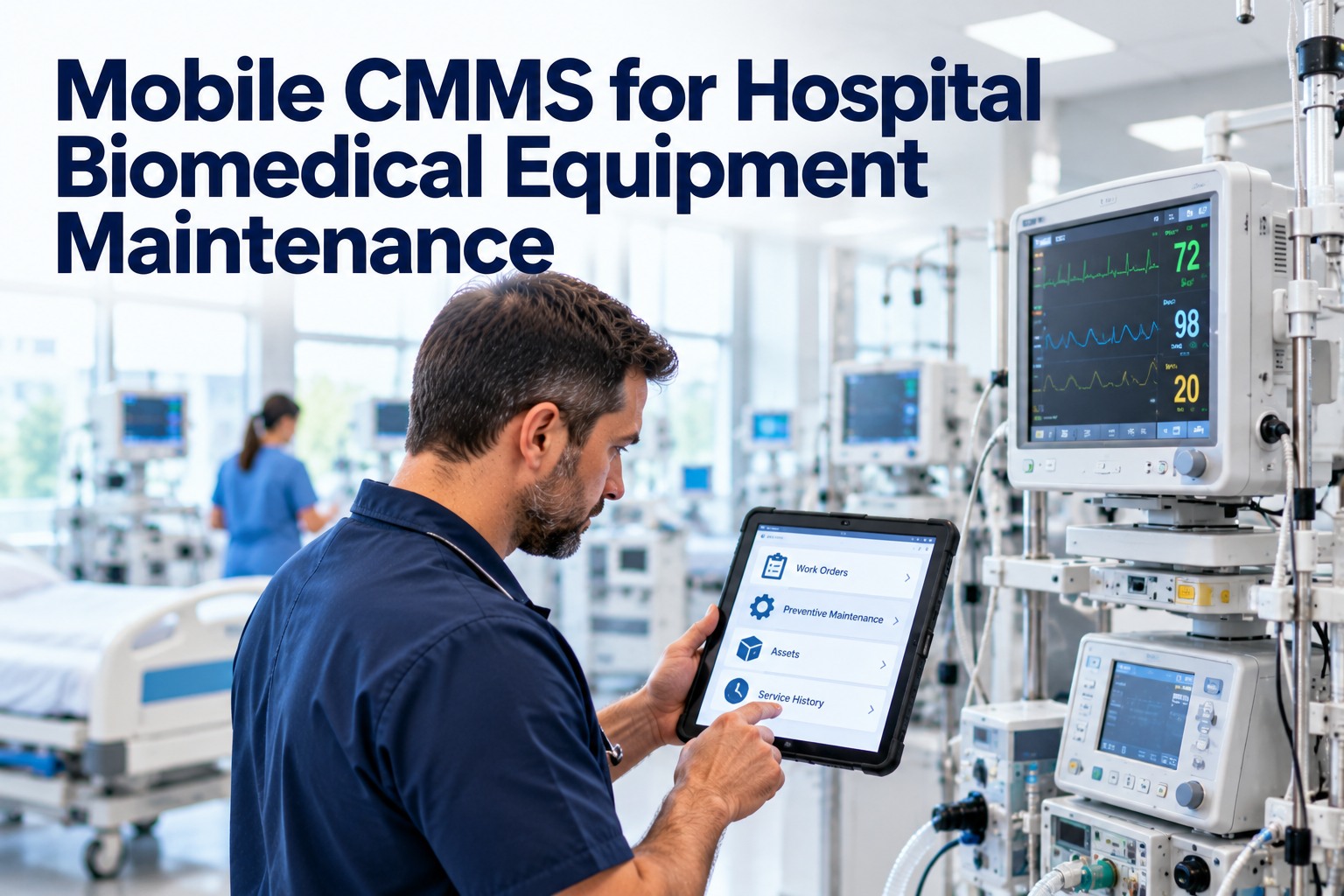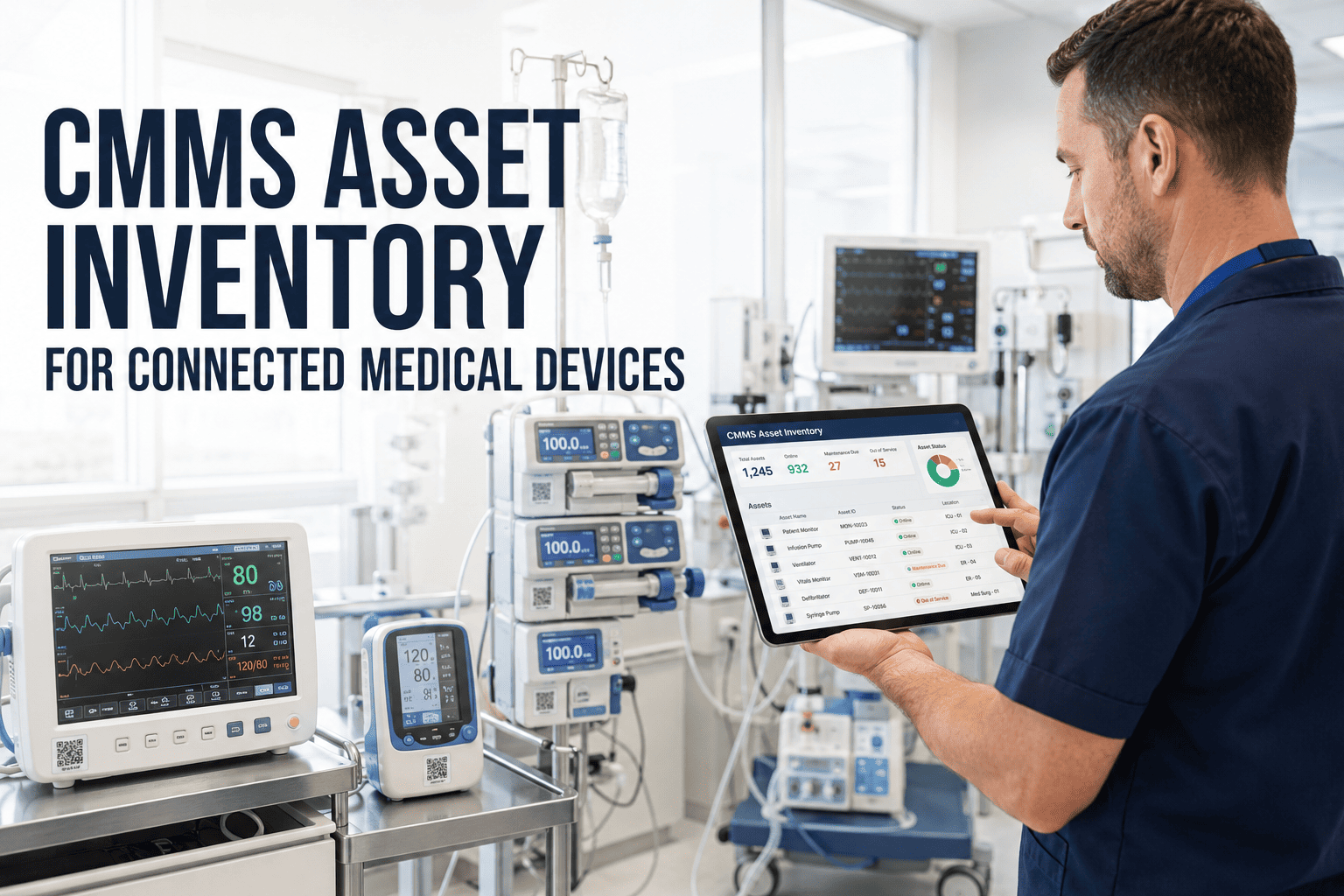
A clinical-grade asset hierarchy is the structured backbone every hospital CMMS depends on — the parent-child mapping of facilities, clinical departments, medical devices, and sub-components that makes preventive maintenance compliance, recall tracking, and Joint Commission survey response possible. Without a defensible medical device CMMS hierarchy, biomed teams lose visibility into device-specific PM intervals, fail to distinguish a $5,000 infusion pump from a $50,000 MRI coil, and cannot produce audit-ready records on demand. This guide walks maintenance and reliability leaders through clinical asset hierarchy design for 2026 — covering parent-child relationships, criticality tagging, compliance linkages, and the architecture that unifies biomedical engineering, facilities, and IT asset management. Ready to replace spreadsheets with a defensible platform? Start Free Trial.
Clinical Asset Hierarchy 2026
Can your hospital produce a defensible asset hierarchy in under 48 hours for a Joint Commission survey?
Most clinical engineering teams cannot. They rely on spreadsheets, disconnected CMMS modules, and tribal knowledge — and pay for it in failed PM compliance, expired recalls, and survey citations. OxMaint's clinical-grade medical device CMMS changes that.
Why Hierarchy Matters
What is a clinical-grade asset hierarchy in a hospital CMMS?
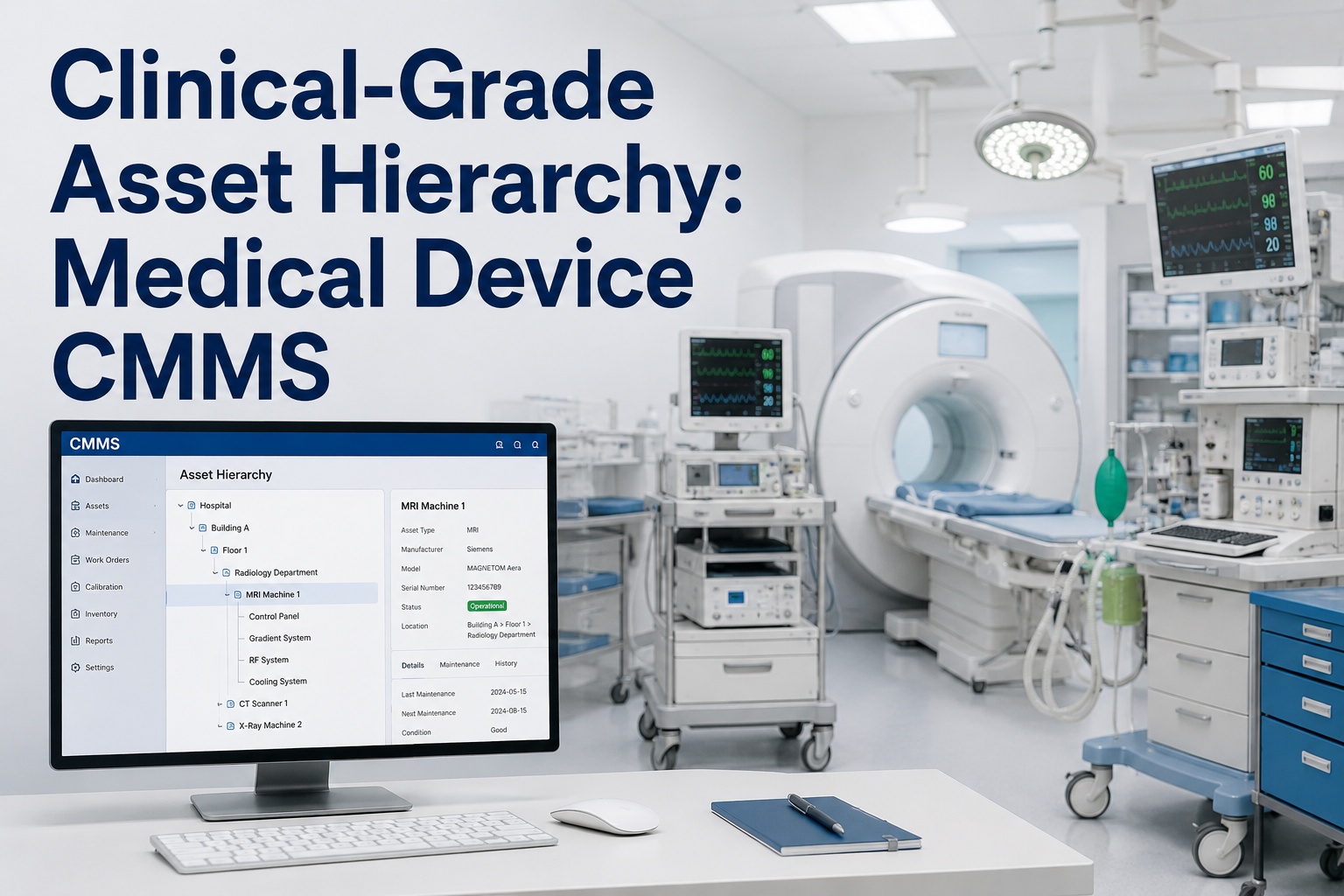
A clinical-grade asset hierarchy is a multi-level parent-child structure inside your medical device CMMS that maps every piece of equipment — from a building's HVAC plant down to a single infusion pump module — into a single, navigable tree. It links each asset to its department, physical location, risk category, manufacturer, model, PM schedule, and compliance documentation so that a biomed engineer, facility director, or IT asset manager can trace any device in seconds, not hours.
Facility & Site Level
Top parent nodes: main hospital, outpatient surgery center, satellite clinic. Each site owns its own location tree, utility feeds, and compliance boundaries — essential for multi-campus health systems managing 10,000+ clinical assets.
Department & Location Level
ICU, cath lab, central sterile, imaging suite — each tagged with square footage, ventilation class, and infection-control zone. Drives location-based PM routing and reduces technician travel time by 15–25%.
Asset & Device Level
Individual medical devices: ventilators, anesthesia machines, CT scanners, patient monitors. Each carries a unique device identifier (UDI), serial number, acquisition cost, and device-specific PM interval.
Sub-Component Level
Child nodes under a parent device: MRI gradient coils, ventilator flow sensors, anesthesia vaporizers. Enables component-level PM tracking, warranty management, and precise spare-parts inventory allocation.
Hierarchy Design
How to structure a medical device CMMS hierarchy that survives an audit
Building a defensible clinical asset hierarchy means designing four linkages into every node: physical (where is it?), functional (what system does it belong to?), regulatory (what standard governs it?), and maintenance (what PM interval applies?). When any one of these linkages breaks, Joint Commission surveyors find the gap — and the citation follows. A well-designed hospital asset hierarchy CMMS enforces all four linkages automatically.
Inventory & Data Cleansing
Baseline every clinical device with a barcode or RFID scan. Purge retired assets, reconcile duplicates, and capture UDI, manufacturer, model, serial, and acquisition date. A 400-bed hospital typically reconciles 8,000–12,000 active medical devices in 4–6 weeks.
Risk-Based Criticality Tagging
Assign each device a criticality score using the FDA risk-based framework: high (life-support, defibrillators), medium (infusion pumps, monitors), low (exam tables). Criticality drives PM frequency, spare-parts minimum, and downtime response SLA.
Parent-Child Mapping
Link each device to its parent system and location. A CT scanner (asset) sits inside Imaging Suite 2 (location) which sits under Radiology (department) under Main Hospital (site). Sub-components like X-ray tubes become children of the scanner — inheriting PM and compliance context.
Compliance & PM Linkage
Attach device-specific PM intervals based on manufacturer specs, Joint Commission standards, and state regulations. Wire each node to its documentation: IFUs, service contracts, calibration records, and recall alerts. The hierarchy now produces audit-ready evidence on demand.
Validation & Go-Live
Run a mock survey: pick 20 random assets, verify each can be located, its PM history pulled, and its compliance status confirmed in under 2 minutes. If any fail, restructure. A clean hierarchy cuts survey preparation time by 60–80%.
Medical Device Categorization
Device categorization standards for a CMMS clinical hierarchy
Medical device categorization is what separates a clinical-grade CMMS from a generic maintenance tracker. The hierarchy must distinguish a Class II infusion pump from a Class III implantable pacemaker programmer, tag each with the right risk level, and apply PM intervals that match manufacturer, ECRI Institute, and AAMI recommendations. The table below shows the categorization framework OxMaint enforces at the asset level.
| Device Category | Risk Level | PM Interval | Compliance Standard | Criticality Tag |
|---|---|---|---|---|
| Life-support (ventilators, defibrillators) | High | Monthly | JCAHO EC.02.04.03 | Critical — Tier 1 |
| Imaging (CT, MRI, fluoro) | High | Quarterly + annual | FDA 21 CFR 1020.30 | Critical — Tier 1 |
| Monitoring (patient monitors, telemetry) | Medium | Semi-annual | AAMI TIR57 | Essential — Tier 2 |
| Therapeutic (infusion pumps, CPAP) | Medium | Quarterly | ECRI Institute guidance | Essential — Tier 2 |
| Diagnostic (ultrasound, ECG) | Low–Medium | Annual | Manufacturer IFU | Standard — Tier 3 |
| General (exam tables, scales, lights) | Low | Annual / as-needed | Internal policy | Non-critical — Tier 4 |
A 320-bed regional hospital reconciles 9,400 clinical assets
Before OxMaint, this hospital tracked assets in three spreadsheets and a legacy CMMS with no parent-child links. PM compliance sat at 71%, recall response averaged 11 days, and the last Joint Commission survey produced 4 EC findings. After rebuilding the hierarchy in OxMaint — 4 tiers deep, risk-tagged, PM-linked — PM compliance hit 96% in 90 days, recall response dropped to under 36 hours, and the next survey produced zero EC findings. Annual maintenance cost fell by $87,000 through eliminated overtime and duplicate parts orders.
How OxMaint Helps
How OxMaint's AI-powered CMMS builds your clinical hierarchy faster
OxMaint was engineered for the realities clinical engineering teams face: fragmented inventories, device-specific PM complexity, and zero tolerance for compliance gaps. The platform turns a months-long hierarchy rebuild into a weeks-long migration — and keeps it audit-ready forever.
Auto-Generated Parent-Child Trees
Import a flat equipment list and OxMaint's AI builds the full 4-tier hierarchy — site, department, location, asset, sub-component — automatically, using UDI data and manufacturer catalogs. Cuts hierarchy build time by 70%.
Device-Specific PM Engine
Each asset node inherits PM intervals from its device category — life-support monthly, imaging quarterly, general annual — with automatic work-order generation. Technicians see exactly what to inspect, with checklists tailored to model and risk class.
Real-Time Recall & Compliance Linkage
OxMaint cross-references FDA recall databases against your asset hierarchy in real time. When a recall hits, every affected device is flagged — with location, custodian, and service history — in under 60 seconds.
Audit-Ready Analytics & Reporting
One click produces a Joint Commission-ready report: every asset, its PM history, calibration records, and compliance status — filtered by department, risk tier, or device category. No more scrambling before a survey.
Comparison
Spreadsheet vs. OxMaint clinical hierarchy CMMS
Most hospitals know the spreadsheet status quo is broken — but underestimate how much it costs until they see the comparison. Here is what changes when you move from a manual tracking system to a purpose-built clinical-grade CMMS.
| Capability | Spreadsheets / Legacy CMMS | OxMaint Clinical CMMS |
|---|---|---|
| Parent-child hierarchy depth | Flat list, no relationships | Unlimited tiers, auto-generated |
| PM interval by device category | Manual entry, error-prone | Auto-inherited from risk tier & device type |
| Recall tracking | Manual FDA lookups, days to respond | Real-time auto-match, under 36 hours |
| Audit report generation | 2–3 weeks of manual compilation | One-click, always current |
| Cross-department visibility | Siloed spreadsheets per team | Biomed, facilities, IT on one platform |
| PM compliance rate | Typically 65–75% | 96%+ within one quarter |
| Annual maintenance cost | Baseline + overtime + duplicate orders | 15–25% reduction in year one |
See OxMaint's clinical asset hierarchy on your own devices
Book a 30-minute demo and we'll map your top 50 medical devices into a parent-child hierarchy live — so you can see PM scheduling, recall tracking, and audit reporting in action.
FAQ
Frequently asked questions about clinical asset hierarchy and medical device CMMS
What is a clinical-grade asset hierarchy in a hospital CMMS?
A clinical-grade asset hierarchy is a multi-level parent-child structure that maps every medical device — from building systems down to individual pump modules — into a single navigable tree with location, risk level, PM schedule, and compliance documentation attached at each node. It is what allows biomed teams to locate any device, pull its history, and prove compliance in under two minutes during a Joint Commission survey.
How does a medical device CMMS improve Joint Commission survey readiness?
A medical device CMMS like OxMaint enforces device-specific PM intervals, maintains calibration and service records at the asset level, and generates audit-ready reports with one click. Hospitals using OxMaint typically cut survey preparation time by 60–80% and reduce Environment of Care findings to zero because every asset's compliance status is verifiable in real time. Book a Demo to see a mock survey response.
How often should medical device PM intervals be reviewed in a CMMS?
PM intervals should be reviewed at least annually, or whenever a manufacturer issues an updated service bulletin, a device is reclassified to a different risk tier, or recall data suggests the current interval is insufficient. OxMaint's AI monitors manufacturer databases and ECRI alerts automatically, flagging any device whose PM interval should be adjusted based on real-world failure data.
What is the difference between asset hierarchy and asset categorization in healthcare CMMS?
Asset hierarchy is the structural tree — how devices relate to departments, locations, and parent systems. Asset categorization is the classification scheme that tags each device by type (life-support, imaging, therapeutic), risk level (high, medium, low), and regulatory class (FDA Class I, II, III). Both are needed: hierarchy tells you where an asset is; categorization tells you how to maintain and regulate it. OxMaint manages both in a single platform.
How long does it take to build a clinical asset hierarchy in OxMaint?
A typical 400-bed hospital with 8,000–12,000 clinical assets can complete a full hierarchy migration in 3–4 weeks, including data cleansing, risk tagging, parent-child mapping, and PM linkage. OxMaint's AI auto-generates the hierarchy from a flat equipment import, cutting build time by roughly 70% compared to manual reconstruction. Start Free Trial to test it on your inventory.
Build a clinical asset hierarchy that passes every survey
Join the hospitals that cut PM compliance gaps by 25 points, reduced recall response to under 36 hours, and eliminated spreadsheet-based tracking for good. OxMaint's AI-powered CMMS makes it possible — start today.
Free 14-day trial · No credit card