Medical gas infrastructure is one of the few hospital systems where a single maintenance failure can affect every patient in a clinical zone simultaneously. Unlike a malfunctioning infusion pump or a defective surgical light — where the impact is confined to one bedside — a bulk oxygen system failure, a contaminated medical air supply, or a mislabelled zone valve can compromise care across an entire ward or floor within minutes. For utilities engineers and biomedical facilities teams responsible for NFPA 99 compliance, this checklist provides a structured, system-by-system inspection framework covering bulk oxygen, medical air compressors, medical vacuum, nitrous oxide, WAGD, and zone valve testing protocols. If your team is still managing gas system PMs on paper logs or disconnected spreadsheets, start a free 30-day trial with Oxmaint and bring every system under one audit-ready digital program — or book a live demo with our healthcare compliance team today.
What Is a Hospital Medical Gas System Inspection?
A hospital medical gas system inspection is the structured, periodic verification that every component of the piped gas infrastructure — from bulk source equipment at the plant room to outlet terminals at the bedside — is operating within safety specifications, correctly labelled, and fully documented for regulatory review. NFPA 99 (Health Care Facilities Code), CMS Conditions of Participation, and Joint Commission Environment of Care standards collectively require that piped medical gas systems are maintained under a defined, traceable maintenance program with documented results. This is not an annual snapshot event. It is a layered program of daily logs, quarterly functional tests, and annual performance qualifications that must be executed consistently across every system in the facility.
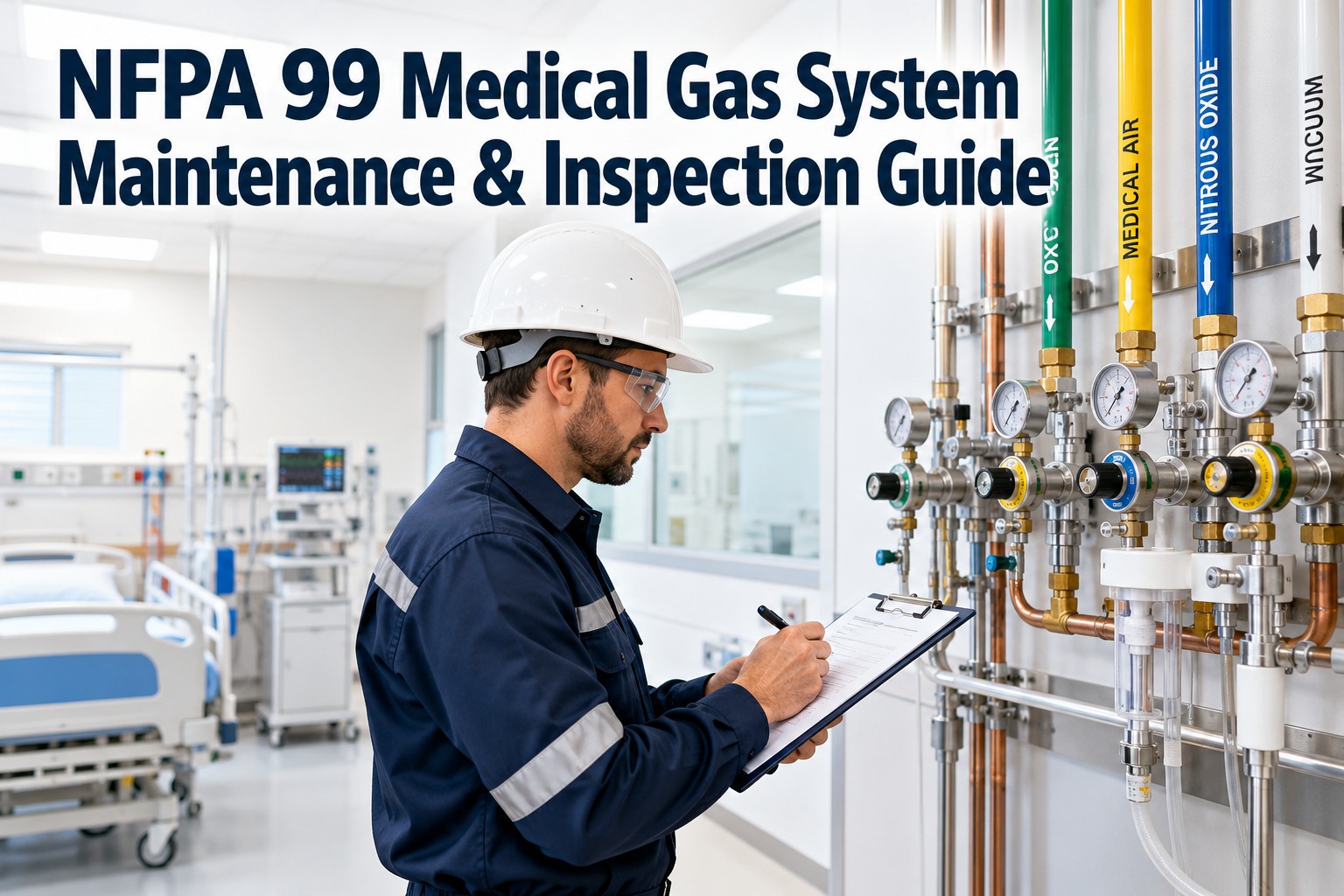
For utilities engineers, the scope of a complete medical gas inspection program covers five core systems: bulk oxygen storage and vaporisation, medical air compressor plants, medical vacuum pump stations, nitrous oxide manifold systems, and waste anaesthetic gas disposal (WAGD) where present. Layered over all five systems is the zone valve infrastructure, master alarm panels, and area alarm units that govern isolation and monitoring. Oxmaint gives utilities teams a single platform to schedule, execute, and document every layer — so every record is timestamped, technician-attributed, and retrievable the moment a surveyor requests it. Start a free trial today or book a demo to see the medical gas PM module in action.
Bulk Oxygen System Inspection Checklist
The bulk oxygen system is the most critical single point of failure in the hospital medical gas infrastructure. A cryogenic tank or cylinder manifold serving a 200-bed hospital may supply oxygen to over 400 outlet terminals across critical care, surgical, and ward areas simultaneously. Every component — from the primary vessel through to the final zone pressure regulator — must be inspected on a documented schedule. Bulk oxygen inspection failures are among the highest-severity findings in Joint Commission Environment of Care surveys and CMS facility reviews. If your current oxygen system PM records consist of handwritten paper logs, start a free 30-day trial with Oxmaint today and digitise every inspection within days — or book a demo to walk through the bulk gas inspection workflow live.
Medical Air Compressor Plant Inspection Checklist
Medical air is arguably the most complex of the five gas systems to maintain. Unlike bulk oxygen — which arrives pre-purified — medical air is manufactured on-site, and the quality of the delivered gas is entirely dependent on the condition and maintenance of the compressor plant. NFPA 99 requires that medical air meet Grade D air specifications, including strict limits on carbon monoxide (10 ppm maximum), carbon dioxide, total hydrocarbons, dew point, and oil content. A poorly maintained compressor plant can deliver gas that passes pipeline pressure checks while simultaneously exposing patients to elevated CO or particulate contamination. Every medical air system PM must include purity verification — not just mechanical checks.
Medical Vacuum System Inspection Checklist
Medical vacuum systems operate continuously across surgical suites, intensive care units, general wards, and procedural areas — and a loss of vacuum in an active operating theatre is a declared emergency. Unlike compressed gas systems, vacuum failures are often preceded by gradual performance degradation that only a structured inspection program catches before clinical impact occurs. The most common precursors to vacuum system failure are deteriorating pump efficiency, blocked or bypassed bacteriological inlet filters, water ingress in wet ring pumps, and accumulation of condensate in receiver vessels. All are detectable through scheduled inspection — none are detectable by visual check alone.
Nitrous Oxide System and WAGD Inspection Checklist
Zone Valve Testing Protocol — NFPA 99 Requirements
Zone valve testing is the single most operationally complex component of a hospital medical gas inspection program — and the one most frequently cited as deficient during Joint Commission and CMS surveys. NFPA 99 Chapter 5 requires that every zone valve in the facility be tested for correct isolation function and that the results be documented with the valve identity, location, gas type, test date, and name of the person who conducted the test. Testing must demonstrate that closing the valve stops gas flow to the correct zone, does not affect adjacent zones, and that the labelling on the valve box accurately identifies the area and gas type it controls. This is not a sample-based requirement — 100% of installed zone valves must be tested annually.
Alarm System Inspection — Master and Area Panels
Why Reactive Gas System Management Creates Catastrophic Risk
| Operational Dimension | Reactive-Only Approach | Structured PM Program |
|---|---|---|
| System Failure Discovery | During clinical use — patient and staff at risk | During scheduled inspection — corrected before impact |
| Medical Air Purity | Assumed compliant until CO alarm triggers or complaint received | Verified quarterly by certified analysis — documented results |
| Zone Valve Integrity | Tested only after a suspected cross-connection incident | 100% tested annually per NFPA 99 — each result documented |
| Alarm Panel Function | Discovered non-functional during an actual emergency event | Tested to activation on a defined schedule — results on file |
| Vacuum System Capacity | Failure noticed when OR vacuum drops during active surgery | Quarterly capacity tests flag degrading pump efficiency early |
| Regulatory Audit Outcome | Critical deficiency findings — potential Immediate Jeopardy designation | Complete documentation chain — survey-ready in minutes |
| Repair Cost | Emergency contractor call-out — 4.8x the cost of planned PM | Scheduled parts and labour — planned intervention at standard rate |
| Biomedical/Facilities Workload | Crisis-driven peaks — unpredictable and operationally disruptive | PM calendar distributes workload — predictable and manageable |
Documentation Requirements for NFPA 99 Compliance
NFPA 99 and Joint Commission Standard EC.02.05.09 require that medical gas system maintenance is performed under a written program, that tests are documented, and that records are available for review. The documentation standard goes beyond a simple pass/fail log — inspectors expect to see which technician performed each test, what the measured values were, what corrective actions were taken for any out-of-specification findings, and evidence of a calibrated test instrument used for purity and alarm verification. Paper-based record systems fail this standard at scale. A 300-bed hospital with seven zone valves per floor across 10 floors generates 70 zone valve test records annually — before accounting for alarm panels, compressor logs, and source equipment documentation. Oxmaint's digital PM platform makes every record instantly searchable by asset ID, system type, floor, or date — and generates compliance summary reports in seconds rather than days. Start a free trial today and see how digital gas system documentation transforms your compliance posture — or book a demo for a walkthrough of the medical gas compliance module.