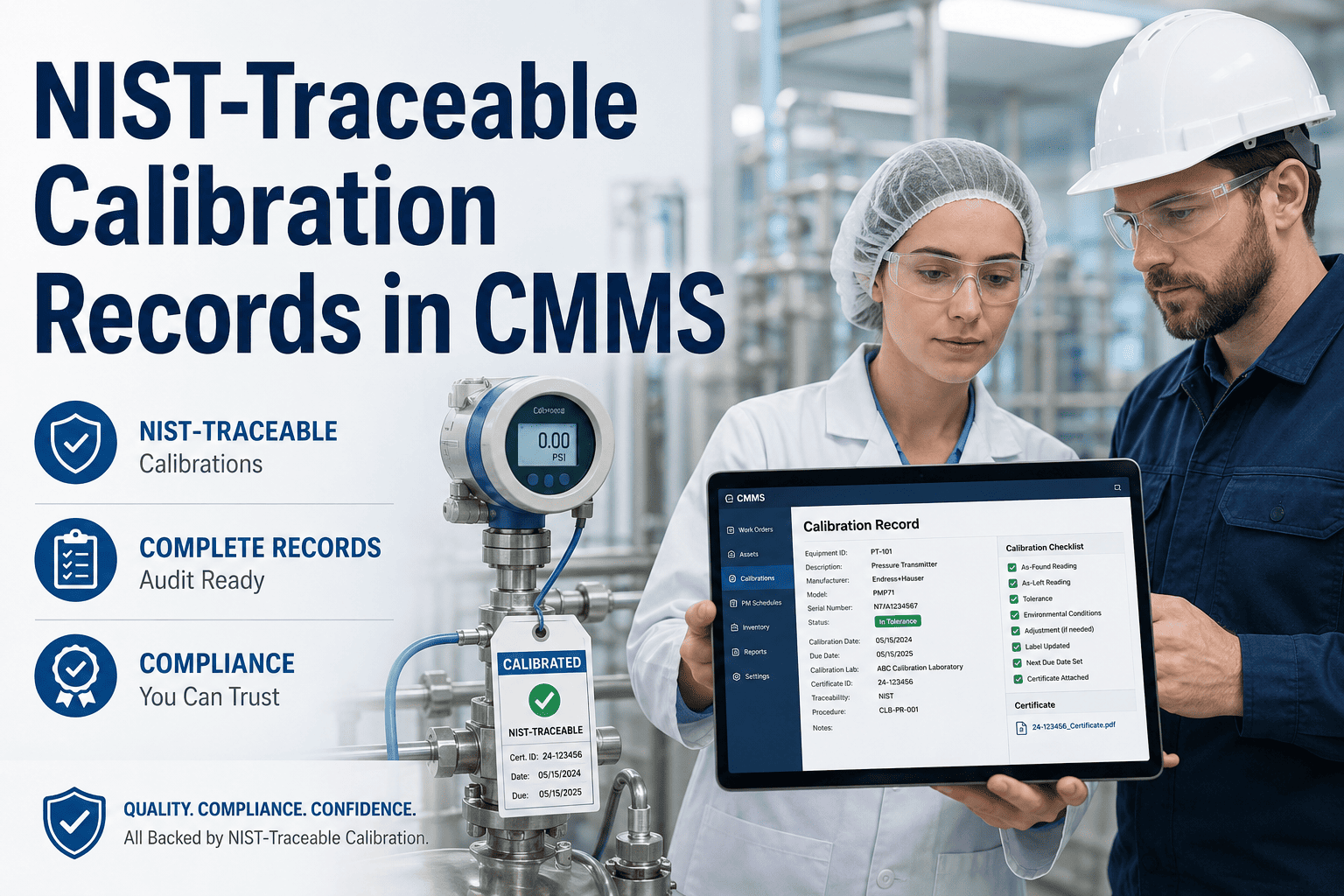
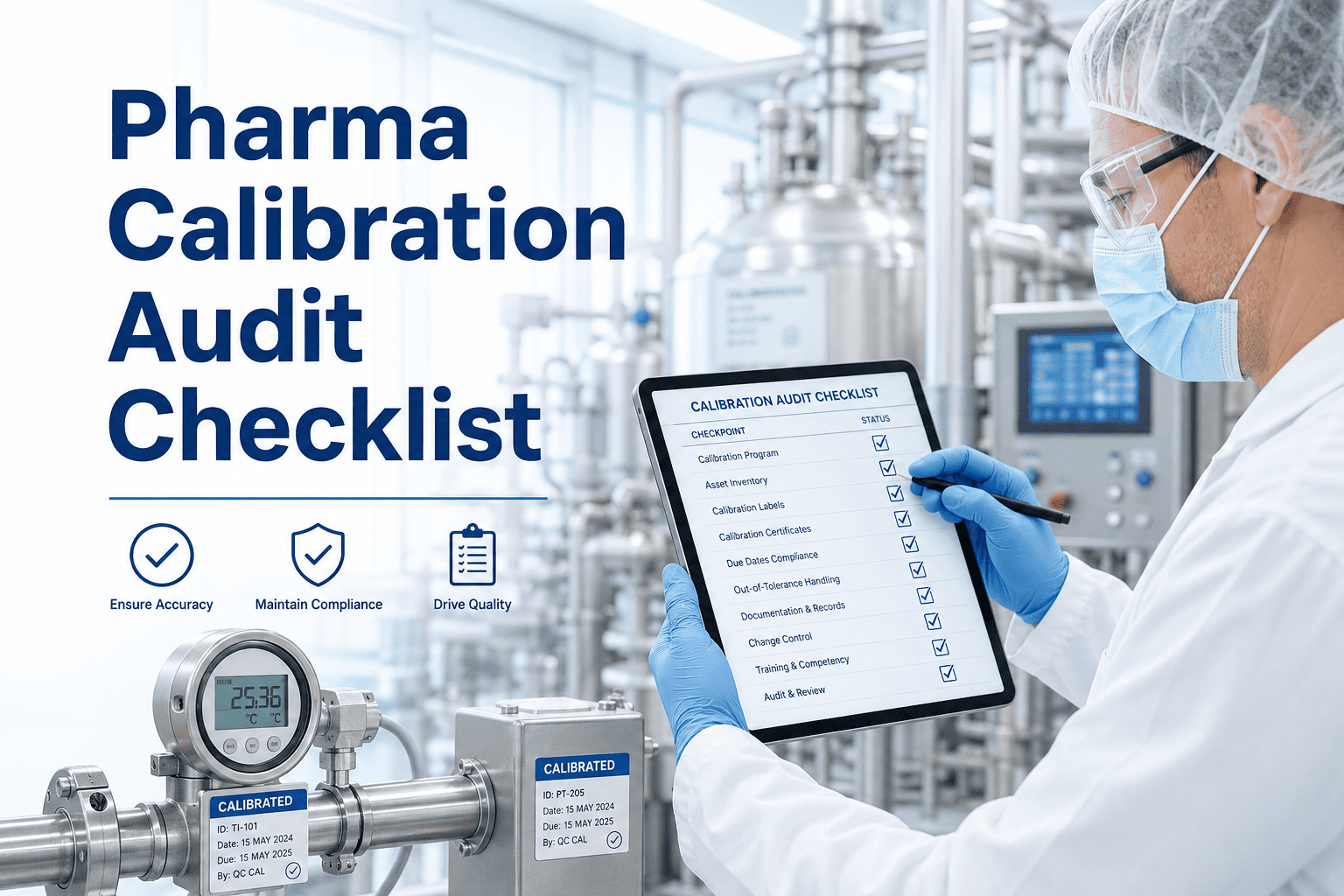
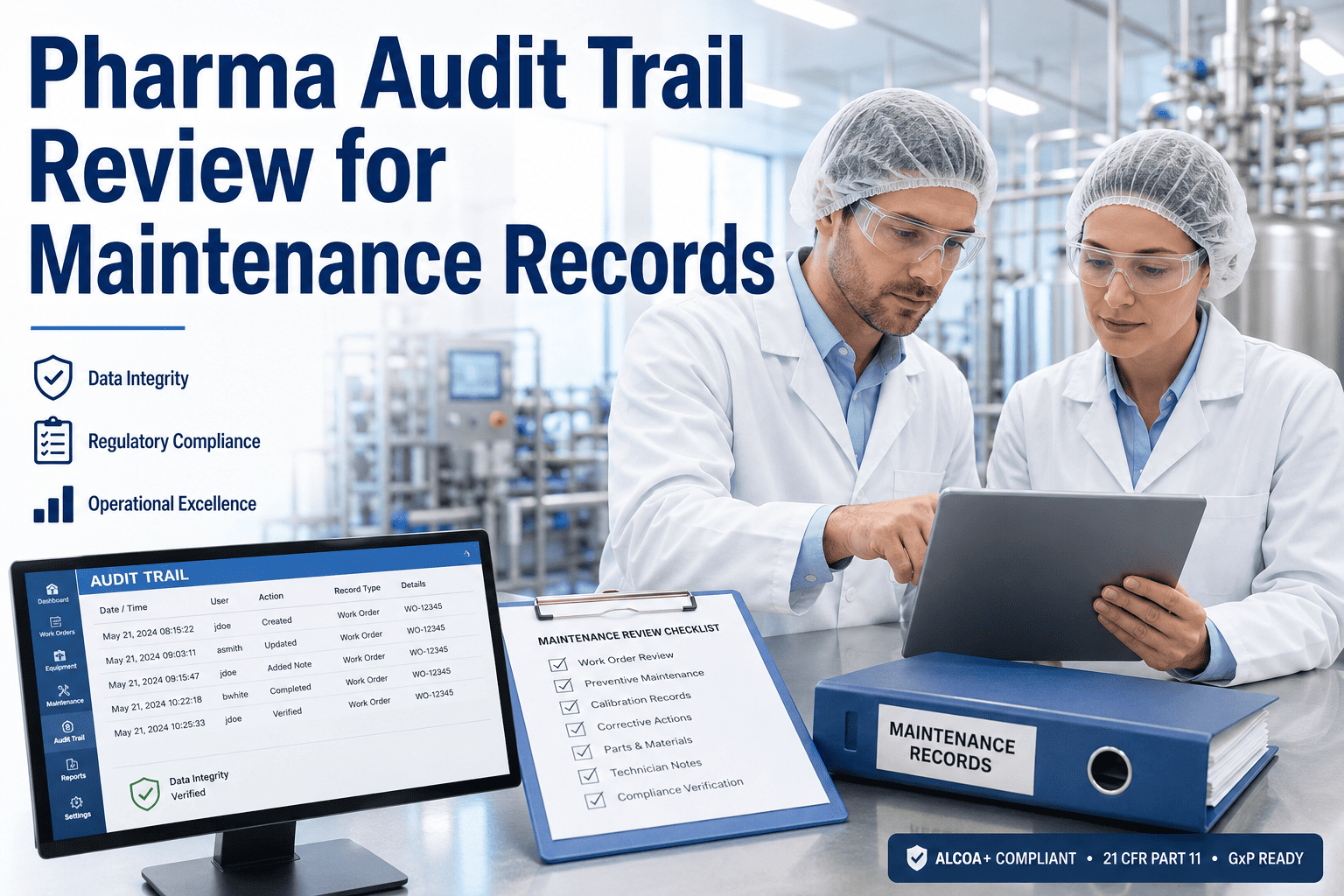
Pharmaceutical and regulated-industry facilities that rely on paper binders or spreadsheets to manage NIST-traceable calibration records face a hidden audit risk: the traceability chain exists in fragments, not as a single verifiable record. A CMMS that stores calibration evidence, links reference standard certificates, flags out-of-tolerance deviations, and generates a complete audit trail on demand removes that risk entirely. Start a free trial on OxMaint to see live traceability records, or book a demo and walk through a complete NIST calibration record chain in under 30 minutes.
Article · NIST Traceability · Pharma CMMS · GMP Calibration
NIST-Traceable Calibration Records in CMMS
How pharmaceutical facilities store, link, and defend NIST-traceable calibration evidence — from reference standard certificates to out-of-tolerance audit trails — inside a modern CMMS.
ISO 17025
International standard governing traceability of measurement results
21 CFR
FDA regulation requiring documented calibration evidence for pharma instruments
68%
of pharma 483 observations involve inadequate calibration documentation
3.1x
faster inspector response when traceability is stored in a CMMS vs binders
What NIST Traceability Actually Means
01
The Chain Requirement
NIST traceability is not a single certificate — it is an unbroken chain. Your instrument is calibrated against a reference standard. That standard is calibrated against a higher-order standard. That standard traces back to a national metrology body (NIST in the US, NPL in the UK, PTB in Germany). Every link in the chain must be documented with a certificate, uncertainty value, and valid calibration date.
02
Measurement Uncertainty
Each calibration in the chain introduces measurement uncertainty. ISO 17025 requires that calibration certificates report the expanded uncertainty at a stated confidence level (typically 95%). A CMMS must store these uncertainty values per reference standard, not just the pass/fail result. During an audit, investigators look for uncertainty budgets — not just certificate numbers.
03
Reference Standard Records
Your working standards — the instruments used to calibrate production equipment — are themselves calibrated assets. They need their own calibration records, due dates, and traceability certificates in the CMMS. Most audit failures occur not because production instruments lack records, but because the reference standards used to calibrate them cannot be traced to a national standard.
The NIST Traceability Chain — Visualized
NIST / NMI
National Metrology Institute
Primary measurement standards — base of all traceability
Level 1
Accredited Calibration Laboratory
ISO 17025 accredited · Issues traceable certificates · Stores uncertainty data
Level 2
Reference / Working Standard
In-house or external standard · Requires its own calibration record in CMMS
Your Instrument
Production / Process Equipment
Final calibration event · Certificate + tolerance + technician + QA approval in CMMS
What a Complete CMMS Calibration Record Contains
| Record Field |
Required For |
Stored In CMMS |
Audit Risk if Missing |
| Instrument asset ID and description |
21 CFR 211.68 · ISO 9001 |
Asset master record |
Cannot link calibration to specific equipment |
| Calibration date and technician name |
21 CFR Part 11 · GMP Annex 11 |
Work order record |
No evidence of who performed the calibration |
| Reference standard used (ID + cert number) |
ISO 17025:6.4 |
Linked standard record |
Traceability chain broken at first link |
| NIST certificate attached (PDF) |
ISO 17025:5.10 · FDA |
Document attachment |
Inspector cannot verify traceability claim |
| As-found and as-left readings |
21 CFR 211.68 · GMP |
Measurement data fields |
No evidence of instrument state before adjustment |
| Tolerance limits and pass/fail result |
21 CFR 211.68 |
Tolerance configuration |
Cannot assess whether instrument was in spec |
| Measurement uncertainty value |
ISO 17025:7.6 |
Certificate data field |
Incomplete uncertainty budget for accreditation |
| QA approval with digital timestamp |
21 CFR Part 11 |
Electronic signature |
21 CFR Part 11 violation — most cited FDA finding |
| Out-of-tolerance flag and CAPA link |
GMP Annex 15 · ICH Q10 |
OOT workflow trigger |
No documented response to non-conformance |
| Next calibration due date |
21 CFR 211.68 |
Scheduled PM record |
Instrument used past calibration expiry |
OxMaint stores every field in this table — linked, searchable, and exportable — for every calibration event across every asset in your facility. Inspectors get a complete traceability package in minutes, not hours.
Out-of-Tolerance: What CMMS Must Do Automatically
An out-of-tolerance result is a compliance event, not just a maintenance task. Regulatory bodies expect a documented, time-stamped response chain within defined windows. A CMMS that only records the OOT finding — without triggering the response workflow — leaves facilities exposed during audit reviews.
1
OOT Result Recorded
As-found reading exceeds tolerance band. CMMS flags automatically — no manual escalation required.
2
Instrument Quarantine
Asset status set to restricted or quarantined in CMMS. Production team and QA notified automatically.
3
Batch Impact Assessment
QA reviews all product batches associated with the instrument during the drift period. Assessment linked to OOT record.
4
CAPA Initiated
Corrective and preventive action record created in CMMS with root cause, corrective steps, and target closure date.
5
QA Closure and Re-release
After recalibration and CAPA closure, QA digital-signs the instrument back into service. Full timeline preserved in CMMS.
Common NIST Traceability Failures in Pharma CMMS
61%
Reference standard records not linked to production instrument calibrations
54%
Calibration certificates stored in paper binders, not attached to CMMS records
47%
Measurement uncertainty values absent from calibration records
39%
OOT results recorded without triggering CAPA or batch impact review
33%
QA approval timestamps missing or undated on calibration sign-offs
28%
Reference standard calibration due dates not tracked in the same CMMS
Source: Analysis of FDA 483 observations and ISO 17025 audit findings across regulated manufacturing facilities (2021–2024)
The traceability chain breaks in one of two predictable places: the reference standard record that is not in the CMMS, and the uncertainty value that was never captured from the certificate. Both are invisible failures until an ISO 17025 auditor or FDA investigator asks for them. A properly configured CMMS makes these fields mandatory — you cannot close a calibration work order without entering the reference standard ID and attaching the certificate. That single enforcement point eliminates the most common traceability finding I have seen in 22 years. The second change that produces the most audit readiness is storing OOT history separately from general maintenance history, so QA can pull a complete OOT trend report independently.
Frequently Asked Questions
What makes a calibration "NIST-traceable" versus just "calibrated"?
A calibration is NIST-traceable when every instrument in the measurement chain — from your production equipment to the reference standard used to calibrate it — can be traced back to a national metrology standard with documented certificates and uncertainty values at each link. Simply calibrating an instrument using an in-house standard without verifying that standard's traceability breaks the chain. ISO 17025 and 21 CFR both require this unbroken chain to be documented.
Book a demo to see how OxMaint structures linked traceability records.
How should a CMMS store NIST calibration certificates to satisfy FDA requirements?
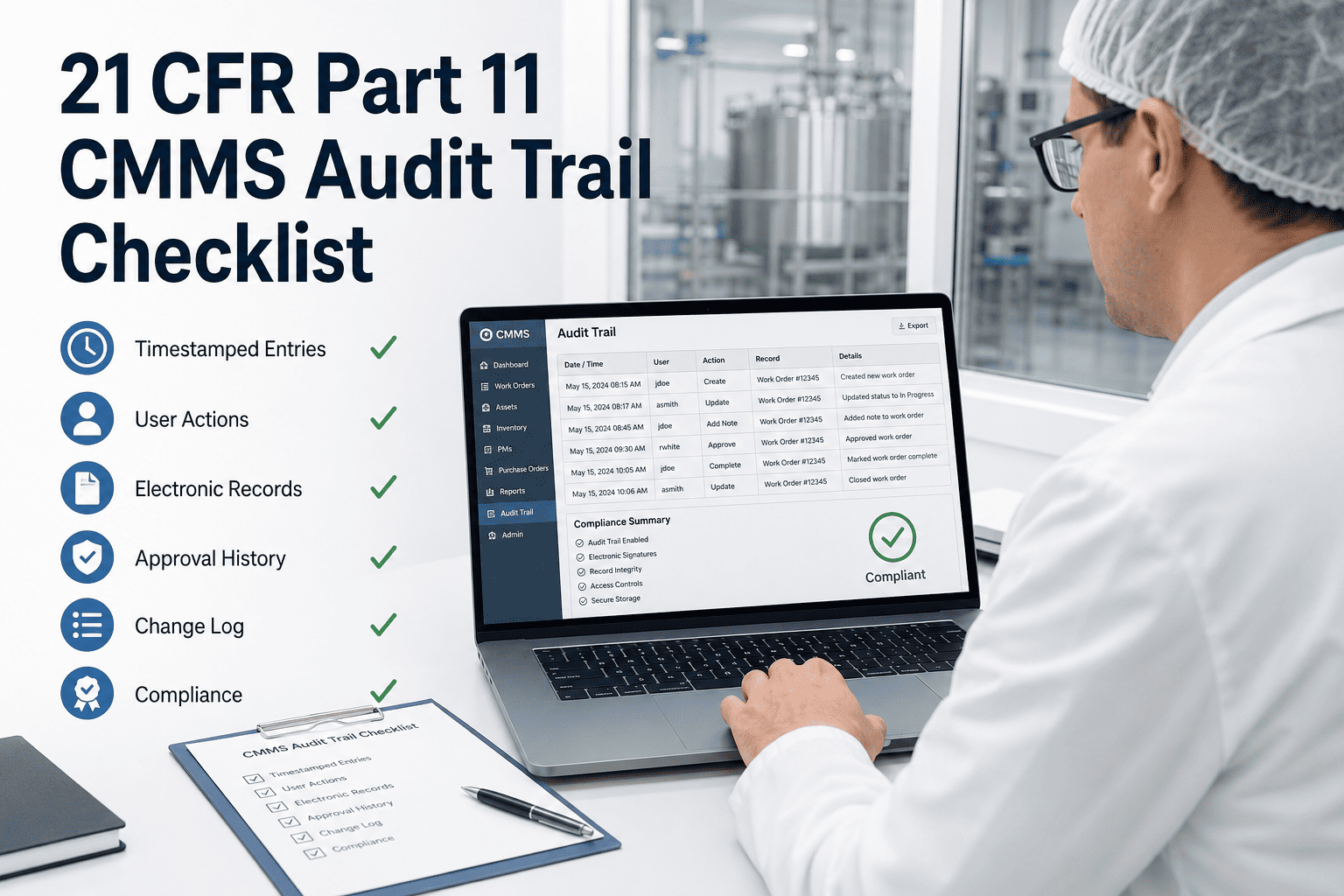
Under 21 CFR Part 11, electronic calibration records must be attributable (linked to a named person), legible, contemporaneous, original, and accurate. This means certificates must be stored as non-editable attachments (typically PDF), linked directly to the specific calibration work order and asset record, with the upload timestamp recorded. Certificates stored in a shared drive folder without a direct CMMS link do not satisfy the attribution and contemporaneous requirements during an FDA inspection.
Start a free trial to explore OxMaint's certificate attachment workflow.
How long must NIST-traceable calibration records be retained in pharma?
Under 21 CFR Part 211.180, pharmaceutical records must be retained for at least one year after the expiry date of the batch with the latest expiry date associated with that instrument's use. In practice, most facilities retain calibration records for 5 to 7 years. A CMMS with a defined record retention policy and automated archiving ensures records are available for both regulatory inspections and product liability review without manual reconstruction from paper archives.
Can OxMaint generate a complete NIST traceability package for an FDA inspector?
Yes. OxMaint can filter calibration records by asset, date range, and location, then export a complete package that includes the calibration work order, technician name, reference standard used, attached certificates, as-found and as-left readings, tolerance results, QA approval timestamp, and any linked OOT or CAPA records. This package is typically requested within the first hour of an FDA site inspection.
Book a demo to see the export workflow in action.
Your NIST Traceability Chain Should Be One Click, Not One Day
OxMaint links calibration certificates, reference standard records, uncertainty values, OOT findings, and QA approvals into a single audit-ready record for every instrument in your facility.