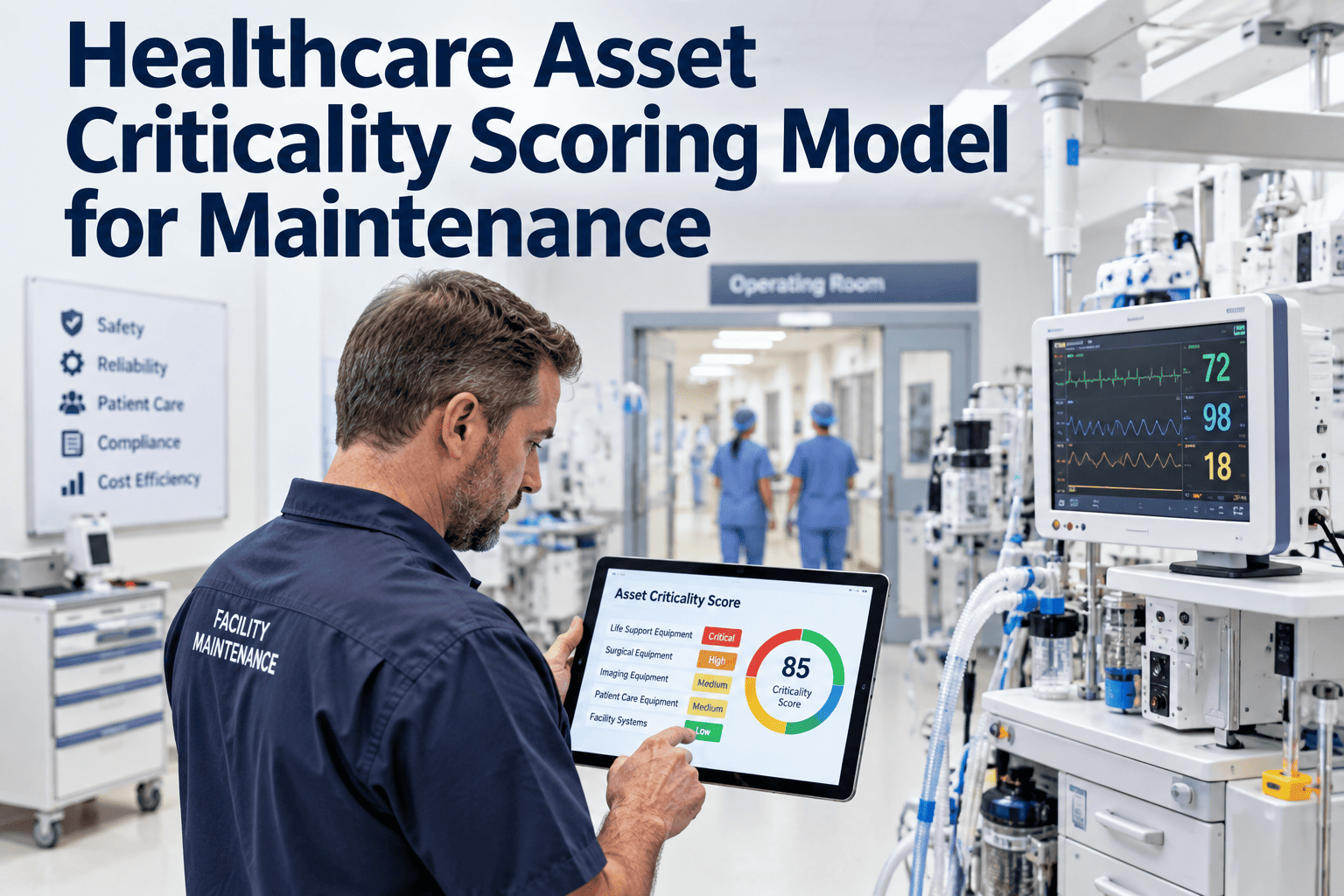
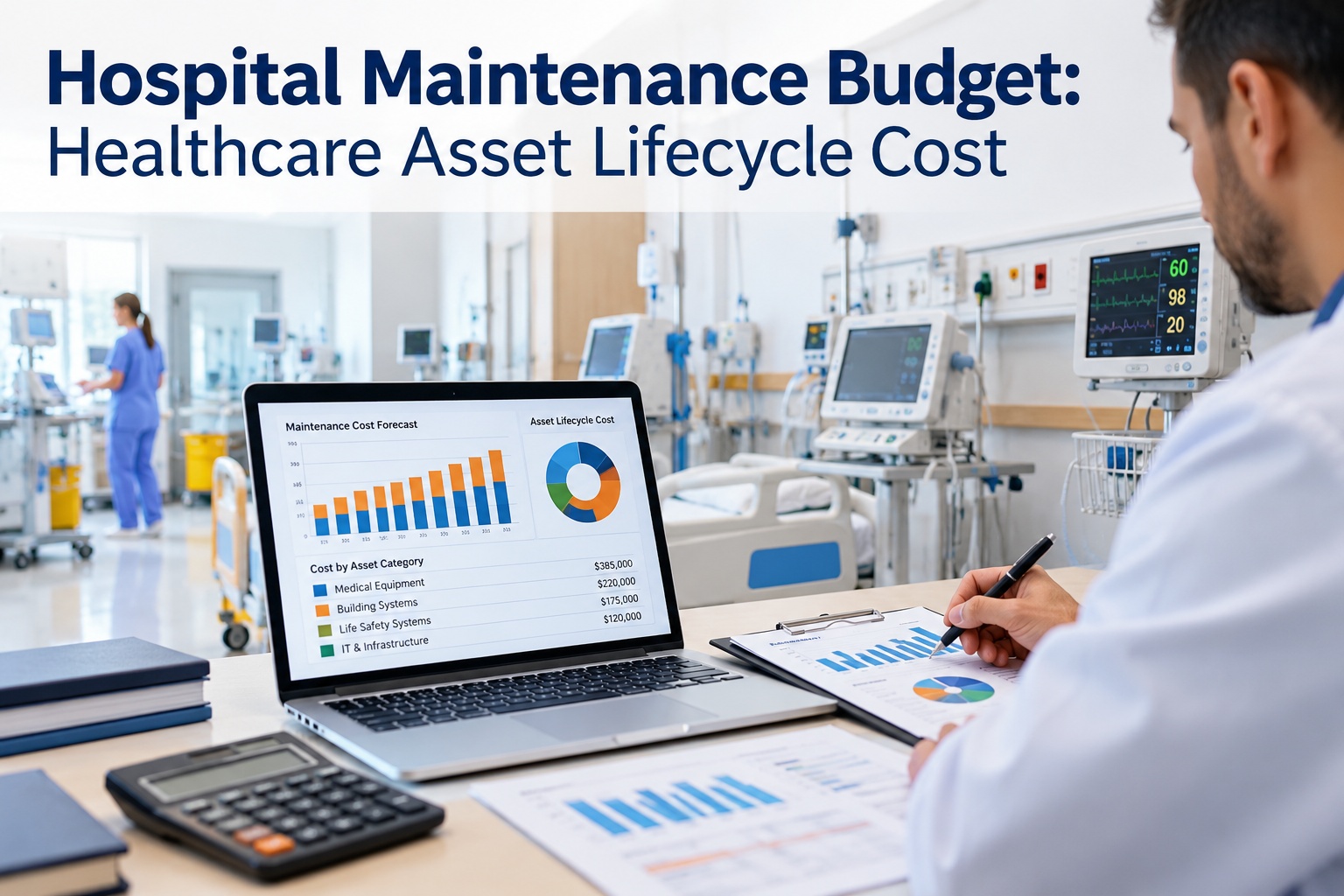
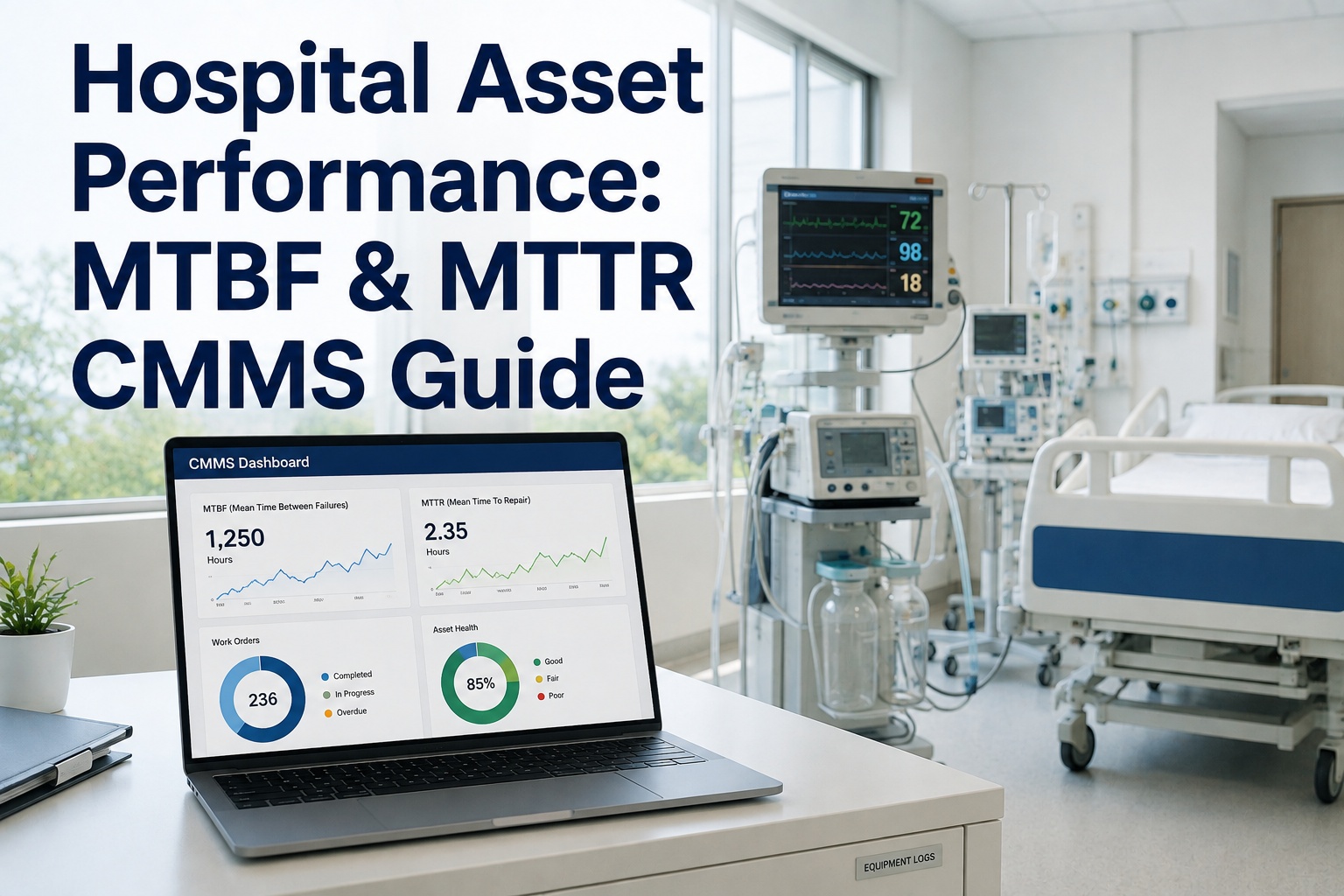
Not every hospital asset deserves the same maintenance attention. A ventilator in ICU and a waiting-room TV both sit on the biomed inventory, and treating them the same is either a Joint Commission finding or a badly spent budget. Healthcare asset criticality scoring is the discipline that puts every device on the same 1-to-10 grid — clinical function, physical risk, likelihood of failure, incident history, mission-criticality — turns the score into a tier, and drives PM frequency, spares stocking and replacement priority from the tier. This guide walks the scoring model inside OxMaint AI-powered CMMS / Maintenance Management Software, aligned to TJC EC.02.04.01 and the Fennigkoh & Smith / ASHE frameworks — or book a biomed walkthrough.
Healthcare HTM · Asset Criticality Scoring · TJC EC.02.04.01 Aligned
Score Every Asset. Tier the Inventory. Drive PM & Spares from Risk.
Hospitals with a flat inventory over-maintain the trivial and under-maintain the critical. OxMaint AI-powered CMMS runs a weighted 5-factor criticality score on every medical device and utility asset, sorts the inventory into High-Risk / Medium / Low tiers, and drives PM cadence, spares stocking and replace-vs-repair calls from the score — the audit trail TJC and CMS want to see.
5-Factor Weighted Score
High / Medium / Low Tiers
Tier-Driven PM Cadence
TJC / CMS Audit Trail
The 5 Scoring Factors OxMaint Captures Per Asset
The Fennigkoh & Smith framework (three factors) was the standard until ASHE and the Joint Commission expanded it to five — clinical application, function, environment, PM requirement and failure probability. OxMaint carries all five per device with per-facility weighting.
EFWeight 25%
Equipment Function
1
3
5
7
10
What the device does clinically. 10 = life support (ventilator, ECMO, defibrillator) · 5 = therapeutic (infusion pump) · 1 = non-medical (waiting-room monitor).
PRWeight 25%
Physical Risk of Failure
1
3
5
7
10
Harm if the device fails during use. 10 = patient death · 5 = injury or misdiagnosis · 1 = no clinical impact.
EUWeight 15%
Environment of Use
1
3
5
7
10
Where the device operates. 10 = anaesthesia / ICU / OR · 5 = general ward · 1 = admin or non-clinical area.
FPWeight 20%
Failure Probability (from MTBF)
1
3
5
7
10
Historical failure rate derived from OxMaint WO close data. 10 = MTBF trending downward & below family baseline · 1 = stable, well above baseline.
IHWeight 15%
Incident History & Recalls
1
3
5
7
10
FDA recalls, sentinel events, safety alerts on the make/model. 10 = active recall or repeated sentinel event · 1 = clean history.
Tier Assignment — What the Score Means
Once every asset has a score, OxMaint sorts the inventory into three tiers. The tier drives everything downstream — PM cadence, spares stocking depth, replace-vs-repair triggers and TJC EC.02.04.01 categorisation. The 12-point threshold for High-Risk is the Fennigkoh & Smith convention still recognised by TJC surveyors.
HIGH-RISK
Score ≥ 12
Critical / TJC High-Risk
PM CadenceOEM-strict, no AEM deferral
Spares DepthFull kit + spare unit on-site
Downtime SLA< 2 hours to restore
ExamplesVentilator, defib, anaesthesia, ECMO
MEDIUM
Score 6–11
Important / AEM Eligible
PM CadenceOEM or AEM programme
Spares DepthCommon failure parts on-shelf
Downtime SLASame shift restore
ExamplesInfusion pump, patient monitor, ultrasound
LOW
Score ≤ 5
Non-Critical / Run-to-Fail
PM CadenceAnnual visual or run-to-fail
Spares DepthOrder-on-fail
Downtime SLANext business day
ExamplesExam lamp, waiting-room screen, patient scale
Worked Scoring Examples — Three Devices, Same Model
The same device model can end up in different tiers depending on where it's deployed. OxMaint scores per-instance, not per-catalogue — a syringe pump in ICU carries a different EU score than the same pump in outpatient day-surgery.
Mechanical Ventilator · ICU Bed 4
EF · Function10× 0.25
PR · Physical Risk10× 0.25
EU · Environment10× 0.15
FP · Failure Prob.6× 0.20
IH · Incident Hist.5× 0.15
Weighted Total15.0
HIGH-RISK · OEM PM
Infusion Pump · General Ward
EF · Function7× 0.25
PR · Physical Risk7× 0.25
EU · Environment5× 0.15
FP · Failure Prob.6× 0.20
IH · Incident Hist.3× 0.15
Weighted Total9.4
MEDIUM · AEM Eligible
Exam Room Lamp · Outpatient Clinic
EF · Function2× 0.25
PR · Physical Risk3× 0.25
EU · Environment3× 0.15
FP · Failure Prob.4× 0.20
IH · Incident Hist.1× 0.15
Weighted Total2.7
LOW · Run-to-Fail
Every PM Hour You Spend on a Low-Tier Asset Is an Hour You Didn't Spend on a High-Risk One.
Score the inventory once in OxMaint and let the tier drive PM cadence, spares stocking and replacement priority — the way TJC and CMS surveyors expect.
The Hospital Inventory After Scoring — Live in OxMaint
Every device in the inventory gets scored, tiered and colour-coded. Biomed opens the dashboard, sees the High-Risk assets first, and works PM and spares from the tier — not from the loudest ward request.
OxMaint · HTM Inventory · Criticality-Sorted · Live
| Asset Tag | Device / Location | Score | Tier | PM Due | MTBF Trend |
|---|
| VEN-ICU-04 | Vent · ICU Bed 4 | 15.0 | HIGH | 18 Sep | → Flat |
| DEF-ED-02 | Defib · ED Bay 2 | 14.6 | HIGH | 22 Sep | ↑ 8% |
| ANE-OR-01 | Anaesthesia · OR 1 | 14.2 | HIGH | 2 Oct | → Flat |
| MRI-RAD-01 | MRI · Radiology | 13.5 | HIGH | Q4 PM | ↓ 12% |
| PMP-W3-114 | Infusion Pump · Ward 3 | 9.4 | MED | 15 Oct | → Flat |
| US-OB-03 | Ultrasound · OB Clinic | 8.1 | MED | 28 Oct | ↑ 4% |
| SCL-OP-42 | Patient Scale · Outpatient | 3.1 | LOW | Annual | → Flat |
| LMP-OP-15 | Exam Lamp · Outpatient | 2.7 | LOW | RTF | — |
What OxMaint Gives a Healthcare HTM Team
5-Factor Scoring Engine
EF, PR, EU, FP, IH captured per asset with per-facility weighting — Fennigkoh & Smith / ASHE aligned.
Auto-Tier Assignment
Weighted score maps to High / Medium / Low tier automatically, re-checked whenever MTBF or incidents update.
Tier-Driven PM Cadence
PM interval, task-card depth and inspector qualification derived from tier — no per-device decisions.
AEM Eligibility Flag
Medium and Low tier assets flagged for Alternative Equipment Maintenance eligibility per TJC EC.02.04.01.
Recall & Incident Ledger
FDA recalls and internal sentinel events auto-lift the IH score so the tier reflects live safety data.
TJC / CMS Audit Export
One-click risk-methodology export with scoring matrix, weightings and per-asset tier — surveyor-ready.
FAQs
Q. Does OxMaint's scoring model satisfy TJC EC.02.04.01 documentation?
Yes — the model is aligned to Fennigkoh & Smith / ASHE and produces the written risk methodology TJC surveyors expect. Weightings and thresholds are configurable per facility.
Start free and pull the sample methodology.
Q. How does OxMaint decide AEM eligibility from the score?
Assets in the High-Risk tier (score ≥ 12) stay on OEM PM with no deferral. Medium and Low tier assets are AEM-eligible and can carry an alternative cadence documented in OxMaint.
Book a demo to see AEM flagging.
Q. Can the same device model carry different scores in different locations?
Yes — scoring is per-instance. A syringe pump in ICU scores differently from the same model in outpatient because Environment of Use and MTBF-based Failure Probability differ.
Try per-instance scoring.
Q. How does the score update when an FDA recall drops?
A recall or sentinel event lifts the Incident History (IH) factor immediately for every affected asset. The weighted score re-calculates and the tier can escalate on the same day.
See the recall workflow in a demo.
Every Asset. Every Factor. One Score. One Tier.
Move your hospital inventory into OxMaint — 5-factor scoring, live tier assignment, tier-driven PM and spares, TJC audit trail on every device.