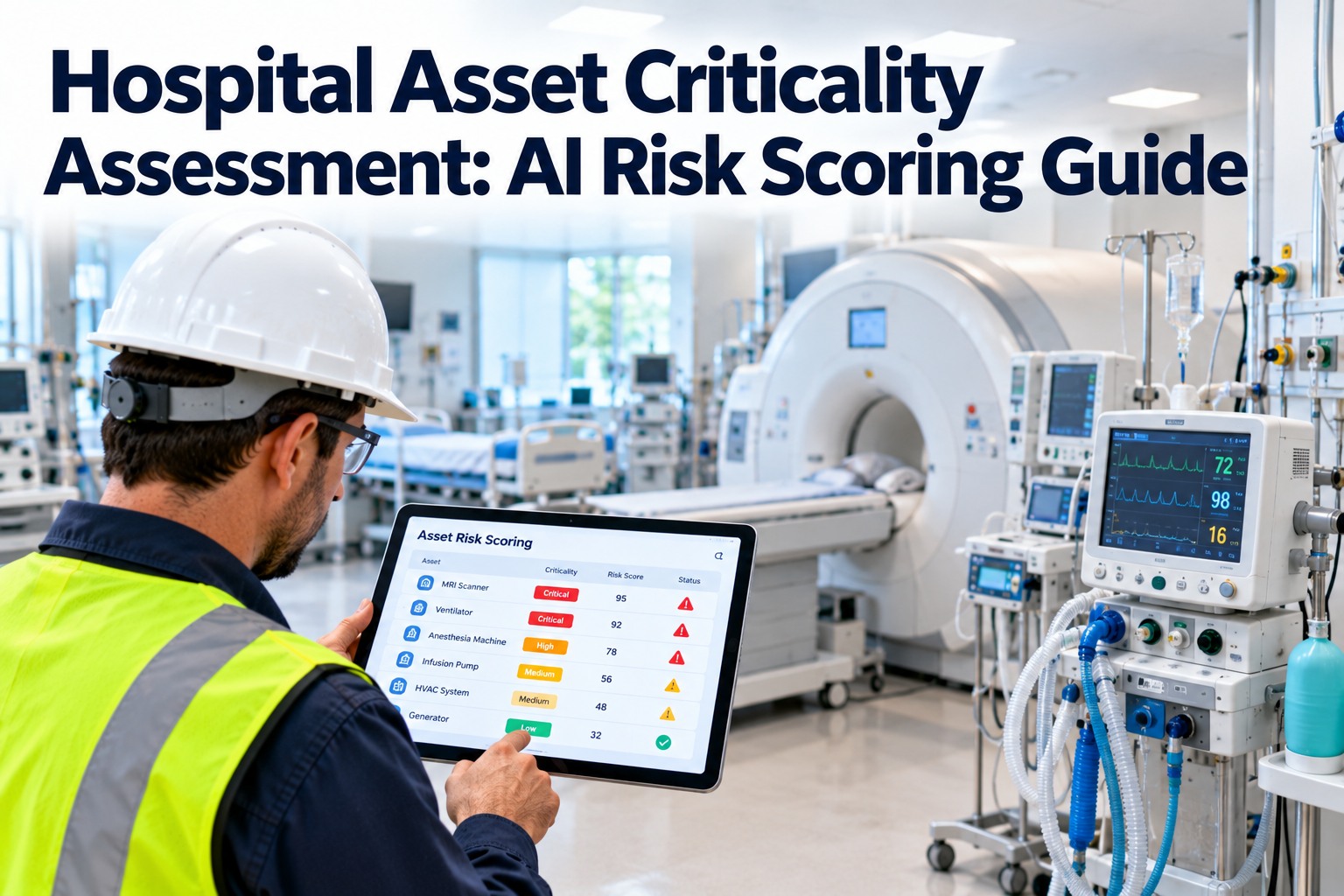
A hospital runs thousands of assets, and they are not equal. A ventilator and a waiting-room TV sit in the same maintenance backlog, but only one can harm a patient if it fails. When every asset is treated the same, the critical ones wait behind the trivial ones — and a once-a-year criticality spreadsheet is stale the day it is filed. Asset criticality assessment fixes the order: it scores each asset by the risk it carries, so maintenance, inspection and spares follow patient safety, not the order tickets arrived. This guide walks that scoring and how to run it in OXMAINT AI, or book a demo of AI asset risk scoring.
HOSPITAL ASSET CRITICALITY · AI RISK SCORING · 2027
Hospital Asset Criticality Assessment: AI Risk Scoring Guide
Flat maintenance queues let a critical asset wait behind a trivial one. OXMAINT AI scores every asset by patient-safety risk, failure probability and operational impact, then drives the queue from that score — so inspections, PMs and spares line up behind the equipment that matters most.
Asset Risk Score
Ventilator94
Infusion pump81
Chiller (OR)72
Patient monitor58
Waiting-room TV14
Illustrative — your scores come from your assets and data
What Criticality Actually Measures
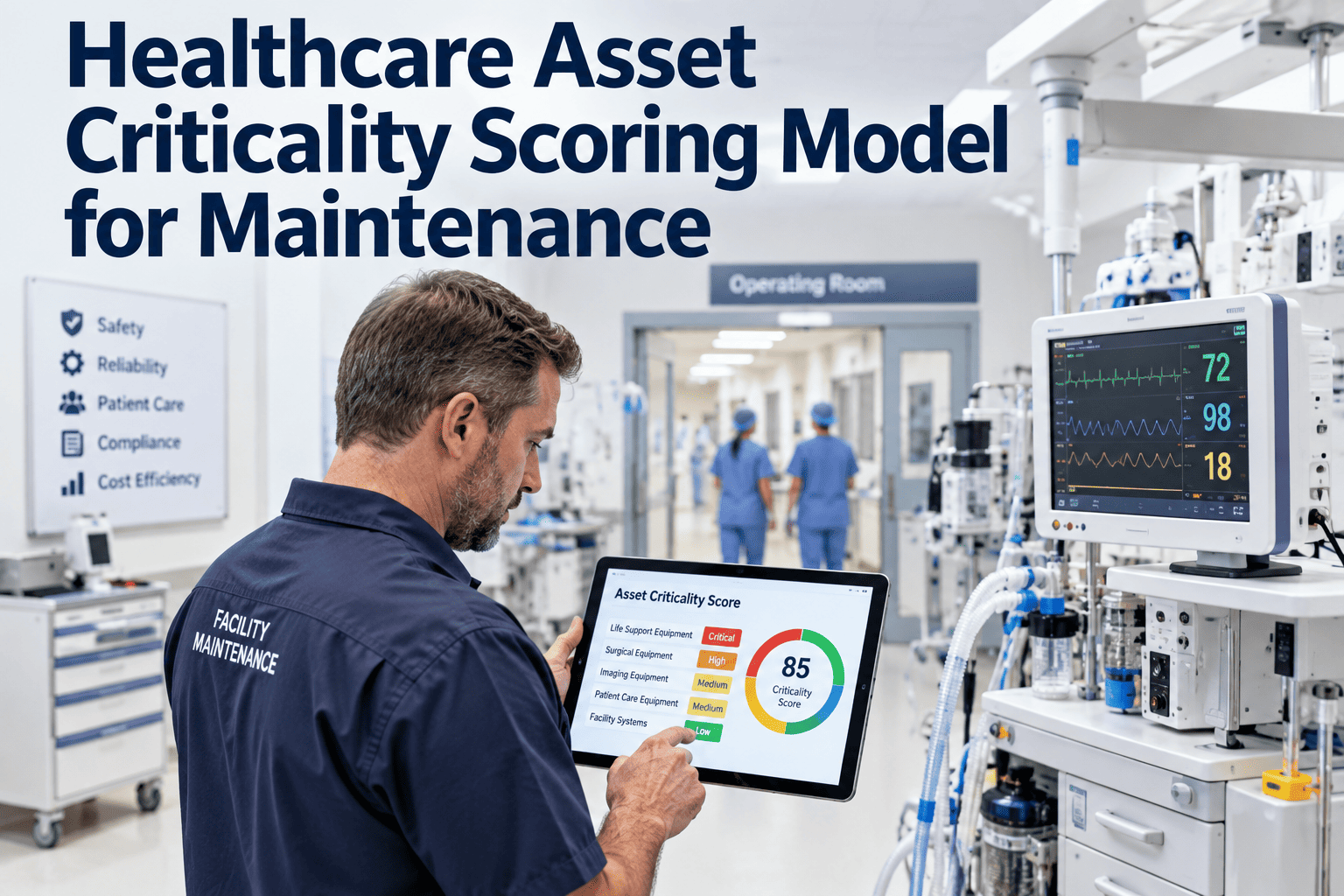
Criticality is not how expensive an asset is or how often it fails — it is how much a failure would hurt, weighed against how likely that failure is. A good score combines a few dimensions, and each one pulls the ranking toward patient safety. Start free and build your asset criticality model in OXMAINT AI.
01
Patient-Safety Risk
What a failure could do to a patient — from life-support and direct clinical function down to no clinical contact at all.
02
Failure Probability
How likely the asset is to fail, from condition data, age, failure history and missed maintenance.
03
Operational Impact
What a failure does to the service — a cancelled list, a closed room, a backed-up department.
04
Redundancy & Recovery
Whether a backup exists and how fast the asset can be restored or replaced if it goes down.
The Criticality Matrix
The simplest way to see a score is a matrix: how bad the failure would be against how likely it is. Where an asset lands sets how hard you work to prevent its failure.
Consequence ↓ / Likelihood →
Low
Medium
High
Severe (patient harm)
High
Critical
Critical
Major (service loss)
Medium
High
Critical
Minor (inconvenience)
Low
Medium
High
This grid scrolls sideways on a phone. The matrix is the picture; the score behind each cell is what OXMAINT AI calculates and keeps current as conditions change.
From Score to Maintenance Strategy
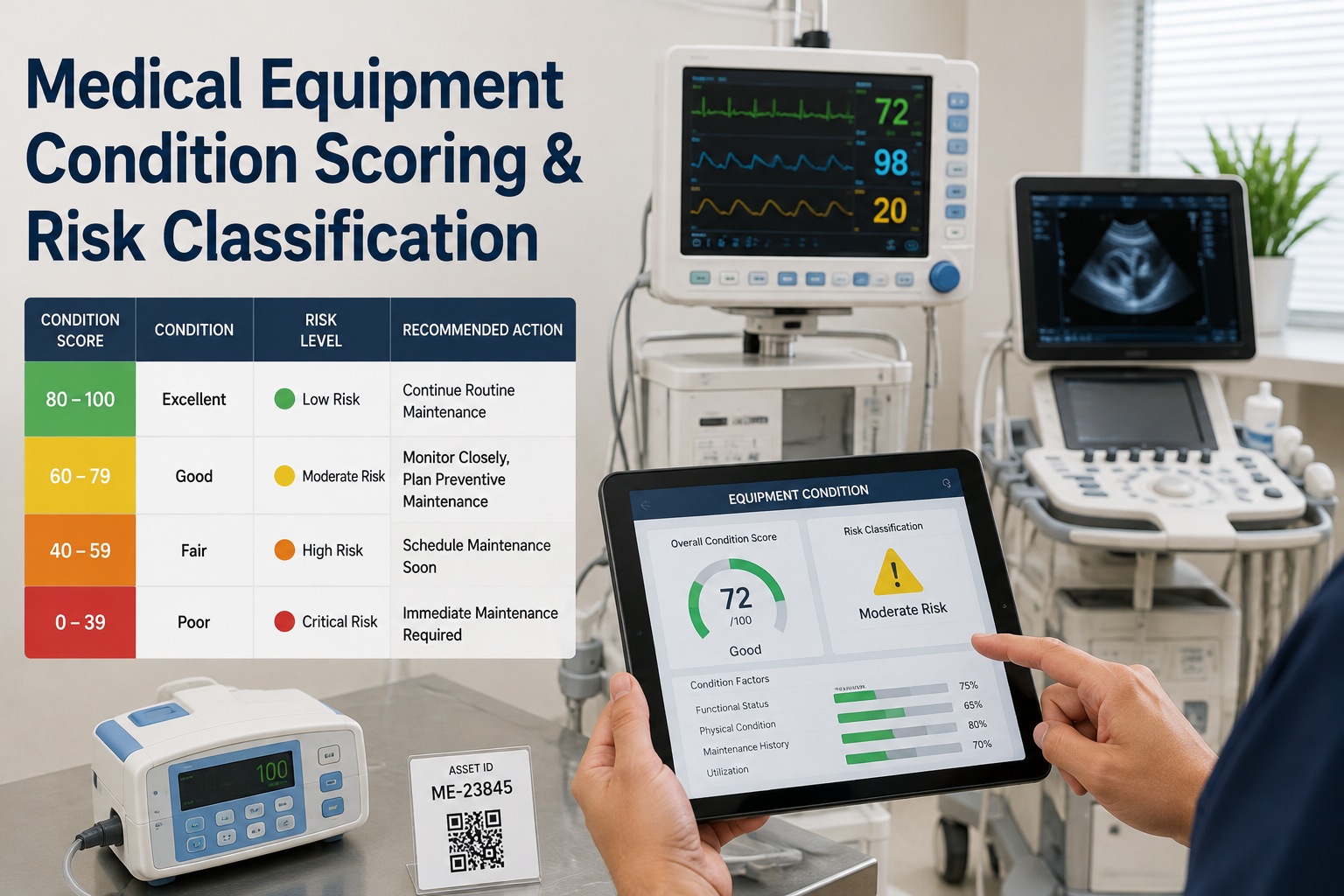
A criticality score is only useful if it changes what you do. Each tier earns a different maintenance strategy, so effort is spent where a failure would hurt most. Book a demo and see risk-based maintenance tiers in OXMAINT AI.
Critical
Predictive monitoring, tight PM intervals, redundancy and spares on hand, priority response. Life-support and direct-clinical equipment lives here.
High
Scheduled preventive maintenance, condition checks, and a fast but not instant response. Equipment whose loss disrupts a service.
Medium / Low
Routine or run-to-failure where safe, with spares ordered as needed. Non-clinical assets whose failure is an inconvenience.
Why AI Changes the Assessment
A manual criticality assessment is a snapshot — accurate the day it is done, drifting every day after. AI keeps the score alive by re-reading the data that moves it.
Manual, Once a Year
→
AI, Continuously
Static spreadsheet
A score set once and rarely revisited, blind to what has changed since.
Live risk score
Re-scored as condition data, failure history and missed PMs change the risk.
One person's judgement
Weightings that vary by who filled the form and when.
Consistent model
The same weighting applied to every asset, with the inputs on the record.
Reactive reordering
Priorities changed only after something fails and forces it.
Early flags
A rising failure probability lifts an asset's priority before it fails.
Where Criticality Programs Fall Down
The idea is sound; the execution is where it usually breaks. These are the gaps that leave a hospital with a criticality list nobody trusts.
×
Set and Forgotten
Scored once, filed, never updated as equipment ages or conditions change.
×
Not Tied to Action
A criticality rating that never actually changes the PM plan or the queue.
×
Inconsistent Scoring
Different people weighting risk differently, so the ranking cannot be trusted.
×
Cost Mistaken for Risk
Expensive assets ranked critical when a cheap one carries the real patient risk.
×
No Failure Data
Probability guessed instead of drawn from the asset's own history and condition.
×
Separate From the CMMS
The list lives in a spreadsheet apart from where work actually gets scheduled.
The Right Order Is a Safety Decision.
Which asset gets attended to first is not an administrative choice in a hospital — it is a patient-safety one. OXMAINT AI scores every asset, keeps the score current, and lets the maintenance queue, the PM plan and the spares list all follow it.
1Score every asset by risk
→
2Rank into criticality tiers
→
3Assign the right strategy
→
4Re-score as data changes
How OXMAINT AI Runs Asset Criticality
OXMAINT AI is the AI-powered healthcare CMMS that holds the asset register, the failure history and the condition data — so it can score criticality and act on it in the same place. Start free and bring your hospital assets onto OXMAINT AI.
Asset Register
Every asset with its location, clinical use, age and full service history in one place.
Risk Scoring
Patient-safety, failure-probability and impact inputs combined into a live criticality score.
Criticality Tiers
Assets sorted into tiers that set the PM interval, response time and spares policy.
Risk-Based PM
Preventive schedules and predictive alerts weighted toward the highest-criticality assets.
Prioritized Queue
Work orders ranked by asset criticality, so the critical job is never buried.
Audit-Ready Record
The score, its inputs and the maintenance it drove, retrievable per asset for review.
EXPERT REVIEW
Written for healthcare facilities, biomedical engineering, clinical engineering and plant maintenance teams responsible for medical and facility equipment. The criticality dimensions, matrix and tiers here are a general framework drawn from standard medical-equipment management and risk-based maintenance practice — the actual scoring model, weightings and equipment classifications for your hospital should come from your medical equipment management plan, your clinical engineering judgement and the governing standards and accreditation requirements. A risk model informs decisions; it does not make the clinical call. OXMAINT AI is a maintenance management platform that scores, ranks and schedules; it does not replace your clinical engineering program, a qualified assessor, or your facility's risk and compliance authority.
Frequently Asked Questions
What is hospital asset criticality assessment?
It is the practice of scoring each asset in a hospital by the risk its failure would carry — combining patient-safety impact, how likely the asset is to fail, the operational disruption a failure would cause, and whether a backup exists. The score ranks every asset so that maintenance, inspection and spares are prioritized toward the equipment that matters most to patient safety, rather than treating a ventilator and a waiting-room screen the same.
Start free and score your hospital assets in OXMAINT AI.
How does AI improve a criticality assessment?
A manual assessment is a snapshot that ages the moment it is filed. AI keeps the score current by continuously re-reading the data that moves it — condition readings, failure history and missed maintenance — and applies the same weighting to every asset instead of relying on who filled the form. That turns criticality from an annual spreadsheet into a live ranking that lifts an asset's priority as its failure risk rises.
Book a demo of AI risk scoring in OXMAINT AI.
What factors go into a medical equipment criticality score?
The core factors are patient-safety risk (what a failure could do clinically, from life-support down to no patient contact), failure probability (from age, condition and failure history), operational impact (the service disruption a failure causes), and redundancy and recovery (whether a backup exists and how fast the asset can be restored). Weighing these together — not any one alone — is what produces a defensible ranking.
Book a demo of the scoring model in OXMAINT AI.
How does criticality change the maintenance plan?
Each criticality tier earns a different strategy. Critical assets get predictive monitoring, tight PM intervals, spares on hand and priority response; high-criticality assets get scheduled preventive maintenance and condition checks; medium and low assets can run on routine or, where safe, run-to-failure. Tying the tier to the strategy is what makes the assessment worth doing — the score has to change what actually happens.
Can a CMMS run asset criticality for a hospital?
Yes, and it is the natural place for it, because a CMMS already holds the asset register, the failure history and the condition data a score depends on — and it is where the resulting work orders are scheduled. Running criticality inside the CMMS keeps the score, the ranking and the action in one place, instead of a spreadsheet that drifts away from the plant it is meant to drive.
Start free and run asset criticality in OXMAINT AI.
Put Patient-Safety Risk at the Front of the Queue.
Run asset criticality on OXMAINT AI: every asset scored by patient-safety risk, failure probability and impact, ranked into tiers, and the maintenance, inspections and spares all following that score — kept current as the data changes.