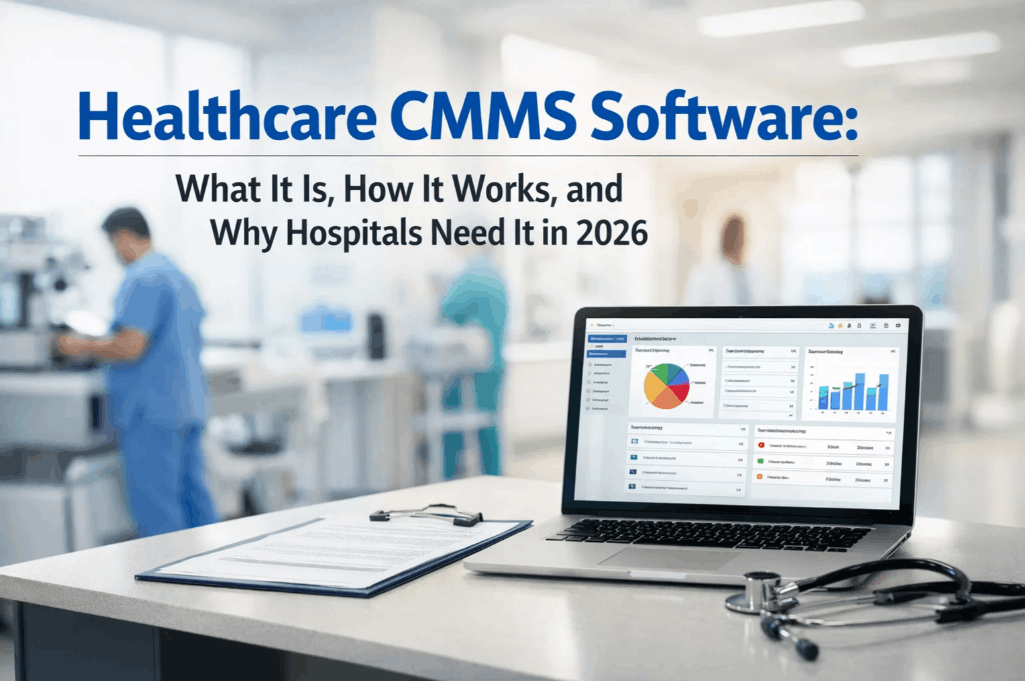
In 2026, hospitals can no longer afford to manage critical equipment the way they did a decade ago. Aging assets, growing regulatory demands, and razor-thin margins have made reactive maintenance a liability rather than a cost-saving measure. Healthcare Computerized Maintenance Management Software — commonly known as healthcare CMMS — has emerged as the operational backbone that high-performing hospital systems depend on to manage assets, automate work orders, and maintain compliance. Whether you are a biomedical engineer, a facilities director, or a hospital CFO trying to control costs, understanding what a CMMS is, how it works, and why it matters has never been more important. This guide covers everything you need to know — from the core definition of CMMS to its financial impact on hospital operations. Ready to see it in action? Sign up for OxMaint free or book a personalized demo to explore the platform built specifically for healthcare maintenance teams.
See How OxMaint Transforms Hospital Maintenance
AI-powered CMMS built for healthcare — from work orders to compliance reporting.
What Is CMMS? The Core Definition Explained
CMMS stands for Computerized Maintenance Management System. At its core, a CMMS is a software platform that centralizes all maintenance-related data and workflows for an organization — tracking assets, scheduling preventive maintenance tasks, managing work orders, and recording the complete service history of every piece of equipment in a facility.
In a healthcare context, a CMMS takes on additional layers of importance. Hospitals operate with thousands of individual assets — from MRI scanners and ventilators to HVAC systems, sterilization equipment, and nurse call systems — each of which requires documented maintenance to satisfy regulatory bodies such as The Joint Commission, CMS, and OSHA. A healthcare CMMS serves as both an operational tool and a compliance record, bridging the gap between clinical engineering, biomedical departments, and facilities management.
The term "maintenance tracking software" is sometimes used interchangeably with CMMS, though the latter encompasses far broader functionality than simple tracking. Modern healthcare CMMS platforms integrate predictive analytics, IoT sensor data, vendor management, and financial reporting into a single unified dashboard — making them a strategic asset management solution, not just a digital work log. Sign up for free to see how a purpose-built healthcare CMMS centralizes these capabilities.
How Does a Healthcare CMMS Work?
A healthcare CMMS functions by creating a digital record for every asset in the facility and automating the workflows that keep those assets operational and compliant. Here is how the core components work together in practice.
Asset Registration and Inventory
Every piece of equipment is entered into the system with its make, model, serial number, purchase date, warranty status, location, and assigned department. This creates the master asset registry from which all maintenance workflows originate.
Preventive Maintenance Scheduling
Based on manufacturer recommendations, regulatory requirements, and historical performance data, the CMMS automatically generates preventive maintenance schedules. Technicians receive automated work orders before equipment reaches a failure threshold — shifting the model from reactive repairs to planned upkeep.
Work Order Management
When a maintenance task is triggered — either by the scheduled calendar, a staff-submitted request, or an IoT sensor alert — the CMMS creates a structured work order. This work order assigns the task to the appropriate technician, tracks time-to-completion, documents parts used, and closes with a digital sign-off that becomes part of the compliance record.
Predictive Analytics and Alerts
Advanced healthcare CMMS platforms integrate with IoT sensors embedded in equipment to monitor real-time performance metrics. When sensor data signals an anomaly — elevated temperature, unusual vibration, power fluctuation — the system alerts the maintenance team before a failure occurs, enabling intervention without operational disruption.
Compliance Reporting and Documentation
Every completed work order, inspection, calibration, and safety check is automatically archived in the CMMS database. When a Joint Commission survey or CMS audit occurs, the facility can generate comprehensive compliance reports in minutes rather than scrambling through paper files or disjointed spreadsheets.
Asset Lifecycle and Financial Reporting
The CMMS tracks total cost of ownership for each asset — including purchase price, maintenance history, parts expenditures, and downtime events. This data powers capital replacement planning and helps hospital CFOs make evidence-based decisions about when to repair versus replace aging equipment.
Key Features of a Hospital CMMS Platform
Not every CMMS is designed for the unique demands of a hospital environment. Healthcare facilities require a purpose-built platform with features that go beyond what generic industrial CMMS software provides. The table below outlines the essential capabilities hospitals should evaluate when selecting a maintenance management system.
| Feature | What It Does | Why It Matters in Healthcare |
|---|---|---|
| Work Order Management | Creates, assigns, tracks, and closes maintenance tasks digitally | Eliminates paper-based workflows and ensures no task is missed or undocumented |
| Preventive Maintenance Scheduling | Automatically triggers maintenance tasks based on time, usage, or condition | Reduces unplanned failures by addressing wear before breakdown occurs |
| Asset Lifecycle Management | Tracks total cost of ownership from acquisition to decommission | Supports capital budget planning and deferred replacement decisions |
| Compliance and Audit Reporting | Generates documentation for regulatory bodies automatically | Reduces preparation time for Joint Commission, CMS, and OSHA inspections |
| Mobile Technician Access | Allows technicians to receive, update, and close work orders from any device | Accelerates response times across large hospital campuses |
| Predictive Maintenance Analytics | Uses sensor data and AI to forecast equipment failures before they happen | Shifts maintenance posture from reactive to proactive, reducing downtime significantly |
| Vendor and Contract Management | Tracks service contracts, warranty status, and vendor performance | Prevents costly out-of-warranty repairs and missed service contract renewals |
| Inventory and Parts Management | Monitors spare parts stock levels and triggers reorders automatically | Eliminates delays caused by missing parts during critical repairs |
Why Hospitals Need a CMMS in 2026
The case for investing in dedicated healthcare maintenance management software has strengthened considerably in recent years. Several converging forces make 2026 the critical inflection point for hospitals that have not yet modernized their maintenance operations.
Joint Commission standards and CMS Conditions of Participation have grown more stringent, with facilities management and biomedical equipment maintenance under increasing scrutiny. A robust CMMS creates the audit trail that survives inspection — and hospitals without one face citation risks and penalty exposure that far exceed any software investment.
Modern clinical equipment is exponentially more complex than previous generations. MRI systems, robotic surgical platforms, and networked ICU monitors require structured, documented maintenance protocols that paper-based systems simply cannot support at scale. Maintenance tracking software provides the structured framework these assets demand.
With biomedical and facilities technician shortages affecting hospitals nationwide, every maintenance department must do more with fewer staff. A hospital CMMS automates scheduling, prioritization, and documentation — freeing skilled technicians to focus on complex work rather than administrative overhead.
As equipment repair timelines lengthen and replacement parts grow more expensive, the financial impact of unplanned failures is increasing year over year. Preventive maintenance software reduces the frequency and severity of these events — delivering measurable ROI that hospital CFOs can quantify and report to their boards.
In an environment of constrained capital spending, hospital leadership needs data-driven justification for equipment replacement and upgrade decisions. Asset lifecycle management data from a CMMS gives financial teams the evidence they need to make defensible capital allocation decisions rather than relying on instinct or outdated service histories.
Maintenance failures in clinical settings are not just financial events — they are patient safety events. A ventilator that fails during an ICU shift, a sterilization unit with a missed calibration, or a patient lift with deferred inspection creates liability exposure and, more importantly, direct risk to human life. A CMMS is a patient safety infrastructure investment as much as an operational one.
CMMS vs. Reactive Maintenance: The Financial Comparison
One of the most compelling arguments for healthcare CMMS adoption is the direct financial comparison between reactive and proactive maintenance models. Hospital finance teams that have modeled this comparison consistently find the same result: reactive maintenance is dramatically more expensive in total cost terms, even when the upfront software investment is accounted for.
Unplanned emergency repairs carry premium labor and parts costs — typically three to five times the equivalent planned maintenance expense. When a piece of imaging equipment fails unexpectedly, the hospital also bears the revenue loss from canceled procedures, overtime costs to clear the resulting backlog, and potential patient attrition from rescheduled appointments. When these cascading costs are totaled, the true financial impact of a single unplanned failure event routinely exceeds the visible repair invoice by a factor of five to ten.
Predictive and preventive maintenance strategies, enabled by a hospital CMMS, have been shown to reduce unplanned downtime by 40 to 50 percent and cut overall maintenance costs by 25 to 35 percent within the first year of implementation. For a facility spending two to five million dollars annually on maintenance and equipment-related losses, that represents a savings range that delivers strong return on investment within the first operating quarter. Book a demo with the OxMaint team to model these numbers against your facility's actual data.
Asset lifecycle management capabilities extend this financial benefit further. By tracking the full maintenance history and total cost of ownership for each asset, a CMMS enables hospital leadership to identify equipment approaching the point where continued maintenance costs outweigh replacement value — avoiding the common trap of over-investing in assets past their productive service life.
Choosing the Right Healthcare CMMS: What to Look For
With dozens of CMMS platforms available, hospital decision-makers must evaluate solutions through a healthcare-specific lens. Generic industrial maintenance software frequently lacks the compliance frameworks, biomedical equipment taxonomies, and integration capabilities that hospital environments require. When evaluating platforms, prioritize the following criteria.
Look for platforms that include pre-built templates and reporting structures aligned with Joint Commission, CMS, OSHA, and NFPA standards — not generic compliance modules that require extensive customization.
The platform must accommodate the specific asset types, maintenance protocols, and inspection requirements of clinical biomedical equipment — not just facilities and HVAC assets common to other industries.
Maintenance teams in hospitals work across large campuses. A mobile-optimized interface that allows technicians to receive, update, and close work orders from any location without returning to a workstation accelerates every workflow.
As hospitals instrument more equipment with condition-monitoring sensors, the CMMS must be able to ingest and act on real-time sensor data — enabling the predictive maintenance capabilities that deliver the highest operational value.
Hospital systems increasingly operate across multiple campuses and affiliated facilities. The CMMS architecture must support multi-site management with appropriate permission structures and consolidated reporting across the entire enterprise.
Healthcare CMMS implementations involve significant data migration, staff training, and workflow redesign. Evaluate vendors not just on software features but on their implementation methodology and ongoing support capabilities for healthcare clients specifically.
Implementing a Hospital CMMS: What the Transition Looks Like
For hospitals transitioning from paper-based or spreadsheet-driven maintenance operations to a modern CMMS platform, the implementation journey typically unfolds across four phases. Understanding this roadmap helps leadership set realistic expectations and resource the initiative appropriately.
The first phase is asset discovery and data migration — cataloging every maintained asset in the facility with its relevant specifications, service history, and current status. This phase is the most time-intensive, but it also delivers immediate value by revealing gaps in existing maintenance records and highlighting assets with incomplete service histories that may represent compliance risks.
The second phase is workflow configuration — mapping the facility's existing maintenance processes to the CMMS platform and designing the preventive maintenance schedules, work order routing rules, and approval workflows that the system will automate. This is where the clinical engineering and biomedical teams work closely with the implementation partner to ensure the platform reflects how the hospital actually operates.
The third phase is staff training and go-live — equipping technicians, supervisors, and department heads with the skills to use the platform effectively. Mobile application training, work order submission processes, and reporting dashboards all require structured onboarding to drive adoption across the maintenance organization.
The fourth phase is optimization and expansion — using real operational data generated in the first months after go-live to refine scheduling parameters, identify underperforming assets, and extend the platform's capabilities to additional asset classes or facility locations. This is where the long-term ROI of the investment compounds, as the system's predictive capabilities improve with more data and the maintenance team's confidence with the platform grows. Hospitals looking to accelerate this phase can sign up for free and leverage built-in analytics that surface optimization opportunities from day one.
Ready to Modernize Your Hospital's Maintenance Operations?
OxMaint is the AI-powered healthcare CMMS trusted by 1,000+ organizations — from work order automation to full compliance reporting.
Frequently Asked Questions About Healthcare CMMS Software
What does CMMS stand for in healthcare?
CMMS stands for Computerized Maintenance Management System. In healthcare, it refers to specialized software that helps hospitals and clinical facilities manage equipment maintenance, work orders, preventive scheduling, compliance documentation, and asset lifecycle tracking across their entire asset inventory.
How is healthcare CMMS different from general maintenance software?
Healthcare CMMS platforms are purpose-built for the regulatory frameworks, equipment types, and operational workflows specific to clinical environments. They include pre-built compliance templates for Joint Commission and CMS standards, support for biomedical equipment taxonomies, and integration capabilities with clinical information systems that general industrial CMMS products do not provide.
What types of hospital equipment does a CMMS manage?
A healthcare CMMS can manage any maintained asset, including imaging equipment such as MRI and CT scanners, ICU ventilators and patient monitors, sterilization and autoclave units, HVAC and building systems, emergency power and backup generators, patient lifts and beds, and surgical equipment. The platform scales across every asset class in the facility.
How does a hospital CMMS support Joint Commission compliance?
A hospital CMMS creates an automated, time-stamped audit trail for every maintenance activity — including preventive maintenance completions, inspection records, calibration documentation, and corrective repairs. When Joint Commission surveyors request maintenance records, the CMMS generates comprehensive reports in minutes, eliminating the risk of missing or disorganized documentation.
What is the ROI of implementing a healthcare CMMS?
Hospitals transitioning from reactive to proactive maintenance with a CMMS typically report a reduction in unplanned downtime of 40 to 50 percent and a decrease in overall maintenance costs of 25 to 35 percent within the first year. Most facilities achieve full return on their CMMS investment within the first operating year, with compounding savings in subsequent years as predictive capabilities mature.
Can a CMMS work across multiple hospital campuses?
Yes. Enterprise-grade healthcare CMMS platforms are designed with multi-site architecture that supports hospital systems operating across multiple campuses, affiliated clinics, and off-site facilities. Administrators can manage assets, work orders, and compliance reporting across the entire enterprise from a single centralized dashboard.
What is preventive maintenance software and how does it relate to CMMS?
Preventive maintenance software is a core functional module within a CMMS platform. It automates the scheduling and assignment of regular maintenance tasks before equipment failure occurs. In a healthcare CMMS, preventive maintenance scheduling is driven by manufacturer recommendations, regulatory requirements, and real-time equipment condition data — reducing the frequency and severity of unplanned failures.
How long does it take to implement a hospital CMMS?
Implementation timelines vary based on facility size, asset inventory complexity, and the extent of data migration required. Smaller single-facility hospitals may achieve an operational go-live within four to eight weeks, while large multi-site health systems implementing enterprise-wide platforms typically complete full deployment over three to six months, including training and optimization phases.
.png)

.jpg)
.jpg)

