
Hospitals run on systems, and those systems break. A single failed sterilizer or an unscheduled elevator outage can disrupt dozens of procedures, delay patient care, and expose your facility to compliance violations that carry six-figure penalties. Healthcare maintenance management software changes how hospitals respond to these pressures, replacing reactive scrambling with structured, data-driven programs that prevent failures before they happen. This complete 2026 guide covers everything hospital maintenance directors, facilities managers, and healthcare executives need to know about selecting, implementing, and maximizing a hospital CMMS system for long-term operational and regulatory success.
Ready to modernize your hospital maintenance program?
Join healthcare facilities already using OxMaint to automate preventive maintenance, reduce equipment downtime, and generate audit-ready compliance reports.
What Is Healthcare Maintenance Management Software?
Healthcare maintenance management software, commonly referred to as a hospital CMMS system (Computerized Maintenance Management System), is a purpose-built platform that centralizes every aspect of a hospital's physical asset lifecycle. It manages work orders, automates preventive maintenance schedules, tracks spare parts inventory, records inspection histories, stores equipment documentation, and generates the compliance reports that accrediting bodies demand during surveys.
Unlike generic CMMS platforms designed for manufacturing or commercial real estate, healthcare-specific systems are built around the regulatory frameworks that govern hospital operations. They incorporate Joint Commission EC standards, CMS Conditions of Participation, NFPA 99 requirements, and ASHRAE 170 ventilation parameters directly into their workflows, ensuring that every maintenance action is captured in a format surveyors can evaluate. The result is not just a maintenance log but a living compliance record that protects your facility around the clock.
Modern healthcare asset management software extends beyond simple work order tracking. Leading platforms in 2026 integrate IoT sensor data from critical equipment, apply predictive analytics to identify failure patterns before breakdowns occur, connect with existing EHR and BMS systems through open APIs, and provide mobile-first interfaces that allow technicians to complete and document work directly at the point of service. Start your free 15-day trial of OxMaint and get all of these capabilities in a single unified platform designed specifically for healthcare environments.
Why Generic CMMS Platforms Fall Short in Healthcare
Hospital maintenance operates under dozens of overlapping federal, state, and accreditation standards. Generic CMMS systems have no awareness of EC.02.05.01, HTM standards, or NFPA 99 chapter requirements, forcing teams to manually translate regulatory requirements into system workflows.
Hospitals operate fire suppression, emergency power, medical gas, and infection control systems that have zero tolerance for maintenance lapses. These systems require specialized inspection protocols, certification tracking, and escalation workflows that general-purpose platforms cannot accommodate.
Joint Commission surveyors arrive without notice and request years of documentation within minutes. Healthcare CMMS platforms are built to generate instant, organized audit packages. Generic systems produce raw data exports that require hours of manual organization before they are presentable.
Hospital assets range from clinical workstations to cardiac catheterization labs. Healthcare maintenance systems automatically tier equipment by patient safety impact, routing high-criticality failures to emergency response workflows while scheduling routine items through standard queues.
Core Capabilities of a Hospital Maintenance Management System
Not all CMMS platforms marketed to healthcare are built for healthcare's actual demands. When evaluating a hospital maintenance management system, these are the core capabilities that separate compliant, scalable platforms from feature-light alternatives that create new compliance risks.
Preventive Maintenance Automation
Preventive maintenance in hospitals is not optional scheduling convenience. CMS and The Joint Commission require documented evidence that critical equipment receives maintenance at manufacturer-specified or evidence-based intervals. A healthcare CMMS automates PM scheduling based on calendar intervals, equipment runtime hours, or sensor-triggered thresholds, then pushes work orders to assigned technicians with step-by-step procedures, required parts lists, and applicable compliance references. Facilities that book a 15-day trial demo with OxMaint routinely discover they have been missing PM cycles on assets they thought were covered, a finding that surfaces as an immediate deficiency during surveys.
Hospital Work Order Management
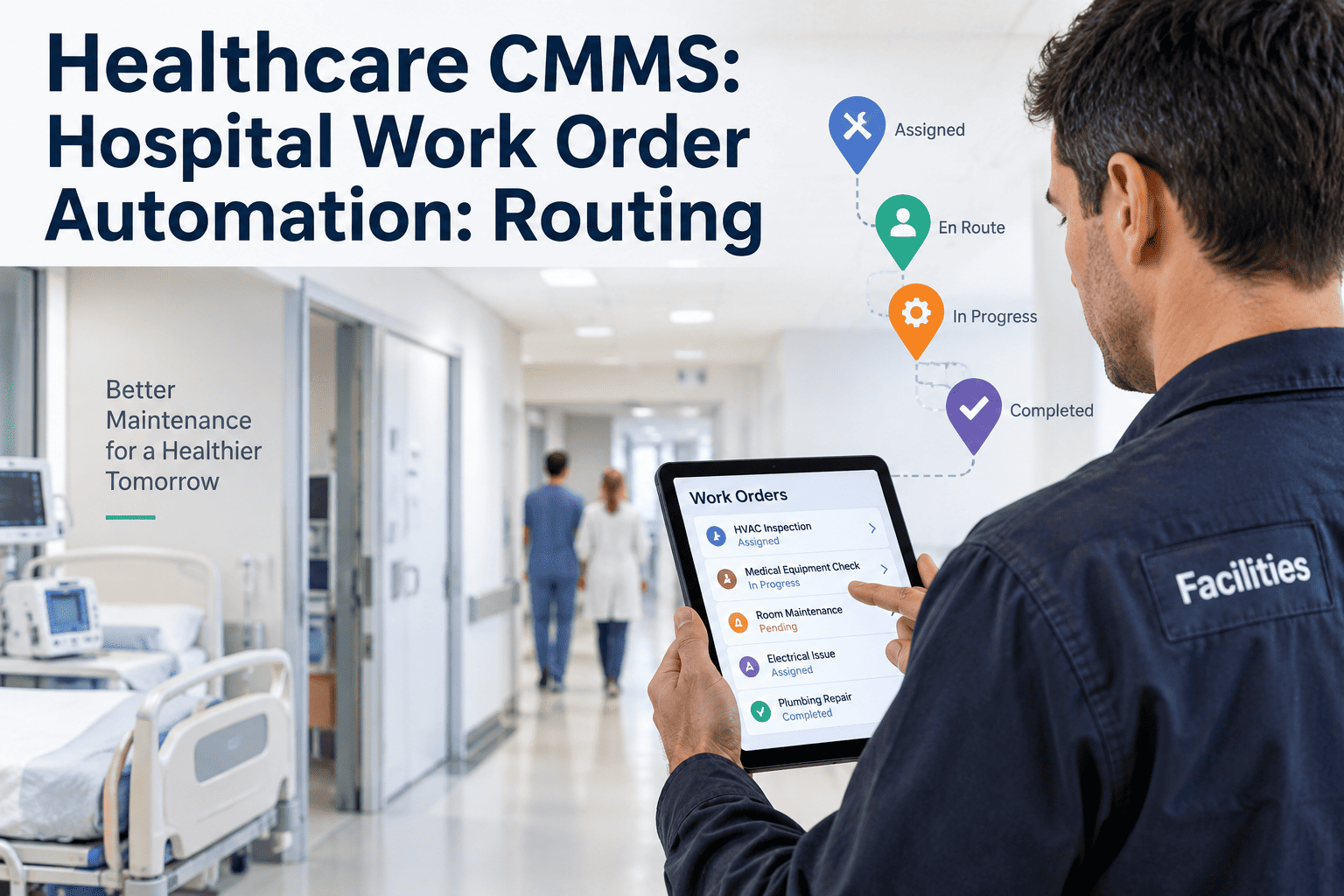
Hospital work order management encompasses the entire lifecycle from initial request to verified closure. Staff submit requests through self-service portals or mobile apps, the system auto-classifies priority based on equipment type and location, dispatches to available technicians, tracks response and resolution times, captures parts used, and documents findings before marking work complete. For life-safety systems, closure requires supervisor verification and sign-off, creating an unbroken accountability chain that satisfies EC.02.05.01 documentation requirements.
Healthcare Asset Management
Healthcare asset management software maintains a complete, up-to-date inventory of every maintainable asset in your facility, from patient lifts and nurse call systems to HVAC air handling units and sterilization autoclaves. Each asset record stores manufacturer specifications, warranty status, maintenance history, associated work orders, inspection certificates, parts lists, and compliance documentation. When a surveyor asks for the complete service history of a specific piece of equipment, your team retrieves it in seconds rather than searching through binders and spreadsheets.
Compliance and Inspection Tracking
Healthcare compliance is not a once-a-year event. It is a continuous documentation obligation covering hundreds of inspections across fire safety, utility systems, medical equipment, and environmental services. A hospital CMMS system with built-in compliance tracking maintains inspection calendars for every regulated system, sends automated alerts when due dates approach, captures results against required standards, and generates the formatted reports that accrediting bodies expect. Facilities that manage compliance manually in spreadsheets average four times more survey findings related to documentation deficiencies than those using dedicated CMMS platforms.
Predictive Maintenance and Analytics
The evolution from preventive to predictive maintenance represents the most significant shift in hospital facilities management in a decade. Healthcare maintenance automation platforms now integrate with IoT sensors embedded in critical equipment, monitoring vibration signatures, temperature trends, power consumption, and runtime patterns to predict failures before they occur. Predictive alerts allow maintenance teams to schedule interventions during planned downtime windows rather than responding to emergency failures that disrupt clinical operations. OxMaint's analytics dashboard surfaces these insights automatically, giving facilities directors the data they need to optimize maintenance spend and justify capital replacement decisions.
Key Compliance Standards a Hospital CMMS Must Support
Joint Commission standard requiring documented management of utility systems including HVAC, plumbing, medical gas, electrical, and fire safety systems with evidence of inspections and corrective actions.
CMS Conditions of Participation requiring hospitals to maintain a safe physical environment through systematic inspection, testing, and maintenance of all life-safety and utility systems.
National Fire Protection Association Health Care Facilities Code governing maintenance requirements for medical gas systems, electrical systems, and HVAC systems across all healthcare occupancy types.
Life Safety Code requiring documented inspection and testing of fire alarm, sprinkler, egress, and smoke compartmentalization systems on prescribed schedules with retained records.
Ventilation standard for healthcare facilities defining air change rates, pressure relationships, temperature, and humidity parameters that must be monitored, documented, and maintained for each clinical zone type.
Alternative accreditation bodies with their own maintenance documentation requirements, all of which are satisfied by the same systematic CMMS-based documentation programs that satisfy Joint Commission standards.
Preventive Maintenance in Healthcare: Building a Program That Survives Surveys
Preventive maintenance in healthcare is simultaneously a patient safety obligation and a financial imperative. The Association for Health Care Engineering estimates that every dollar invested in preventive maintenance returns between three and five dollars in avoided emergency repair costs and equipment life extension. More critically, facilities with mature PM programs experience 60 to 80 percent fewer equipment-related patient safety events than those operating primarily in reactive maintenance modes.
An effective preventive maintenance program in healthcare is built on four pillars. The first is a complete and accurate asset inventory, because you cannot schedule maintenance for equipment you do not know exists. The second is evidence-based or manufacturer-specified maintenance frequencies tied to actual equipment criticality, not arbitrary annual schedules. The third is verified completion with documented findings, not just a checkbox indicating the work was performed. The fourth is trend analysis that uses completion data and findings over time to refine intervals and identify assets approaching end of useful life.
Paper-based and spreadsheet-driven PM programs consistently fail on pillars three and four. Technicians complete work but documentation is incomplete, inconsistent, or lost. Trend analysis is impossible when findings are recorded in handwritten notes scattered across multiple binders. Healthcare maintenance automation through a purpose-built CMMS closes these gaps by making complete documentation the default rather than the exception, and by surfacing trend data automatically through built-in analytics.
PM Frequency Guidelines by Equipment Category
Joint Commission surveyors reviewing EC.02.05.01 will examine whether PM intervals are defensible, meaning based on manufacturer recommendations, risk assessments, or recognized industry standards rather than arbitrary timelines. The following frequencies represent baseline standards that healthcare facilities should meet or exceed based on individual risk assessments.
Healthcare Maintenance Automation: What It Means in Practice
Healthcare maintenance automation is not about replacing skilled technicians with software. It is about eliminating the administrative burden that prevents maintenance teams from focusing on skilled technical work. In a typical hospital without automation, maintenance supervisors spend between 30 and 40 percent of their time on administrative tasks: scheduling work orders, chasing completion confirmations, compiling reports, tracking parts, and preparing for compliance reviews. Healthcare maintenance automation software reclaims that time.
Automation in a hospital CMMS context operates at five levels. Scheduling automation triggers work orders based on calendar intervals, runtime meters, or sensor readings without manual intervention. Dispatch automation routes work orders to the right technician based on skill sets, certifications, location, and current workload. Escalation automation elevates unresolved high-priority work orders through management chains when response time thresholds are exceeded. Reporting automation assembles compliance documentation packages from completed work order data without manual data aggregation. And predictive automation uses machine learning models trained on equipment performance data to recommend maintenance actions before failures occur.
Hospitals that implement comprehensive maintenance automation consistently report reductions in emergency work order volume of 25 to 40 percent within the first year, driven primarily by improved PM compliance catching issues before they become failures. Response times for high-priority work orders drop by 30 to 50 percent when dispatch automation eliminates the coordination lag between receipt and assignment. And survey preparation time collapses from days to hours when reporting automation can generate organized compliance packages on demand.
Selecting Healthcare Maintenance Management Software: 2026 Evaluation Framework
The healthcare CMMS market includes dozens of platforms ranging from enterprise systems that require six-figure implementation budgets to lightweight apps that lack the compliance depth hospitals need. This evaluation framework gives facilities directors a structured approach to identifying the platform that fits their facility's size, complexity, and compliance obligations.
Must-Have Requirements for Hospital CMMS Systems
Before evaluating features, establish non-negotiable requirements. Healthcare-specific compliance templates for Joint Commission, CMS, and applicable NFPA standards must be built in, not bolted on. Mobile functionality must allow full work order completion, photo documentation, and signature capture without a network connection, because many hospital mechanical rooms have poor connectivity. Role-based access controls must support the complex permission structures that govern who can close life-safety work orders versus who can view them. Audit trails must be tamper-evident and exportable in formats that surveyors can review. And integration APIs must support connections to your existing BMS, EHR, and procurement systems.
Scalability and Implementation Considerations
A CMMS implementation fails not because of the software but because of the change management. Successful hospital CMMS deployments begin with a complete asset discovery to ensure the system's asset inventory reflects actual facility inventory. They involve maintenance technicians in workflow design rather than imposing top-down processes that do not match how work actually flows. They include structured training with role-specific learning paths rather than generic orientation sessions. And they establish clear metrics for measuring program success in the first 90, 180, and 365 days post-implementation.
OxMaint's implementation team specializes in healthcare deployments and provides dedicated onboarding support that guides facilities through asset import, workflow configuration, compliance template setup, and technician training. Book a demo and start your 15-day free trial to see how the implementation process works and what your facility's timeline would look like.
The ROI of Healthcare Maintenance Management Software
Every major technology investment in healthcare requires a defensible return on investment calculation. For healthcare maintenance management software, the ROI case is built on four measurable value streams.
The first is avoided penalties and survey findings. CMS penalizes the bottom quartile of hospitals annually for hospital-acquired conditions, and Joint Commission findings tied to documentation gaps translate directly into corrective action plans, follow-up surveys, and in severe cases, accreditation at risk. Facilities with mature CMMS programs report 50 to 70 percent reductions in compliance-related findings during accreditation surveys. The second value stream is reduced emergency repair cost. Emergency repair labor rates run two to three times higher than scheduled PM labor, and unplanned equipment failures typically require expedited parts procurement at premium prices. Moving 30 percent of emergency work to preventive maintenance reduces total maintenance spend by 15 to 25 percent in most healthcare facilities.
The third value stream is extended equipment lifespan. Healthcare equipment maintained on consistent PM schedules operates 20 to 35 percent longer before requiring capital replacement, according to ASHE benchmarking data. In a hospital with a 200-million-dollar equipment portfolio, extending average asset life by even 10 percent represents a 20-million-dollar reduction in capital replacement spend over a decade. The fourth value stream is staff productivity. Eliminating paper-based workflows and manual report compilation recovers 30 to 40 percent of maintenance supervisor time, allowing facilities teams to accomplish more work with the same headcount at a time when healthcare workforce shortages make hiring additional staff increasingly difficult.
Build a Maintenance Program That Passes Every Survey
OxMaint gives hospital maintenance teams the tools to automate PM scheduling, manage work orders, track compliance, and generate audit-ready reports from a single platform built for healthcare.
Frequently Asked Questions
Everything hospital maintenance directors and facilities managers need to know about healthcare CMMS software.
What is healthcare maintenance management software?
Healthcare maintenance management software is a specialized CMMS platform designed to manage hospital equipment maintenance, work orders, preventive maintenance schedules, compliance inspections, and audit documentation. Unlike general-purpose systems, healthcare CMMS platforms are built around Joint Commission EC standards, CMS Conditions of Participation, NFPA 99, and ASHRAE 170 requirements, making compliance documentation a built-in output rather than a manual after-task.
How does a hospital CMMS improve Joint Commission survey outcomes?
A hospital CMMS improves survey outcomes by ensuring every maintenance action, inspection, and corrective action is documented in a standardized, timestamped, and instantly retrievable format. Surveyors reviewing EC.02.05.01 look for documented evidence of PM completion, inspection results against target values, and corrective action chains. CMMS platforms generate these records automatically as work is completed, eliminating the documentation gaps that generate survey findings in paper-based programs.
What is the difference between preventive and predictive maintenance in hospitals?
Preventive maintenance follows scheduled intervals based on time or usage regardless of current equipment condition. Predictive maintenance uses real-time sensor data and analytical models to identify equipment showing early signs of failure and schedule maintenance when needed. Hospitals deploying predictive maintenance report 25 to 40 percent reductions in unexpected equipment failures and significant reductions in over-maintenance of equipment in good condition.
What equipment should be included in a hospital asset management system?
A comprehensive system should include HVAC air handling units, medical gas systems, emergency generators and transfer switches, fire alarm and suppression systems, sterilization equipment, patient care technology, elevators, electrical distribution equipment, plumbing systems, and building automation systems. Starting with life-safety and high-criticality clinical equipment ensures the highest-risk assets are managed first.
How long does it take to implement a healthcare CMMS?
A single community hospital with 200 to 300 beds typically completes basic implementation, including asset import, workflow configuration, and technician training, in four to eight weeks. Large health systems may require three to six months for full deployment. Cloud-based platforms like OxMaint significantly reduce timelines compared to legacy on-premise systems, and pre-built healthcare compliance templates further accelerate the process.
Can healthcare maintenance software integrate with existing hospital systems?
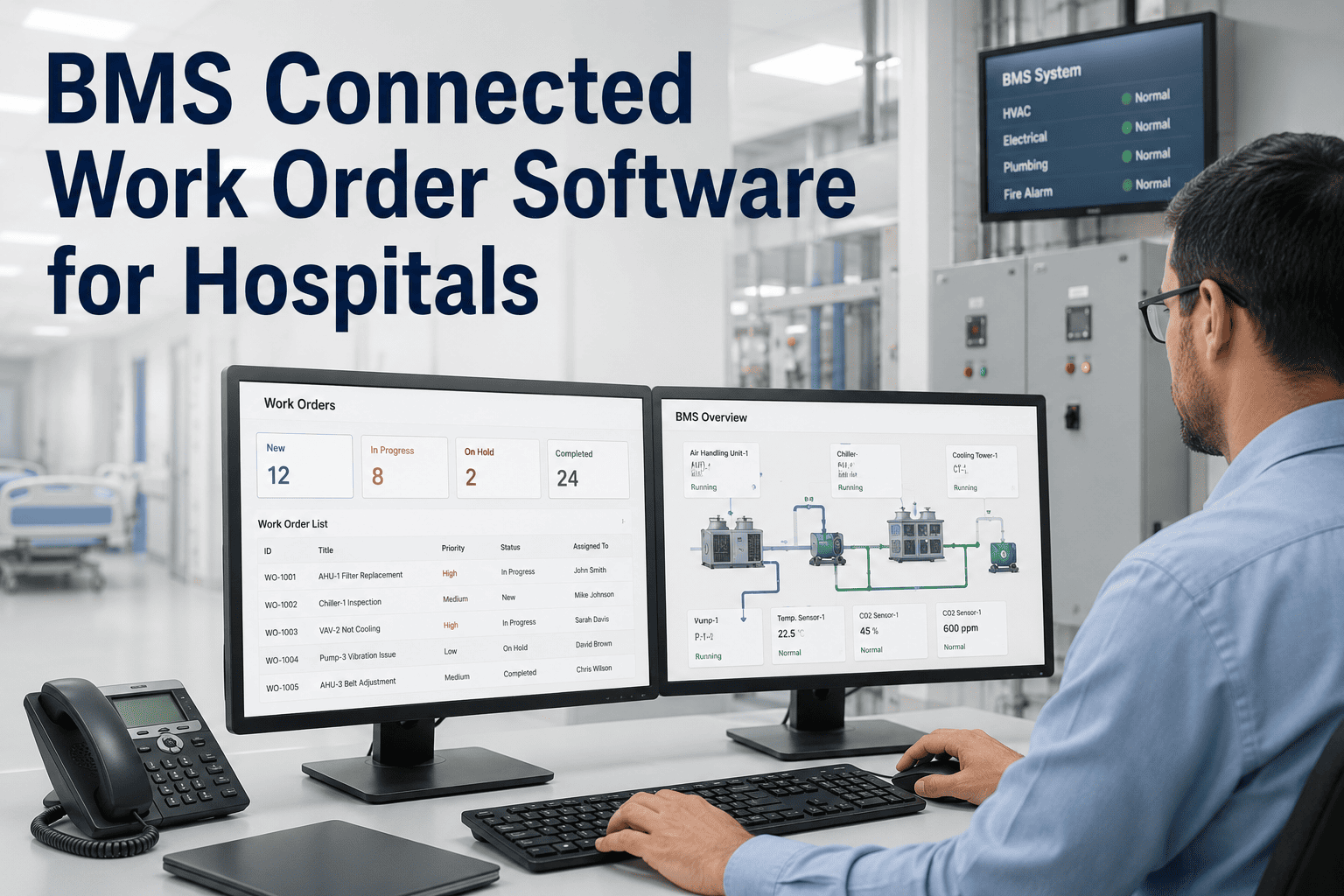
Yes. Leading platforms provide API integrations with building management systems, electronic health records, procurement and inventory systems, and IoT sensor platforms. These allow work orders to be triggered automatically by BMS alarms, parts consumption to update procurement records in real time, and sensor data to feed predictive maintenance models without manual data entry.
How does healthcare maintenance software support infection control?
Healthcare maintenance software supports infection control by ensuring that HVAC systems, water management programs, and environmental services equipment receive maintenance on schedules that prevent conditions enabling pathogen growth and transmission. CMMS platforms maintain automated PM schedules for cooling tower treatment, HVAC filter changes, condensate drain cleaning, and HEPA filter integrity testing, all directly linked to hospital-acquired infection prevention. Documented records also provide the evidence infection control teams and surveyors need to confirm facility systems are not contributing to infection risk. Start your free 15-day trial to see how OxMaint handles infection control compliance tracking from day one.

.png)
.jpg)
