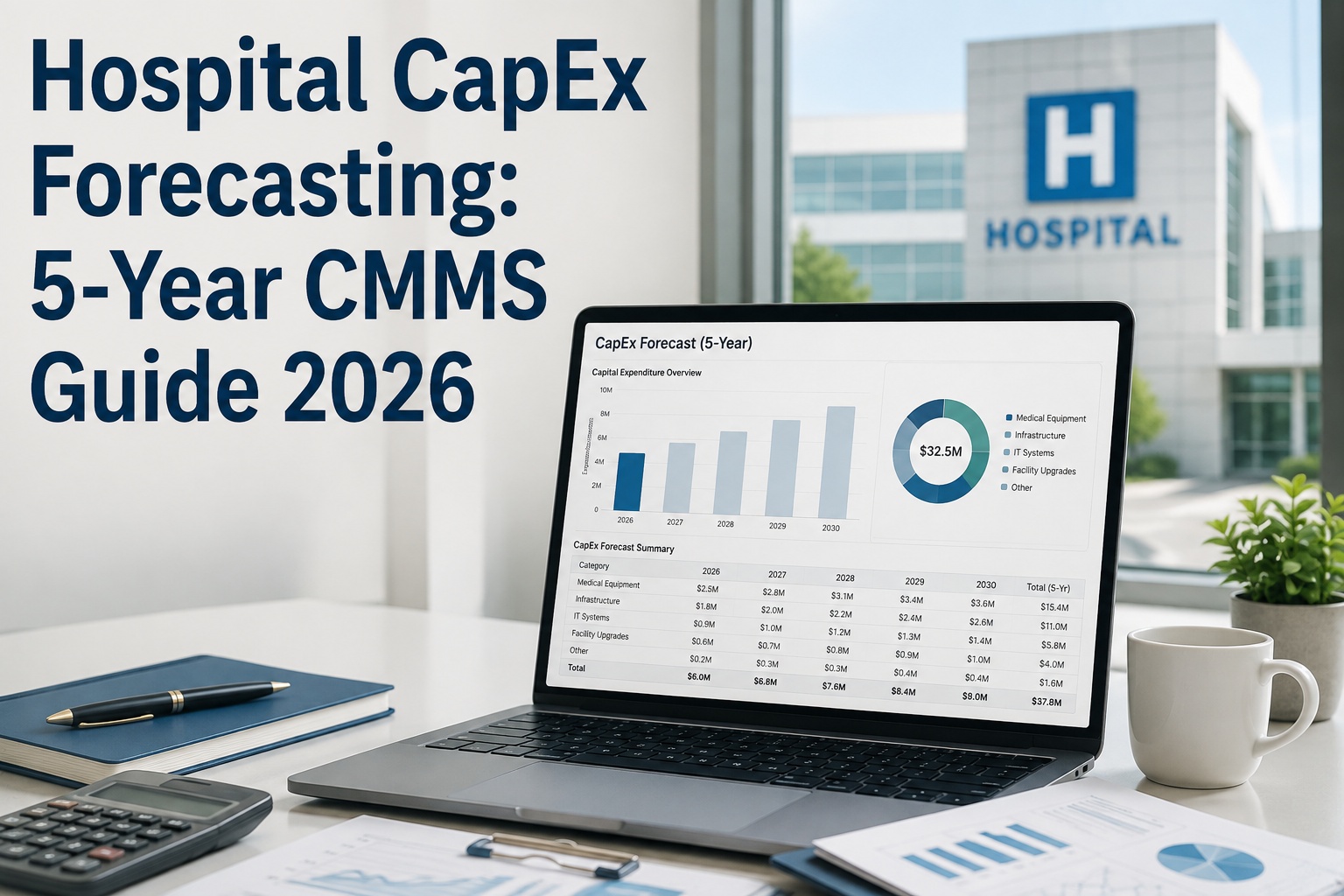
Hospital CapEx forecasting is where clinical leadership, finance, and facilities either align on a 5-year capital plan or fight the same annual battle over shrinking budgets. This 2026 CMMS guide covers hospital CapEx forecasting with a focus on building a 5-year rolling plan: asset condition data as the foundation, lifecycle modeling, replacement sequencing, and the capital planning discipline that turns budgeting into a defensible process. By replacing static spreadsheets with an AI-powered CMMS, healthcare facilities teams can cut premature replacement spending by 15–25% and present investor-grade reports to the C-suite. Ready to see the platform in action? Start Free Trial or read on to build your 5-year roadmap.
The 2026 Hospital Capital Planning Blueprint
Is your 5-year capital plan built on real asset data — or last year's best guess?
Hospital CapEx forecasting fails when facilities teams rely on reactive spreadsheets and subjective age-based replacement. OxMaint transforms your CMMS data into a defensible, lifecycle-driven 5-year capital roadmap that aligns clinical, finance, and operational leadership.
The Foundation of Capital Forecasting
Why Hospital CapEx Forecasting Requires CMMS-Driven Asset Data
Over 60% of hospitals still forecast capital replacement using fixed-asset depreciation schedules and installation dates. The result? Critical clinical equipment is replaced too late — risking patient safety and compliance — while non-critical assets are replaced too early, wasting millions. A 5 year capital planning healthcare strategy must be anchored in real-time condition data, maintenance history, and lifecycle cost analytics pulled directly from a CMMS.
Condition-Based Assessment
Move beyond age-based replacement. Track asset health scores, failure rates, and maintenance costs per asset to determine true remaining useful life.
Lifecycle Cost Tracking
Aggregate parts, labor, and downtime costs over an asset's lifespan to pinpoint the exact moment when repairing costs more than replacing.
Regulatory Compliance
Align capital requests with The Joint Commission, DNV, and ISO 55000 standards by proving asset risk and condition with verifiable CMMS data.
Step-by-Step Capital Planning Guide
How to Build a 5-Year Capital Replacement Plan with a CMMS
Building a healthcare capital forecast that survives finance committee scrutiny requires a disciplined, year-over-year methodology. Here is the 5-step sequence for turning raw CMMS data into an approved capital budget.
Baseline Asset Registry & Criticality
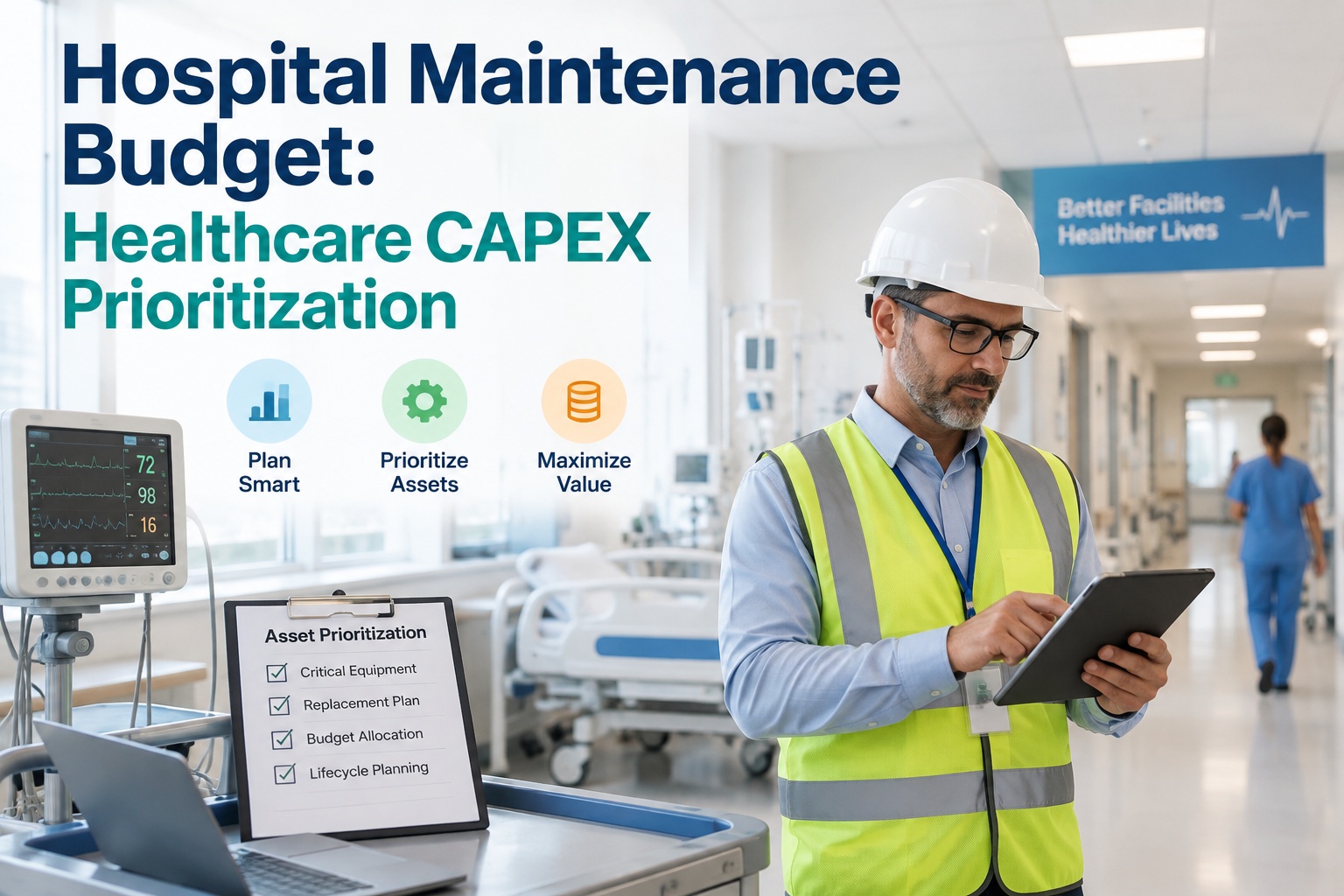
Audit 100% of clinical and facility assets. Assign a criticality tier (Life Safety, Patient Care, Infrastructure, Comfort) based on risk to patient outcomes and regulatory exposure.
Condition Assessment & Health Scoring
Inspect assets and log condition data in the CMMS. Calculate a health score (0–100) using age, PM compliance, MTBF, and reactive maintenance frequency.
Lifecycle Cost & Replacement Modeling
Use the CMMS to project 5-year maintenance costs versus replacement costs. Flag assets crossing the "replace-before-repair" threshold using predictive analytics.
Risk-Weighted Replacement Sequencing
Rank capital requests by a risk matrix (Criticality × Condition × Lifecycle Cost). Sequence replacements to smooth annual spend and avoid multi-year budget spikes.
Investor-Grade Reporting & Approval
Generate automated board reports showing cost avoidance, risk mitigation, and energy savings for each capital request. Present a unified 5-year plan to the C-suite.
Financial Modeling
The Hospital CapEx Forecasting Formula
To defend a capital request, you must prove that replacing an asset is more cost-effective than maintaining it. OxMaint calculates this automatically using the lifecycle replacement threshold formula.
Annual Replacement Trigger Formula
Replace When: (Projected 5-Yr Maintenance Cost) + (Risk-Adjusted Downtime Cost) > (Replacement Cost) + (Disposal/Install Cost)
Real-World Scenario
A 400-Bed Regional Medical Center
A facilities team managing 8,500 assets was spending $1.2M annually on reactive repairs for aging HVAC chillers. By running OxMaint's lifecycle cost analytics, they identified 3 chillers crossing the replacement threshold. By sequencing these replacements into a 3-year CapEx plan instead of reactive emergency replacements, they avoided $310K in emergency labor and downtime costs, reducing their 5-year facility spend by 22%.
Spreadsheets vs. CMMS
Hospital Capital Planning: Spreadsheets vs. CMMS CapEx
Most hospitals manage capital forecasting in isolated Excel spreadsheets. This creates blind spots, version-control issues, and subjective bias. See how a dedicated CMMS capital budget healthcare approach compares.
| Capability | Excel Spreadsheets | OxMaint CMMS |
|---|---|---|
| Data Source | Manual entry, outdated depreciation tables | Real-time work order & condition data |
| Risk Assessment | Subjective, anecdotal prioritization | Automated criticality & health scoring |
| Lifecycle Costing | Static formulas, hard to update | Dynamic AI-driven cost projections |
| Reporting | Manual chart building, prone to errors | Investor-grade 1-click board reports |
| 5-Year Horizon | Fixed, breaks when assets fail early | Rolling, auto-adjusts to condition changes |
Stop Guessing. Start Defending Your Capital Budget.
See how OxMaint turns your maintenance data into a 5-year capital plan that finance and clinical leadership actually agree on.
The OxMaint Solution
How OxMaint Powers Your Healthcare CapEx CMMS Guide
OxMaint is an AI-powered CMMS and EAM platform built to solve the exact data gaps that plague hospital capital forecasting. By connecting daily maintenance execution to long-term capital strategy, OxMaint ensures every replacement request is backed by hard data.
AI-Powered Health Scoring
OxMaint analyzes work order history, PM compliance, and sensor data to generate real-time asset health scores, eliminating subjective condition assessments from your capital plan.
Outcome: Cut premature asset replacements by up to 25%.
Predictive Lifecycle Analytics
Automatically project when an asset will cross the replacement threshold based on rising maintenance costs and failure frequency, mapped across a 5-year rolling horizon.
Outcome: Reduce unplanned downtime by 30–50%.
Investor-Grade Board Reports
Generate 1-click capital request reports featuring cost-avoidance metrics, risk matrices, and compliance alignment (ISO 55000 / Joint Commission) for the C-suite.
Outcome: Cut capital approval cycles from weeks to days.
Seamless Data Migration
OxMaint onboarding imports your existing asset registers, spreadsheets, and historical work order data, so your 5-year forecast starts with a complete baseline.
Outcome: Go live in weeks, not months.
Frequently Asked Questions
Hospital CapEx Forecasting & CMMS: Top Questions
What is hospital CapEx forecasting in a CMMS?
Hospital CapEx forecasting in a CMMS uses real-time asset condition, maintenance cost, and failure data to project when equipment needs replacement over a 5-year horizon. Unlike spreadsheet forecasting, a CMMS capital forecasting healthcare approach dynamically updates as assets age and maintenance costs rise, ensuring capital budgets are defensible and data-driven.
How does a 5-year capital plan work for healthcare facilities?
A 5-year capital plan sequences equipment replacements based on risk, condition, and lifecycle cost. Year 1 covers immediate safety and compliance replacements, while Years 2–5 project proactive replacements. The plan is rolling—updated annually as new condition data enters the CMMS—allowing hospitals to smooth spending and avoid emergency capital requests.
Why should hospitals use CMMS for capital budgeting instead of Excel?
Spreadsheets rely on static depreciation data and manual updates, leading to premature replacements or catastrophic failures. A hospital CapEx CMMS guide approach uses actual work order history and predictive analytics to identify the exact replacement threshold, reducing wasted capital by 15–25% and improving audit readiness.
Can OxMaint integrate with our existing hospital asset register?
Yes. OxMaint seamlessly imports existing asset registers, spreadsheets, and historical maintenance data. To see how quickly your team can migrate from spreadsheets to a full CMMS capital budget healthcare platform, Book a Demo with our team.
How long does it take to implement a hospital CapEx CMMS?
Most hospitals go live with OxMaint in 2–4 weeks. The platform rapidly ingests your asset data and immediately begins calculating health scores and lifecycle costs. You can start building your 5-year capital forecast 2026 plan on day one by trying our Start Free Trial.
Build a 5-Year Capital Plan Finance Can't Reject
Join forward-thinking hospitals using OxMaint to turn maintenance data into defensible capital strategies. See your asset lifecycle analytics live on a 30-minute call.
Free 14-day trial · No credit card required


.png)
.jpeg)
