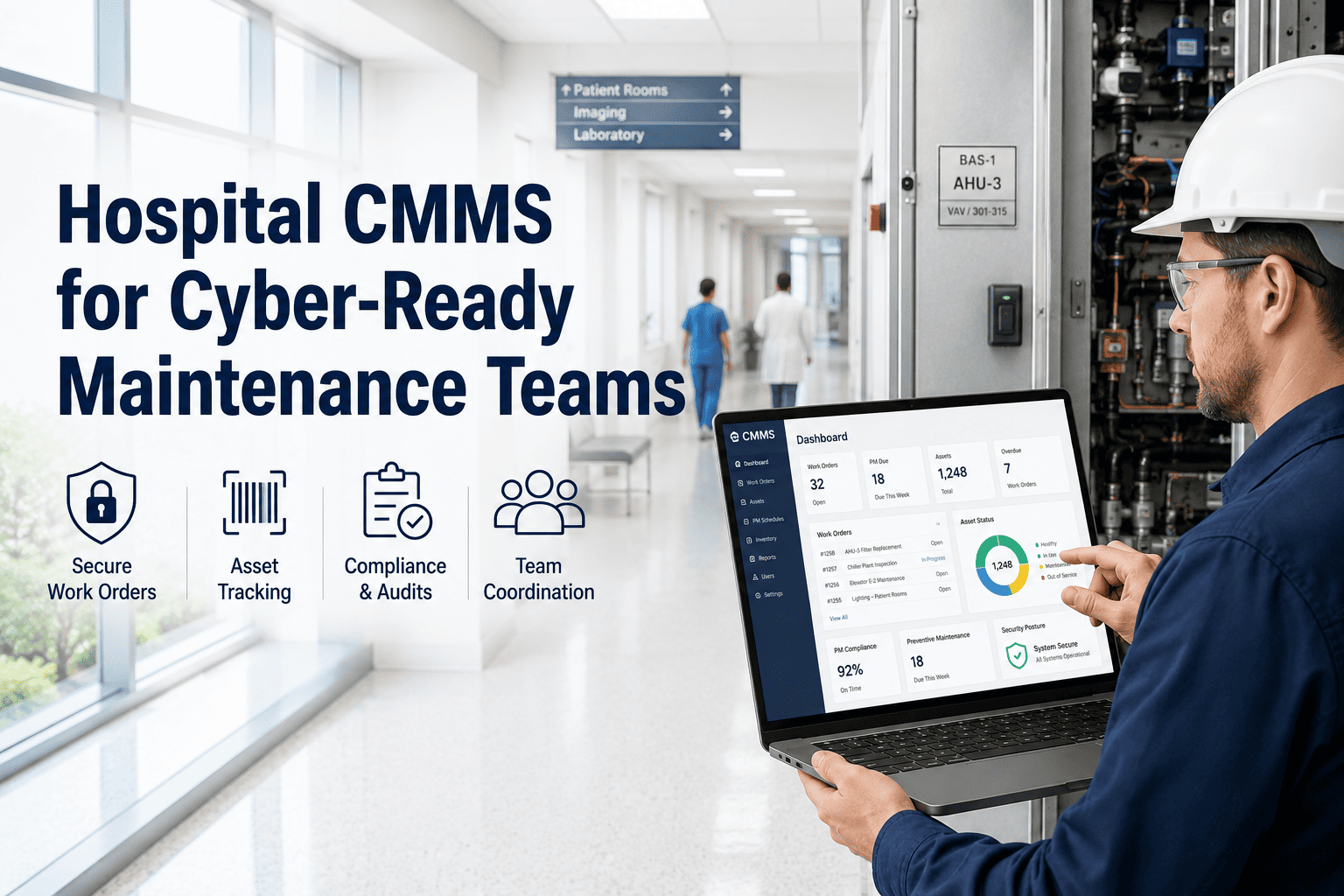
Hospital maintenance teams managing connected devices face a new threat: cyberattacks entering through unprotected CMMS platforms are now the third leading entry point for healthcare breaches. In 2024, 31% of hospital ransomware events traced back to a maintenance or facilities system — not the EHR, not billing. The gap between device inventory, patch scheduling, and work order evidence is where attackers find their way in. OxMaint closes that gap with a CMMS built for the cyber-ready hospital maintenance team.
Hospital CMMS — 2025 Cybersecurity Edition
Your CMMS Is Either a Defense Layer or an Attack Surface
Track every connected device, assign patch tasks, close work orders with evidence, and keep maintenance records audit-ready — all in one platform built for hospitals under cyber pressure.
99%
of hospitals have IoMT devices with at least one known exploited vulnerability
$10.9M
average healthcare breach cost in 2024 — highest of any industry
6.2
average vulnerabilities per connected medical device on hospital networks
31%
of ransomware entry points traced to maintenance and operational systems
The Core Problem
Why Connected Hospitals Are Maintenance Teams' Hardest Problem
IoMT Inventory Gaps
The average hospital now runs more than 3 IoT-connected devices per patient bed. Without a real-time CMMS inventory, facilities teams cannot track which devices are online, which carry known vulnerabilities, or which are past end-of-life support.
Patch Tasks Without Ownership
FDA and manufacturer security advisories arrive without a clear workflow owner. Biomedical, IT, and facilities teams each assume someone else is scheduling patch verification. The result: 74% of hospitals relying on legacy systems experienced at least one cyber incident in the past year.
Audit Evidence That Doesn't Exist
When an incident occurs, regulators require timestamped evidence of every maintenance action, device access, and PM completion. Spreadsheet-based teams scramble for records that were never captured. Under the 2025 HIPAA Security Rule, MFA and audit log gaps now carry financial penalties.
OxMaint Solution
What Cyber-Ready Hospital Maintenance Looks Like in OxMaint
01
Connected Asset Registry
Every IoMT device — infusion pumps, ventilators, imaging systems, monitoring equipment — is registered with asset ID, network status, firmware version, and maintenance history. No phantom records, no missing devices. The registry syncs with work orders so every action links to the right asset automatically.
Asset Tracking
02
Patch & Firmware Task Scheduling
When a manufacturer advisory or FDA cybersecurity guidance lands, OxMaint converts it into a scheduled work order with assigned technician, deadline, and verification checklist. Overdue patch tasks escalate automatically — no advisory slips through the workflow.
Cybersecurity Tasks
03
Timestamped Work Order Evidence
Every work order closes with photo capture, technician signature, timestamp, and completion notes. Audit packages for Joint Commission, HIPAA, or FDA inspection are generated in one click from the CMMS — no manual evidence collection required before survey day.
Compliance Records
04
Downtime Risk Escalation
Critical device failures, missed PM deadlines, and high-risk open work orders trigger instant escalation notifications to supervisors. Maintenance managers see the risk before patient care is affected — not after an incident report is filed.
Risk Escalation
See It in Action
Tour the Hospital CMMS Built for Cyber Readiness
Our healthcare team walks you through connected asset setup, patch task workflows, and audit evidence exports in 30 minutes. No sales pitch — just the platform applied to your facility type.
Benchmark Data
Hospital CMMS vs. Spreadsheet Maintenance: The Risk Gap
| Capability | Spreadsheet / Legacy System | OxMaint CMMS | Compliance Risk Without CMMS |
|---|---|---|---|
| Connected device inventory | Manual, often incomplete | Real-time, auto-synced | Untracked devices = undetected vulnerabilities |
| Patch / firmware task tracking | Email threads, no workflow | Scheduled work orders with deadlines | 73% of healthcare attacks exploit known, patchable flaws |
| PM completion evidence | Paper logs, photos in email | Timestamped, photo-verified, signed | Survey failure, HIPAA penalty exposure |
| Audit package generation | Manual compilation, days of work | One-click export, survey-ready | Evidence gaps during Joint Commission visits |
| Overdue task escalation | Supervisor checks manually | Automated alerts by criticality tier | Critical devices missed during incident windows |
| Downtime incident linkage | Disconnected from work orders | Linked to asset, PM history, repair cost | No root cause, repeated incidents |
Expert Review
Healthcare facilities that lack a centralized CMMS with IoMT asset tracking are operating with a significant blind spot. When maintenance records are siloed across email threads and paper logs, there is no defensible audit trail — and no way to demonstrate compliance during an FDA or Joint Commission inspection. A structured CMMS is not optional for any facility running more than a handful of connected clinical devices.
BT
Bryan Tanner
Healthcare Facilities Compliance Specialist, 14 years in hospital biomedical and facilities management
The 2025 HIPAA Security Rule changes the calculus for hospital maintenance teams. MFA, encrypted access logs, and documented access controls are now regulatory requirements — not best practices. Facilities teams that have not aligned their CMMS to these requirements are looking at financial penalties that dwarf the cost of the software they avoided purchasing.
MR
Maria Reyes
Clinical Engineering & Compliance Consultant, former HTM Director at a 600-bed regional medical center
FAQ
Frequently Asked Questions
Does OxMaint replace our existing biomedical equipment management system?
OxMaint is designed to work alongside or replace legacy biomedical tracking tools depending on your facility's needs. Most hospitals use OxMaint as the unified work order and asset tracking layer across facilities, biomedical, and clinical engineering — consolidating disconnected spreadsheets and email threads into one platform. For facilities already using enterprise ERP systems, OxMaint integrates with standard APIs so records stay synchronized. Start a trial to see how it maps to your current setup.
How does OxMaint help during a Joint Commission or CMS survey?
OxMaint generates timestamped audit packages directly from completed work orders — covering PM history, technician signatures, photo evidence, and asset records for any equipment category. Surveyors requesting maintenance documentation receive organized, date-stamped exports rather than stacks of paper logs. Facilities using OxMaint report significantly faster evidence retrieval during survey visits and fewer findings related to incomplete maintenance records. Book a demo to see the audit export workflow.
Can OxMaint track firmware versions and patch status for connected medical devices?
Yes. Each asset record in OxMaint includes fields for firmware version, last patch date, manufacturer advisory status, and network connectivity type. When FDA or manufacturer cybersecurity advisories require action, maintenance managers create scheduled patch verification tasks linked to the affected devices. Completion requires technician sign-off and evidence capture before the task closes. This creates a defensible record that the advisory was received and acted upon — critical under HIPAA Security Rule requirements and FDA post-market cybersecurity guidance. See asset tracking features in a free trial.
What is the typical deployment time for a hospital starting with OxMaint?
Most hospital facilities teams are fully operational within 2–4 weeks. The process includes asset data import from existing spreadsheets or CMMS exports, PM schedule configuration, and technician onboarding on the mobile app. OxMaint's healthcare implementation team handles configuration for the specific regulatory environment — NFPA 99, Joint Commission EC chapters, and FDA device tracking requirements. Larger multi-campus health systems typically plan for 6–8 weeks to cover all locations. Discuss your deployment timeline in a 30-minute call.
Hospital CMMS — Built for Cyber Readiness
Stop Running Connected Devices on Disconnected Records
OxMaint gives hospital maintenance teams a single platform for connected asset tracking, patch task management, work order evidence, and audit-ready compliance reporting — designed for the volume and risk profile of modern healthcare facilities.
2–4 wks
Hospital go-live
1-click
Audit export
100%
Timestamped records
Zero
Missing patch evidence