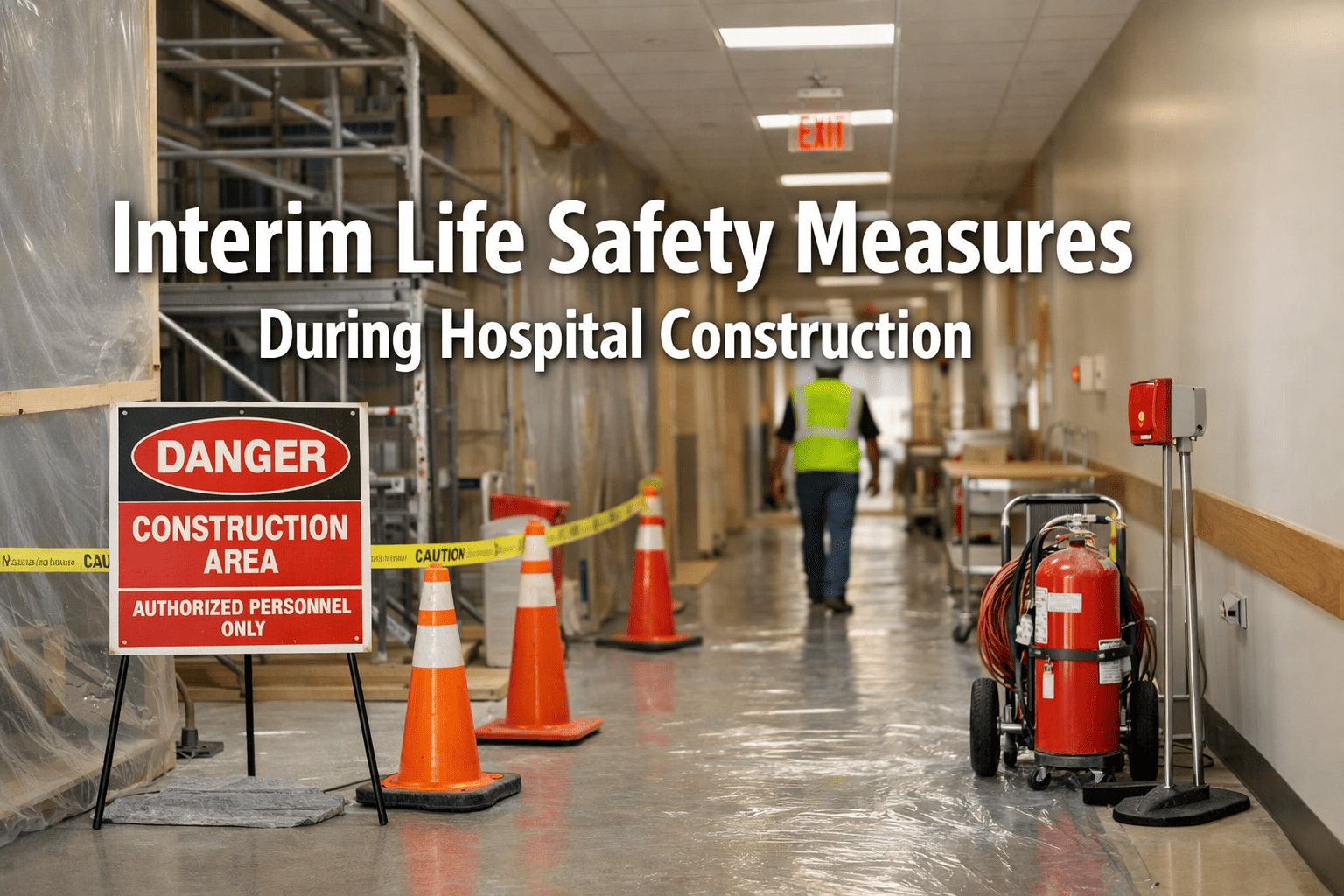
Every other building empties out before the crew moves in. A hospital cannot. The patients a few metres from the barrier wall are often the most vulnerable people in the region — immunocompromised, ventilated, mid-surgery — and they stay there while the wall behind them comes down. That is what makes hospital construction its own discipline: the building has to keep caring for people while it is being torn apart, and a failure that would be a nuisance anywhere else — a dust cloud, a tripped sprinkler zone, a lost circuit — is a patient-safety event here. This guide covers the risk-assessment framework that governs that work, the controls it drives, and the records that prove it was done. The OXMAINT AI — the AI-powered maintenance management software — runs the inspections, corrective actions and records behind it.
Healthcare Facilities · Construction & Renovation Safety · Compliance Guide · 2026
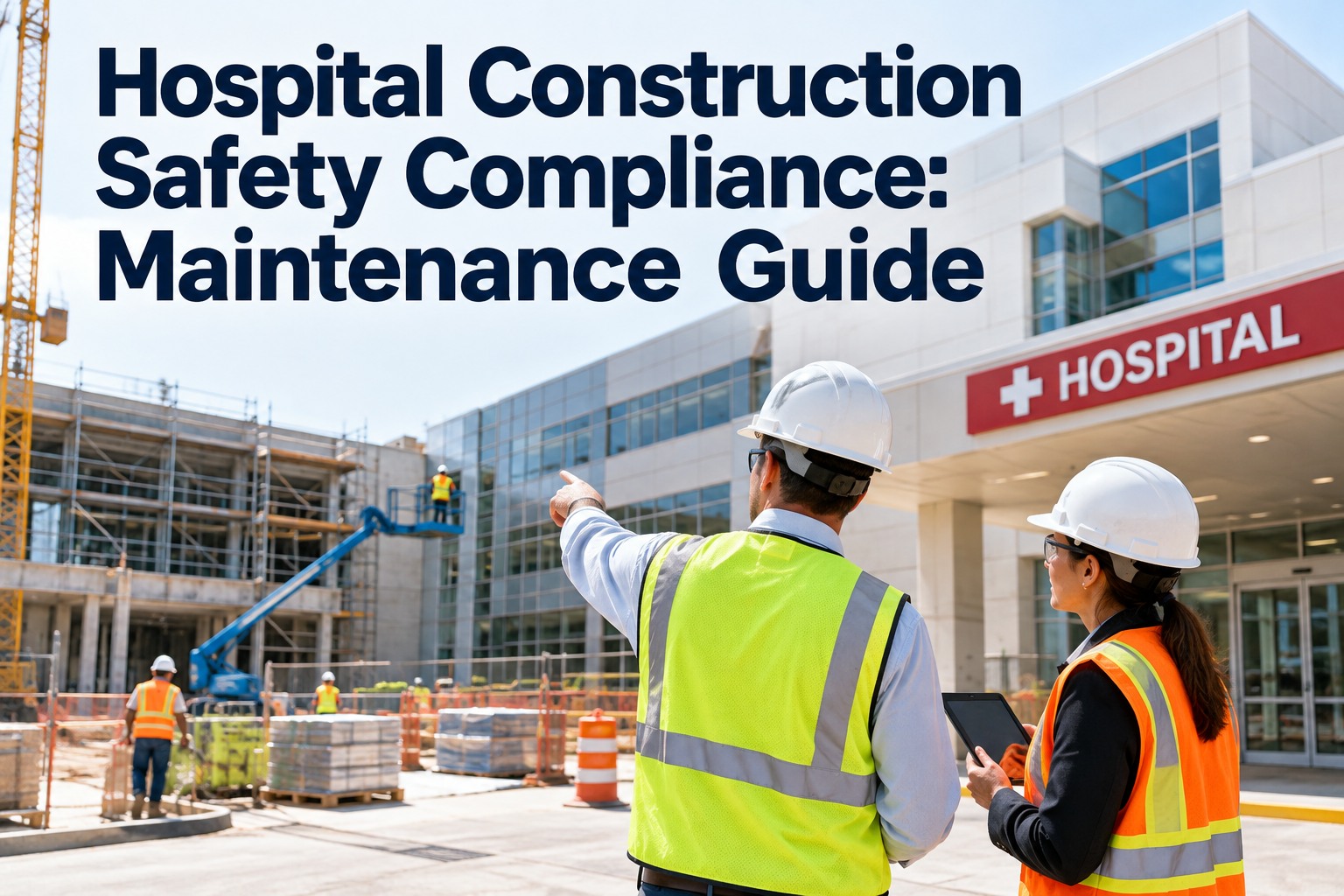
Hospital Construction Safety Compliance: Maintenance Guide
Patients never leave the building — so the risk assessment comes first. This guide maps the pre-construction assessment, the infection-control and life-safety controls it drives, and the inspection and record trail that keeps the project compliant, with OXMAINT AI holding it together.
It Starts With the Assessment, Not the Build
Before a single wall comes down, a pre-construction risk assessment looks at what the work will do to the patients and systems around it. That assessment is the hub — it drives every control that follows, across four domains that each carry their own patient-safety risk; start free and run the assessment as a permit in OXMAINT AI.
Pre-Construction
Risk Assessment
What will the work do to the patients and systems around it?
Domain 1
Infection control
Dust carries Aspergillus; to an immunocompromised patient it can be fatal. Containment is governed by the ICRA.
Domain 2
Life safety
Construction impairs fire alarm, sprinkler and egress. Interim life-safety measures fill the gap while they are down.
Domain 3
Utilities & systems
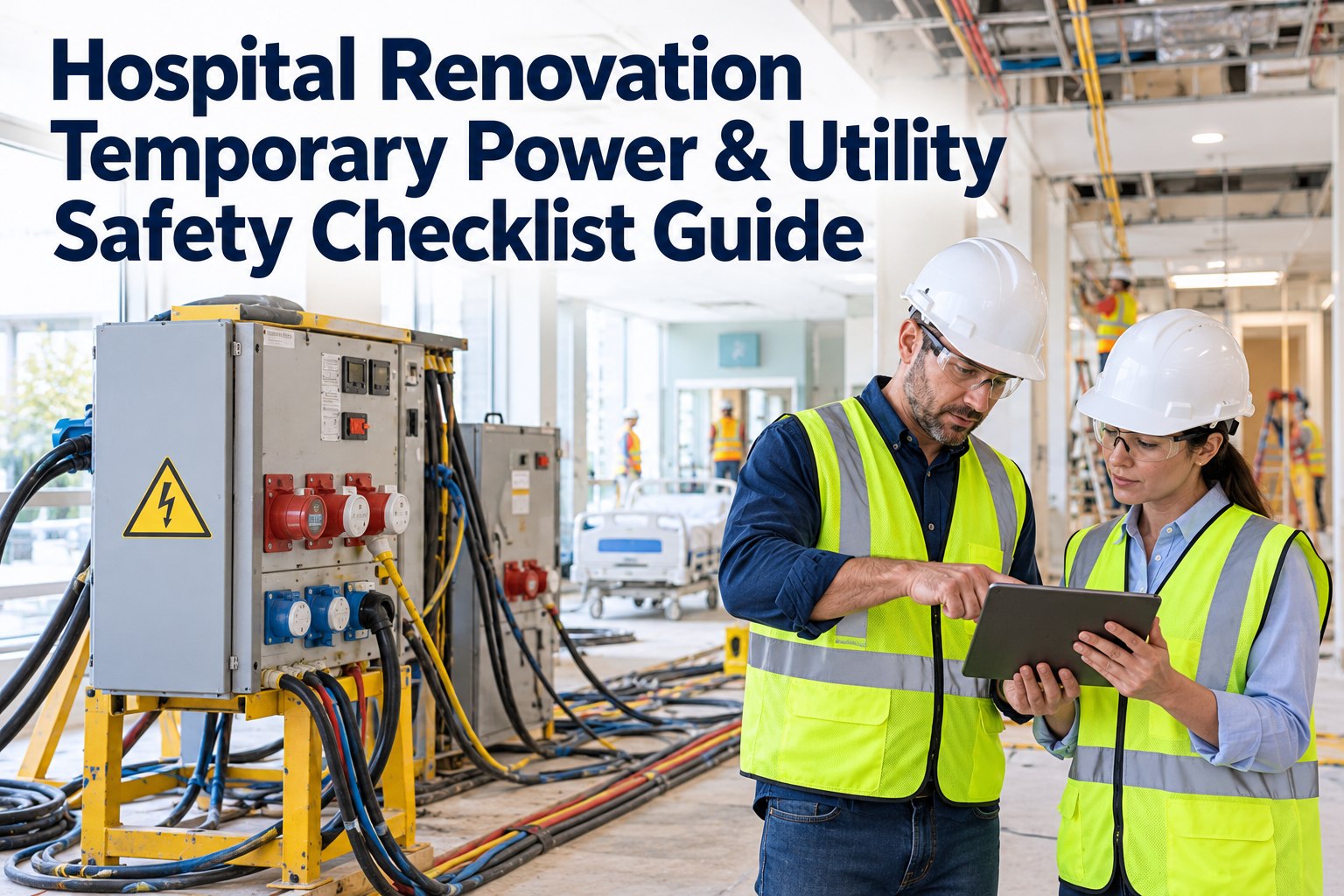
Temporary power, medical gas and air pressurisation must keep serving occupied areas without interruption.
Domain 4
Access, egress & noise
Patient routes, emergency access, noise and vibration all have to stay within safe limits next to care.
The ICRA Matrix — How Precautions Are Set
Infection-control precautions are not chosen by feel. They come from a matrix: the type of construction on one axis, the risk group of the nearby patients on the other, and the crossing point sets the precaution class. The more invasive the work and the more fragile the patients, the higher the class. It scrolls sideways on a phone; book a demo to attach the ICRA class to each project in OXMAINT AI.
Patient risk group
Type Ainspection
Type Bsmall-scale
Type Cdemolition
Type Dmajor
Low — office areas
I
II
II
III / IV
Medium — general care
I
II
III
IV
High — ICU, ER, nursery
I
III
IV
IV
Highest — oncology, transplant, OR
II
IV
IV
IV
A higher class means tougher containment — from simple dust control at Class I up to sealed barriers, negative air pressure and anterooms at Class IV. The matrix turns a judgement call into a documented decision, which is exactly what a surveyor wants to see.
What Containment Actually Looks Like
At the higher classes, infection control becomes a physical system around the work zone — built to hold dust in and keep the surrounding air clean. These are the pieces that make up a Class III or IV barrier; start free and schedule daily barrier checks in OXMAINT AI.
Sealed barrier
Rigid, sealed walls floor-to-deck isolating the zone — not plastic sheeting taped at the edges.
Negative air pressure
The zone held at lower pressure than the corridor so air flows in, never dust out.
HEPA filtration
Air scrubbers exhausting through HEPA, with the pressure differential monitored.
Anteroom & walk-off
An entry vestibule and tacky mats so crews do not track debris into clean areas.
When Life Safety Has a Hole in It
Construction routinely takes a sprinkler zone, an alarm loop or an exit out of service — leaving the building's automatic protection with a gap. Interim life-safety measures are the temporary controls that fill it until the system is whole again, and they are required the moment a feature is impaired; book a demo to track every impairment and its measures in OXMAINT AI.
Extra fire watchPatrols of the affected area when detection or suppression is impaired
Temporary alarm & detectionInterim smoke detection or notification where the permanent system is down
Protected egressAlternate exits marked and kept clear when a route is affected
Added extinguishersExtra portable units staged in and around the work zone
Staff awarenessAffected staff briefed on the impairment and the interim plan
The Barrier You Built on Monday Is Only Safe If Someone Checked It on Tuesday.
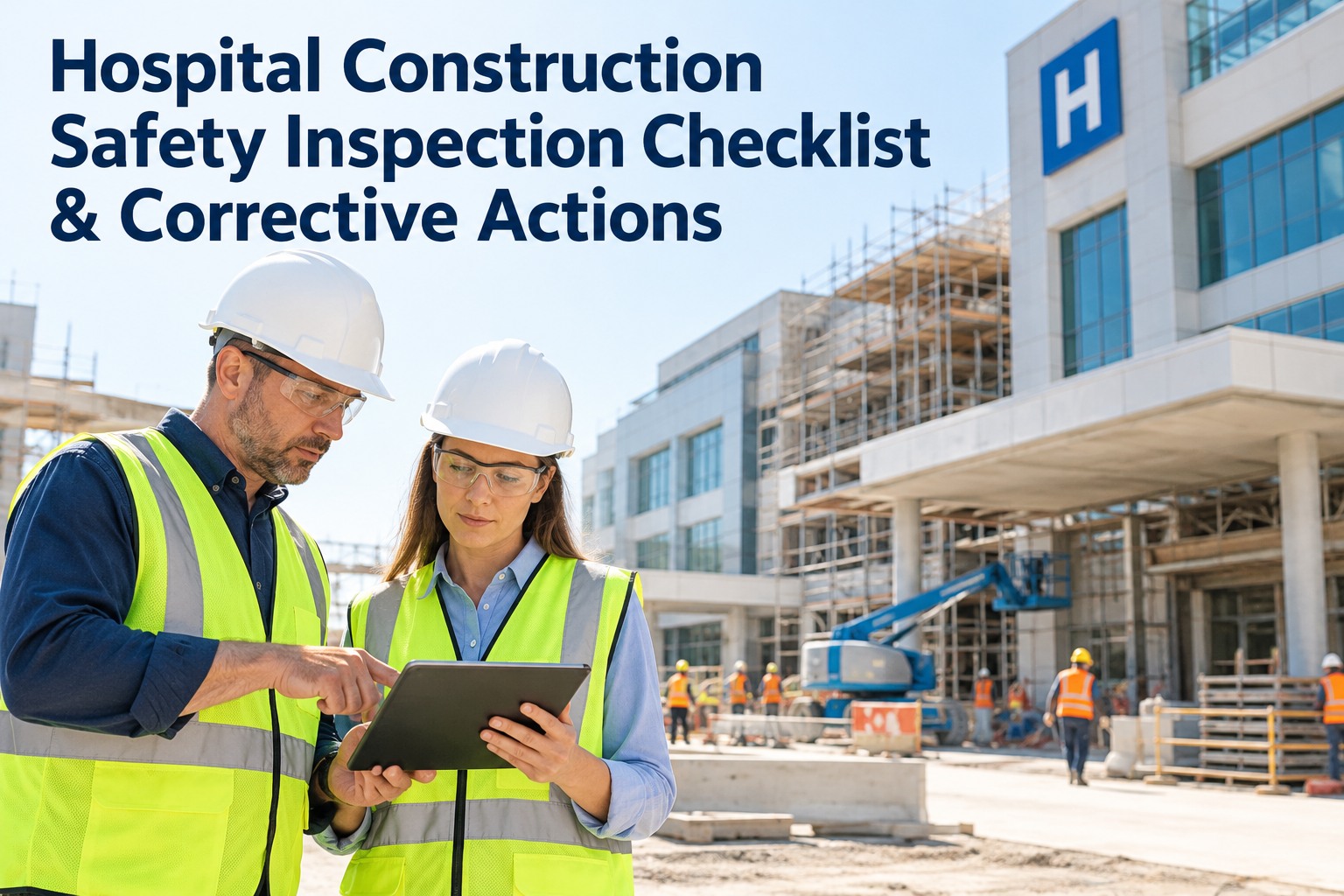
Containment degrades — a barrier gets bumped, pressure drifts positive, a fire watch is missed, a permit lapses. Compliance is not the plan on day one; it is the daily inspection and the record that proves it held every day after. The OXMAINT AI maintenance management software schedules the checks, captures the results and turns any failure into a tracked corrective action.
Compliance Is the Record, Kept Daily
An accreditor does not ask whether you had a plan — it asks for proof the controls held throughout the project. These are the records a hospital construction project has to keep, and the rhythm they are kept on; start free and hold them all on one project record in OXMAINT AI.
The assessment & permit
The signed pre-construction and infection-control assessment with the precaution class, kept for the project.
Daily barrier & pressure logs
Containment, negative pressure and walk-off checks recorded every day the zone is open.
Impairment & fire-watch log
Each life-safety impairment, the interim measures and the fire-watch patrols that covered it.
Corrective actions
Every failed check followed through to a dated, verified fix — the loop a surveyor looks for.
How OXMAINT AI Runs Construction Compliance
A construction project is a burst of permits, daily inspections, impairments and corrective actions on a deadline — exactly the kind of recurring, record-heavy work a maintenance platform is built for. Here is what the OXMAINT AI maintenance management software brings; start free and run the project in OXMAINT AI.
Assessment & permit records
The pre-construction and ICRA assessment captured with its class, approvals and scope on one project record.
Daily inspection schedules
Barrier, pressure and fire-watch checks set to recur for the life of the project, so none is skipped.
Impairment tracking
Every life-safety impairment logged with its interim measures and closed out when the system is restored.
Corrective-action loop
A failed check opens a tracked action with an owner and a date, closed only when the fix is verified.
Mobile checks with photos
Inspectors capture barrier and pressure checks from a phone at the zone, with a photo on the record.
Contractor & access control
Who is on site, under which permit, held on record so access matches the approved scope.
Frequently Asked Questions
What is an ICRA in hospital construction?
An Infection Control Risk Assessment — the process that sets infection-control precautions for a construction or renovation project by weighing the type of work against the risk group of nearby patients, producing a precaution class that dictates the containment required.
What are interim life safety measures?
Temporary controls put in place when construction impairs a life-safety feature such as a sprinkler zone, fire alarm or exit — extra fire watch, temporary detection, protected egress, added extinguishers and staff briefing — kept until the permanent system is restored.
Why is dust so dangerous in a hospital?
Construction dust can carry Aspergillus spores, and to an immunocompromised patient — on chemotherapy, after a transplant — an airborne infection can be life-threatening. Containment that would be optional elsewhere is a patient-safety requirement in a hospital.
What makes hospital construction compliance different?
The patients never leave. The work happens next to occupied, often high-acuity care, so infection control, life safety and utility continuity all have to hold throughout — and compliance rests on daily inspection and records, not a one-time plan.
How does a CMMS help with construction safety compliance?
It holds the assessment and permit, schedules the daily barrier, pressure and fire-watch checks, tracks each life-safety impairment and its interim measures, runs failures through a corrective-action loop and keeps the full record a surveyor asks for;
OXMAINT AI runs the whole construction compliance trail.
Keep the Hospital Safe While You Rebuild It.
Run hospital construction safety compliance inside the OXMAINT AI maintenance management software — assessment and permit records, daily barrier and pressure inspections, impairment and fire-watch tracking, a corrective-action loop and mobile checks with photos — so infection control and life safety hold every day of the project, and every control has the record to prove it.