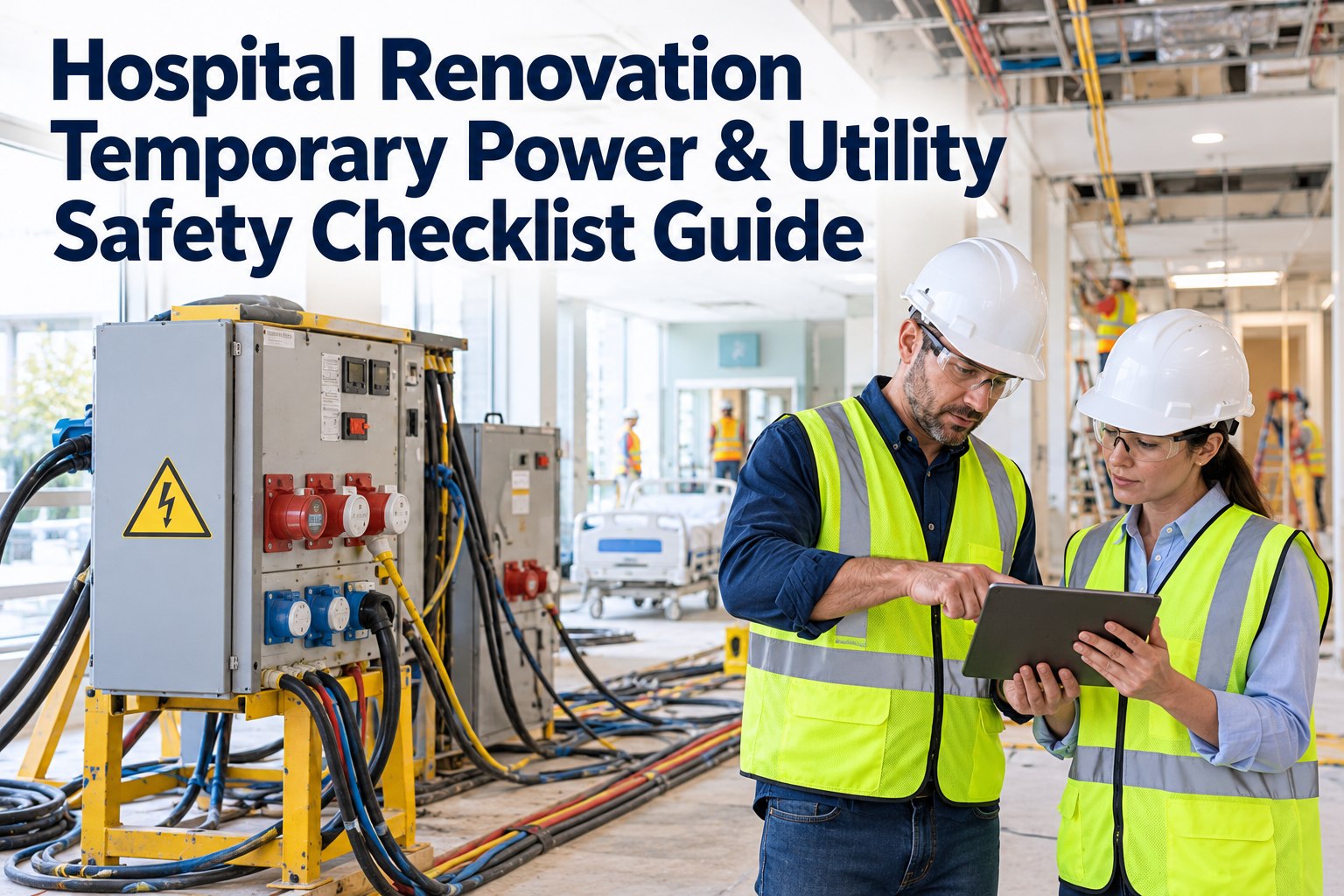
Hospital Renovation Temporary Power & Utility Safety Checklist Guide

By Willam Jerry on October 12, 2026

hospital-renovation-temporary-power-utility-safety-checklist-guide

Renovating a live hospital means adding temporary, unproven electrical infrastructure into a building where the power feeding a ventilator or an operating-room light can never be allowed to fail. A spider box, a run of cord, a generator tie-in — each is a new hazard set down beside systems that must stay energized. The whole discipline is doing the work without ever touching what keeps patients alive. The OXMAINT AI — the AI-powered maintenance management software — schedules the temporary-power checks, runs this inspection and keeps the record that proves patient care stayed protected.

Healthcare · Renovation & Construction · Temporary Power & Utility Safety · 2026

Hospital Renovation Temporary Power & Utility Safety Checklist

Temporary power, electrical connections, utility isolation and backup systems — inspected so the renovation never reaches the systems that keep patients alive. Tick each item, and let OXMAINT AI schedule the checks, flag a hazard and drive the corrective work order.

First: What Must Never Be Interrupted

Before a single temporary connection is made, the rule is to know exactly what cannot lose power. A hospital's essential electrical system and its clinical utilities are the lines a renovation works around, never through; start free and map every protected circuit before work begins in OXMAINT AI.

Do Not Interrupt
The systems a renovation must work around
1
Life Safety branch
Exit and egress lighting, fire alarm, and the systems that get people out safely.
2
Critical branch
Patient-care outlets and lighting in ORs, ICUs and other critical-care areas.
3
Equipment branch
Essential mechanical plant — isolation-room HVAC, medical-gas and vacuum systems.
4
Emergency & backup power
The generator, transfer switches and the path that carries them to the branches above.
These are governed by the essential electrical system under NFPA 99 and NEC Article 517 — confirm the branches and circuits affected with your facilities and clinical engineering teams for each project.

The Temporary Power & Utility Safety Checklist

With the protected systems mapped, this is the inspection that keeps the temporary side safe. Work through each group on setup and on a regular interval through the project; book a demo to run this checklist as a scheduled inspection in OXMAINT AI.

01
Temporary Power Equipment
02
Connections & Cords
03
Utility Isolation & Lockout
04
Backup & Emergency Power
05
Monitoring, Signage & Records

Before You Cut In — the Isolation Sequence

The riskiest moment is the tie-in — the point where temporary work meets live hospital power. This is the order that keeps it safe, every time; start free and run the isolation sequence as a permitted workflow in OXMAINT AI.

1
Coordinate
Agree the shutdown window and scope with facilities and clinical teams.
→
2
Identify
Confirm the exact circuit, and that it serves only the intended area.
→
3
Isolate
Lock out, tag out, and prove the circuit is de-energized.
→
4
Work
Make the connection within the approved scope and controls.
→
5
Restore
Re-energize, verify, and confirm every protected system is back.

Where Temporary Power Turns Dangerous

Temporary installations fail in predictable ways — unfamiliar, un-permanent and easy to overload. These are the hazards the inspection is really guarding against; book a demo to catch these before they reach patient care in OXMAINT AI.

Overloaded temporary supply
Too much load on a spider box or generator — the most common temporary-power failure.
Damaged cords
Cords run through doorways and over floors get crushed, cut and worn into a shock risk.
Wrong circuit isolated
A mislabeled panel means the wrong circuit is cut — or a live one is worked on.
Essential power disturbed
A tie-in that reaches an essential branch risks the one supply that must never fail.

The Renovation Is Temporary. The Patient Care Beside It Is Not.

A temporary installation that no one is tracking is exactly how a construction circuit ends up disturbing a critical one. The OXMAINT AI maintenance management software schedules every temporary-power inspection, runs the checklist, and keeps the record — so the renovation stays on its own side of the wall and patient care stays protected.

How OXMAINT AI Manages Renovation Power Safety

Temporary-power safety holds up only when the inspection, the isolation and the record are handled in one place — and that is the job the software does. Here is what the OXMAINT AI maintenance management software brings to renovation utility safety; start free and run your renovation safety program in OXMAINT AI.

Scheduled temporary-power inspections
The checklist set on an interval for the life of the project, so no temporary install is left unchecked.
Isolation & lockout workflow
The tie-in sequence run as a permitted, logged workflow, so no circuit is cut without approval.
Protected-system register
The essential branches and clinical utilities held on record, so what must not be touched is always clear.
Hazard alerts & corrective actions
A failed check becomes a tracked work order, assigned and followed through to a confirmed fix.
Photo evidence on file
Inspection photos kept with each finding, so the temporary installation is documented as it was.
Project-wide safety records
Every inspection, isolation and correction kept and searchable for the project and for survey.

Frequently Asked Questions

Why is temporary power risky in a hospital renovation?
Because it adds unfamiliar, un-permanent electrical infrastructure into a building where essential systems must stay energized. A temporary circuit that overloads or ties into the wrong panel can reach the power keeping patients alive.
What must stay powered during a renovation?
The essential electrical system — the Life Safety, Critical and Equipment branches under NFPA 99 and NEC Article 517 — plus emergency power and clinical utilities like medical gas and isolation-room ventilation.
What does temporary power need to be safe?
GFCI protection, an assured equipment grounding program, properly rated panels and cords, protection from water and traffic, clear labeling kept separate from essential systems, and regular inspection through the project.
How is a circuit safely isolated before work?
Coordinate the shutdown, identify and verify the exact circuit, lock out and tag out, prove it de-energized, do the work within scope, then re-energize and confirm every protected system is restored.
How does a CMMS help with renovation power safety?
It schedules the temporary-power inspections, runs the isolation workflow, holds the protected-system register, tracks corrective actions and keeps the project safety record; OXMAINT AI runs the whole renovation safety program.

Build Beside Patient Care Without Ever Reaching It.

Run renovation temporary-power safety inside the OXMAINT AI maintenance management software — scheduled inspections, an isolation and lockout workflow, a protected-system register, hazard alerts, photo evidence and project-wide safety records — so temporary power, connections and utilities stay safe and the essential systems never lose a moment.

Share This Story, Choose Your Platform!