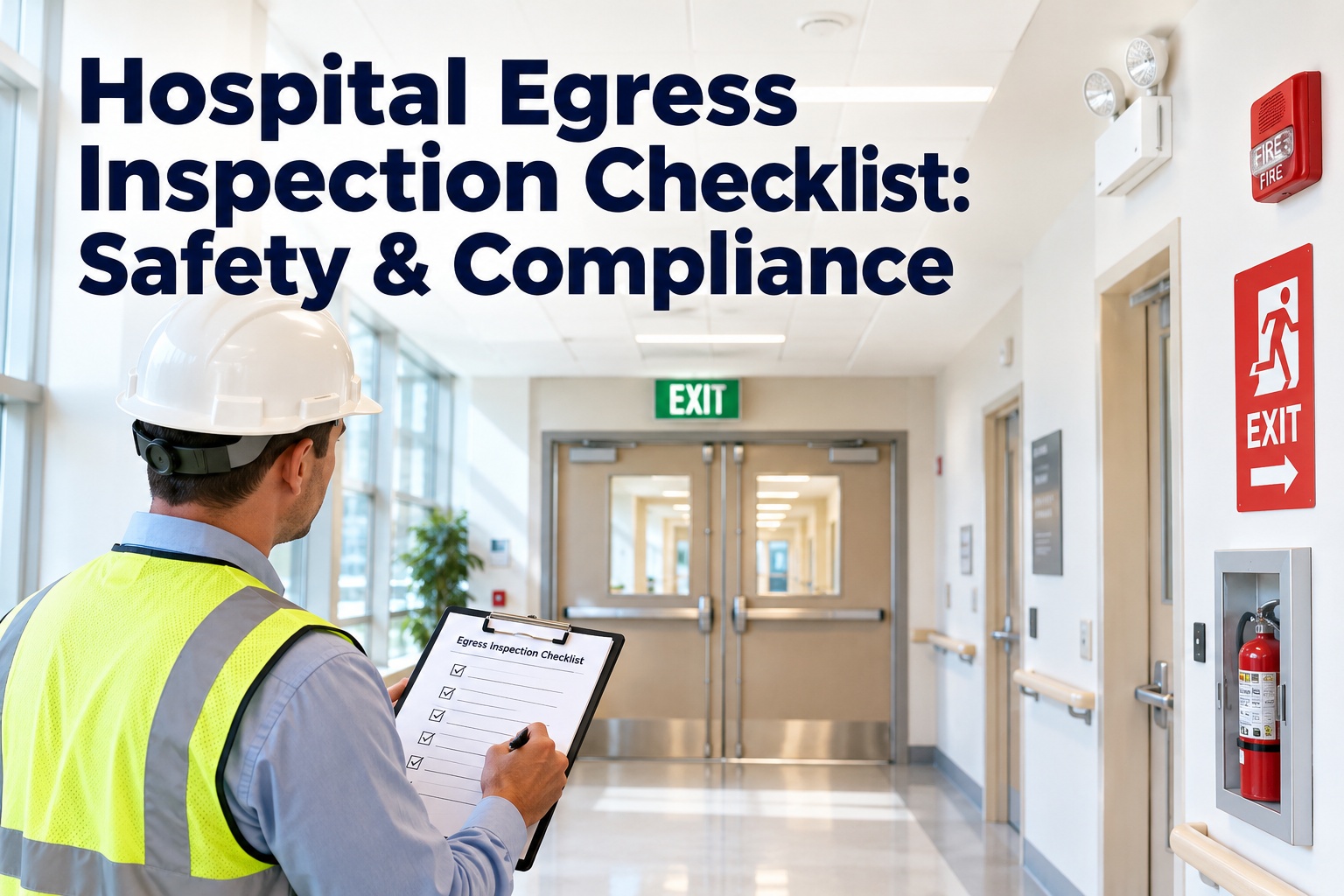
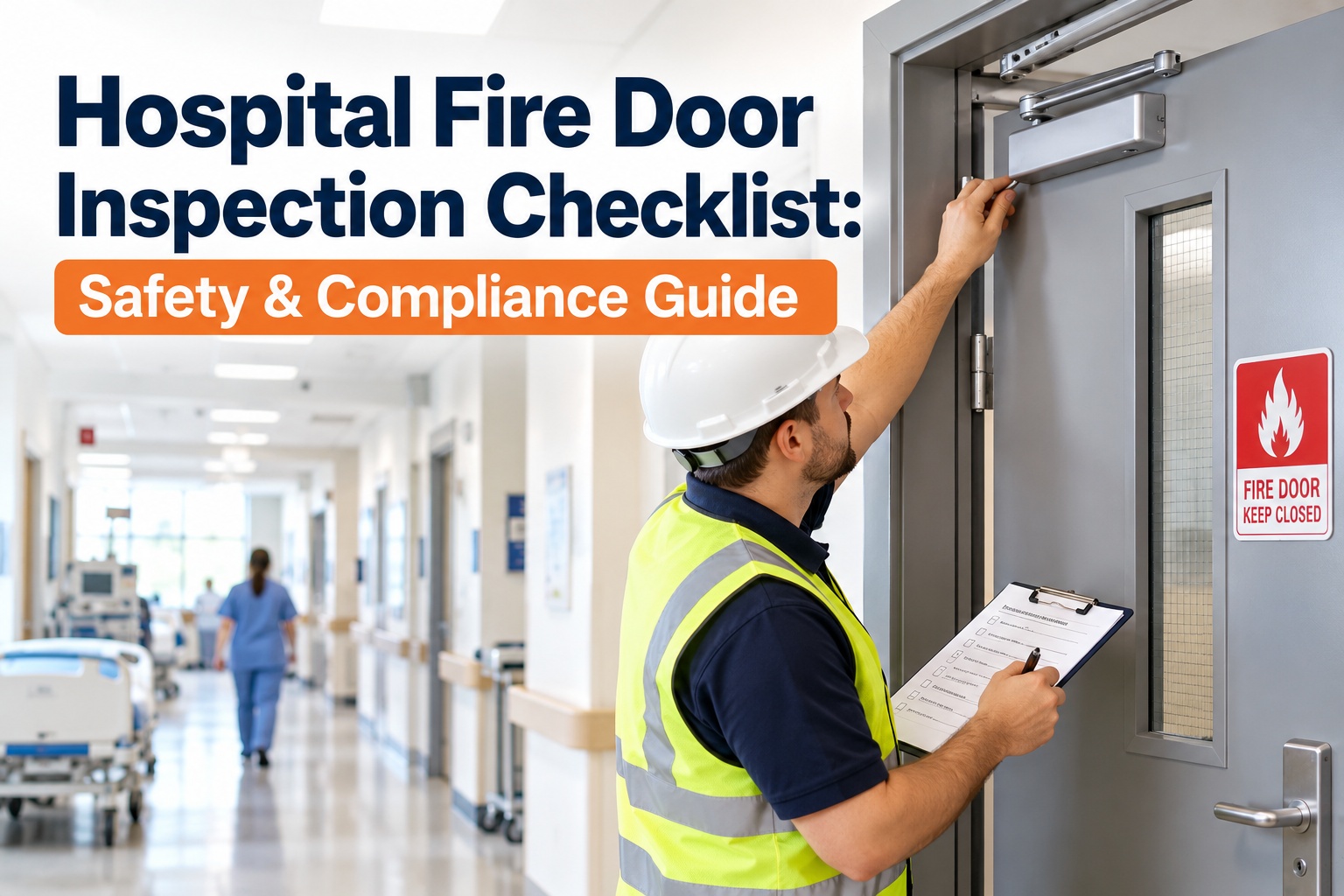
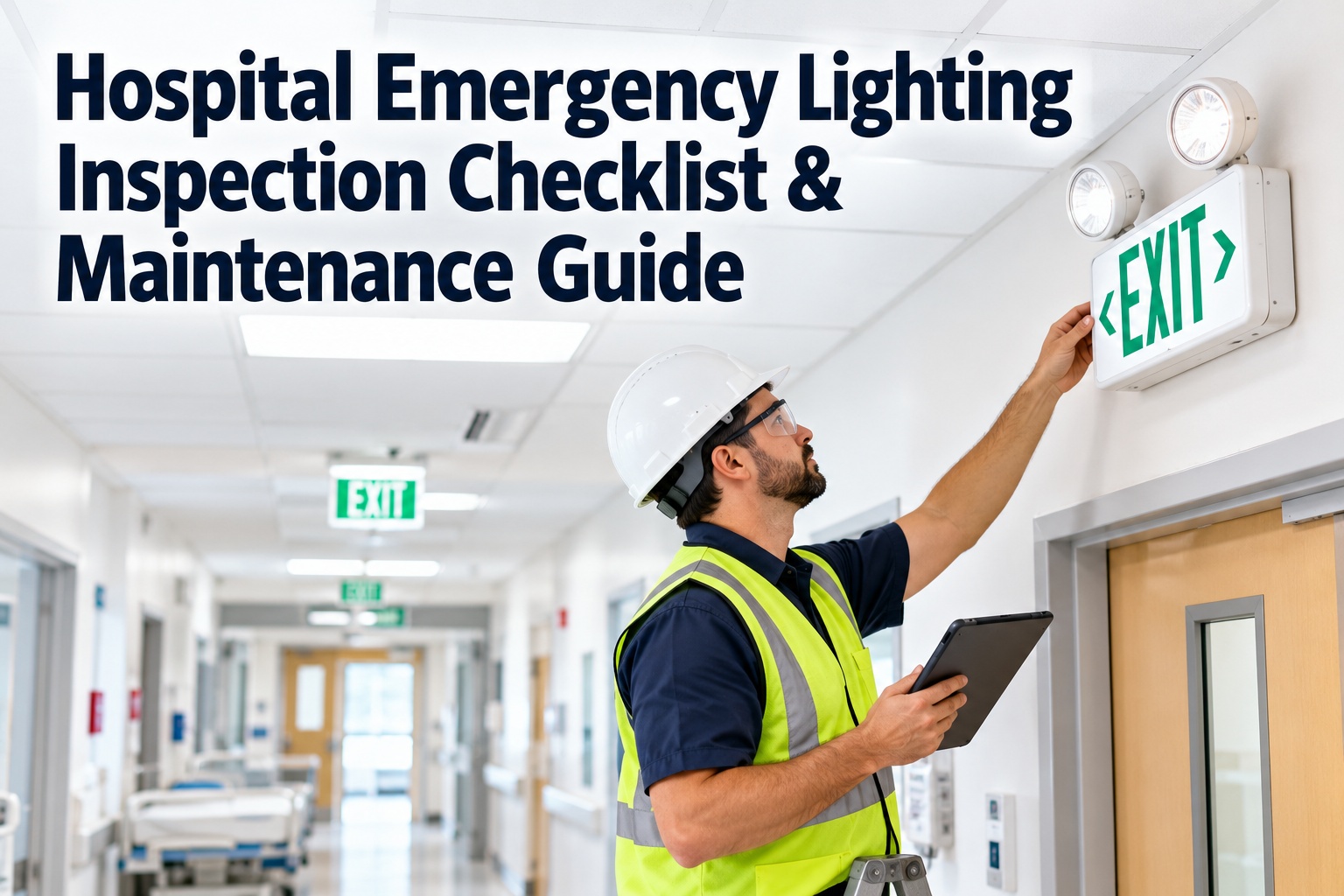
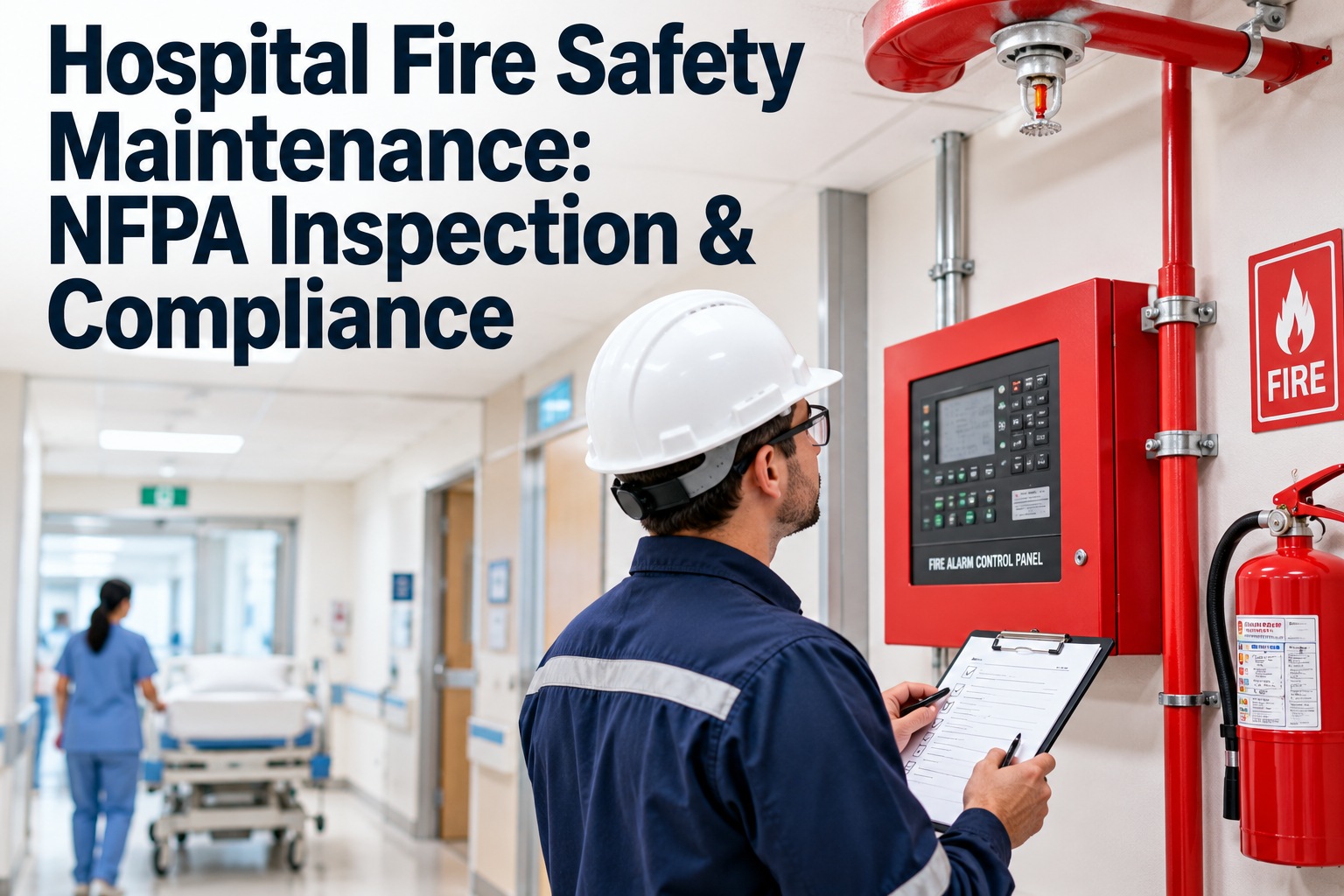
In an emergency, a hospital's exit route is only as strong as its weakest point one chained door, one cart in a corridor or one dead exit sign can turn a safe route into a dead end. Egress inspection is about walking the whole path from bed to outside and fixing what fails. OXMAINT AI is the hospital maintenance management software that turns every egress finding into a tracked work order.
HOSPITAL LIFE SAFETY · EGRESS INSPECTION · CORRECTIVE WORK ORDERS · 2026
Hospital Egress Inspection Checklist: Safety & Compliance
Walk the exit route station by station — doors, corridors, stairwells, emergency lighting and exit signs — then let OXMAINT AI log each defect, open the corrective work order and keep the test records ready for surveyors.
Exit doors
Corridors
Stairwells
Emergency lighting
Exit signs
30 sec
minimum monthly function test for each emergency lighting device
90 min
minimum annual duration test for emergency lighting on battery power
2018
year CMS required annual NFPA 80 testing of fire door assemblies in health care occupancies
3 years
record retention advised for emergency lighting test logs in one widely used checklist
WALK THE ROUTE
A list of doors does not show whether a patient can actually get out. The weak point is usually in the gap between items: a propped door, a blocked turn, a sign nobody can see. That is why this checklist follows the path itself.
The Egress Route, Station by Station
Start at the patient room door and walk to the outside discharge. At every station, ask two questions: does it work, and can I prove it was checked? Sign up free and turn this route into a recurring round.
1
Room door and exit access
- Opens and closes freely
- No wedges or door stops
- Exit path leads clearly out
Breaks it: a door that will not latch or stays propped
→
2
Corridor
- Clear of carts and stored equipment
- Handrails secure
- Floor free of trip hazards
Breaks it: clutter narrowing the route
→
3
Fire and smoke barrier doors
- Label intact and no damage
- Closes and latches fully
- Held open only by approved devices
Breaks it: a door that cannot close on alarm
→
4
Stairwell
- Nothing stored on landings
- Lighting working
- Door latches behind you
Breaks it: a blocked or dark landing
→
5
Exit discharge
- Exit door opens in one motion
- Outside path clear to a safe area
- Exit sign lit and visible
Breaks it: a locked, chained or blocked exit
Routes differ by building. Mark every route on your floor plans and give each one an owner.
The Full Egress Inspection Checklist
Use this on your rounds, then record each failed item as a defect. Items are written to be practical; your authority having jurisdiction, accreditor and Life Safety Code edition set the final rules. Book a demo to see these loaded as mobile round templates.
A fire door note: CMS clarified that fire door assemblies need annual inspection and testing under NFPA 80, while ordinary non-rated doors such as most patient room doors are kept up through routine maintenance. Confirm the current edition your facility is held to.
From Failed Check to Fixed Door: Triage
Not every defect has the same urgency. A suggested triage keeps the dangerous items at the front of the queue. Start free and set priorities on your first work order.
FIX NOW
The route is compromised
- Locked, chained or blocked exit
- Stairwell door that will not latch
- Dead exit sign or light on a main route
Work order same shift. Consider interim life safety measures while it is open.
THIS WEEK
The route works but is weakened
- Damaged door seal or label
- Loose handrail
- Aimed-wrong emergency lamp head
Scheduled work order with a due date and an owner.
PLAN IT
A pattern needs a proper fix
- Doors propped because of traffic flow
- Repeated corridor clutter
- Ageing emergency batteries
Project work order, reviewed by the safety committee.
Suggested triage for illustration. Apply your hospital's own risk assessment and policy.
Don't Let a Failed Check Sit in a Binder.
Put your egress routes into OXMAINT AI. Every failed item becomes a work order with a photo, an owner and a due date, and every test leaves a record.
The Inspection Rhythm
Egress safety is a habit, not an event. Four recurring tasks cover most of it. Book a demo to see them scheduled automatically.
ROUNDS
Weekly visual check
Exit signs lit, corridors clear, doors not propped.
MONTHLY
Lighting function test
Run each emergency light for at least 30 seconds and log it.
ANNUAL
Battery duration test
Run each unit for at least 90 minutes on battery power.
ANNUAL
Fire door assembly test
Inspect and test fire-rated assemblies under NFPA 80.
How OXMAINT AI Supports Egress Safety
OXMAINT AI is a CMMS built to keep this work visible. It gives your team the schedule, the checklist and the record in one place. Try it free on your own stairwells.
MAPEvery door and light on a register
Exit doors, fire doors, emergency lights and signs held as assets by building and floor.
ROUNDRoute-based inspection rounds
Mobile checklists that follow the route, with pass or fail on each item.
PHOTODefects with photo proof
Snap the blocked door or dead sign and attach it to the finding.
ORDERCorrective work orders
A failed item opens a work order with a priority, an owner and a due date.
TESTTest history per device
Monthly and annual results stay on the light or door they belong to.
PROOFSurvey-ready records
Find the log for any door, light or sign in seconds when a surveyor asks.
Questions Facility Teams Ask
How often should a hospital inspect its egress routes?
Use a weekly visual round for signs, corridors and doors, with monthly and annual testing on top. Your accreditor and local authority set the final frequency.
Start free and schedule the rounds.
What is the difference between the monthly and annual emergency lighting tests?
The monthly test runs each device for at least 30 seconds to prove it works. The annual test runs it for at least 90 minutes on battery power to prove it lasts.
See how both are logged in a demo.
Do all hospital doors need annual fire door testing?
According to a 2017 CMS memo, fire-rated door assemblies need annual NFPA 80 inspection and testing, while non-rated doors such as most patient room corridor doors do not, but they should still be maintained.
Track both kinds in one register.
What should we do when an exit is blocked and cannot be cleared right away?
Can software replace a qualified inspector?
Keep Every Exit Open and Every Record Ready — With OXMAINT AI.
Route-based rounds, photo defects, corrective work orders and a test history for every door and light. Start with one wing and see the gaps in a week.