A hospital runs on thousands of medical devices, and every one of them is either safe, accurate and documented — or a patient-safety and survey risk waiting to surface. A ventilator that misses its PM, an infusion pump that drifts out of calibration, a defibrillator with no electrical-safety record: each is a finding, and worse, a hazard. OXMAINT AI is the AI-powered maintenance management software that classifies every device by risk, schedules its PM and calibration, and keeps the service record a surveyor will ask for.
Biomedical Equipment · Clinical Engineering · PM & Calibration · 2026
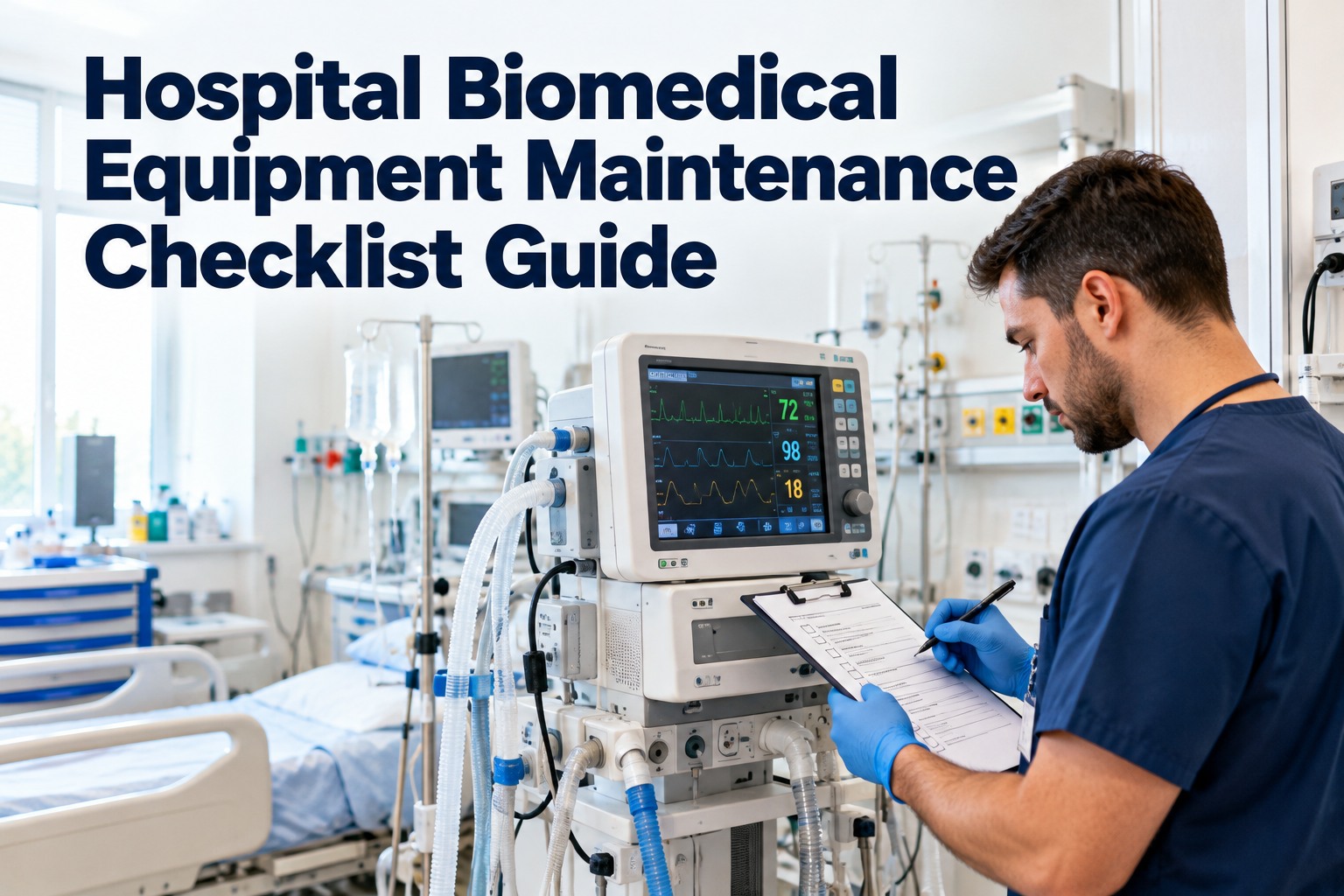
Hospital Biomedical Equipment Maintenance Checklist Guide
The biomed program that passes a survey isn't the one with the most work orders — it's the one where every device is classified, scheduled and documented. OXMAINT AI, a healthcare technology management platform, runs the whole program: risk classification, PM and calibration schedules, electrical-safety records and completion tracking — so life-support equipment hits 100% and nothing is a blank line on survey day.
Classify
→
Schedule
→
Verify
→
Document
BIOMED PM STATUS · ICU
Ventilator V-7 · Life-supportPM OK
Defibrillator D-3 · Life-supportPM due 3d
Infusion pump IP-22PM overdue
Patient monitor M-9Calibrated
100%
scheduled PM completion required for life-support equipment
≥95%
typical completion target for non-life-support, per the plan
AEM
risk-based intervals allowed — imaging, radiation & lasers excluded
Pre-use
electrical-safety & performance check before a device's first patient use
Risk Classification Decides the Strategy
Not every device is maintained the same way — and the rules say so. The first job of a biomed program is to classify each asset, because risk class decides the interval, the completion target, and whether you can set your own schedule at all. There are three strategies.
LIFE-SUPPORT
Ventilators · defibrillators · anesthesia machines · dialysis · infant incubators
Manufacturer PM intervals, 100% scheduled completion with zero tolerance for a miss. Out-of-service units are formally accounted for.
OEM-MANDATED
Diagnostic imaging (X-ray, CT, MRI) · radiation equipment · medical lasers
Must follow the manufacturer's recommendations — these are excluded from AEM and can't be moved to a self-set interval.
AEM-ELIGIBLE
Lower-risk, non-life-support devices with a sound maintenance history
Risk-based intervals, set by an evidence-based assessment from a qualified professional, to the completion target in your plan.
Get the classification right and the whole schedule falls out of it; get it wrong and you either waste effort or invite a finding. Start free and classify your device inventory in OxMaint.
The Four Pillars of a Biomed Program
Whatever the device class, a complete program rests on four activities. Preventive maintenance keeps it working; calibration keeps it accurate; electrical safety keeps it from harming; records keep it provable.
Preventive Maintenance
Scheduled functional checks, wear-part and battery changes, and cleaning — on the interval set by the device's risk class.
Performance & Calibration
Output verified against spec with traceable test analyzers, so a pump, monitor or analyzer reads true — and drift is caught early.
Electrical Safety Testing
Ground resistance and leakage currents checked within limits, so a device connected to a patient can't become a shock hazard.
Service Records
Every inspection, PM, calibration and repair logged against the device — the history a survey, a recall or an incident review needs.
Miss any one pillar and the device may run, but the program won't hold up. Book a demo to see all four tracked per device in OxMaint.
The Biomedical Maintenance Checklist
Work through these five stages for each device. They move from getting it into the program correctly, through the recurring work, to the documentation that proves it — let qualified biomed personnel sign each item off.
Twenty checks, one record per device — the difference between a program you run and a stack of paper you defend. Start free and run this checklist with a dated record in OxMaint.
On a Life-Support Device, 99% PM Completion Is a Failing Grade.
The standard for life-support equipment is zero missed PMs — and a surveyor checks the number, not the effort. OxMaint schedules every device by its risk class, flags anything slipping before it's overdue, and builds the completion record that proves you hit the mark.
How OxMaint Runs the Biomed Program
Clinical engineers do the inspections, calibrations and repairs. OxMaint runs the program around them — classification, scheduling, records and the completion numbers a survey turns on.
Device Inventory & Risk Class
Every device catalogued with its ID, location and risk classification — the foundation the whole schedule is built on.
PM Scheduling by Class
Each device on the right interval for its class, with alerts before due — so life-support work never slips.
Calibration Tracking
Performance and calibration logged against spec, with out-of-tolerance results flagged for action.
Electrical-Safety Records
Ground and leakage results captured per test, kept against the device for its whole service life.
Recall & Alert Management
Device safety alerts and recalls tracked to the affected assets, so action is recorded, not just received.
Completion Dashboard
Live PM completion by risk class, so you can prove 100% on life-support and target on the rest at any moment.
The clinical work stays with your biomed team; the program, the schedule and the proof live in one place. Sign up free and build your biomed program in OxMaint.
Reviewed by OxMaint Healthcare Technology Operations
Content was checked against Joint Commission EC.02.04.01 / EC.02.04.03, CMS AEM guidance and AAMI practice for medical equipment management. Classifications, intervals and electrical-safety limits vary by device, standard and jurisdiction — confirm against the manufacturer's instructions and your own program.
Frequently Asked Questions
What PM completion rate is required for medical equipment?
Life-support equipment must reach 100% scheduled PM completion with zero tolerance for a miss. Non-life-support equipment typically targets 95% or higher, as defined in the hospital's Medical Equipment Management Plan.
What is an AEM program?
Alternative Equipment Maintenance lets a hospital set risk-based intervals instead of the manufacturer's, based on an evidence-based assessment by a qualified professional — but imaging, radiation equipment and lasers are excluded and must follow the manufacturer.
Book a demo to manage AEM eligibility in OxMaint.
Does every new device need inspection before use?
Yes. New, leased, rented, loaned, physician-owned and evaluation devices all need an incoming electrical-safety and performance inspection before their first patient use.
What's the difference between PM and calibration?
Preventive maintenance keeps a device working — functional checks, wear parts, cleaning. Calibration keeps it accurate — verifying its output against a traceable standard so readings and doses are true.
How does this help on a survey?
A classified inventory, scheduled PM, calibration and electrical-safety records per device, and a live completion number are exactly what a surveyor checks — replacing a scramble with a report you can pull in seconds.
Every Device Classified, Scheduled and Proven.
Put your whole biomedical fleet on one platform with OXMAINT AI — risk classification, PM and calibration schedules, electrical-safety records, recall tracking and a live completion dashboard. Hit 100% on life-support, stay audit-ready on the rest, and keep every device safe for the patient it's connected to.