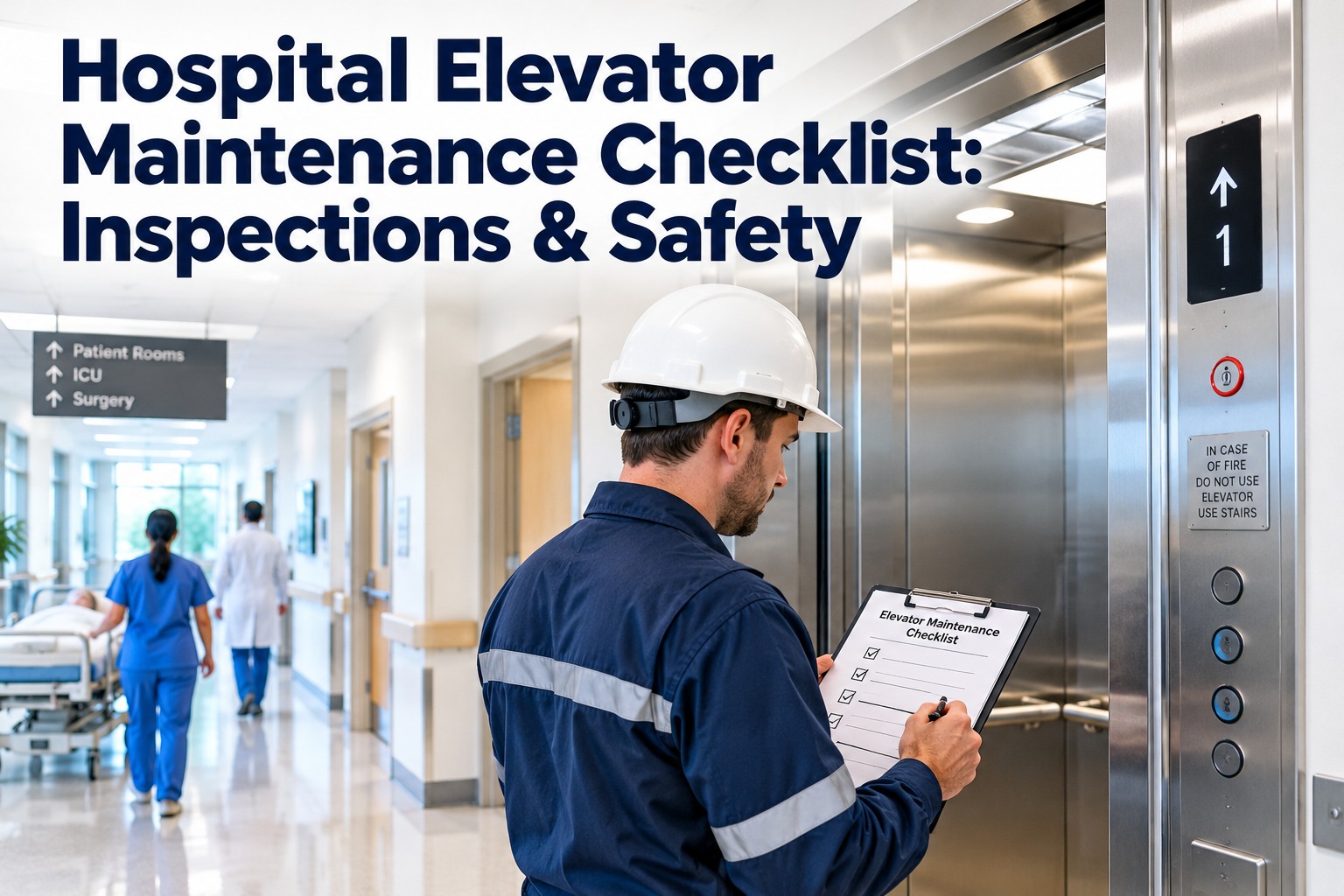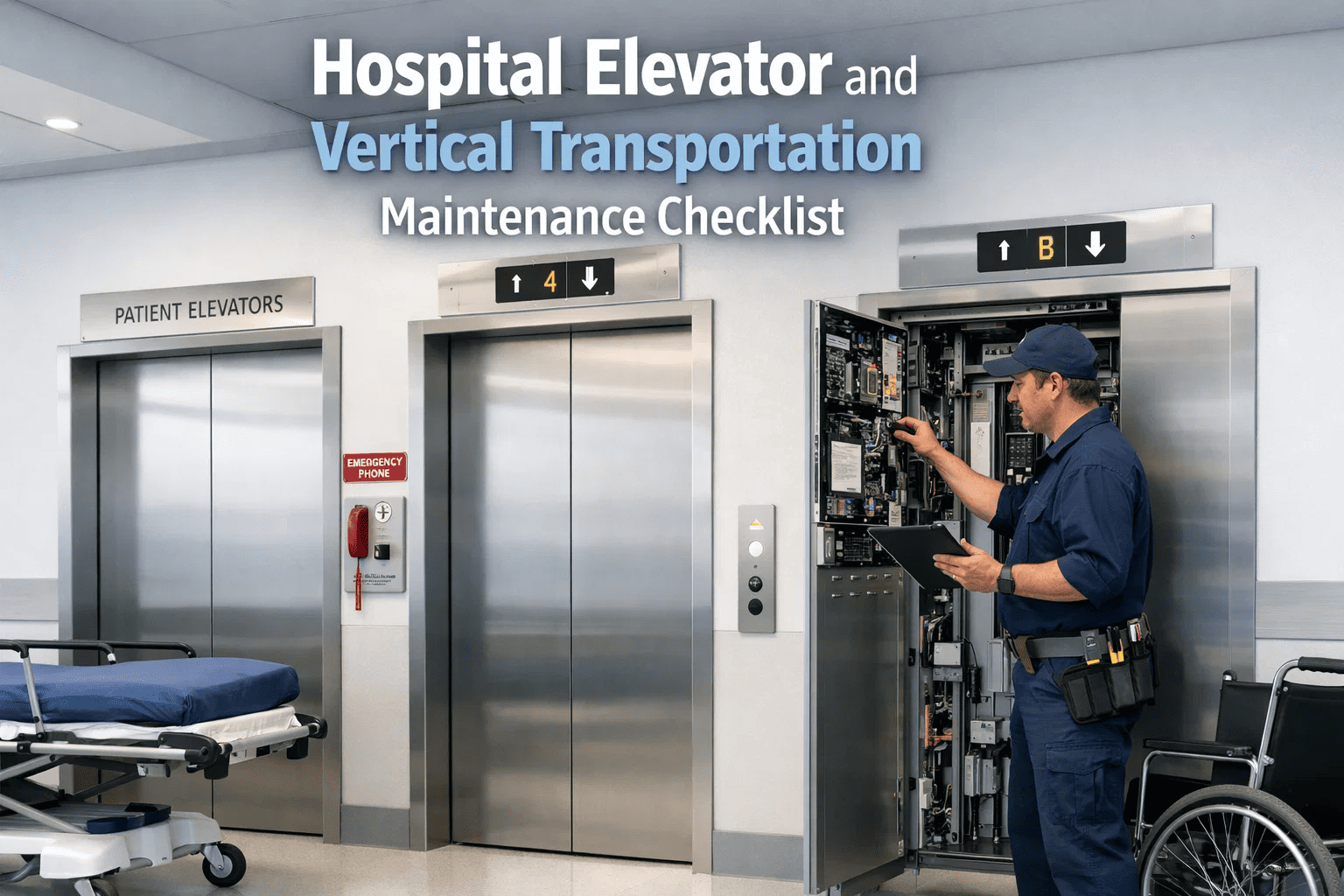
Hospital elevators carry patients on stretchers, staff rushing between floors, and equipment that cannot afford a delay. When a lift fails in a healthcare facility, the consequences are not measured in inconvenience — they are measured in clinical risk, regulatory exposure, and emergency repair bills that dwarf what a structured preventive maintenance program would have cost. This checklist gives facilities engineers a comprehensive, ASME A17.1-aligned framework for managing every aspect of hospital vertical transportation: passenger elevators, service lifts, dumbwaiters, and pneumatic tube systems. Use it to build a defensible PM program, pass your next inspection, and keep every vertical transport asset operating at the standard a healthcare environment demands. If you want to automate this entire workflow, start a free trial for 30 days and see how digital PM scheduling eliminates the manual tracking burden from day one.
Oxmaint automates ASME A17.1 PM schedules, inspection records, and emergency system documentation across every lift in your facility portfolio — no manual chasing, no compliance gaps.
What Is Hospital Elevator and Vertical Transportation Maintenance?
Hospital vertical transportation maintenance is the structured, documented process of inspecting, servicing, testing, and certifying all conveyance systems within a healthcare facility — from passenger and service elevators to dumbwaiters, manlift systems, and pneumatic tube networks. Unlike commercial building lifts, hospital elevators operate under 24/7 clinical demand, carry infection-sensitive patients and critical equipment, and are governed by ASME A17.1 (Safety Code for Elevators and Escalators), state elevator safety laws, and The Joint Commission's Environment of Care standards simultaneously.
A compliant hospital elevator PM program is not a calendar reminder to call the service vendor once a year. It is a risk-stratified, asset-level maintenance system that documents every inspection, every test, every part replacement, and every emergency response — and makes that record instantly retrievable by a regulatory surveyor or risk manager at any point. Facilities engineers who start a free trial with Oxmaint can configure all of this into automated workflows on day one.
- ASME A17.1 — Safety Code for Elevators
- ASME A17.3 — Existing Installations
- NFPA 101 — Life Safety Code
- Joint Commission EC.02.05.07
- State elevator inspection authorities
- CMS Conditions of Participation
Vertical Transport Asset Types in Hospitals
Before building a PM program, every asset in the vertical transport portfolio must be individually registered, classified, and scheduled according to its function and criticality. Treating all lifts as the same asset type is one of the fastest routes to a compliance gap.
Pain Points Facilities Engineers Face Without a Structured PM Program
Most hospital elevator failures trace back to the same root causes: deferred inspections, inconsistent documentation, and vendor relationships that lack structured accountability. The risks compound fast.
Missing a single annual ASME-required test can trigger a citation during a Joint Commission survey — and if the elevator involved is classified as a utility system, it may put your CMS certification at risk. Facilities averaged 2.4 elevator-related EC findings per survey in recent healthcare accreditation data.
When maintenance is managed through vendor invoices and paper logbooks, there is no reliable way to verify that scheduled PMs were actually completed to spec. 61% of surveyed healthcare facilities report gaps between what vendors invoice and what inspection records confirm.
Without an integrated emergency phone monitoring system and documented response protocol, a patient or staff member trapped in a stalled cab may wait significantly longer than the 60-minute maximum response time most state codes require.
A 20-year-old traction elevator reaching end-of-life is a six-figure capital replacement. Without condition scoring and lifecycle tracking, that cost shows up as a surprise — not a planned CapEx line item in the next budget cycle.
Complete Hospital Elevator Maintenance Checklist
The checklist below is organized by inspection frequency and system area, aligned with ASME A17.1 requirements. Every item should be digitally logged with technician ID, timestamp, and pass/fail status — not initialed on a paper form that gets filed in a binder. Want this entire checklist running as automated PM work orders? Book a demo and we will walk you through the Oxmaint setup in 30 minutes.
Dumbwaiter and Pneumatic Tube System PM Checklist
These assets are frequently excluded from hospital vertical transport PM programs — and that exclusion creates real risk. Dumbwaiters are regulated under ASME A17.1 in most U.S. states, while pneumatic tube systems are critical lab and pharmacy infrastructure that can fail silently until a stat medication delivery is missed.
Emergency Phone and Entrapment Response Requirements
ASME A17.1 Section 2.27.1 requires that every elevator cab contain a means of two-way communication accessible to an entrapped passenger — without the use of a telephone handset. For hospitals, the standard to reach is higher: communication must connect to a 24/7 monitored station capable of dispatching rescue within 60 minutes. Joint Commission surveys frequently flag this requirement.
Test emergency phone or intercom monthly. Document that connection is established, monitoring station responds, and the cab number is correctly identified by the receiving operator.
Confirm that the monitoring endpoint is staffed 24/7/365. A connection to an answering service or voicemail does not satisfy ASME A17.1 requirements in most state adoptions.
Maintain written entrapment response procedure with response time target. Most state codes require qualified rescue personnel on site within 60 minutes. Document all entrapment events with timeline records.
Emergency communication devices must function when normal power is lost. Test battery backup monthly — verify call can be placed and received during simulated power interruption. Replace batteries per manufacturer schedule.
Reactive vs. Planned Elevator Maintenance: The Operational Cost Difference
The numbers below represent actual operational outcomes in hospital facilities. If your current elevator program is primarily reactive — vendor called when something breaks — the cost differential is not theoretical.
| Dimension | Reactive Maintenance | Planned PM Program (Oxmaint-Managed) |
|---|---|---|
| Average Repair Cost per Event | 4.8x higher than scheduled PM cost | Predictable, budgeted cost per asset per year |
| Unplanned Downtime Frequency | 3.2 outages per elevator per year (industry avg.) | Less than 0.8 outages per elevator per year |
| Regulatory Citation Risk | High — documentation gaps at every survey | Low — continuous audit-ready records |
| Patient Transport Disruption | Unplanned, impacts clinical operations mid-shift | Scheduled during low-census windows |
| Equipment Lifespan | Shortened by deferred maintenance degradation | Extended 3–5 years through proactive care |
| Emergency Phone Compliance | Tested when broken, not on schedule | Monthly test with digital log and timestamp |
| CapEx Forecasting Accuracy | Replacement surprises hit budget as emergencies | 5–10 year rolling CapEx model from condition data |
| Vendor Accountability | Invoice-based, no completion verification | Work order close-out with digital sign-off |
How Oxmaint Manages Hospital Elevator PM Programs
Oxmaint is built for the exact operational complexity that hospital vertical transport maintenance creates: multiple asset types, multiple inspection frequencies, regulatory documentation requirements, and the need to hold vendors accountable across a portfolio of properties. Here is how it works in practice. If you want to see it in your environment, book a demo with a healthcare specialist today.
Every elevator, dumbwaiter, and lift registered with make, model, installation date, inspection authority, certificate number, and condition score — searchable at portfolio level or drilled to component.
Daily, monthly, quarterly, and annual PM tasks automatically create work orders on schedule. Technicians receive mobile assignments with checklists, photos, and sign-off fields — no paperwork.
Inspection requirements mapped directly to PM tasks. When a firefighters' service test is completed, the record is automatically timestamped and linked to the compliance framework — no manual filing.
External elevator contractors receive work orders through the platform and close them with digital sign-off. No more wondering whether a vendor visit actually happened or what was done.
Condition scores and maintenance history feed rolling CapEx models. Know which elevator is approaching end-of-life two years before it becomes a capital emergency.
Generate a complete elevator compliance report — all inspections, tests, certificates, and corrective actions — for any date range in seconds. No scrambling before a Joint Commission visit.
ROI From a Structured Elevator PM Program
Frequently Asked Questions
What does ASME A17.1 require for hospital elevator inspections?
ASME A17.1 requires periodic inspections and tests at intervals specified in the code — most critical tests are annual, including safety device tests, governor inspections, and full-load tests. Monthly tests are required for firefighters' emergency operation (Phase I and II) and emergency lighting. State elevator safety laws adopt ASME A17.1 with local amendments, so the applicable requirements for your facility depend on state adoption. Hospitals are also subject to Joint Commission EC.02.05.07, which requires that elevator and escalator maintenance and testing follow a documented schedule. Facilities using Oxmaint can configure all of these intervals into automated PM schedules, ensuring nothing is missed regardless of which inspector shows up.
How often should hospital elevator emergency phones be tested?
Monthly is the minimum standard for most healthcare facilities, and ASME A17.1 Section 2.27 requires testing as part of the periodic inspection cycle. In practice, best-in-class hospital programs test emergency communication devices monthly and document each test with the specific cab number, the response received from the monitoring station, and battery backup function. The test record should be retained and retrievable for at least three years. A monitoring station that does not respond with a 60-minute rescue capability is a compliance failure under most state code adoptions and a patient safety risk that cannot be deferred.
Are hospital dumbwaiters covered under ASME A17.1?
Yes — ASME A17.1 Section 7.3 covers dumbwaiters specifically. In states that have adopted ASME A17.1, dumbwaiters are subject to periodic inspection and certification requirements just like passenger elevators, though the specific test intervals differ. Common hospital dumbwaiter failures include door interlock malfunctions, drive mechanism wear, and weight capacity violations caused by departments loading more than the rated capacity. A well-maintained dumbwaiter inspection program should include monthly door interlock tests, quarterly mechanical inspections, and annual third-party inspection with certificate renewal. Pneumatic tube systems are not covered under ASME standards but require their own documented PM schedule given their critical role in stat medication and specimen transport.
How should hospitals document elevator maintenance for Joint Commission surveys?
The Joint Commission expects facilities to demonstrate a documented preventive maintenance schedule for all elevators, evidence that the schedule is being executed, records of all tests required by applicable codes (including Phase I and Phase II firefighters' service tests), current inspection certificates, and corrective action records for any deficiencies found during inspections. Documentation must be retrievable on demand — surveyors expect to be able to review records for any elevator in the facility within minutes, not hours. Facilities that store this documentation in Oxmaint can generate a complete survey-ready elevator compliance report for any time period in seconds. If your current documentation system cannot produce that report in under five minutes, your compliance posture has a material gap worth addressing before your next survey cycle. Start a free trial to see how the documentation framework works in practice.
Oxmaint replaces manual checklists, paper logbooks, and spreadsheet PM tracking with a digital system built for healthcare compliance. Every inspection scheduled, every work order documented, every certificate filed — and survey-ready reports available in seconds.