
Hospital facilities are among the most complex built environments in the world. Every square foot, from the sterile operating suite to the basement mechanical room, must function without interruption to protect patient safety, satisfy regulatory inspectors, and contain operating costs. Yet many healthcare organizations still rely on paper binders, disconnected spreadsheets, or tribal knowledge to manage the thousands of inspection tasks required each year. This guide delivers a complete hospital facility maintenance checklist covering every critical system, from HVAC and electrical infrastructure to medical gas networks and fire suppression, so your team can move toward proactive compliance rather than reactive crisis management. Whether you are preparing for a Joint Commission survey, a CMS life safety inspection, or simply trying to eliminate the costly surprise failures that disrupt patient care, this 2026 reference covers the full scope of what modern hospital maintenance demands. Start managing your facility checklist in Oxmaint and turn these requirements into automated, trackable work orders from day one.
Automate Your Hospital Maintenance Checklist
Oxmaint CMMS gives healthcare facility teams the tools to convert every inspection requirement into automated preventive maintenance schedules, mobile work orders, and audit-ready compliance documentation, all in one platform.
Why a Structured Maintenance Checklist Is Non-Negotiable in Healthcare
Hospitals operate under a unique regulatory framework that imposes strict documentation requirements on every maintenance activity. The Joint Commission's Environment of Care (EC) and Life Safety (LS) chapters require evidence-based maintenance programs, meaning facilities must demonstrate not only that tasks were completed, but when, by whom, and with what result. CMS Conditions of Participation extend these requirements to any facility accepting Medicare or Medicaid reimbursement, and OSHA standards layer on occupational safety obligations that affect the maintenance workforce itself.
Beyond compliance, structured checklists directly reduce patient harm risk. The Joint Commission's sentinel event data consistently identifies environment-of-care failures, including power interruptions, ventilation failures, and fire suppression malfunctions, as contributing factors in serious adverse events. A missed quarterly inspection of an emergency generator transfer switch or a skipped monthly test of a nurse call system is not simply a paperwork deficiency. It is a gap in the system that protects every patient in the building. The checklist framework presented here aligns with NFPA 99, NFPA 101, ASHRAE 170, and CMS Appendix A requirements so that your facility maintenance program meets the regulatory baseline while building toward operational excellence.
HVAC and Ventilation System Maintenance Checklist
Hospital ventilation is governed by ASHRAE 170-2021, which specifies pressure relationships, air change rates, humidity ranges, and filtration requirements for every room category from operating rooms to soiled utility spaces. HVAC failures directly threaten infection control, making this system one of the highest-priority areas in any facility maintenance program.
HVAC Inspection and Maintenance Tasks
- Review BAS alarms for temperature and pressure deviations in critical care areas
- Verify OR and ICU differential pressure indicators are reading within specification
- Confirm AHU supply and return fan operation on BAS dashboard
- Inspect humidifier operation and drain pan condition in critical AHUs
- Check chiller and cooling tower operating parameters
- Verify isolation room negative pressure with smoke test or magnehelic gauge
- Replace or inspect MERV-14 prefilters in critical care AHUs
- Test and calibrate room pressure monitors and alarms
- Lubricate AHU fan bearings and inspect belts or VFD operation
- Clean condensate drain pans and verify proper drainage
- Replace HEPA terminal filters in OR, oncology, and transplant units
- Perform air balance verification on modified spaces or after construction
- Inspect ductwork for visible contamination in high-risk areas
- Test economizer damper function and outside air volume
- Complete ASHRAE 170 air balance and air change rate survey for all regulated spaces
- Clean cooling towers and conduct Legionella risk assessment per ASHRAE 188
- Comprehensive AHU coil cleaning and inspection
- Review and update water management plan documentation
Electrical Systems Maintenance Checklist
Hospital electrical infrastructure is categorized under NFPA 99 into the Essential Electrical System, which includes the Emergency System, Equipment System, and normal power. Each category has defined testing intervals, load transfer requirements, and documentation standards. A failure to document an annual load bank test or a missed monthly generator exercise is a direct compliance finding during survey. Sign up for free to start building automated electrical maintenance schedules for your facility.
Electrical maintenance in healthcare is further complicated by the continuous occupancy of patient care areas. Shutdown windows for switchgear maintenance or UPS testing must be carefully coordinated with clinical operations to prevent patient harm. The checklist below provides the regulatory-required intervals as the minimum baseline, and a modern CMMS automatically schedules these windows during low-census periods.
Electrical System Maintenance Frequency Guide
| System Component | Weekly | Monthly | Quarterly | Annual |
|---|---|---|---|---|
| Emergency Generator | Visual inspection, fuel level | 30-minute exercise under load | Coolant, oil, battery test | Load bank test, full service |
| Automatic Transfer Switches | — | Operation indicator check | — | Full transfer test, contact inspection |
| UPS Systems | — | Battery health dashboard review | Runtime test, thermal scan | Full battery capacity test |
| Isolated Power Systems (OR) | — | LIM alarm functional test | — | Full isolation test, hazard current measurement |
| Distribution Panels and Switchgear | — | — | Thermal imaging scan | Torque check, cleaning, arc flash label review |
| Ground Fault Protection | — | — | — | GFCI receptacle testing in all patient care areas |
| Grounding and Bonding | — | — | — | Patient care area receptacle ground resistance testing |
Fire Safety and Life Safety System Maintenance Checklist
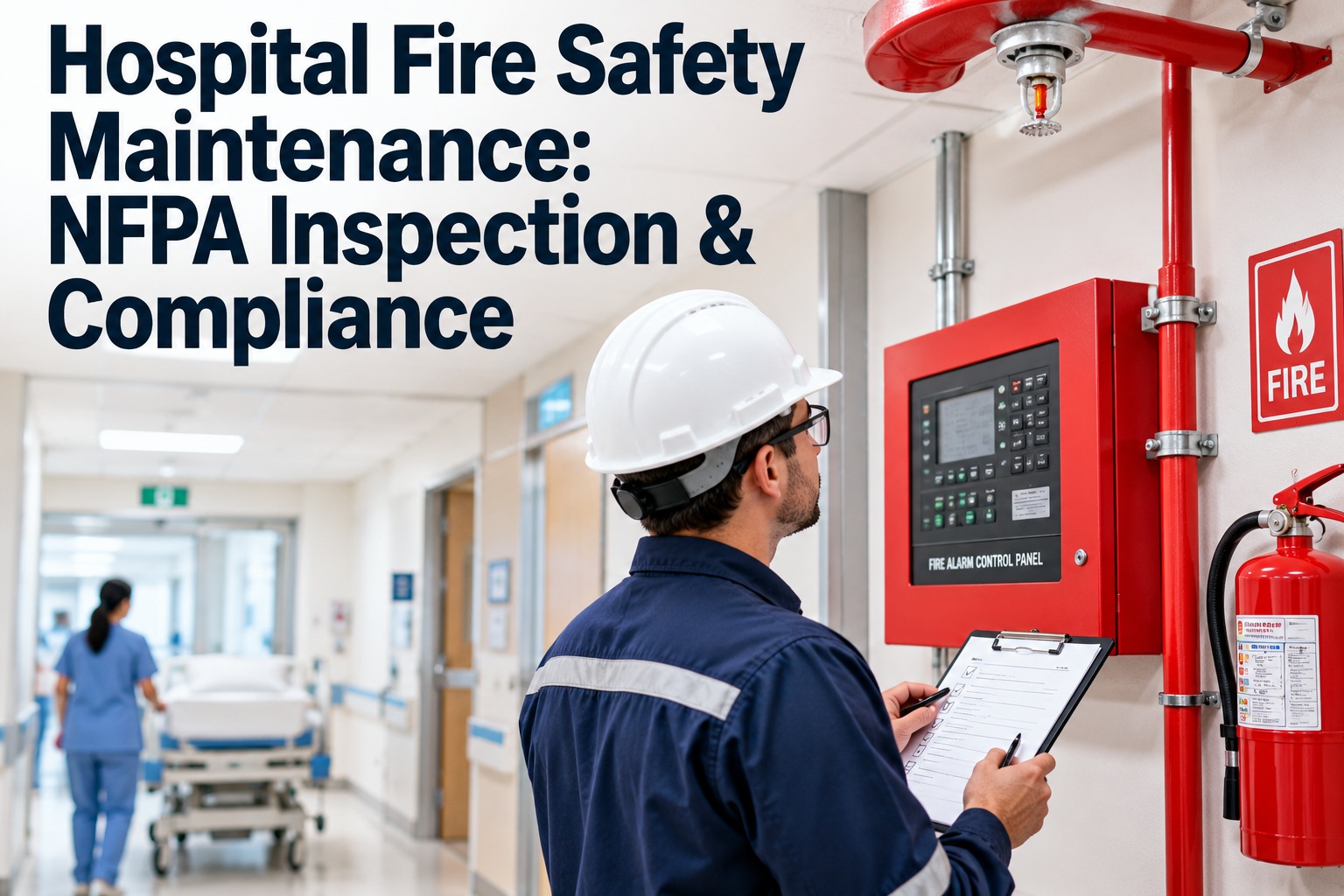
Life safety compliance is the single most common source of Joint Commission citations and CMS deficiencies. NFPA 101 and NFPA 25 govern the inspection, testing, and maintenance of fire alarm systems, sprinkler systems, standpipe systems, fire doors, and suppression systems. Unlike equipment maintenance, life safety system testing failures carry immediate jeopardy status during CMS surveys, meaning patient care can be suspended until deficiencies are corrected. The stakes of a missed fire door inspection or an untested sprinkler system are exceptionally high.
Fire and Life Safety Inspection Tasks
- Fire alarm control panel status check, no active troubles or supervisory signals
- Portable fire extinguisher visual inspection and accessibility verification
- Exit sign and emergency lighting operational check
- Sprinkler system control valve position verification and tamper switch test
- Kitchen hood suppression system visual inspection
- Fire door closer and latch hardware functional test on 20% of doors (rotating sample)
- Corridor smoke detector functional test in randomly selected zones
- Full fire alarm system device test per zone (rotating quarterly to cover full system annually)
- Sprinkler waterflow alarm and supervisory device test
- Emergency lighting 30-second function test
- Fire damper verification in high-priority areas following construction
- 100% fire alarm initiating and notification device testing per NFPA 72
- Complete sprinkler system internal inspection and obstruction investigation per NFPA 25
- Emergency lighting 90-minute discharge test
- 100% fire door gap measurement and hardware inspection per NFPA 80
- Full fire damper actuation test (all dampers on 4-year rolling cycle)
Medical Gas System Maintenance Checklist
Medical gas systems, including piped oxygen, medical air, nitrous oxide, carbon dioxide, and vacuum, are classified as Category 1 life support systems under NFPA 99. A contaminated medical air supply or an undetected pressure drop in a piped oxygen system can be immediately life-threatening. Maintenance of these systems requires qualified personnel certified under ASSE 6000 series standards, and all testing and inspection records must be preserved for the life of the facility. Book a demo to see how Oxmaint tracks medical gas compliance tasks automatically.
Medical Gas Inspection and Testing Tasks
- Monitor master alarm panels at nurse stations for zone valve box alerts
- Verify medical air compressor and vacuum pump system pressure within specification
- Review dew point monitor readings on medical air systems
- Test all medical gas master alarm panel signal functions
- Inspect compressor and vacuum pump intake filters
- Verify automatic changeover manifold function on bulk oxygen systems
- Purity analysis of medical air at compressor outlets per NFPA 99 Table 5.1.3.5.2
- Test area alarm panels at all zone valve boxes
- Inspect all outlet station retaining hardware and flow test a random sample
- Comprehensive system pressure test and leak survey
- Full medical air purity analysis including CO, CO₂, hydrocarbons, and particulates
- Calibration of all area alarms and master alarm panel transducers
- Inspection and operational test of all zone valve boxes
Plumbing and Water Management Checklist
Hospital water systems carry dual risks: waterborne pathogen transmission, particularly Legionella, and the operational failures that disrupt surgical suites, sterile processing, and patient care floors. ASHRAE 188 and CMS infection control requirements mandate a formal Water Management Plan (WMP) with documented risk assessment, control measures, and monitoring records. Facilities without an active, documented WMP face immediate jeopardy findings during CMS inspection.
Plumbing System Maintenance Schedule
| Component | Frequency | Task | Regulatory Driver |
|---|---|---|---|
| Domestic Hot Water | Weekly | Temperature monitoring at distal outlets (min 110°F at point of use) | ASHRAE 188, WMP |
| Cooling Towers | Monthly | Legionella culture sampling and disinfectant residual testing | ASHRAE 188 |
| Low-Use Outlets | Weekly | Flushing of rarely used sinks, showers, and eyewash stations | WMP, CDC guidelines |
| Backflow Preventers | Annual | Certified tester inspection and documentation | Local plumbing codes |
| Eyewash Stations | Weekly | Activation test and 15-minute flow verification at labeled stations | OSHA 29 CFR 1910.151 |
| Steam Sterilizer Supply | Monthly | Steam quality testing (superheat, dryness, non-condensable gases) | AAMI ST8 |
| Water Heater Systems | Annual | Sediment flush, anode rod inspection, thermal expansion valve test | Manufacturer specs, WMP |
Medical Equipment and Clinical Technology Maintenance Checklist
Biomedical equipment maintenance is a distinct discipline within hospital facility management, typically managed by a Biomedical Engineering or Clinical Engineering team. However, facility managers must understand how this program integrates with the broader Equipment Management Plan required by Joint Commission EC.02.04.01. Every piece of equipment with patient contact, including beds, lifts, infusion pumps, monitoring systems, and imaging equipment, must have a documented maintenance strategy with defined inspection intervals and acceptance criteria. Sign up for free to manage your full biomedical equipment inventory in Oxmaint.
Medical Equipment PM Categories
Building Envelope and Structural Maintenance Checklist
While mechanical and electrical systems dominate the compliance conversation, the building envelope, roofs, walls, windows, doors, and below-grade waterproofing, represents a major source of facility failures that directly affect patient care. Water intrusion triggers mold remediation protocols that can take entire units offline. A failed roof drain that floods an electrical vault or mechanical room creates immediate life safety risk. A cracked expansion joint in an exterior wall allows moisture infiltration that compromises wall assemblies, insulation, and eventually interior finishes in patient care areas.
Building Envelope Inspection Schedule
| Building Component | Inspection Frequency | Key Inspection Points |
|---|---|---|
| Roof Membrane and Flashings | Semi-annual + after major weather events | Punctures, blistering, flashing separation, drain blockage, ponding areas |
| Exterior Masonry and Cladding | Annual | Crack mapping, mortar joint erosion, sealant condition, staining from moisture |
| Windows and Curtain Wall | Annual | Gasket condition, frame corrosion, sealant integrity, weep hole obstruction |
| Loading Docks and Service Entrances | Monthly | Door seal condition, pit drainage, leveler plate function, pest exclusion integrity |
| Expansion Joints | Annual | Sealant condition, backer rod exposure, differential movement gaps |
| Parking Structures | Annual (licensed structural engineer every 5 years) | Deck coating condition, joint sealants, drain function, rebar corrosion indicators |
How CMMS Software Transforms Hospital Facility Maintenance
The checklists above represent hundreds of individual tasks spanning dozens of systems, each with distinct frequencies, required skill sets, parts inventories, and documentation requirements. Managing this volume manually through spreadsheets or paper binders is not only inefficient but creates regulatory exposure whenever documentation gaps appear during survey. A Computerized Maintenance Management System is the technology infrastructure that turns these checklists into a living, automated program.
Platforms like Oxmaint allow facility teams to build custom preventive maintenance schedules for every system category in this guide, assign work orders to qualified technicians, track completion against due dates, manage parts inventory for critical spare components, and generate the compliance reports that Joint Commission, CMS, and OSHA surveyors request on demand. Instead of a survey preparation crisis where staff scramble to locate documentation, every inspection record is indexed, timestamped, and retrievable in seconds. The ROI calculation is straightforward: reduced survey findings, extended equipment life, fewer emergency repairs, and lower liability from documented, defensible maintenance programs.
Automate Your Hospital Facility Maintenance Checklist
Oxmaint CMMS gives healthcare facility teams the tools to convert every checklist in this guide into automated preventive maintenance schedules, mobile work orders, parts tracking, and audit-ready compliance documentation, all in one platform built for the demands of healthcare operations.
Compliance Documentation and Audit Readiness
No maintenance program is complete without the documentation infrastructure to prove it happened. Joint Commission EC and LS chapters require that facilities maintain inspection and testing records for specific periods, typically two years for most equipment, and for the life of the facility for some life safety system records. CMS requires similar documentation and can review records going back multiple years when investigating complaint-driven surveys.
Best-practice documentation for each maintenance task includes the date and time of work, the identity and qualifications of the technician who performed the task, the specific procedure performed or referenced maintenance procedure number, the results including measured values, pass or fail determination, any deficiencies noted, and the corrective action taken or planned for deficiencies. A well-configured CMMS captures all of these fields automatically as part of the work order closure process, building the audit record as a byproduct of normal maintenance operations rather than as a separate documentation burden. Book a demo to see Oxmaint's compliance reporting in action.
Integrating Construction and Renovation into the Maintenance Program
Hospital facilities are rarely static. Renovation projects, new service line buildouts, departmental relocations, and infrastructure upgrades are continuous in most large healthcare organizations. Each construction project creates maintenance implications that must be captured before the project closes out: new equipment added to the preventive maintenance inventory, updated HVAC air balance data for modified spaces, changes to fire alarm zone configurations, new fire door locations requiring inspection, and revised electrical panel schedules. A facility maintenance program that does not have a formal process for capturing post-construction handoffs will accumulate uncovered assets over time, creating growing compliance and operational exposure.
Infection Control Risk Assessments (ICRAs) required during construction also generate maintenance obligations, including the temporary installation of dust barriers with negative pressure, HEPA filtration units requiring filter change tracking, and the management of construction-related water system disturbances that trigger Legionella monitoring protocols. These temporary maintenance obligations must flow through the same CMMS system as routine preventive maintenance so that nothing falls through the cracks during the inherently disruptive construction period.
Frequently Asked Questions
Hospital facility maintenance is governed primarily by The Joint Commission (Environment of Care and Life Safety chapters), the Centers for Medicare and Medicaid Services (CMS Conditions of Participation), OSHA (occupational safety standards for maintenance workers), and National Fire Protection Association codes including NFPA 99, NFPA 101, NFPA 25, and NFPA 72. State health department licensing requirements and local building and fire codes add additional obligations that vary by jurisdiction.
The Joint Commission requires most inspection and testing records to be retained for two years and available on demand during survey. CMS has similar requirements. Life safety system records including fire alarm testing, sprinkler inspections, and fire door surveys may need to be retained for the life of the facility depending on state requirements. Equipment maintenance histories are typically retained for the operational life of the equipment plus two years. A CMMS eliminates retention management burden by archiving all records electronically with searchable history. Sign up for free to start building your digital audit trail today.
Life safety findings consistently represent the largest category of Joint Commission citations, particularly in fire door compliance. Missing or inadequate gap measurements, failed latch hardware, doors held open by unapproved devices, and missing fire door inspection records are the most frequent specific findings. Sprinkler system obstruction documentation and generator load test records are also frequent citation sources. A well-managed CMMS with automatic scheduling of these tasks and mobile documentation capability dramatically reduces exposure in these categories.
Yes. CMS and The Joint Commission both require healthcare facilities to have a formal Water Management Plan (WMP) consistent with ASHRAE Standard 188. The WMP must include a system description, hazard analysis, control measures, monitoring procedures, and response protocols for Legionella and other waterborne pathogens. The maintenance program executes the WMP through scheduled tasks including hot water temperature monitoring, low-use outlet flushing, cooling tower sampling, and culture testing, all of which must be documented in the CMMS for audit purposes.
Yes. Oxmaint is designed for asset-intensive operations including healthcare facilities and supports custom preventive maintenance schedules for HVAC, electrical, fire safety, medical gas, plumbing, medical equipment, and building envelope systems. It provides mobile work order access for technicians, automated parts inventory tracking, compliance report generation, and configurable triggers based on calendar intervals, operating hours, or condition-based thresholds. Book a demo to see the full platform and explore how it fits your facility's specific needs.



.png)