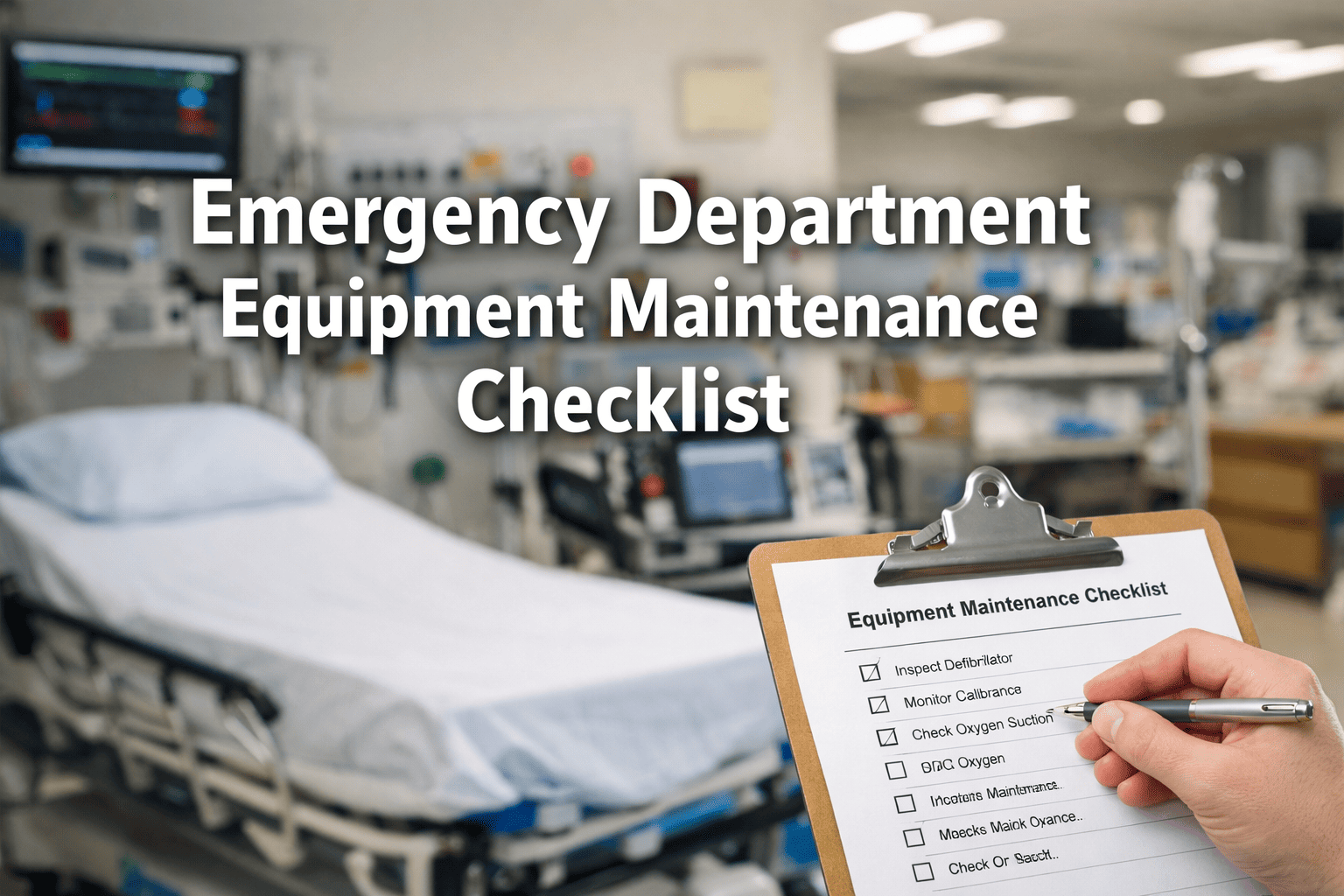
Every second counts in an emergency department — and the equipment your team reaches for in those seconds must work without hesitation. Studies show 23% of adverse events in hospitals are linked to equipment failures or maintenance lapses, yet most ED teams are still managing inspections on paper binders and memory. This checklist covers every critical device in your emergency department: crash carts, defibrillators, ventilators, cardiac monitors, IV pumps, portable imaging, and more — structured by inspection frequency and device criticality. Facilities looking to move beyond paper can book a demo to see how digital inspection workflows eliminate compliance gaps and protect patients every shift.
Emergency Department Equipment Compliance
Hospital Emergency Department Equipment Maintenance Checklist
The complete ER readiness protocol — crash carts, ventilators, defibrillators, monitors, and every critical device your team relies on.
Joint Commission Aligned
FDA 21 CFR Part 820
IEC 60601 Standards
OSHA Compliant
23%
Adverse events linked to equipment failure
4.8x
Higher cost of reactive vs planned maintenance
68%
Of defibrillator failures found during inspection, not use
$1.2M
Average cost of a preventable sentinel event
Why This Matters
What Is ED Equipment Maintenance Compliance?
Scheduled Inspection
Structured, time-based or usage-based checks conducted on every ER device before each shift, weekly, monthly, and annually — preventing failure before it reaches the patient.
Documented Readiness
Audit-ready records proving each device was inspected, tested, and cleared for use — the evidence Joint Commission and CMS surveyors require under EC.02.04.01.
Biomedical Verification
Technical performance verification by qualified biomedical engineers — confirming device output, calibration, alarm thresholds, and electrical safety at defined intervals.
Team Accountability
Clear assignment of inspection tasks across nursing, biomedical, and facilities staff — with digital sign-off ensuring nothing is skipped between shifts or handoffs.
Inspection Framework
Quick Reference: Frequency by Device Criticality
| Device Category | Pre-Shift | Daily | Weekly | Monthly | Biannual | Annual PM |
|---|---|---|---|---|---|---|
| Crash Cart / Defibrillator | Yes | Yes | Yes | Full Check | Biomed PM | Full Cal. |
| Ventilator | Yes | Yes | Circuit Check | Full PM | — | Full Cal. |
| Cardiac Monitor | Yes | Yes | — | Full Check | Biomed PM | Full Cal. |
| IV Infusion Pump | Yes | — | — | Full Check | Biomed PM | Full Cal. |
| Portable X-Ray | — | Visual | Operational | Full Check | QA Testing | Full Cal. |
| Suction Units | Yes | Yes | — | Full Check | — | Full PM |
| Point-of-Care Lab Equipment | — | QC Run | — | Full Check | Biomed PM | Full Cal. |
| Laryngoscope / Airway | Yes | Yes | — | Full Check | — | Replace Parts |
Ready to automate this schedule? Start a free trial and assign every row in this table to a technician automatically, or book a demo to see it live.
Pain Points
Where Emergency Departments Break Down
Shift Handoff Blind Spots
Paper checklists completed at start-of-shift are often lost by handoff time. Incoming teams have no visibility into what was checked, flagged, or deferred — and patients pay the price.
Crash Carts Found Incomplete
An incomplete crash cart during a code is a sentinel event. 1 in 5 hospitals reports missing medications or expired supplies discovered mid-resuscitation — directly tied to missing inspection routines.
Overdue PM with No Alert
Preventive maintenance schedules set in spreadsheets go stale. When a device overruns its PM window by weeks — with no alert triggered — teams only find out during a Joint Commission survey.
No Audit Trail for Surveyors
Joint Commission EC.02.04.01 requires written evidence of every inspection. Paper logs get lost, damaged, or backdated — and digital binders with no timestamps don't hold up under scrutiny.
Technician Knowledge Gaps
High ED staff turnover means new technicians inherit undocumented inspection habits. Without standardized digital workflows, each person does it differently — creating inconsistency across shifts and sites.
Reactive, Not Preventive
Emergency repairs on critical ER devices cost 4.8x more than scheduled maintenance. When a ventilator fails mid-shift, teams lose clinical time, divert patients, and face potential regulatory action.
Complete Inspection Protocol
Device-by-Device Maintenance Checklist
01
Crash Cart Inspection
Pre-Shift
Daily Log
Monthly Full Restock
Physical & Seal Checks
Medications & Supplies
Critical stat: 1 in 5 hospitals has discovered missing or expired crash cart supplies during an actual code. Pre-shift seals and monthly full restocks eliminate this risk entirely.
02
Mechanical Ventilator Inspection
Pre-Use Check
Weekly Circuit
Monthly Full PM
Operational Checks
Circuit & Consumables
Regulatory note: The Joint Commission standard EC.02.04.01 requires documented PM for all life-support equipment. Missing ventilator PM records are among the top 5 findings in TJC surveys.
03
Cardiac Monitor / ECG System
Pre-Shift
Daily Waveform Check
Monthly Calibration
Display & Alarm
Leads, Battery & Connectivity
Critical stat: Alarm fatigue from improperly configured monitors contributes to 86% of sentinel events involving monitoring failures. Default alarm settings must be verified every shift.
04
IV Infusion Pump Inspection
Pre-Use
Monthly Check
Annual Biomed PM
Pump Performance
Physical & Electrical
FDA alert: IV pump malfunctions account for 35% of medication error reports submitted to MedWatch. DERS and drug library currency are critical safeguards that must be verified monthly.
05
Portable X-Ray Unit
Daily Visual
Weekly Operational
Biannual QA Testing
Radiation & Output
Mechanical & Safety
Regulatory note: State radiation control programs require annual QA testing documentation. Missing records can result in facility license suspension independent of Joint Commission action.
06
Suction Units & Airway Equipment
Pre-Shift
Daily Test
Monthly Full Check
Wall & Portable Suction
Airway Management Kit
Evidence: Unavailable or failed suction equipment is a direct cause of preventable aspiration deaths in emergency settings. Pre-shift checks take under 3 minutes but can save a life within the first hour of a shift.
07
Point-of-Care Lab Equipment
Daily QC Run
Monthly Calibration
Annual Biomed PM
Blood Gas & Glucose Analyzers
Coagulation & Troponin
CLIA requirement: CMS mandates daily quality control for all waived and moderate-complexity POC analyzers. Undocumented QC failures can trigger laboratory certificate suspension.
Managing all seven device categories across multiple ED bays is what Oxmaint was built for. Start a free trial and have every checklist above assigned, tracked, and audit-ready — or book a demo to see the full workflow live in under 30 minutes.
Before vs After
Paper Checklists vs Digital ED Inspection Management
Paper-Based Inspection
Binders lost or backdated during surveys
No alert when PM date is overdue
Inspection quality varies by technician
No visibility across shifts or locations
Survey prep takes days of manual search
Expired supplies discovered at the bedside
No data to prove compliance patterns over time
Emergency repairs at 4.8x the planned cost
Oxmaint Digital Inspection
Timestamped, tamper-proof digital records always accessible
Automatic PM alerts — days before overdue, not after
Standardized step-by-step workflows for every device type
Real-time dashboard across all bays and all sites
Survey-ready reports generated in under 60 seconds
Expiry date tracking triggers restock before it reaches the cart
Trend reports show compliance rates over months and years
Planned maintenance reduces repair costs by up to 40%
How Oxmaint Solves It
Built for ED Equipment Complexity — Not Adapted From It
Asset Registry
Every Device. One Record.
Full asset hierarchy — Portfolio, Property, Department, Asset, Component. Every ventilator, pump, and monitor has a complete service history, PM schedule, and calibration log in one place.
Mobile Inspections
Checklists at the Bedside
Technicians complete inspections on mobile — scan the device barcode, step through the checklist, attach a photo, sign off. Pre-shift crash cart checks take under 3 minutes with zero paper.
Automated Scheduling
PM Alerts Before Overdue
Set inspection intervals per device type and Oxmaint assigns, escalates, and notifies automatically. Know about overdue PMs 7 days before — not during a TJC walk-through.
Audit Readiness
Survey-Ready in Seconds
Generate a complete EC.02.04.01 compliance report in under 60 seconds. Every signature, timestamp, corrective action, and PM record — exportable and legally defensible.
Work Order Management
Defects to Resolution
When a failed check is flagged, a work order is created instantly — assigned to the right technician, tracked to completion, with full repair history attached to the asset record.
Multi-Site Visibility
All EDs. One Dashboard.
Manage inspection compliance across multiple emergency departments and hospital campuses from one portfolio-level dashboard. Spot the outlier site before it becomes a liability.
ROI & Results
What Systematic ED Maintenance Delivers
40%
Reduction in Emergency Repair Costs
Planned maintenance vs reactive repairs — documented across healthcare facilities using structured PM programs.
68%
Device Failures Caught Before Clinical Use
Pre-shift inspection programs intercept most defects before they reach a patient encounter.
3 min
Average Crash Cart Check Time (Digital)
Mobile-first digital checklists reduce pre-shift inspection time by over 60% vs paper-based processes.
60 sec
To Generate a TJC-Ready Compliance Report
What takes days with paper binders takes under a minute with Oxmaint's automated reporting engine.
Your ER Equipment Can't Afford a Missed Check
Oxmaint gives emergency departments the tools to automate every inspection workflow, track every device, and walk into any Joint Commission survey without hesitation. Start protecting patients with every shift — not just when surveyors arrive.
Documentation Guide
What Surveyors Look for in Your ED Equipment Records
01
Signed Inspection Logs
Every checklist must carry a technician signature, date, and time. Undated or unsigned records are treated as missing records during TJC survey review of EC.02.04.01.
02
Corrective Action Traceability
When a defect is found, surveyors require a documented corrective action — not just a note that something was wrong. The closed-loop work order record proves the issue was resolved.
03
PM Interval Compliance Rate
Surveyors check whether scheduled PMs were completed on time — not just whether they exist. A history showing consistent on-time completion is the strongest evidence of a functioning program.
04
Calibration Certificates
Defibrillators, monitors, ventilators, and POC analyzers require external calibration certificates. These must be accessible within minutes during a survey — not searched for over hours.
Oxmaint stores all of the above — signatures, work orders, PM records, and calibration certificates — in a single searchable system. Book a demo to see how survey prep goes from days to minutes, or start a free trial and get your first inspection workflow live today.
FAQ
Common Questions on ED Equipment Maintenance
How often must crash carts be inspected in a hospital emergency department?
Crash carts require a visual tamper-seal check every shift (minimum twice daily in a 24-hour ED), a full documented inventory check at least monthly, and an immediate full restock and re-seal after every use. The Joint Commission standard EC.02.04.01 requires that all emergency equipment be inspected at intervals sufficient to ensure readiness — most accredited facilities interpret this as no less than daily. Documentation must include technician identification, date, time, and the seal number verified.
What are the Joint Commission requirements for defibrillator maintenance?
The Joint Commission requires that defibrillators be included in the facility's equipment management plan under EC.02.04.01. This means documented preventive maintenance at manufacturer-recommended intervals (typically every 6 to 12 months by a qualified biomedical engineer), daily operational checks including a charge-discharge test, battery status verification, and pad expiry confirmation. All records must be available for review and must demonstrate consistent on-time completion — not just existence of a maintenance plan.
Who is responsible for biomedical equipment maintenance in the ED — nursing or biomedical engineering?
Responsibility is shared but distinct. Nursing staff are responsible for pre-shift operational checks, confirming device readiness, and flagging defects immediately through work order requests. Biomedical engineering (or a contracted third-party) is responsible for scheduled preventive maintenance, calibration, and technical performance verification. The critical failure point is handoff — defects flagged by nursing must be tracked through to biomed resolution, with closed-loop documentation proving the issue was addressed before the device returned to clinical use.
What happens if the Joint Commission finds missing equipment maintenance records during a survey?
Missing or incomplete maintenance records under EC.02.04.01 can result in a Requirement for Improvement (RFI), which requires a written corrective action plan and follow-up evidence within 45 to 60 days. Repeated or systemic failures can escalate to a Conditional Accreditation status, which triggers a focused survey and reputational consequences. Beyond accreditation, missing records can be used as evidence of negligence in patient harm litigation — making audit-ready documentation a patient safety and legal imperative, not just a compliance exercise.