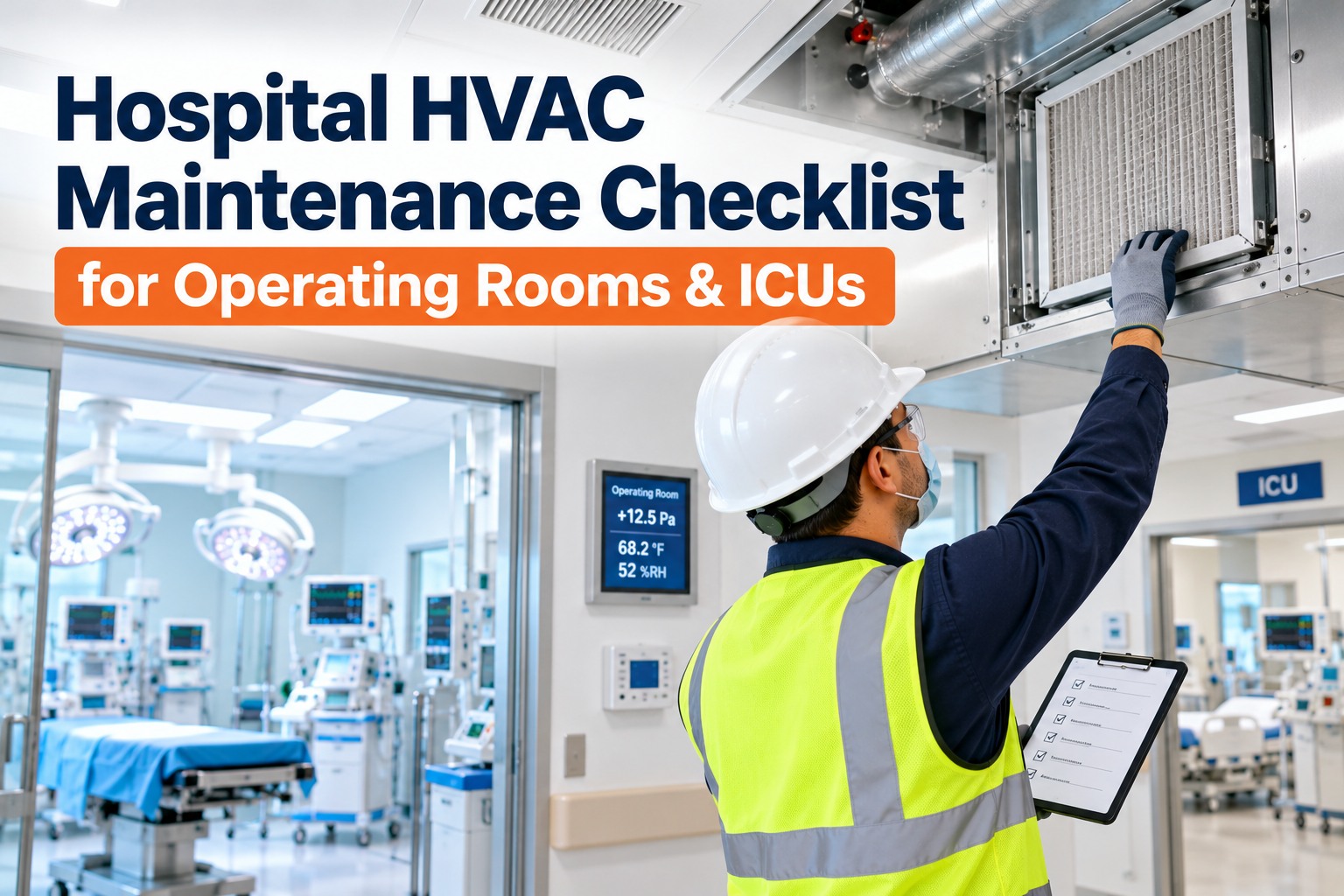
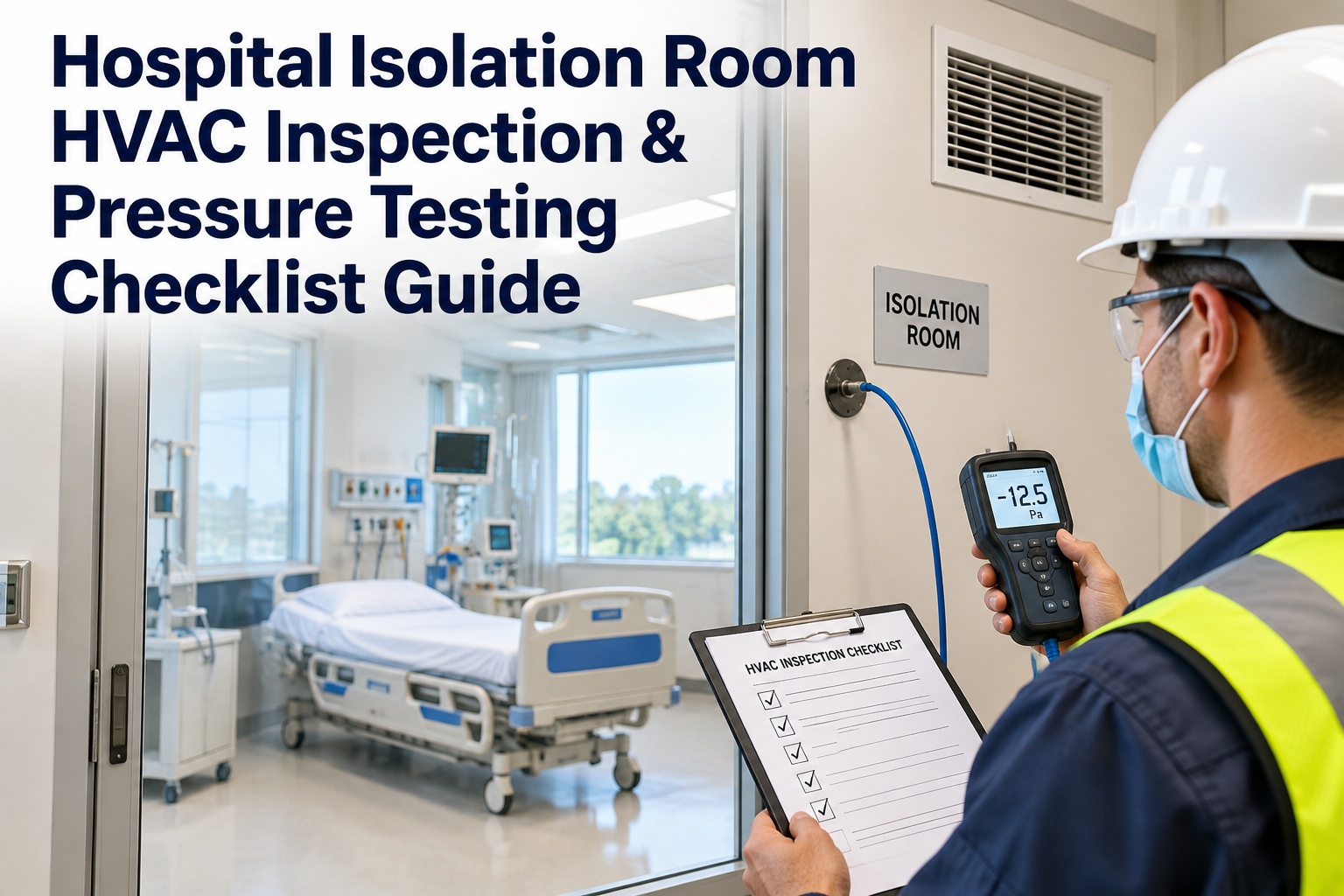
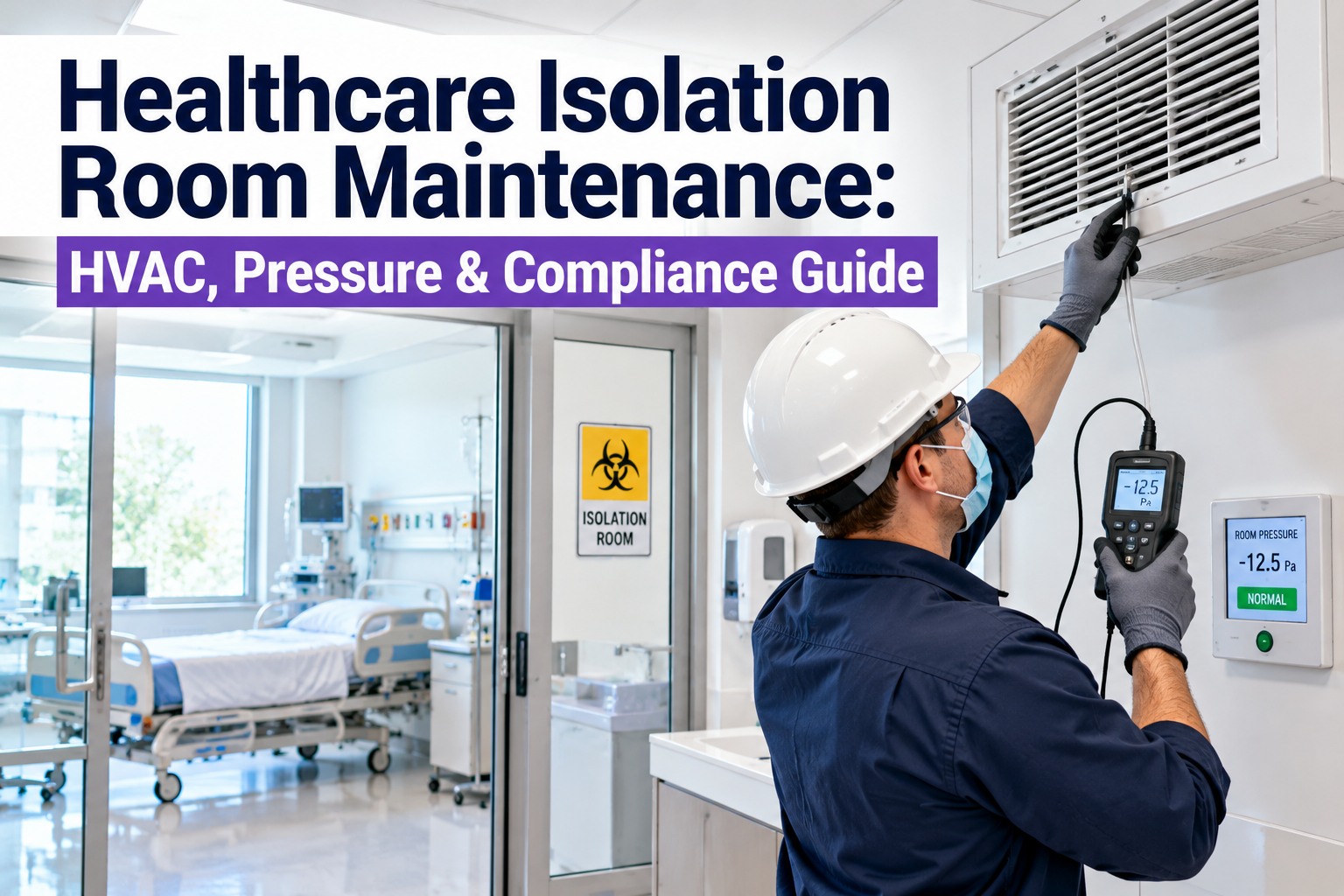
In a hospital, an air handler isn't just comfort equipment — it's an infection-control device. An operating room stays sterile because it's held at positive pressure to its corridor; an isolation room protects everyone else because it's held negative; a transplant patient's room is shielded by HEPA-filtered positive pressure. When airflow, filtration, or pressure drifts in any of these zones, the room quietly stops protecting the people inside it, and the failure is usually invisible until it shows up as a pressure alarm, a surgical-site infection, or an Environment of Care citation. The fix is a disciplined, documented HVAC preventive-maintenance program built around each zone's requirements. This checklist lays out exactly what to verify and how often, and shows how to schedule it as recurring work in OxMaint's preventive maintenance module — or book a demo to see it mapped to your critical zones.
Facility Infrastructure / HVAC Checklist
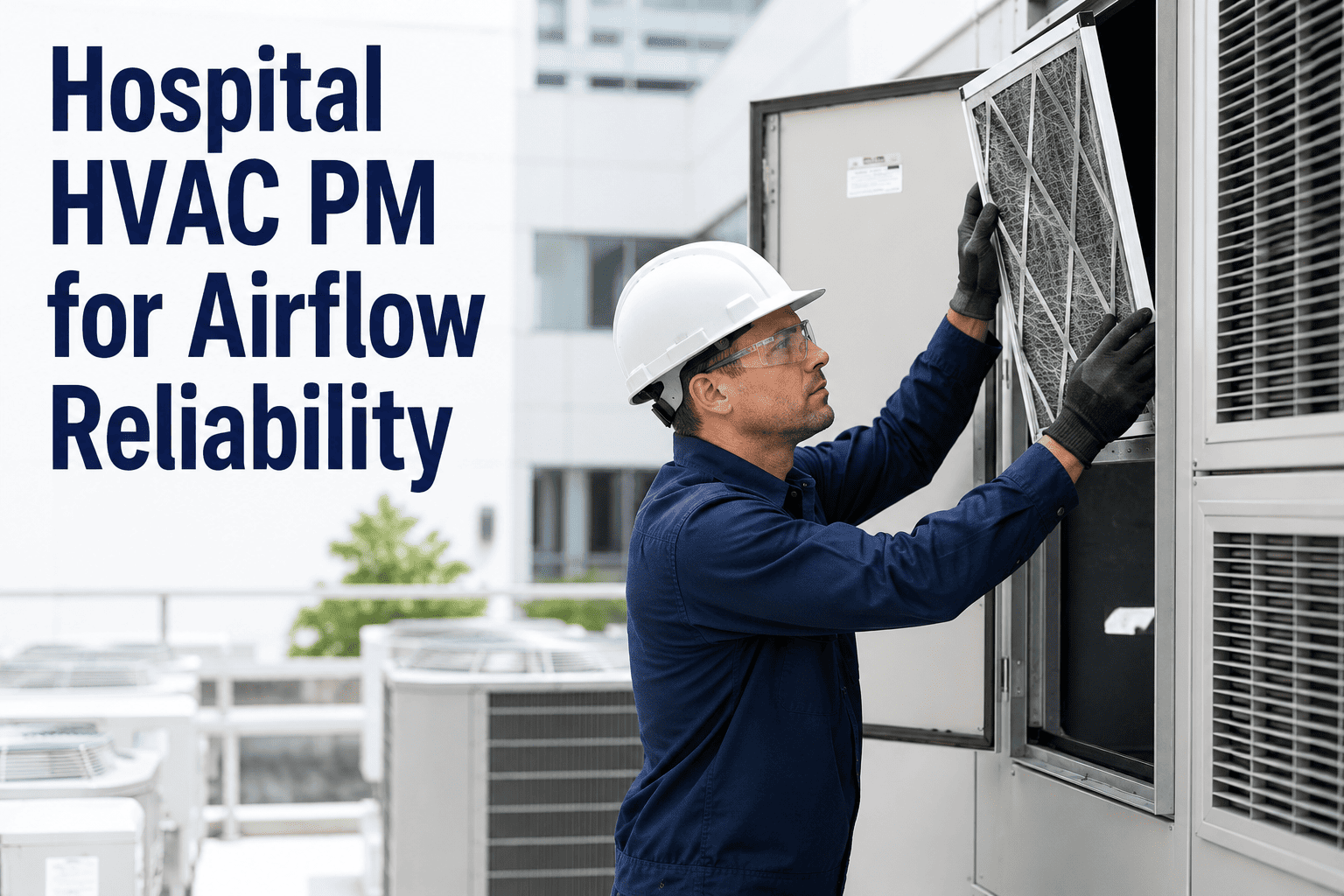
Hospital HVAC PM for Airflow Reliability
Schedule HVAC preventive maintenance, inspections, and alerts for the critical care zones where airflow, filtration, and pressure protect patients — ORs, isolation rooms, and ICUs.
20 ACH
Minimum total air changes for an operating room
12 ACH
Minimum for an airborne infection isolation room
MERV 16
OR final-filter minimum under ASHRAE 170 (2021)
0.01" w.g.
Minimum pressure differential for a controlled space
Why critical-zone airflow can't drift
Each zone is defined by the direction its air moves. Reverse it — through a loading filter, a failing fan, or a stuck damper — and the room's whole purpose inverts.
Operating room
Positive pressure keeps corridor air away from the open sterile field.
Isolation room
Negative pressure contains airborne pathogens inside the room, exhausted outdoors.
Protective env.
Positive pressure plus HEPA supply shields immunocompromised patients from spores.
Critical-zone airflow standards (ASHRAE 170)
ASHRAE Standard 170 sets the targets the Joint Commission references for ventilation. These are common reference values — confirm against the current edition and your authority having jurisdiction.
| Zone | Pressure | Min total ACH | Filtration | Monitoring |
| Operating room |
Positive |
20 (≥4 outdoor) |
MERV 16; HEPA for high-risk |
Continuous |
| Isolation (AII) |
Negative |
12, exhausted outdoors |
HEPA before any recirculation |
Continuous + visual |
| Protective env. |
Positive |
12 |
HEPA-filtered supply |
When occupied |
| ICU / patient care |
Per space type |
~6 |
MERV 14+ |
Logged |
| General ward |
Varies |
~6 (2 outdoor) |
MERV 13+ |
Periodic |
The HVAC PM checklist, by interval
Group every task by how often it's due, set the right threshold per zone, and let the system reopen each one on schedule. Here's the working checklist.
Continuous / dailyHighest priority
Verify OR positive and isolation negative pressure on room monitors
Confirm visual pressure alarms are active and not in a fault state
Log critical-zone temperature and humidity against target bands
Check air-handler run status and clear any overnight alarms
MonthlyRoutine
Inspect and change prefilters; record differential pressure
Read and trend final-filter DP gauges for loading
Inspect belts, drives, and motor condition
Check condensate drains and pans for blockage
Clean diffusers, grilles, and return registers
QuarterlyRoutine
Inspect and clean coils; check for fouling and bypass
Test damper operation and actuator response
Verify or calibrate BAS sensors and control set points
Review filter-change history and DP trends per zone
Semi-annual / annualValidation
Test HEPA integrity and replace terminal filters as due
Verify air changes per hour for OR and isolation rooms
Full air-handler service; inspect fans and bearings
Recalibrate pressure monitors and validate set points
Compile ASHRAE 170 and Environment of Care documentation
Turn this checklist into recurring work
OxMaint generates each task at the right interval, routes it to the right technician, and files the readings as proof.
Alerts that matter in critical zones
Scheduled tasks catch what's predictable; alerts catch what isn't. Each of these should fire in real time and open a work order automatically.
OR or isolation pressure excursion
Filter differential pressure over threshold
HEPA integrity loss
Temperature or humidity out of band
Air-handler or fan fault
A pressure reversal in an OR or isolation room is a patient-safety event the moment it happens — so it should reach a technician immediately, not at the next scheduled round.
Expert Review
"The mistake I see is treating hospital HVAC like office HVAC with stricter filters. It isn't — in a critical zone, the pressure relationship is a clinical control, and when it fails it fails silently. A filter loads up over weeks, airflow drops, and one morning the OR that should be positive is barely holding neutral, with nobody aware until a monitor trips. The teams that never get surprised do two unglamorous things: they trend filter differential pressure instead of waiting for a change-out date, and they let the pressure monitors open a work order automatically the instant a zone drifts. Schedule the predictable, alert on the rest, and document both — that's the whole game."
Reviewed by a hospital facilities engineer, 17+ years in healthcare HVAC and ASHRAE 170 compliance.
See critical-zone PM scheduled live
Walk through OR, isolation, and ICU HVAC tasks running on schedule — with pressure and filter alerts wired to your own air handlers.
Frequently asked questions
1
What HVAC parameters does ASHRAE 170 set for critical zones?
ASHRAE 170 defines air changes per hour, pressure relationship, filtration, temperature, and humidity for 60-plus healthcare space types. Operating rooms need positive pressure and at least 20 total air changes per hour with MERV 16 final filtration; airborne infection isolation rooms need negative pressure and at least 12 air changes exhausted outdoors. The Joint Commission references the standard directly. Map each zone in
OxMaint.
2
How often should OR and isolation-room airflow be verified?
Pressure relationships in operating rooms and isolation rooms should be monitored continuously through permanently installed devices, with readings logged daily and visual alarms verified each round. Air-change verification and HEPA integrity are confirmed on a periodic schedule set by your policy and authority having jurisdiction. A CMMS turns each into a recurring, documented task.
Book a demo to see critical-zone scheduling.
3
Why is pressure direction so important in these rooms?
Direction is the whole point: an operating room is positive to its corridor so contaminated air can't reach the sterile field, while an isolation room is negative so airborne pathogens stay contained. If either reverses — from a clogged filter, a failing fan, or a stuck damper — the room silently stops protecting anyone. Continuous monitoring with automatic alerts catches that drift. See it in
OxMaint.
4
What should trigger an HVAC alert in a critical zone?
A pressure excursion in an OR or isolation room is the top alert — it's a patient-safety event the moment it occurs. Filter differential pressure crossing its threshold, HEPA integrity loss, and temperature or humidity drifting out of band should all alert too, alongside any air-handler fault. Each one should open a work order automatically rather than wait for a round. Configure alerts in
a demo.
5
What filtration do operating rooms require?
The 2021 edition of ASHRAE 170 raised the operating-room final-filter minimum to MERV 16, and HEPA filters are required at the air terminal device for the highest-risk procedures such as orthopedic implants, transplants, and neurosurgery. Filter differential pressure should be trended so a loading filter is replaced before it starves airflow. Track filter PM in
OxMaint.
6
How does HVAC PM connect to Joint Commission compliance?
Two things must both be true: the system has to meet ASHRAE 170's technical parameters, and you have to document the maintenance that keeps it there. A hospital can hit every airflow number and still fail an Environment of Care citation if it can't produce the records. A CMMS generates that documentation as a byproduct of doing the work.
Book a demo to see audit-ready records.
7
Can one checklist cover every zone in the hospital?
A single master checklist works as long as it's organized by zone classification, because the targets differ — an OR, an isolation room, a protective-environment room, and a general ward each carry their own pressure, air-change, and filtration requirements. The checklist sets the right task and threshold per space rather than one blanket rule for all. Build it per zone in
OxMaint.
8
How does OxMaint schedule hospital HVAC PM?
OxMaint turns each zone's requirements into recurring work orders at the correct interval, routes them to the right technician, captures readings and photos at completion, and alerts on pressure, filter, or environmental excursions. Every task lands in an audit-ready record tied to the asset and exportable for survey. Run it on your own air handlers with a
free trial.
Keep every critical zone in spec
Schedule the PM, trend the filters, alert on the excursions, and document all of it — so ORs stay positive, isolation rooms stay negative, and your records stay survey-ready.