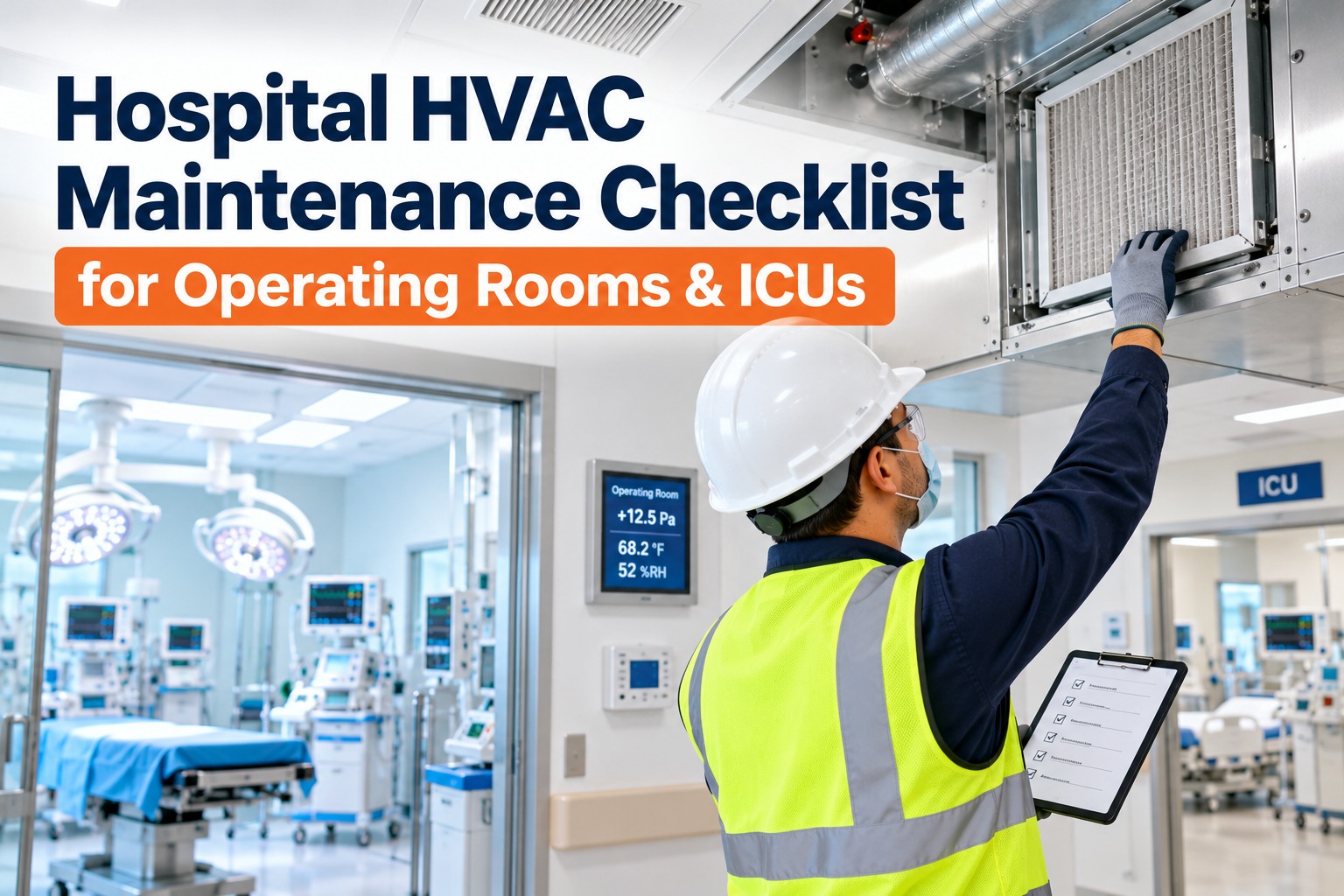
Hospital HVAC Maintenance Checklist for Operating Rooms & ICUs

By Willam Jerry on October 21, 2026

hospital-hvac-maintenance-checklist-operating-rooms-icus

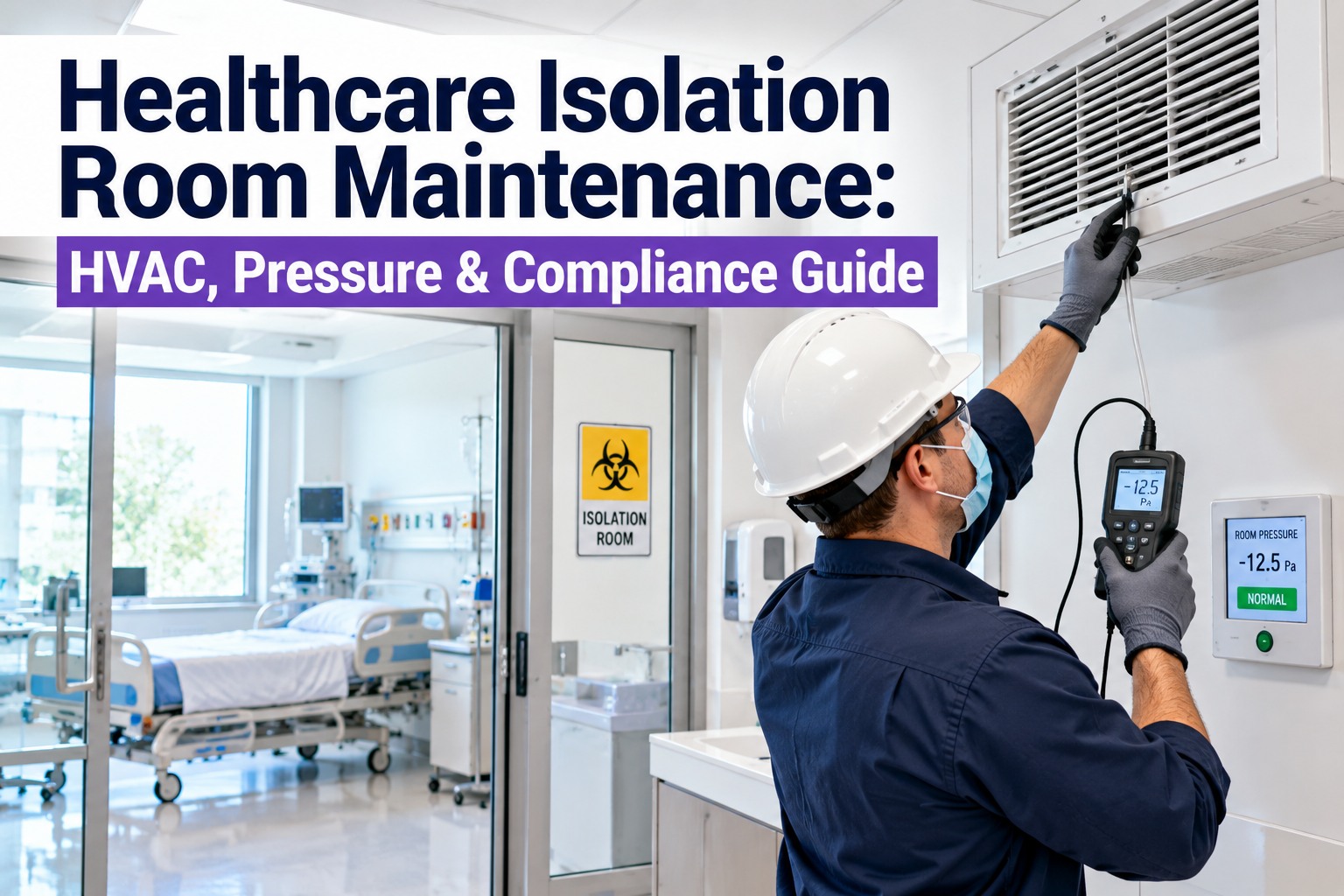
In an operating room or an ICU, the air itself is a clinical control. Positive pressure keeps contaminants out of the sterile field, air changes flush the room, filtration strips the particles, and temperature and humidity hold the margins that protect the patient. When the HVAC drifts — a loaded filter, a reversed pressure, a humidity swing — the room quietly stops doing its job. This hospital HVAC maintenance checklist for operating rooms and ICUs walks every controlled parameter and logs each deviation as a tracked work order in OXMAINT AI — or book a demo of healthcare HVAC compliance in OXMAINT AI.

HOSPITAL HVAC MAINTENANCE · OR & ICU · ENVIRONMENTAL CONTROL · 2026

Hospital HVAC Maintenance Checklist for Operating Rooms & ICUs

A reversed pressure or a clogged filter in a critical space is an infection-control risk and a survey finding at once. OXMAINT AI is the AI-powered CMMS that runs the HVAC maintenance route, logs every out-of-range reading, and raises a scheduled work order with the record attached — so a drifting parameter becomes a closed, documented fix, not a problem found during a case.

1 · Check parameters 2 · Log deviation 3 · Schedule repair 4 · Keep the record
20
minimum total air changes per hour commonly cited for operating rooms
+
operating rooms held positive to adjacent spaces; isolation rooms negative
20–60%
relative humidity band widely cited for ORs in recent editions
4
controlled parameters — pressure, air changes, temperature, humidity

The Pressure Cascade: Which Way the Air Should Move

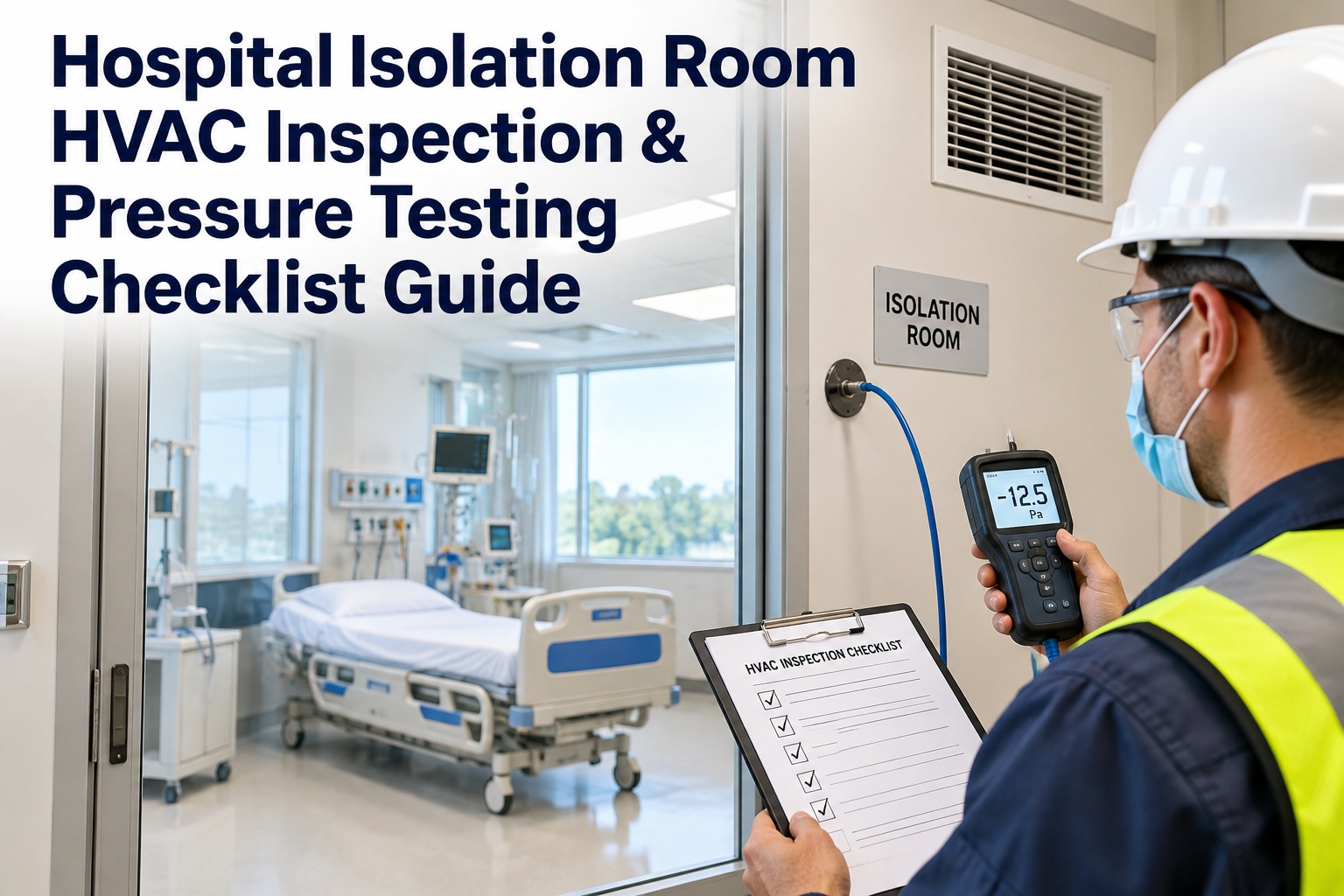
Every critical space is defined by which way air flows across its door. A sterile space pushes air out to keep contaminants from drifting in; an isolation space pulls air in to keep pathogens from drifting out. Lose the differential and the room's protection is gone. Start free and track pressure across your critical spaces in OXMAINT AI.

+
Operating Room / PE Room
Positive — air flows OUT to the corridor
Corridorreference
← out
in →
−
Airborne Isolation Room
Negative — air flows IN from the corridor

A minimum differential of roughly 2.5 Pa (about 0.01 inch water column) is the commonly cited threshold for a maintained positive or negative relationship.

Critical-Space Parameter Reference

Each space type has its own target band. These are the commonly cited ASHRAE 170 reference values — the figures your maintenance readings get checked against. Confirm the exact numbers against the edition your jurisdiction has adopted.

Space
Pressure
Total ACH
Outdoor ACH
Temp
RH
Operating Room
Positive
20
4
68–75°F
20–60%
ICU / Critical Care
NR*
6
2
70–75°F
30–60%
Protective Environment
Positive
12
2
Per design
Max 60%
Airborne Isolation
Negative
12
2
Per design
Max 60%

*NR = no fixed pressure relationship required for a general ICU bay; isolation and protective rooms within it carry their own requirements. Values are commonly cited references, not a substitute for the adopted standard.

The OR Filter Train: Two Beds, Not One

Operating-room air is cleaned in stages — a coarse prefilter catches the bulk, a high-efficiency final filter catches the fine particles before the air reaches the room. Both beds have to be monitored and changed on condition, not guesswork.

1
Prefilter
Around MERV 7 — catches large particles and protects the final bed from loading too fast.
→
2
Final Filter
MERV 14 or higher — the high-efficiency bed that cleans air before it enters the OR. PE and isolation spaces step up to HEPA.
→
3
Monitor ΔP
Track the pressure loss across each bed — a rising reading is the signal to change, before airflow suffers.

The Hospital HVAC Maintenance Checklist

Work the five maintenance domains in turn — filtration, airflow, pressure, temperature and humidity, then controls and records. Tick each item as you go; the whole row toggles. Book a demo and run this checklist from a tablet in OXMAINT AI.

01Air FiltrationTwo-bed
02Airflow & Air ChangesACH
03Pressure Differentials±2.5 Pa
04Temperature & HumiditySetpoints
05Controls, Records & ResponseDocumentation

When a Critical Space Drifts Out of Range

These are the failures that most often take an OR or ICU out of spec — each one a reason to catch the parameter before it crosses the line.

×
Pressure Reversal
A positive OR gone neutral or negative lets contaminants drift toward the sterile field.
×
Loaded Filters
An unchanged bed raises pressure loss and starves the room of its design air changes.
×
Humidity Drift
Too low risks static and patient cooling; too high risks microbial growth and condensation.
×
Low Air Changes
Reduced supply flow means the room clears contaminants slower than it was designed to.
×
Uncalibrated Sensors
A monitor reading right while the room is wrong is worse than no monitor at all.
×
Fouled Coils & Drains
Dirty cooling coils and standing water harm capacity and become a contamination source.

How OXMAINT AI Keeps Critical Spaces In Range

OXMAINT AI is the AI-powered maintenance management software that carries a critical space from the HVAC route to the closed, documented repair — the asset register, the PM schedule, the deviation readings and the audit trail on one platform. Put your ORs and ICUs on it when you start free and schedule critical-space PMs in OXMAINT AI.

Critical-Space Register
Every OR, ICU, isolation and protective room as an asset with its target parameters on file.
Scheduled PM Routes
Recurring filter, airflow, pressure and humidity checks generated automatically so none slips.
Mobile Readings
The five-domain checklist runs from a phone at the room, with readings logged on the spot.
Deviation → Work Order
Any out-of-range reading raises a prioritised repair with the value and location attached.
Audit-Ready Records
Signed, dated maintenance records retained and ready to produce at survey time.
Compliance Rollup
A live view of which spaces are in range, which have open deviations and which are overdue.

A Room Out of Range Is a Risk to the Patient in the Suite.

Caught on a PM route, a rising filter pressure or a slipping differential is a scheduled repair with a record. Missed, it's a critical space that no longer protects the patient — and a finding at the next survey. OXMAINT AI makes the route repeatable and the record automatic.

EXPERT REVIEW

Written for hospital facilities, plant-operations and infection-control teams. Ventilation of critical healthcare spaces is governed by ASHRAE Standard 170 and the FGI Guidelines, with hospitals also accountable under CMS and accreditation bodies such as The Joint Commission. The air-change, pressure, temperature, humidity and filtration figures cited here are commonly referenced values that differ by the adopted edition and by space classification — confirm the exact requirements against the standard and your authority having jurisdiction before using them for commissioning or compliance. Continuous pressure and environmental monitoring is typically provided by a building automation or monitoring system; OXMAINT AI is a maintenance management platform that schedules the PMs, records the readings and tracks the repairs — it does not replace that monitoring hardware or a qualified HVAC engineer.

Frequently Asked Questions

How often should operating-room HVAC be maintained?
Critical-space HVAC is maintained on a layered schedule — frequent filter and pressure checks, periodic airflow and calibration verification, and an annual review — with the exact cadence set by the equipment, the space classification and your facility policy. The point is a repeatable route so every parameter is checked and recorded. Start free and schedule OR and ICU HVAC PMs in OXMAINT AI.
Why must an operating room be positively pressured?
Positive pressure makes air flow out of the OR toward adjacent spaces, so airborne contaminants from the corridor can't drift into the sterile field. An isolation room is the opposite — negative pressure pulls air in so pathogens don't escape. Losing the differential removes that protection, which is why pressure is checked on every route.
What air-change rate does an operating room need?
A minimum total air-change rate of around 20 per hour is commonly cited for operating rooms, with roughly 4 of those being outdoor air; a general ICU is typically lower, around 6 total. These are reference values — the exact minimum depends on the edition of ASHRAE 170 your jurisdiction has adopted and the room's classification.
What filtration do critical hospital spaces use?
Operating rooms commonly use a two-bed train — a coarser prefilter (around MERV 7) followed by a high-efficiency final filter (MERV 14 or higher). Protective-environment and airborne-isolation spaces step up to HEPA filtration. Tracking the pressure loss across each bed is what tells you when to change it.
What happens if a critical space reads out of range?
The deviation should be documented, corrected, and the record kept to show the finding and the fix. Tracking each out-of-range reading as a work order with the value and a completion date is what turns a drifting room into a closed, provable repair at survey time. Book a demo of deviation-to-repair tracking in OXMAINT AI.

Keep Every Critical Space In Range, On the Record.

Run hospital HVAC maintenance on OXMAINT AI: a register of every OR, ICU and isolation room, auto-scheduled PM routes across filters, airflow, pressure and humidity, a mobile checklist, and a documented work order raised for every deviation — so every space is provably in range and every finding is provably fixed.
Share This Story, Choose Your Platform!