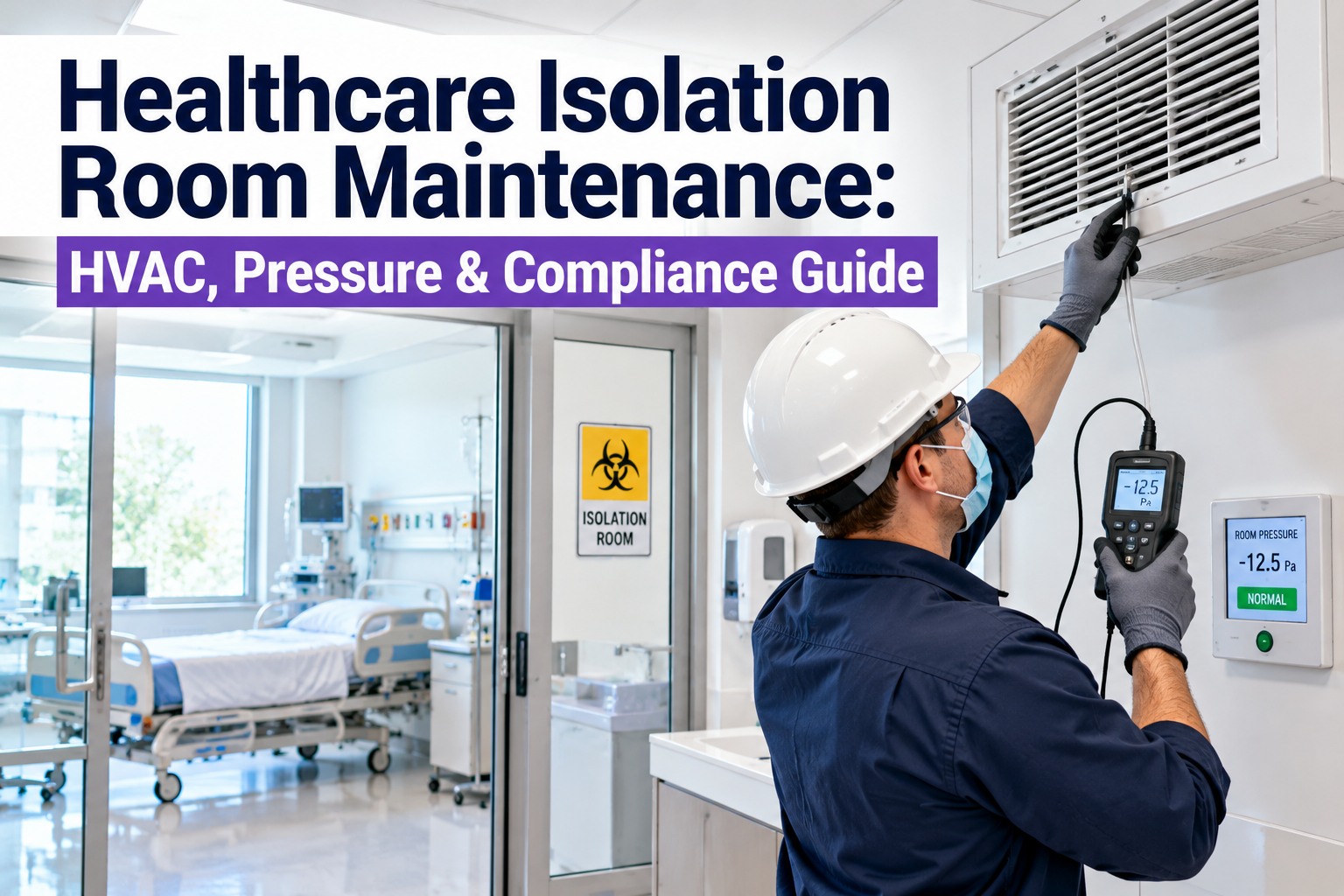
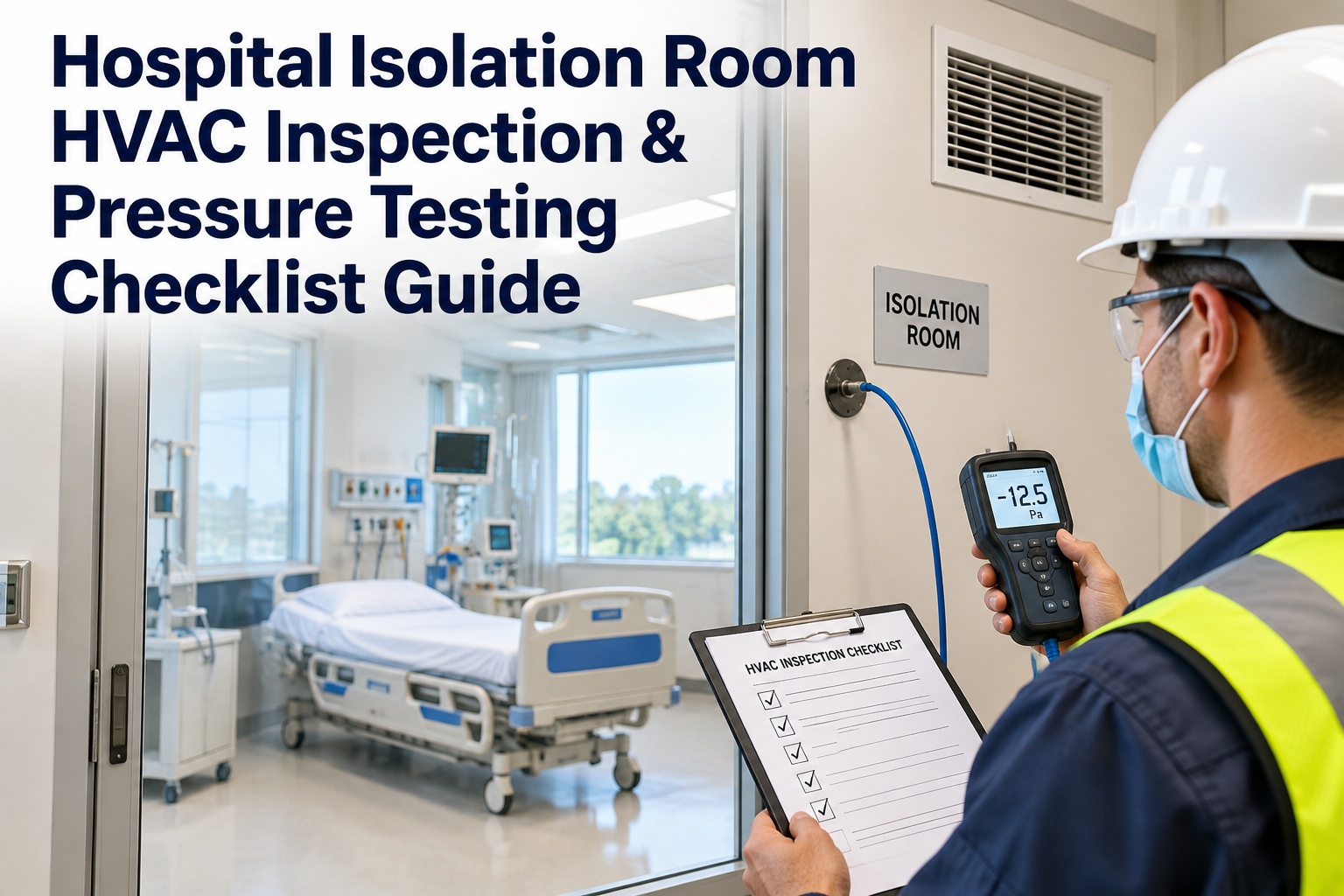
A door propped open for a meal tray, a manometer reading nobody wrote down, an exhaust belt slipping a little more each week — any one of them can quietly turn a negative-pressure isolation room positive, and the first sign is often an exposure that should never have happened. Isolation rooms are the one space where an HVAC lapse is an infection-control event, and where the record of a passing pressure check is what a surveyor asks for first. This guide covers isolation room maintenance end to end — airflow direction, pressure, ventilation, preventive maintenance and compliance documentation — on OXMAINT AI, the AI-powered CMMS for healthcare facilities teams.
Healthcare Facilities · Isolation Rooms · HVAC, Pressure & Compliance
Healthcare Isolation Room Maintenance: HVAC, Pressure & Compliance Guide.
A room that loses its pressure differential stops protecting anyone — and the lapse is invisible until it is documented or discovered. OXMAINT AI runs the whole isolation-room program on one platform: scheduled PMs on fans, filters and sensors, the daily occupied-room pressure check as a logged task, BAS alarms routed to work orders, and a survey-ready record per room.
1 Pressure
2 Ventilation
3 PM
4 Document
0.01" w.c.
minimum pressure differential to the corridor
12 ACH
minimum air changes per hour for the room
Daily
documented pressure check while the room is occupied
ASHRAE 170
the governing ventilation standard for the space
Two Rooms, Two Directions — Which Way Does the Air Flow?
Every isolation room is defined by one thing: which way the air moves. Get the direction right and the room protects who it is meant to protect; get it wrong — a negative room drifting positive — and it protects no one while everyone assumes it does. Maintenance exists to verify the direction, not just that the fan runs. Sign up free and track both room types in OXMAINT AI.
NEGATIVE · AIIR
Corridor → Room → Exhaust out
Protects: everyone else from the patient's airborne pathogens
Patients: TB, measles, varicella and other airborne-spread disease
Pressure: negative to the corridor (≥ 0.01" w.c.)
Exhaust: to the exterior, 10 ft from intakes, or HEPA
POSITIVE · PE
HEPA supply → Room → Out to corridor
Protects: the patient from outside contaminants
Patients: severely immunocompromised, such as transplant recipients
Pressure: positive to the corridor (≥ 0.01" w.c.)
Supply: HEPA-filtered, at least 12 air changes per hour
A patient who needs both — infectious and immunocompromised — requires an anteroom between the room and the corridor. The direction through every door still has to be verified.
The Vital Signs of an Isolation Room
Like a patient, an isolation room has a handful of readings that have to stay in range for it to be doing its job. These are what every inspection and PM confirms. Book a demo to see these parameters tracked per room.
Pressure Differential
≥ 0.01" w.c. vs corridor
Verified by manometer or a continuous monitoring device at the door.
Air Changes
≥ 12 ACH
Measured airflow; some existing AIIRs run at 6 ACH under CDC guidance.
Directional Airflow
Correct way at the door
Confirmed with a smoke test, air strip or smoke tube at the threshold.
Filtration
HEPA where required
HEPA on PE supply and recirculated exhaust; condition read from the differential across it.
Exhaust
Exterior, 10 ft clearance
Discharged away from intakes, windows and public areas; fan and damper sound.
Temp & Humidity
Within the design range
Held for patient comfort and to limit microbial growth in the space.
Targets are typical values — always confirm against the current ASHRAE 170, the CDC guidelines and your authority having jurisdiction.
Monitoring Cadence — Check It Daily While It's in Use
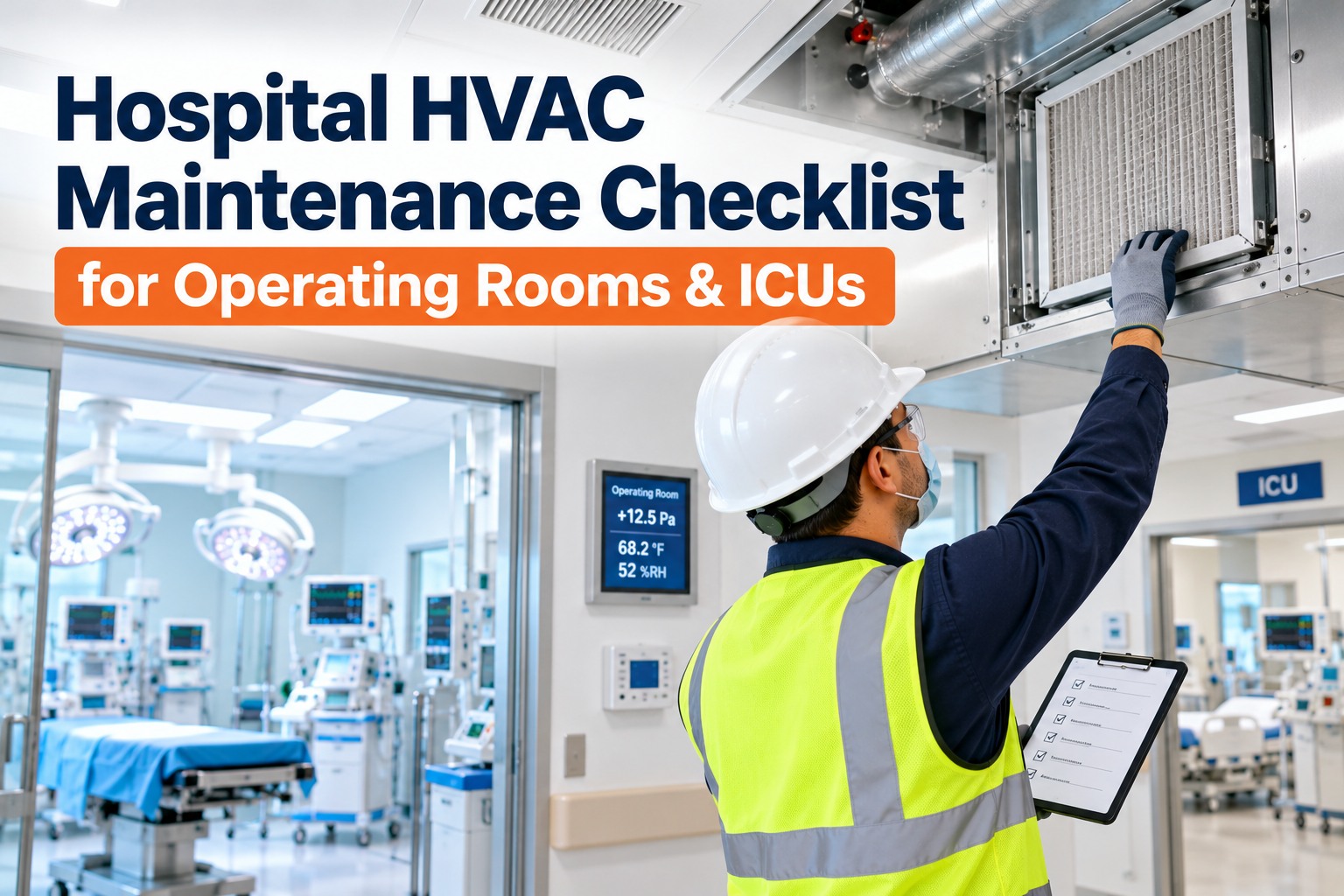
Pressure is not a set-and-forget value. The CDC guidance is to monitor the differential every day a patient occupies the room — a continuous device gives the live reading, and a documented daily visual check proves it was watched. A periodic smoke test confirms the direction the gauge implies, scheduled PM keeps the fans, filters, sensors and door hardware honest, and balancing or certification happens at the required interval. Start free and make the daily check a logged task.
The Isolation Room PM & Inspection Checklist
Six systems, each with its own checks. Tick as you go — the boxes are live.
02Supply, Exhaust & Filters
04Anteroom (Where Present)
06Documentation & Compliance
Compliance — The Standards and the Survey
Isolation rooms answer to a stack of authorities: the CDC Guidelines for Environmental Infection Control, ASHRAE 170, the FGI Guidelines, the Joint Commission's Environment of Care standards and the CMS Conditions of Participation. The surveyor does not stand and watch the room hold pressure — they read the log that proves it did. A room that performed perfectly but has a gap in its daily record is still a finding, which is why the documentation is not paperwork around the work; it is the work. Book a demo to see survey-ready isolation-room records.
Prove Every Room Held Its Pressure — Every Day It Mattered.
Put the schedule, the daily checks, the smoke tests and the PM history on one platform — so isolation-room performance is something you can run, monitor and evidence, not something you hope held up between surveys.
How OXMAINT AI Runs Isolation Room Maintenance
OXMAINT AI is the maintenance system of record for the space — it schedules the work, captures the readings and keeps the evidence. Pressure control, balancing and infection-control decisions stay with facilities engineering and infection prevention; the platform makes sure the program runs and the record holds.
REGISTER IT
Every Room and Its HVAC Assets
Each isolation room on one register, tagged negative or positive, with its fans, filters, sensors and doors as linked assets.
SCHEDULE IT
PMs on Fans, Filters & Sensors
Filter changes, fan service, sensor calibration and door-hardware checks all fire on their own cadence — nothing drifts.
MONITOR IT
The Daily Check as a Task
The occupied-room daily pressure check is a recurring, logged task with the reading captured — not a clipboard by the door.
ALERT IT
BAS Alarm to Work Order
A pressure or airflow alarm from the building system opens a ranked work order — owned and tracked, not a beep in a hallway.
CHECK IT
The Checklist on Mobile
The full isolation-room inspection on a phone, with smoke-test results and photos captured against the room.
PROVE IT
Survey-Ready Record Per Room
Daily logs, smoke tests, filter changes and PM history held per room — the evidence a surveyor asks for, in seconds.
"
Our isolation rooms were maintained well — the problem was proving it between surveys. The daily pressure checks lived on a paper log taped inside each room, and when the survey came, reconciling those against our PM records was a scramble that always turned up a missing day or two. Moving the daily check and the PMs onto one record didn't change how we maintain the rooms. It changed whether we could stand behind them on demand — and in an isolation room, that distinction is the whole job.
Director of Facilities & Engineering · Acute-Care Hospital
Frequently Asked Questions
What is the difference between a negative and positive pressure isolation room?
A negative-pressure airborne infection isolation room (AIIR) draws air in from the corridor and exhausts it out, protecting everyone else from an infectious patient. A positive-pressure protective environment (PE) room pushes HEPA-filtered air out to the corridor, protecting an immunocompromised patient from outside contaminants. The airflow direction is the entire distinction.
What pressure differential does an isolation room require?
At least 0.01 inch of water column relative to the corridor — negative for an AIIR, positive for a PE room — with at least 12 air changes per hour. Some existing AIIRs operate at 6 ACH under CDC guidance. Always confirm against the current ASHRAE 170 and your authority having jurisdiction.
How often must isolation room pressure be monitored?
Every day the room is occupied, per CDC guidance. A continuous monitoring device gives the live reading, and a documented daily visual check records that it was verified. A periodic smoke test confirms the actual airflow direction behind the gauge reading.
What standards govern isolation room maintenance?
The CDC Guidelines for Environmental Infection Control in Health-Care Facilities, ASHRAE 170, the FGI Guidelines, the Joint Commission Environment of Care standards and the CMS Conditions of Participation all apply. Documented compliance is what a surveyor assesses.
Why manage isolation room maintenance in a CMMS?
It schedules every PM, turns the daily pressure check into a logged task, routes BAS alarms to work orders, and keeps the timestamped record that proves each room held its pressure — per room, survey-ready.
Sign up free to set it up in OXMAINT AI.
Right Direction. Right Pressure. Proven Every Day.
Move your isolation-room program onto OXMAINT AI — negative and positive rooms on one register, PMs and daily pressure checks on schedule, BAS alarms routed to work orders, and an audit-ready record per room. Keep the air flowing the right way, and keep the proof that it did.