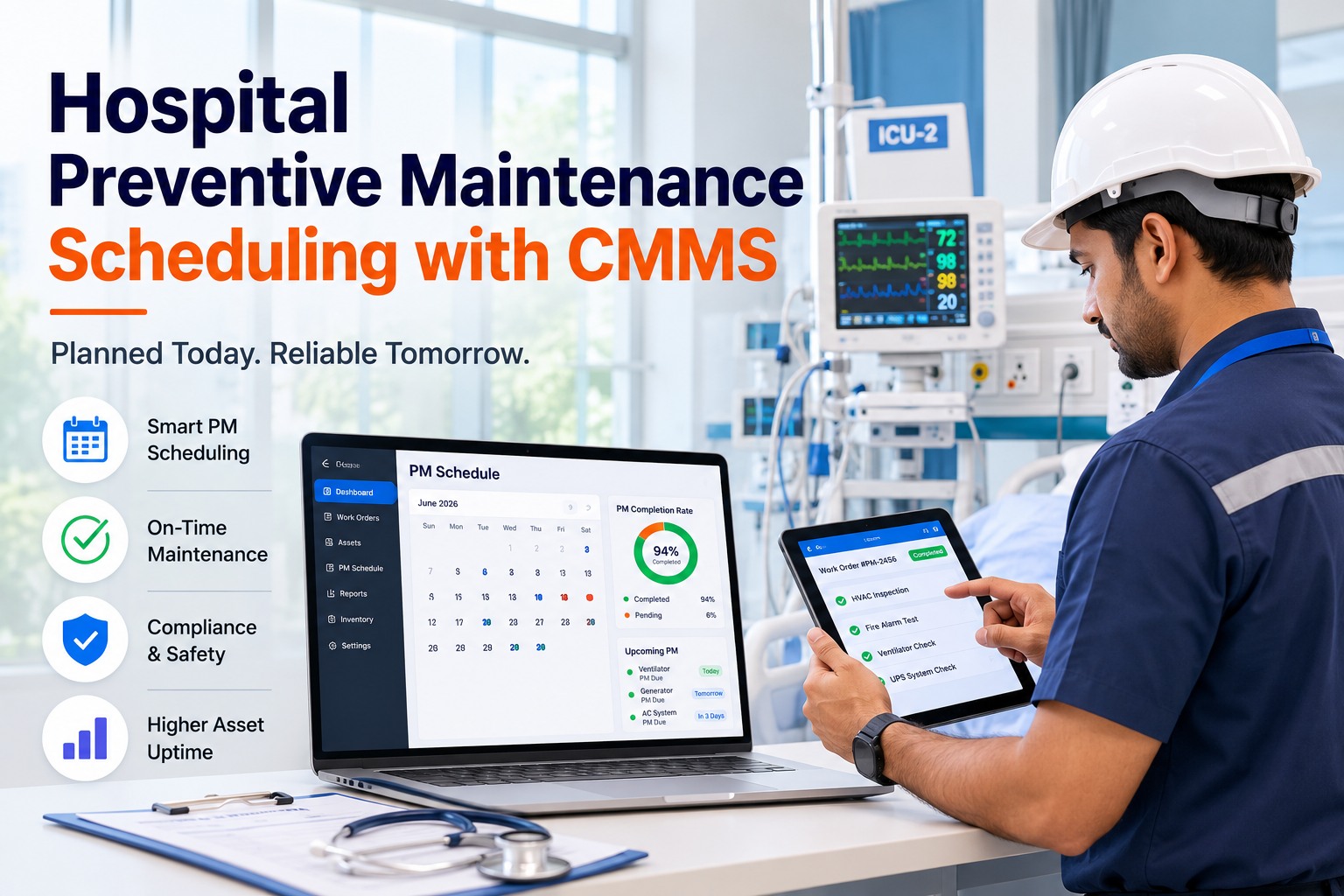
Most hospital maintenance departments do not have a preventive maintenance problem. They have a completion problem. The intervals are written, the work orders exist, the technicians are competent — and the on-time PM completion rate still sits around 68%, which means roughly a third of scheduled maintenance lands late or not at all. Those missing points are not distributed randomly. They fail for three diagnosable reasons: scheduling failure, technician capacity, or parts availability. And the most damaging property of a missed PM in a hospital is that it is silent. A technician gets pulled to an emergency, the PM slips, nobody is notified, and the gap only surfaces when a surveyor asks for a completion rate — by which point it is a citation rather than a scheduling adjustment. Closing the distance from 68% to 95%-plus is not a matter of working harder. It is a matter of the system noticing before the deadline passes, and telling someone senior enough to move resources. This guide covers how hospitals build that scheduling and escalation programme. Start a free Oxmaint trial and automate PM generation with overdue escalation, or book a demo to see completion rate tracked by asset class and department.
Healthcare · Preventive Maintenance · PM Scheduling
Hospital Preventive Maintenance Scheduling CMMS
A preventive maintenance scheduling guide for hospitals — moving from a 68% baseline to 95%-plus on-time completion with automated work order generation, overdue escalation cascades, and CMMS-based compliance reporting.
-
68% to 95%+
on-time PM completion with automated generation and escalation
-
85%
industry starting threshold; top quartile reaches 88–95%
-
4.8x
cost of emergency work vs the same task planned
-
80%+
overdue backlog reduction within the first 60 days
Diagnose Before You Push
Where the Missing 32% Actually Goes
A department below 65% completion does not need exhortation, it needs a diagnosis. Overdue PMs cluster into three causes, and each has a different remedy — pushing harder on the wrong one just burns the team out. Identify your largest categories of overdue PMs, then ask which of these is producing them.
- Scheduling failure Work orders that never generate, generate late, or sit in a queue nobody owns. Nothing should fall through the gap between a manager's memory and the CMMS scheduler — PM must be triggered automatically from the asset record by interval, runtime hours, or cycles.
- Technician capacity A backlog above 10% of open work orders past due signals a capacity constraint, not a discipline problem. Measure open work order hours against available technician hours to see how many weeks of work are actually queued.
- Parts availability A PM that cannot be closed because a part is missing is a stockroom failure wearing a maintenance costume. Integrated parts inventory removes the search — and the deferral it causes.
A dashboard that breaks completion down by asset class and department turns "we are at 68%" into a ranked list of what to fix first. Book a demo to see overdue PMs broken out by cause and department.
The Warning Window
Escalate Before the Threshold, Not After
The single mechanical change that moves a department from the sixties to the nineties is this: a missed PM is never silent. When a technician is pulled to an emergency, the slip must announce itself — early, and to someone with the authority to reallocate resources.
-
1
PM generates automatically
Tied directly to the asset record and triggered by interval, runtime hours, or cycles. Daily checklists push to mobile; weekly, monthly, quarterly, and annual tasks appear with advance notice windows. -
2
Completion rate crosses the warning line
Set the alert threshold at 90% — deliberately below the 95% standard — so the category is flagged while there is still a window to recover, not after the breach. -
3
Escalation routes upward, by criticality
Alerts go to the facility director and VP simultaneously, not just to the technician who is already overloaded. Life-support equipment escalates immediately to a supervisor. -
4
Resources move, and the record stands
The work is reassigned or the parts released, the PM closes with technician identity and timestamp, and the audit trail captures who created, modified, and closed it.
Escalation is what makes a target achievable without manual follow-up — which is precisely what manual systems cannot reliably deliver. Sign up for Oxmaint to configure escalation cascades by criticality.
Know Your Numbers
The Benchmarks That Define the Programme
Chasing a single headline number is the wrong move. Move the most critical systems — life safety, imaging, HVAC — to 95%-plus first, then address lower-priority assets. These are the metrics that tell you where you stand.
| Metric | Target | What It Reveals |
|---|---|---|
| PM completion rate | 85% floor, 88–95% top quartile | Programme discipline and scheduling health |
| Life support adherence | 100% | Priority flagging is working |
| Overdue backlog | Under 10% of open work orders | Capacity, scheduling, or parts constraint |
| Planned vs reactive | 80–90% planned | Whether PM is actually preventing breakdowns |
| MTBF trend | Rising year over year | PM extends asset life, not just paperwork |
MTBF is the honest one — a rising trend is the clearest signal a PM programme is extending asset life rather than generating paperwork to satisfy a checklist. Book a demo to see PM compliance, backlog age, and MTBF update live.
The Case Closes Faster Than Expected
Emergency Work Costs 4.8x the Same Job Planned
Preventive maintenance is the single highest-return investment a hospital facilities team can make, and the arithmetic is not subtle: emergency maintenance on an identical task costs 4.8 times more than the same work performed on a planned schedule, once overtime labour and emergency premiums are counted. Meanwhile US hospitals collectively carry more than $100 billion in deferred maintenance, and a Condition-level deficiency can suspend Medicare and Medicaid payment entirely. The improvement curve is fast: overdue backlog falls by more than 80% within the first 60 days, PM compliance moves into the nineties within the first two quarters, and MTBF gains follow within two to three maintenance cycles. Scheduling automation is what responds first — because it is the constraint that was never about effort.
Oxmaint for Hospital PM
How Oxmaint Runs PM Scheduling
-
Auto Generation
Triggered From the Asset
PM work orders generate automatically from the asset record by interval, runtime hours, or cycles — daily checklists pushed to mobile, longer cadences appearing on the calendar with advance notice windows.
-
Escalation Cascade
A Missed PM Is Never Silent
Configurable overdue workflows escalate by criticality, with the warning threshold set below the standard so a slipping category is flagged to the facility director and VP while there is still time to recover.
-
Cause Breakdown
Scheduling, Capacity, or Parts
Completion rate broken down automatically by asset class and department, so the largest categories of overdue PMs are visible and the highest-impact fixes get prioritized first.
-
Mobile Close-Out
Signed at the Point of Work
Technicians receive, execute, and close work orders on mobile with integrated parts inventory and digital checklists — capturing technician ID, timestamp, readings, photos, and signature.
-
Live KPIs
Compliance, Backlog, MTBF
PM compliance rate, backlog age, and MTBF update in real time as technicians close work orders, giving operations directors the current maintenance health of every department on one screen.
-
Survey Output
Documentation Generated, Not Assembled
Compliance reporting produced from the maintenance record itself, with a full audit trail of who created, modified, and closed each work order — replacing the days spent assembling documentation manually.
Frequently Asked
Hospital PM Scheduling Questions
What is a good PM completion rate for a hospital?
The industry starting threshold is 85%, with top-quartile performers reaching 88–95%. Life support and other critical equipment should sit at 100%. If a department is below 65%, the priority is not raising the number directly but identifying the largest categories of overdue PMs and determining whether the cause is scheduling failure, technician capacity, or parts availability — because each of those has a different fix. Sign up for Oxmaint to break completion down by asset class.
How do hospitals get from 68% to 95% on-time completion?
Through two mechanisms working together: automated work order generation tied directly to the asset record, and automatic escalation of overdue tasks. Manual systems cannot reliably deliver this because a missed PM in a manual system is silent — a technician is pulled to an emergency and nobody is notified. Automation makes the slip visible immediately, and escalation routes it to someone able to reallocate resources rather than to the technician who is already overloaded.
Where should the overdue alert threshold be set?
Below the standard you must meet, so the alert creates a warning window rather than reporting a breach. A common configuration triggers escalation when completion for any critical category falls below 90%, giving the team room to recover before the 95% accreditation standard is compromised. Crucially, alerts route to the facility director and VP simultaneously, not just at technician level — because at that point the problem is a resourcing decision, not a task. Book a demo to see threshold alerts configured.
How quickly do PM metrics improve after deployment?
Scheduling-driven metrics respond fastest. Work order close time improves from day one of mobile deployment, and overdue backlog reduction is among the earliest indicators, with documented reductions of over 80% within the first 60 days. PM compliance and backlog age typically show movement within 60 to 90 days, with facilities reaching the 90%-plus threshold within the first two quarters. MTBF improvements follow within two to three maintenance cycles. Sign up for Oxmaint to start tracking these metrics.
Generate · Warn · Escalate · Close
The Fix Is Not Effort. It Is a System That Notices.
Every PM that slips when a technician gets pulled to an emergency, every backlog that grows unmeasured, and every completion rate discovered at survey rather than managed weekly is a compliance gap that a schedule alone was never going to close. Oxmaint gives hospital maintenance teams one platform to generate PM from the asset record, warn before the threshold is breached, escalate by criticality to people who can move resources, close work orders signed at the point of work, and produce the compliance documentation as output rather than as a project.

.png)
.jpg)
