
Joint Commission surveyors do not schedule appointments to review your documentation — they arrive and ask for it immediately. When the Environment of Care chapter opens in a standard TJC survey, the first 60 minutes are consumed by a single demand: produce your maintenance logs, utility system test records, equipment service histories, and inspection certificates — organized by EC standard chapter, covering the previous 12 months. Hospitals running paper binders, scattered spreadsheets, and technician memory walk into that review carrying a liability, not a record. The result is measurable: over 65 percent of TJC-surveyed hospitals received EC-chapter citations in 2025, with documentation deficiencies accounting for more than 70 percent of all findings. The equipment in most of those facilities was serviced. The records simply could not prove it. For hospitals ready to convert maintenance operations into a permanent, audit-ready compliance record, start a free 30-day trial with Oxmaint or book a compliance readiness demo with our healthcare facilities team to see EC documentation automation running in a live hospital environment.
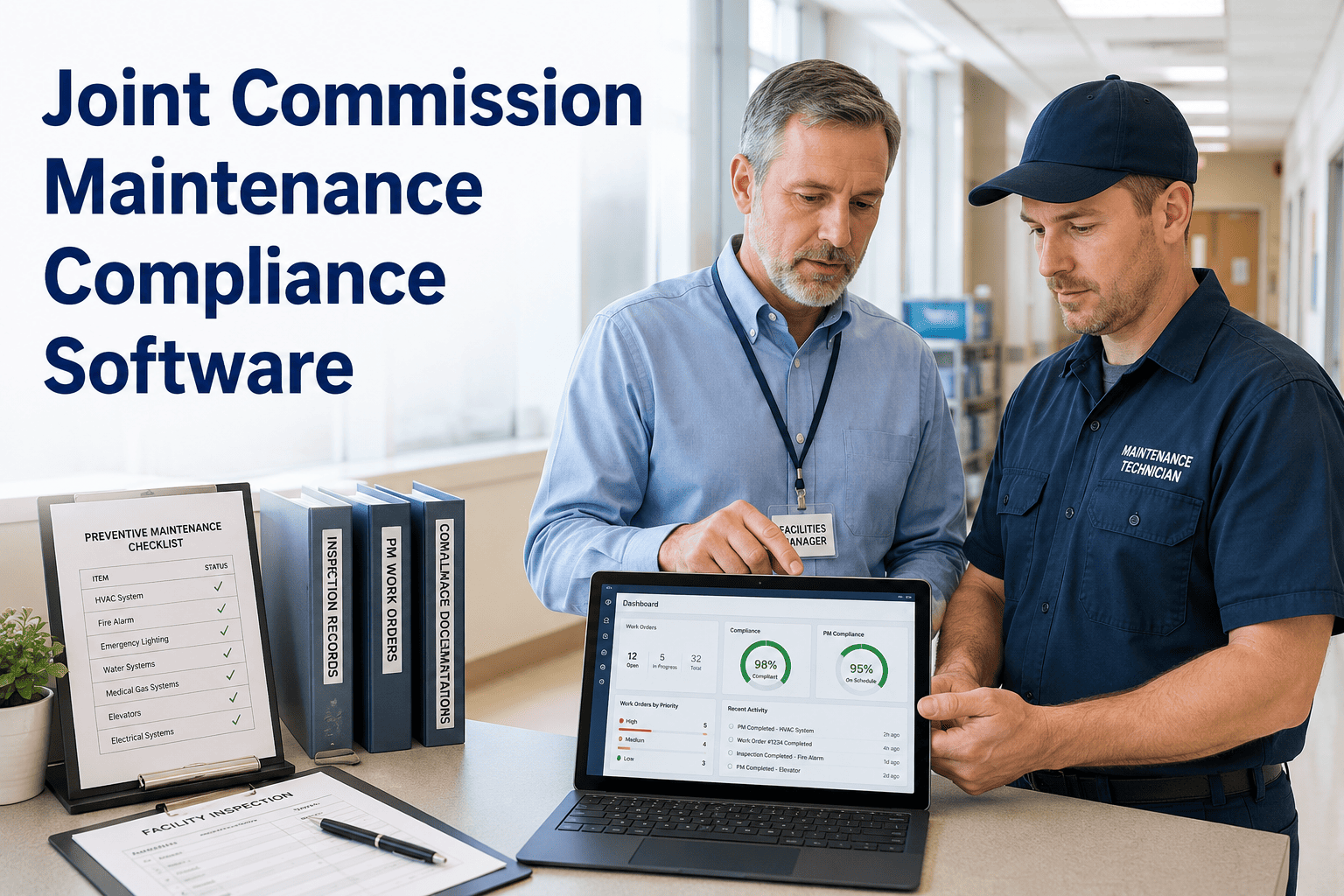
Joint Commission Compliance Made Easy: CMMS Automates EC Standard Documentation
65% of hospitals receive EC citations. 70% of those trace to documentation failures — not maintenance failures. The fix is systematic, not reactive.
Give Your Compliance Team a System That Surveyors Trust
Oxmaint replaces binders, spreadsheets, and technician memory with a single digital record that links every work order, inspection, PM schedule, and equipment history to the exact EC standard it satisfies. Walk into your next TJC survey with organized, timestamped, signed documentation — not a collection of fragmented records and nervous explanations.
What Is Joint Commission EC Compliance?
The Joint Commission's Environment of Care chapter is a set of operational standards governing how healthcare facilities manage their physical environment, utility systems, medical equipment, and safety programs. Unlike clinical quality standards, EC compliance lives entirely in documentation. The question surveyors ask is never "did you service the HVAC unit?" — it is "show me the signed work order with the technician name, completion date, parts replaced, readings taken, and the next scheduled service interval." Hospitals that cannot produce complete, organized answers to that question, consistently, for every piece of regulated equipment, face findings that threaten accreditation status regardless of actual maintenance quality. Want to see what complete EC documentation looks like inside a CMMS? Start a free 30-day trial with Oxmaint or book a live demo with our compliance specialists to walk through a real survey readiness report in detail.
EC compliance is not a one-time certification — it is a continuous operational discipline. TJC conducts unannounced surveys on a rolling 18-to-36-month cycle, which means facilities must maintain audit-ready documentation at all times. The facilities achieving consistent accreditation without remediation plans share one operational characteristic: they have eliminated manual record-keeping entirely and use CMMS platforms to auto-generate, timestamp, and organize every maintenance activity against the specific EC standard it satisfies.
6 EC Standards Every Hospital Must Document
Each Joint Commission EC standard maps directly to a documentation requirement. Miss the record — even when the maintenance was performed — and the finding is the same as if the work was never done.
4 Documentation Failures That Drive EC Citations
These are not theoretical compliance risks. They are specific, identifiable documentation failure patterns that TJC surveyors identify in more than half the facilities they review annually — and all are entirely preventable with systematic digital records management.
How Oxmaint Automates Joint Commission EC Documentation
Oxmaint connects every work order, inspection, and PM completion to the specific EC standard it satisfies — generating survey-ready documentation automatically as maintenance operations run. Ready to eliminate documentation gaps permanently? Start a free 30-day trial or book a healthcare compliance demo to walk through real EC documentation in action.
Step-by-Step: From 800 Hours to 30 Minutes of Survey Prep
Here is the exact process healthcare facilities use with Oxmaint to transform TJC survey preparation from a quarterly crisis into a routine administrative task that takes under 30 minutes on any given day.
Manual Documentation vs. CMMS-Automated EC Compliance
This is not a theoretical comparison. The gap between manual and digital EC documentation is measurable in citation rates, survey prep hours, and remediation costs — and it shows up in every TJC survey cycle.
| Compliance Activity | Manual / Paper-Based | Oxmaint CMMS-Automated |
|---|---|---|
| Annual Survey Prep Time | 700–900 staff hours, binder assembly | Under 30 minutes — auto-generated reports |
| Work Order Documentation | Handwritten logs, frequent missing fields | Digital, structured, timestamped, signed |
| EC Standard Mapping | Manual sorting by staff memory and guesswork | Auto-categorized by standard at record creation |
| PM Schedule Adherence | Calendar-based, 31% missed intervals | Condition-triggered, auto-escalating alerts |
| Inspection Records Storage | Paper forms, unsearchable physical archive | Digital, searchable, retrievable by standard or date |
| Documentation Citation Risk | 70% of EC findings are doc gaps | 40% fewer documentation-related citations |
| Multi-Site Compliance View | Isolated per facility, no portfolio visibility | Unified real-time dashboard across all sites |
| Corrective Action Tracking | Email chains, undocumented closures | Linked finding-to-resolution audit trail |
The ROI of Automated EC Compliance Documentation
These figures reflect the operational and financial impact of replacing manual EC documentation with CMMS-driven compliance automation in healthcare facilities across the USA, UK, and Australia — based on aggregated ASHE and compliance consulting benchmarks.
Frequently Asked Questions
How does CMMS help with Joint Commission EC compliance documentation? +
A CMMS platform automates the complete documentation chain that TJC surveyors audit. When a work order is created, assigned, executed, and closed, the system automatically captures timestamps, technician identity, materials used, readings taken, and the next service date — linking each record to the applicable EC standard. When surveyors request documentation, compliance managers generate a complete, organized 12-month history for any EC chapter in under 30 seconds, rather than spending days compiling fragmented paper records. More critically, the system prevents gaps before they form: automated PM triggers, escalation alerts for overdue inspections, and real-time compliance score dashboards keep documentation complete continuously — not just in preparation for surveys. Want to see what EC documentation looks like inside a live CMMS environment? Start a free 30-day trial with Oxmaint or book a live demo with our healthcare compliance team to see a real survey readiness report generated in real time.
Which EC standards generate the most TJC citations and findings? +
EC.02.05.01 (utility systems management) and EC.02.03.01 (life safety — fire systems) generate the highest volume of TJC findings nationally. Utility system documentation failures are cited in approximately 28 percent of all EC findings, driven primarily by missed inspection intervals for HVAC systems, medical gas systems, and emergency power generators. Fire system deficiencies — including missed fire door inspections, sprinkler test gaps, and undocumented smoke compartment assessments — account for another 22 percent of EC findings. EC.02.04.01 medical equipment findings, particularly around imaging systems, infusion pumps, and sterilization equipment, have increased significantly since 2023 as TJC has intensified scrutiny of clinical equipment PM documentation in response to a rising number of patient safety incidents traced to missed service intervals.
How quickly can a hospital get Oxmaint running for EC compliance documentation? +
Most hospital facilities teams are actively documenting in Oxmaint within 5 to 10 business days of onboarding. The implementation sequence is practical: import your asset inventory, configure PM schedules against EC standard intervals, set up work order templates for each standard category, and assign technician access. Unlike enterprise CMMS platforms requiring months of consultant-led implementation and six-figure setup fees, Oxmaint is built for teams that need operational capability quickly. Historical records can be imported from spreadsheets to preserve continuity of your audit trail. There are no heavy implementation fees and no extended onboarding contracts — facilities start capturing compliant documentation from day one with no implementation overhead consuming staff time and budget.
Can Oxmaint support TJC compliance across a multi-hospital health system? +
Oxmaint is purpose-built for multi-site healthcare portfolios. Health systems can manage EC documentation across every hospital, surgery center, and outpatient facility in a single platform — with a portfolio-level compliance dashboard showing documentation completeness, overdue PMs, and open findings by site, by standard, or across the entire network simultaneously. System-level Compliance Directors monitor every facility's TJC readiness in real time without requiring separate logins or site visits. When a regional or system-wide survey is approaching, the platform generates consolidated documentation packages for all sites simultaneously — eliminating the coordination overhead that turns every survey cycle into a system-wide emergency for health systems currently managing compliance across fragmented spreadsheets, legacy software, and paper binders per facility.
Stop Scrambling for Records. Start Running Survey-Ready Operations Every Day.
Oxmaint connects every work order, inspection, and PM schedule to the EC standard it satisfies — generating audit-ready compliance documentation automatically as your team works. No binder sprints. No documentation gaps. No remediation plans from preventable findings.
Trusted by Compliance Directors, Quality Managers, and Healthcare Facility Managers across the USA, UK, Australia, UAE, and Germany. Built for multi-site healthcare portfolios with full TJC EC standard mapping, digital signatures, and one-click survey reporting built in from day one.


.jpg)
