A Joint Commission survey does not fail because a hospital stopped maintaining its equipment. It fails because the maintenance happened and no one can prove it. The gap between what your facilities team does every day and what a surveyor can verify in an audit is not a performance problem — it is a documentation problem. Environment of Care standards, particularly EC.02.04.01 through EC.02.06.01, consistently rank among the most cited findings in surveys precisely because field activity rarely connects automatically to a retrievable, auditable digital record. In 2024, one Midwest hospital paid $75,000 in fines plus a 90-day corrective plan for an EC.02.04.01 violation rooted not in missing maintenance, but in missing records. For hospitals that want to enter every survey cycle knowing the evidence is complete and exportable on demand, OxMaint.ai closes the gap between field execution and audit-ready compliance documentation.
JOINT COMMISSION COMPLIANCE GUIDE 2026
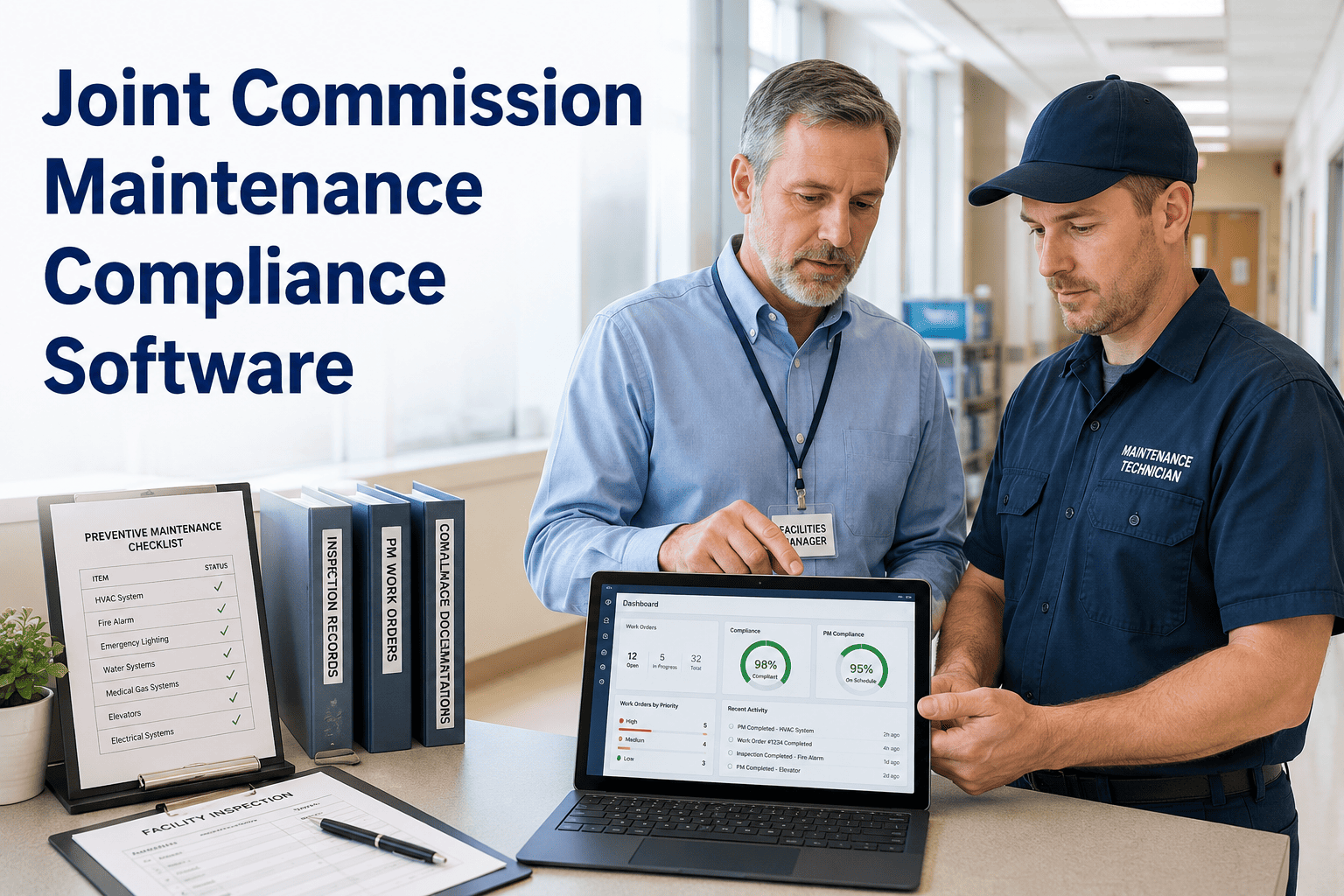
Joint Commission Maintenance Compliance Software for Hospital EC Standards
Keep EC.02.04, EC.02.05, and EC.02.06 records audit-ready with asset logs, PM proof, inspection checklists, and survey exports — all generated automatically as your team works.
EC STANDARDS BREAKDOWN
The four EC standards that determine your survey outcome
EC.02.04.01
Medical Equipment Management
Every device with patient contact must be inventoried, risk-classified, and maintained at documented intervals. PM completion rates, calibration records, and corrective actions must be retrievable on demand.
Top cited finding
EC.02.05.01
Utility Systems Management
Electrical distribution, plumbing, and HVAC serving patient care areas require documented inspection intervals and performance test records. Critical area pressure differentials and filter changes must be logged.
High survey risk
EC.02.05.07
Emergency Power Systems
Generator load test records — monthly 30-minute tests and annual 4-hour full-load tests per NFPA 110 — with runtime, load percentage, and transfer time documented at point of test. Gaps create immediate threat-to-life findings.
Immediate threat to life
EC.02.03.01
Fire Protection Systems
Sprinkler inspections, suppression system service, fire alarm panel tests, and fire door integrity checks — all retained for the full accreditation cycle and linked to specific building location and system asset.
Accreditation cycle retention
THE DOCUMENTATION GAP
Where most hospitals fail — and it is not the maintenance
What your team does
Monthly generator load test completed
Infusion pump PM performed
Sprinkler head inspection completed
HVAC filter replaced in OR suite
Medical gas alarm panel checked
What surveyors can verify
Log in a binder — date illegible
Technician recalls it — no record
Paper form filed — location unknown
Spreadsheet entry — found
Never documented
Survey finding issued — not for missing maintenance. For missing proof.
HOW OXMAINT CLOSES THE GAP
Every field action becomes an auditable record — automatically
01
EC-Standard Checklists Built Into Every Work Order
PM checklists for EC.02.04, EC.02.05, and EC.02.03 are pre-built into the work order. When a technician completes the checklist on mobile, the compliance record creates itself — no data entry required after the fact.
02
Asset Inventory with Risk Classification
Complete equipment inventory with patient contact flag, risk level, manufacturer PM interval, and last-service date visible in a single view. EC.02.04.01 requires exactly this — and the platform maintains it automatically.
03
Automated Escalation Before Overdue Intervals
Platform alerts supervisors when inspection intervals approach and when they pass. No PM silently skipped in high-workload periods. Overdue items visible on the compliance dashboard before the surveyor asks.
04
Survey-Ready Export on Demand
All compliance records exportable by EC standard, asset class, building, or date range — formatted exactly as surveyors review. No pre-survey sprint to compile records from multiple disconnected sources.
05
Corrective Action Tracking to Closure
Survey findings and internal deficiencies tracked from identification through evidence-based closure. Corrective action audit trail demonstrates continuous improvement — a requirement under EC.04 assessment standards.
06
Real-Time Compliance Dashboard
EC coordinator sees PM completion rates, open deficiencies, calibration currency, and inspection evidence status across all standards simultaneously. Know what is at risk before the survey window opens.
See your compliance dashboard configured for Joint Commission EC standards
Book a live walkthrough and see how OxMaint maps your equipment inventory, inspection schedules, and corrective action tracking to EC.02.04, EC.02.05, and EC.02.06 — with survey-ready exports built in from day one.
SURVEY READINESS TIMELINE
From deployment to survey-ready in 30 days
Day 1
Asset inventory imported
Equipment records migrated from spreadsheets or existing systems. Risk classification and EC standard mapping applied. PM intervals configured per manufacturer and regulatory requirements.
Day 5
EC-mapped PM schedules live
Automated work order generation active for all asset classes. Field technicians receive mobile assignments with pre-built EC-compliant checklists. Offline capability enabled for all low-connectivity areas.
Day 14
Compliance dashboard operational
Real-time view of PM completion rates, overdue inspections, and open deficiencies by EC standard. EC coordinator and facilities leadership have full visibility without waiting for weekly reports.
Day 30
Survey-ready exports confirmed
Full audit trail established. Survey-ready report exports tested and verified. Corrective action workflow active. Facility enters next survey window with complete, retrievable documentation — not gaps to explain.
FREQUENTLY ASKED QUESTIONS
What compliance managers ask before selecting Joint Commission CMMS software
The next surveyor will not ask what your team maintained. They will ask what you can prove.
OxMaint gives hospital compliance teams the documentation infrastructure to enter every survey cycle with complete, retrievable EC records — built automatically as field work happens, not reconstructed the week before surveyors arrive.



.jpg)

