Maintenance Management Automation in Healthcare: From Reactive to Proactive Operations
By Jack Edwards on March 11, 2026
Healthcare facilities run on uptime. A single ventilator failure, an HVAC shutdown in an ICU, or a delayed sterilization cycle is not a maintenance inconvenience — it is a clinical emergency. Yet 67% of hospitals still operate on reactive maintenance models, spending 4.8x more per repair while exposing patients and staff to preventable risk. This guide breaks down how maintenance management automation is rewiring hospital operations from the ground up. Want to see automation in action across your entire asset portfolio? start a free trial for 30 days and experience what a fully automated maintenance program feels like, or book a demo with our healthcare operations specialists today.
Industry Benchmark
4.8x
Higher cost of emergency vs. scheduled repairs in hospitals
Detection Rate
62%
Critical failures detectable 24–72 hrs before clinical impact
Annual Waste
$2.4M
Average emergency repair spend in reactive hospital programs
Lifespan Loss
35%
Asset lifespan lost annually without condition-based tracking
Definition
What Is Maintenance Management Automation in Healthcare?
Maintenance management automation in healthcare is the systematic use of intelligent software to plan, trigger, execute, track, and document maintenance tasks across hospital assets — without manual intervention at every step. It replaces clipboard-and-calendar workflows with rule-based triggers, mobile execution, digital compliance trails, and predictive condition scoring. For facilities managing 500 to 5,000+ assets across clinical and non-clinical environments, automation is not a luxury — it is the only way to hit regulatory thresholds, reduce emergency spend, and protect patient-facing uptime simultaneously.
Core Framework
8 Automation Capabilities That Transform Hospital Maintenance
A fully automated hospital maintenance program is not a single tool — it is eight interconnected capabilities working as one system.
01
Automated PM Scheduling
Work orders auto-generate on calendar, runtime, and cycle-count triggers — no manual creation, no missed intervals.
Hospitals achieve 95%+ PM compliance within 90 days
02
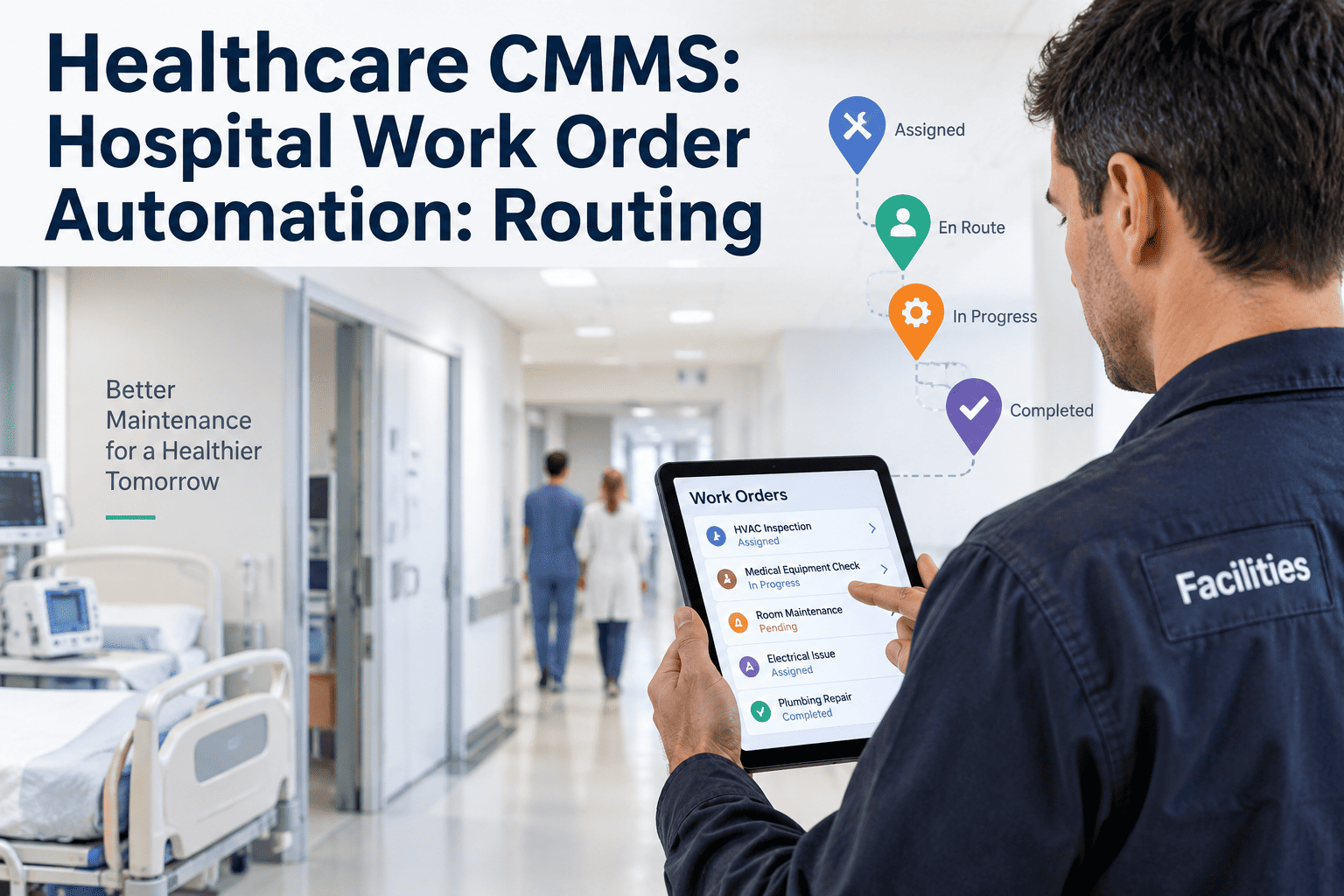
Digital Work Order Routing
Work orders route automatically to the right technician with asset context, checklists, and parts availability pre-confirmed.
67% drop in MTTR within 6 months of mobile deployment
03
Compliance Auto-Documentation
Every PM, inspection, and repair generates a timestamped, digitally-signed compliance record automatically — no manual compilation.
Audit packages produced in under 10 minutes
04
Condition-Based Monitoring
Live asset condition scores updated by inspections, IoT sensor feeds, and repair history — high-risk equipment surfaces before it fails.
62% of failures intercepted 24–72 hrs in advance
05
CapEx Forecast Automation
Rolling 5–10 year capital replacement models generated from live asset condition data — not guesswork or straight-line depreciation.
70% fewer unbudgeted CapEx surprises in year one
06
Spare Parts Auto-Alerts
Parts inventory linked to work orders with reorder alerts triggered before stock-outs delay repairs. MTTR drops when parts are always ready.
Parts-related repair delays eliminated at 95th percentile
07
Portfolio-Level Dashboards
Real-time board-ready reporting across all sites — asset health index, PM compliance rate, emergency spend trends, and CapEx runway in one view.
20+ hours of reporting work eliminated per cycle
08
IoT and SCADA Integration
Real-time sensor feeds trigger maintenance actions automatically — no human monitoring required. Equipment tells the system when it needs attention.
Failure prediction accuracy above 85% with sensor integration
The Problem
The Real Cost of Reactive Healthcare Maintenance
Every day a hospital runs a reactive maintenance program, it pays a compounding premium — in emergency repair costs, compliance exposure, asset lifespan erosion, and clinical risk.
Failure Risk
Zero Visibility Into Asset Degradation
Without condition scoring, every asset is either working or broken — there is no early warning system. Equipment degrades silently until failure, and clinical operations absorb the impact without advance notice.
Hospitals running disconnected or paper-based systems routinely fall below the 85% PM compliance threshold required by Joint Commission Environment of Care standards — creating automatic survey findings and CMS penalty exposure reaching $1M+ per cycle.
Major hospital equipment — MRI, chiller plants, central sterile units — costs $150K to $2.5M per replacement. Without condition tracking, these replacements appear mid-year as emergency capital requests, triggering board-level scrutiny that could have been avoided with 18 months of advance data.
Unplanned Cost Range$150K–$2.5M per unplanned asset replacement
Efficiency
Audit Prep Consumes Weeks of Management Time
Paper logs, legacy CMMS exports, and email-based work order trails cannot produce clean audit packages under survey pressure. Facilities teams spend 3–4 weeks manually compiling documentation before every accreditation cycle — time that adds zero operational value and still does not guarantee a clean survey.
Time Wasted3–4 weeks manual audit prep per survey cycle
Built for Healthcare
Stop Firefighting. Start Preventing.
Oxmaint gives hospital maintenance teams the automation platform to move from reactive chaos to proactive control — with full asset visibility, automated PM scheduling, compliance documentation, and CapEx forecasting built in from day one. Most hospitals are fully live in 2 weeks.
How Oxmaint Automates Healthcare Maintenance — Step by Step
Oxmaint is purpose-built for healthcare — structured around the asset hierarchy clinical environments actually use: Portfolio, Property, System, Asset, Component. Automation is not bolted on as a feature — it is the operating model.
01
Asset Intelligence
Build a Complete Hospital Asset Registry in Days
Oxmaint consolidates every asset — from surgical lights to HVAC air handling units — into a single structured registry with live condition scores, full service history, estimated remaining useful life, and linked PM schedules. Migration from spreadsheets or legacy CMMS systems is supported by Oxmaint's onboarding team. Most hospitals are fully live within 2 weeks.
Calendar, runtime, and cycle-count triggers auto-generate work orders and route them to the right technician before a PM window is missed. PM compliance tracked in real time with automated escalation when any system falls below threshold.
95%+
PM compliance within 90 days
03
Work Order Management
Every Work Order From Open to Close — Digitally
Technicians receive mobile-first assignments with full asset context, manufacturer documentation, and parts inventory status. No paper trails. No lost records. Average MTTR drops 67% within 6 months.
67%
Reduction in MTTR within 6 months
04
Compliance
Audit-Ready Documentation — Always
Joint Commission, CMS, and OSHA compliance records generated automatically. Timestamped, digitally signed, and always retrievable. Audit packages for any department available in under 10 minutes at any point in the year.
<10 min
To produce any compliance package
05
CapEx Planning
5–10 Year Forecasts From Live Asset Data
MTBF trends and condition scores feed rolling capital replacement models. Finance and capital committees receive multi-year CapEx forecasts grounded in actual asset condition — not vendor estimates. Surprise CapEx requests drop by over 70% in year one.
70%
Fewer unbudgeted CapEx requests
Before vs After
Reactive vs. Automated: The Performance Gap Is Measurable
Reactive maintenance is not a neutral baseline — it actively amplifies costs, compliance risk, and clinical downtime at every decision point.
Performance Metric
Reactive Program
With Oxmaint
PM Compliance Rate
58–72% average. No real-time tracking. Survey findings likely.
95%+ across all departments. Real-time tracking. Auto-escalation alerts.
Mean Time to Repair
12–18 hours. Paper work orders. Parts located on the fly.
Under 2 hours. Mobile work orders. Parts confirmed before job start.
Emergency Repair Spend
$1.2M–$2.4M annually. Unbudgeted. No advance warning.
Under $180K annually. Forecasted. Largely eliminated by automated PM.
Asset Condition Visibility
Unknown. No scoring. Dark assets throughout facility.
Live condition scores on every asset. High-risk equipment auto-flagged.
Audit Preparation Time
3–4 weeks of manual document compilation per survey cycle.
Compliance packages in under 10 minutes. Always current. Always retrievable.
CapEx Forecasting
Guesswork. Mid-year surprises of $150K–$2.5M per asset.
5–10 year rolling model from live data. 70% fewer budget surprises.
Asset Lifespan
35% of useful life lost annually to undetected degradation.
Full lifecycle extracted. Condition-based replacement decisions.
Leadership Reporting
20+ hours analyst time. Stale data. No portfolio view.
Real-time dashboards. Board-ready reports available in minutes.
Measurable Outcomes
What Hospitals Report After Deploying Oxmaint
Real outcomes from hospital maintenance teams — not projections. Most results visible within 6–12 months of deployment.
34%
Fewer Unplanned Failures
Within 12 months of structured PM deployment
67%
Drop in Average MTTR
Mobile work orders with integrated parts lookup
95%+
PM Compliance Achieved
Centralised scheduling with real-time compliance tracking
70%
Fewer CapEx Surprises
5–10 year forecasts driven by live condition data
FAQ
Common Questions on Healthcare Maintenance Automation
What makes maintenance automation different from a standard hospital CMMS?
A standard CMMS stores work orders and schedules tasks — but still relies heavily on manual input, manual follow-up, and manual reporting at every step. Maintenance automation takes the same data infrastructure and connects it to rule-based triggers, auto-routing, real-time compliance tracking, and predictive condition scoring that operate continuously without requiring human initiation at each step.
How does automated maintenance management improve Joint Commission compliance?
Joint Commission Environment of Care standards require documented PM across all medical equipment classes, with evidence available on demand during surveys. Automated maintenance management keeps PM compliance above 85% through auto-generated work orders and real-time compliance tracking with escalation alerts before gaps develop.
How long does it take to deploy a maintenance automation platform in a hospital?
Most hospitals using Oxmaint are fully operational within 2 weeks of deployment — including asset registry migration, PM schedule setup, and technician mobile onboarding. Oxmaint's onboarding team handles data migration from existing spreadsheets, legacy CMMS platforms, and paper-based systems without disrupting ongoing maintenance operations.
Which hospital asset types should be included in an automated maintenance program?
A complete hospital automation program should cover all four asset categories: clinical equipment (imaging systems, ventilators, anaesthesia units, patient lifts, infusion pumps), building systems (HVAC, electrical distribution, plumbing, fire suppression), clinical infrastructure (medical gas systems, sterile processing, clean rooms), and facilities assets (elevators, patient-facing spaces, car parks).
Get Started Today
Automate Your Hospital Maintenance Program. Prevent Failures Before They Happen.
Oxmaint delivers everything healthcare maintenance automation requires — full asset registry, automated PM scheduling, compliance documentation, condition-based monitoring, CapEx forecasting, and portfolio-level reporting — with no heavy implementation and no long onboarding. Most hospitals are fully operational in 2 weeks.
.png)

.png)